


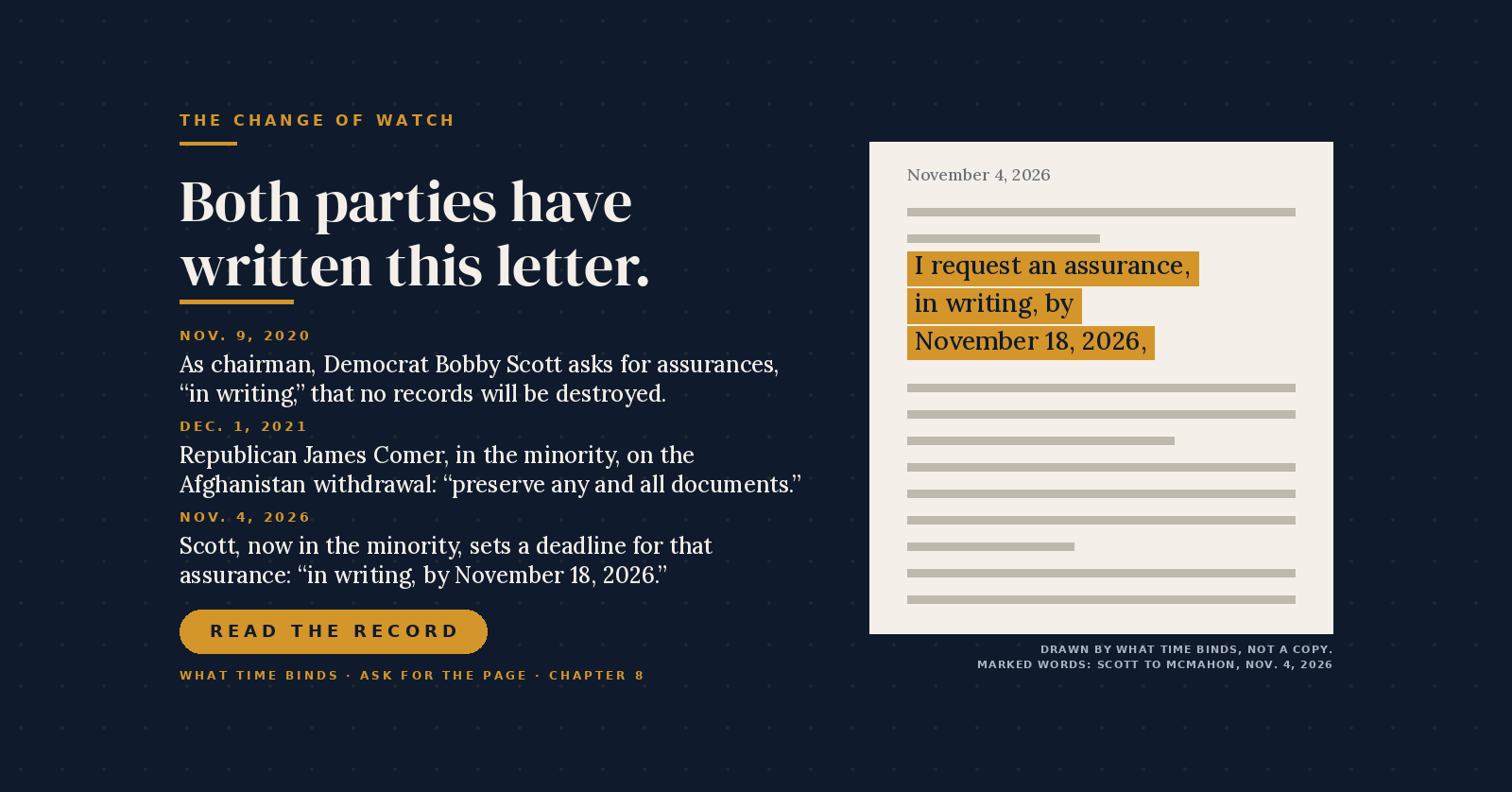
A chapter draft of the book in progress.
On Nov. 4, Rep. Robert C. “Bobby” Scott put a deadline in writing. Scott is the top Democrat on the House Committee on Education and Workforce. His letter to Education Secretary Linda McMahon asks for one thing:
“I request an assurance, in writing, by November 18, 2026, that records, documents, data, or information have not been and will not be concealed, modified, removed, transferred, destroyed, or otherwise rendered inaccessible.”
The same notice went that day to the heads of ten federal departments and agencies. Nov. 18 fell on a Wednesday. An answer may sit in a committee inbox. I found none in the public record when I searched on Nov. 20, Nov. 21 and Nov. 22.
The same Wednesday produced more letters. Rep. Robert Garcia, the top Democrat on the House Oversight Committee and, in NPR’s words, “poised to become the chair of the committee,” released twelve preservation letters to thirteen of President Trump’s family members, allies and officials, from Donald Trump Jr. to Stephen Miller and Susie Wiles. “Oversight Democrats demand that you preserve all records, communications, and information relevant to the matters outlined in this letter,” reads the one to Miller.
Later that day, White House Counsel Will Scharf wrote to Democratic lawmakers in a letter AP quoted. AP reported that the letter effectively dismissed their requests for information for the rest of the year. While “some of you may (or may not) become a chair in the 120th Congress,” Scharf wrote, “that does not mean that requests from the 119th Congress carry over.”
One deadline and two rounds of letters in one Wednesday, and one question under all of them. A sentry answers it at the end of every watch: when the watch changes, what carries over?
Both parties have written this letter
Both parties have written this letter, and both have written the answer.
On Nov. 9, 2020, six days after the presidential election, Scott sent the same request as the committee’s chairman, to seven departments and agencies: “The Committee seeks assurances, in writing, that records, documents, data, or information have not been and will not be destroyed, modified, removed, transferred, or otherwise rendered inaccessible during the transition.” The transition was to the Biden administration.
Republicans wrote the same kind of letter from the minority. On Dec. 1, 2021, Rep. James Comer, then the top Republican on the Oversight Committee, wrote to President Biden and two cabinet secretaries: “We write to demand that you take all necessary measures to preserve any and all documents and communications related to the withdrawal of U.S. forces from Afghanistan amid the Taliban’s takeover of that country.” On Aug. 15, 2022, CBS News reported that 18 Republicans on the House Judiciary Committee, led by Rep. Jim Jordan, had asked the attorney general, the FBI director and the White House chief of staff to keep their records on the FBI’s search of Donald Trump’s home: “Please preserve all responsive documents in your possession, custody, or control.” That October, the Washington Times reported, Jordan sent more preservation letters; he was “poised to chair the committee if, as expected, Republicans win the House majority in the Nov. 8 elections.”
Then came an answer, from the other side. On Dec. 29, 2022, with the 118th Congress days away, Richard Sauber, Special Counsel to the President, wrote to Jordan:
“The requests in your letter, and the members’ requests to which you refer, were not made as part of the congressional oversight process in the 117th Congress to which the constitutional accommodation obligations apply.”
Nearly four years later, the parties had traded places. AP reported that Scharf said he “was citing a position that the administration of Democratic President Joe Biden took in 2022.” I read his Nov. 18 line as Sauber’s letter with the signatures swapped.
The letters differ in their reach. Scott writes to agency heads, the officials the records law already binds. Garcia’s letters reach further: to officials such as the Vice President and the White House chief of staff, and past them to the President’s sons and son-in-law. The Republican letters of 2021 and 2022 went to officials, each tied to one event. The answers differ less. Each White House told a minority on its way to the majority that its requests would have to be made again under the new gavel.
What do the letters do? AP put it plainly: “The preservation notices do not compel recipients to turn over documents.” A letter from a member without the gavel asks. The duty to keep the record was already law. “The head of each Federal agency shall make and preserve records containing adequate and proper documentation of the organization, functions, policies, decisions, procedures, and essential transactions of the agency,” reads 44 U.S.C. 3101. Under 18 U.S.C. 2071, a custodian who “willfully and unlawfully conceals, removes, mutilates, obliterates, falsifies, or destroys” a record faces a fine, up to three years in prison, or both, and the loss of the office. Naming the statute accuses no one.
I read all of this as normal. Each party should respect the other’s request to keep the record. A true investigation, with the evidence collected and kept, should reveal the truth.
See for yourself. Open Scott’s letter to Secretary McMahon and read its footnotes. Find the 1950 law and the criminal statute. Then open his 2020 letter to Secretary DeVos and set the two requests side by side.
The logbook
In my twenty-three years as a Marine I served duty more times than I can count. Duty was security for the unit, and every duty kept a logbook.
Okinawa was the last duty station where I stood duty. In 2007 or 2008, I had Officer of the Day duty during a typhoon and coordinated with Camp Kinser base operations on the damage we expected. Outside the base, the local Japanese went about their day as if nothing were happening. It seemed they knew something we didn’t.
The logbook was light OD green. The executive officer posted the duty each day. The new duty wrote out the book’s opening declaration again on taking the post, then set up the log with the A-duty and the duty driver, if there was one. A ruler lived inside the book. Any part of a page left unused got lined out, and the line carried the duty’s initials.
Who signed on. Who signed off. Who was present at muster and who was not. What the weather did. Whether every door was locked at the count. Weapons accounted for at turnover. Phone calls received. Officers of the Day who came through. When we had to wake the commanding officer, and why.
I drew duty one month and drew it again a few months later. I turned back through the same book to the pages where I had logged my last duty.
The Corps has eleven General Orders. Two of them govern the end of a watch. The Basic School’s handout on the interior guard prints the fifth this way: “To quit my post only when properly relieved.” And the sixth: “To receive, obey, and pass on to the sentry who relieves me all orders from the commanding officer, officer of the day, officers, and noncommissioned officers of the guard only.”
The sixth order names no logbook. The logbook is how you do that. On our duty, the executive officer ran the change, and the new duty wrote the declaration fresh before taking the post.
A record does small work that no single memory can do alone.
See for yourself. Find the sixth General Order in the Marine Corps’ own text. The Basic School’s handout, Responsibilities of the Interior Guard, prints all eleven.
The record not filed
For nearly thirty years, members of a women’s caucus in Congress have laid a wreath at the Women in Military Service for America Memorial at Arlington National Cemetery. The quiet years left thin, scattered pages: a Defense Media Activity story on “the 16th annual recognition ceremony” in 2013, a member’s release on the “22nd Annual” in 2019, an Air Force news page on the “24th annual” in 2022. I read the gap this way: no office kept the sum, so the sum lived in the numbering.
Then the twenty-eighth broke. Task & Purpose reported on June 10, 2026, that the ceremony was canceled after the Navy and the Air Force declined; a defense official told the site the Marines had planned to attend until it was canceled. Military Times reported the next day that “The Marine Corps did not respond to a query.” Twenty-seven ceremonies that worked left a page here and there. The one that failed was in the news the day it was to be held.
I have to correct my own record here. In The Locus of Repair, on July 13, I wrote that five services sent no one, that the ceremony came every June, and that none of the earlier ceremonies made the news. Those lines overstated the record. On Nov. 21, I corrected that essay with a dated note at the top.
See for yourself. Pick one quiet year, 2013 or 2019, and find its page. Note who wrote it down.
What carries over
What carries over is the record. This is the mechanism this chapter adds to the book, and Part II uses it by that name. A record is dated, written, portable, and outside the room’s power to revise.
Scott’s letter carries its deadline in its own text. It asks for an answer “in writing.” A spoken assurance leaves the room with the person who gave it. It sits on a committee website, so it left the room where it was written. Sauber’s sentence of December 2022 still says what it said, and that is why a White House can cite a 2022 position back at the party that took it.
Memory stays with the people who held the post, and it leaves when they do. This month, at my mother’s house in Kansas, she handed me an old MRE bag full of the letters people sent me in boot camp: my father, my mother, my brother, friends from church and from high school, all in handwriting. She had kept them for thirty-three years. Every envelope carried my Social Security number on the address line. Memory would have kept the gist. The bag kept the letters.
The Twentieth Amendment ends “the terms of Senators and Representatives at noon on the 3d day of January,” and in 2027 that is Jan. 3. Scharf’s position, as AP reported it, is that the requests can be set aside for the rest of the year and do not carry over. Even a subpoena lapses when a Congress ends, in a 1982 opinion of the Justice Department’s Office of Legal Counsel, though the office allowed that if a successor committee sued, a court might treat “the prior subpoena and refusal to comply as a historical fact.” The force lapses. The fact stays. Whoever holds the gavels after Jan. 3, the letters are on the page, with their dates.
Part I of this book named seven ways words drift: the two-level reading, the magnet word, the absent author, the quiet edit, the container, the binary and the cycle. Part II asks what holds while they drift. It starts with the record, because the record holds longest.
Both parties ask for the log before the watch changes, and the letters themselves are the part that carries over. Every Monday I publish the next chapter of Ask for the Page, the book I’m writing in public from the record. Subscribe and the next one is in your inbox, free.
What time binds
In 1921, Alfred Korzybski published Manhood of Humanity. In its third chapter he wrote: “I define HUMANITY, in the universal tongue of mathematics and mechanics, to be the TIME-BINDING CLASS OF LIFE.” By time-binding, he explained, “I mean the capacity in virtue of which man is at once the heritor of the by-gone ages and the trustee of posterity.” Heritor and trustee. A sentry is both on every watch, and the log is what passes between the two.
I am a longtime reader of Korzybski, and yes, What Time Binds takes its name from his idea. It shapes how I publish. We must pass on the most credible information, and that takes the foundation source. That is what I try to do here.
Who keeps the file
For an agency, the law names the head of it, and 44 U.S.C. 3106 names the Archivist as the relief when an agency head fails to act. For everyone else, the answer is the reader. Chapter 2 said it first: “I wrote down a date, and the dates kept arriving. That is the whole method of this book.” This chapter names the instrument behind that method.
The habit
Keep the record whether or not anyone reads it.
The habit is small. Write the date. Write what happened, including what went right. Put it where the next person can find it. Each entry is dull on the day it is written, and it becomes the record on the day someone asks.
See for yourself. Before you read the pin, write one line about something that went right this week. Put the date on it.
The record: dated, written, portable, and outside the room’s power to revise.
What it includes: a duty log; a preservation letter; a member’s release posted the day of the ceremony; a bag of letters a mother kept; a dated note in your own file.
What it cannot be read to say: that a letter proves wrongdoing; that a letter from a member without the gavel compels anything; that a written record is true because it is written; that memory is worthless; that only officials keep records.
The question: If you handed this post to someone tomorrow, what would they find written down?
Dates we’re watching
Nov. 18, 2026: Scott’s deadline for written assurances from ten departments and agencies. I found no answer posted as of Nov. 22.
Jan. 3, 2027, noon: the terms of the 119th Congress end. Watch whether the new chairs send the same requests again, and whether anyone answers them.
When either date produces a page, I will add it here with its date.
Whoever holds a gavel after Jan. 3 holds it because of a ballot. Read your next ballot the way you read the record: every race, every proposition, at vote411.org.
This essay is chapter 8 of Ask for the Page, the book What Time Binds is writing in public, one chapter a Monday through December 14. The comments are the appendix: tell me where the record is wrong and I will show the page or fix the line. Paid subscriptions open at 500 readers, and the paid product is Coded Threads, the codebooks built from these comment sections. A pledge now is a vote for that.
Jerry W. Washington, Ed.D., is a Marine Corps veteran of twenty-three years, a combat engineer by trade, an instructor at UC Irvine’s Division of Continuing Education, and the writer of What Time Binds, a record of how institutions bend words and how the page holds them to account.
The pages
Rep. Robert C. “Bobby” Scott to Secretary Linda McMahon, Nov. 4, 2026, and the committee’s release of the same day
Scott to Secretary Betsy DeVos, Nov. 9, 2020, and the committee’s release
Rep. James Comer to President Biden, Secretary Blinken and Secretary Austin, Dec. 1, 2021
CBS News, Arden Farhi, Aug. 15, 2022, reposted by House Judiciary Committee Republicans (the FBI search)
The Washington Times, Oct. 17, 2022 (Jordan’s October letters)
Richard Sauber, Special Counsel to the President, to Rep. Jim Jordan, Dec. 29, 2022 (a copy posted to DocumentCloud)
Rep. Robert Garcia to Stephen Miller, Nov. 18, 2026, and Oversight Democrats’ release of the same day
NPR, Barbara Sprunt, via OPB, Nov. 18, 2026
AP, Joey Cappelletti and Seung Min Kim, via the Atlanta Journal-Constitution, Nov. 18, 2026
44 U.S.C. 3101, 44 U.S.C. 3106, 18 U.S.C. 2071 and the Twentieth Amendment, Cornell Legal Information Institute
Office of Legal Counsel, U.S. Department of Justice, Continuing Effect of a Congressional Subpoena Following the Adjournment of Congress, Dec. 14, 1982
The Basic School, student handout B141136, Responsibilities of the Interior Guard
Alfred Korzybski, Manhood of Humanity (1921), Chapter III, Project Gutenberg
Defense Media Activity, May 23, 2013, posted to DVIDS July 3, 2025; Rep. Aumua Amata Coleman Radewagen, release, May 16, 2019; Air Force Office of Special Investigations, 2022
Task & Purpose, Patty Nieberg, June 10, 2026; Military Times, Hope Hodge Seck, June 11, 2026
What Time Binds, The Locus of Repair, July 13, 2026 (corrected Nov. 21, 2026)
The Okinawa duty comes from my own memory, and the boot camp letters sit in the bag my mother kept. Will Scharf’s Nov. 18 letter is quoted as AP reported it; I could not find the letter itself. The 2022 White House letter is quoted from a copy posted to DocumentCloud. “No answer posted” means my searches on Nov. 20, Nov. 21 and Nov. 22 found none.
Memory sometimes gets polished over time. But altering a record isn't polishing.
I'm not sure why, but changing the record feels dirty in a way that memory changing doesn't. Is it because I'm picturing the bad uses? Because I'm reaching for the word kaizan again, when a correction would be fine? Or does it come down to how the record gets used?
The handwritten letters were a precious record, I think. But I wonder if they carried the memory in with them too. If the past is what tied the record and the memory together, that's a lovely thing. And it's lovely that there was someone, your mother, who kept them tied.