

A chapter draft of the book in progress.
The husk
On the evening of Oct. 20, my friend Arimitsu answered a question I had asked under Chapter 4. Arimitsu reads each chapter of this book as it runs and answers at length. I had asked whether keigaika, a Japanese word, was the right word for a rule worn down to its shell.
The answer was a careful yes, “quite close, though perhaps not exactly the same.” Then came the husk. “Keigai is a husk: a body the soul and the insides have left, down to the frame.” The suffix carries the rest: “Add ka, ‘becoming,’ and you get the process, or the result, of something turning into form alone.”
Then Arimitsu suggested the difference may be in my verb. “Worn down” is attrition, “rubbed away over time.” In keigai, “the inside has simply left, however it went, and the shell itself may be untouched.”
A worn thing shows its wear. An untouched shell is harder to check, because nothing about it asks to be checked. The word sits where it always sat. The rule keeps its name. What it holds has changed.
Five days later, the Justice Department filed a brief that put a disputed act inside an old word.
The page
On Sunday, Oct. 25, the United States filed its reply in United States v. California, a suit in federal court in Los Angeles. The government wants an order, before Election Day, that makes California “segregate ballots of only those individuals identified to be likely noncitizens” (page 3). Those ballots would wait “until citizenship can be confirmed” (page 6).
The request rests on lists the government sent to counties. Los Angeles County told the court on Friday that the government’s letter “demanded that election officials review more than 20,000 entries within 48 hours” (page 4 of its opposition). On Saturday the state told the court that federal agencies had sent “similar letters and lists of alleged noncitizens to counties across California,” also with 48 hours to answer. The letters, as the state quotes them, warn that officials “risk becoming aiders and abettors to a federal crime.” The state, citing a New York Times report, added one detail about the lists: “The list delivered to Mendocino County, for example, included only individuals from outside the county.”
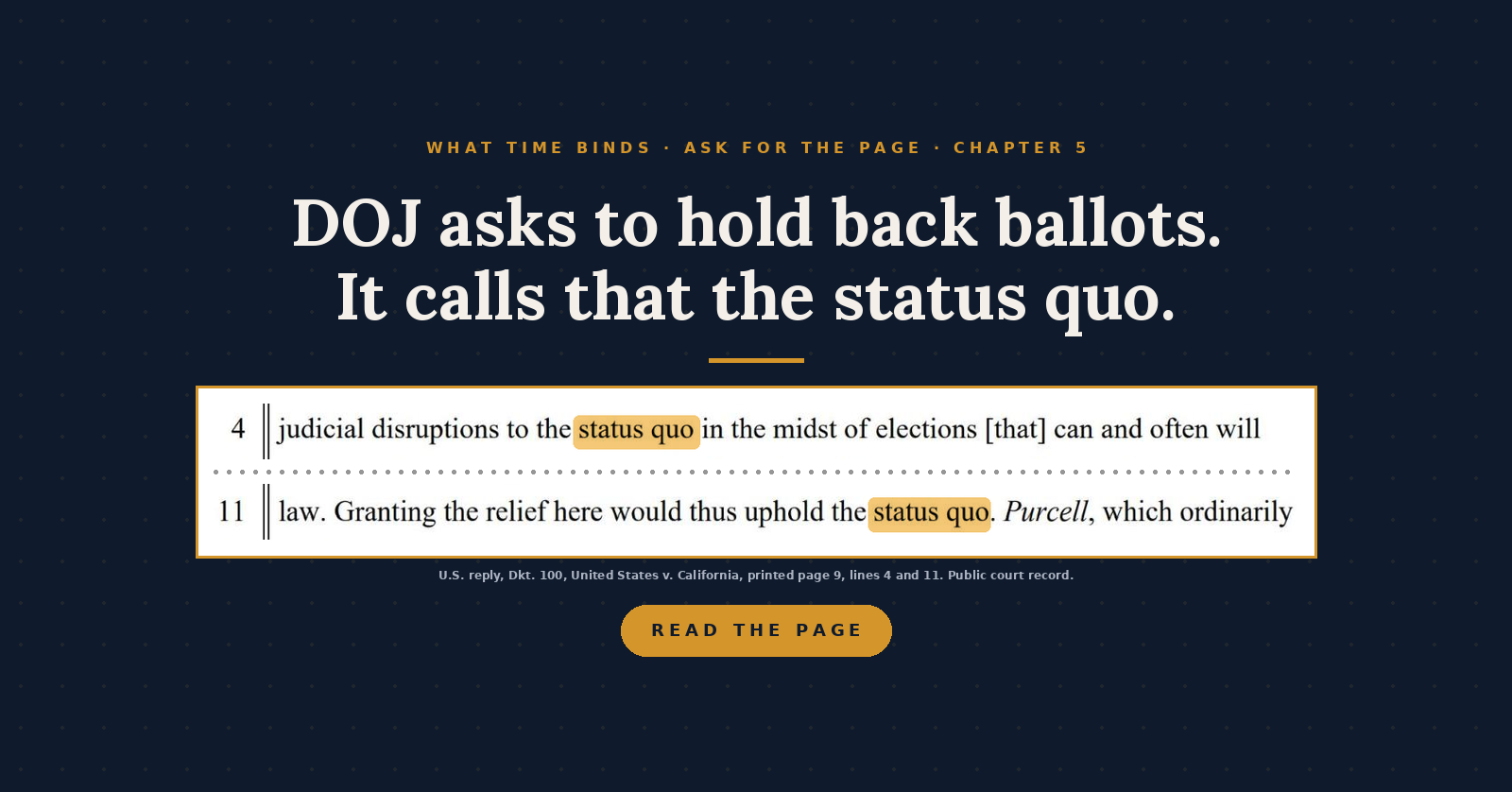
Page 9 of the reply puts the government’s status quo argument in two sentences. “Noncitizens are not permitted to vote in federal elections under either federal or state law. Granting the relief here would thus uphold the status quo.”
The first sentence is the law, and it has not been disputed in the case. The second sentence turns on one word: thus. By the reply’s own account, these voters “have already cast their ballot” (page 9), and page 1 says granting the motion maintains the status quo “by preventing tabulation of unlawful votes while protecting lawful votes.” The order it seeks would hold some cast ballots back from the count. That is a change to how the count runs, pressed in a reply filed nine days before Election Day. The reply calls it the status quo.
The reply gives its reasons on the same page. The people on the government’s list, it says, “are likely ineligible noncitizen voters who have already cast their ballot,” and California “has a procedure in place to provide the ballot-segregation remedy” for challenged ballots. California answers, as the reply reports it, that the procedure applies only during a formal recount; the reply calls that “a legalistic distinction without an equitable difference.” The County adds that the government “describes the voters on its list only as ‘likely’ noncitizens” (page 9 of its opposition).
Open the reply and turn to page 9 (the PDF’s page 10). Read the two sentences, then read them again without the word thus. Earlier on the same page, the reply quotes a court warning against “judicial disruptions to the status quo in the midst of elections.” Compare what the word means each time.
On Monday, a Ninth Circuit panel, Judges Bennett, Bumatay and Sanchez, dismissed the government’s emergency appeal, 2 to 1, “for lack of jurisdiction.” The district judge had set a hearing and said he would rule promptly, so the panel found no denial to review. Judge Bennett, concurring, took up the word: “Plaintiff argues that it needs an injunction to maintain the status quo. I disagree.” Judge Sanchez, concurring, wrote that the injunction “would transform California’s election rules for an election that is already underway.” Judge Bumatay dissented; he would have granted the government relief. The district judge hears the request Tuesday, Oct. 27.
One act, three labels
The three filings describe the same act. Some ballots go into a separate pile and do not count until someone confirms the voter’s citizenship. Each side gives that act a different name, and each name calls a different rule.
The government’s names are “a ministerial task” (page 6), “ballot segregation” and the status quo (page 9). “A ministerial task” answers a different rule: California’s argument that the order would commandeer state officials (pages 5 and 6). “Ballot segregation,” the reply says, does not “change the rules of an election.” That matters because of Purcell, a Supreme Court decision that, in the reply’s words, “ordinarily applies to rule changes in voter maps or voter requirements.” The reply says Purcell “is simply not implicated by this suit.”
Los Angeles County’s name is a purge. “A purge does not escape the statute by being called a ballot hold,” its lawyers wrote (page 9). The statute is the National Voter Registration Act. It says a state “shall complete, not later than 90 days prior to the date of a primary or general election for Federal office, any program the purpose of which is to systematically remove the names of ineligible voters from the official lists of eligible voters.” For this election, the County notes, that quiet period began Aug. 5.
The County calls the government’s program “systematic by design” and grants that it “would not formally strike names from the rolls.” Then it answers: “But setting aside registered voters’ ballots until an open-ended federal review ends accomplishes the same exclusion the quiet period exists to prevent.” The County had already answered the government’s word: “The Executive seeks more than preservation of the status quo” (page 8).
The government’s answer rests on a Ninth Circuit reading of the statute. Citing Mi Familia Vota v. Fontes, a 2025 decision, its reply says the rule bans “systematic cancellation programs” but not “individualized removals,” and it calls its list “particularized” (page 6). The County cites the same case for the other side. The department’s spokeswoman, Kiersten Pels, reached for the same vocabulary. In a statement Saturday, reported by the Associated Press, she said the department is “not requesting a purge, cancellation of registrations, or any programmatic action.” The statute’s word is “program.” Hers is “programmatic.”
Read the statute at subsection (c)(2)(A), then page 9 of the reply. Find “program” in one and “status quo” in the other.
Each word argues for the rule that gets to look at the ballot. “Status quo” keeps the act clear of Purcell. “Particularized” would keep it clear of the quiet period. “Systematic” and “purge” put it inside. Each of these is a party’s argument, and no court has ruled on any of them.
The container
This chapter’s mechanism is the container. An institution takes a word with no fixed edge and fills it with what the moment needs, so the category does the work the evidence has not done.
Here the evidence is a set of lists. The County says officials got 48 hours to review more than 20,000 entries. The state says one county’s list named only people from outside that county. No court has tested the lists. The reply answers that senior officials “swore under oath” that the list holds only people “highly likely to be noncitizen aliens,” and that the government “has criminally charged individuals on that list for unlawful voting” (page 8). No court has weighed those statements yet. The reply also says that even if California is right about errors, the state “is still tabulating thousands” of unlawful votes (page 8). The request does not wait for a court to weigh any of it. Until one does, the word carries the request. Call the act the status quo, and a judge asked to preserve the status quo can grant it. Call it a purge, and a federal statute bars it in the last 90 days before the vote.
Arimitsu’s husk shows why the container works. The word looks whole. “Status quo” still sounds like what it has always meant: things as they stand. “Ministerial” still sounds like paperwork. A word that looks untouched is easy to pass without checking.
Page 9 shows the container at work. When the reply quotes a court, “the status quo” is an election left to run without “judicial disruptions.” When the reply speaks for itself, the same words describe an order that would hold part of the count back.
I wrote about another container in August, in A Word Without a Definition. The full chapter sets the two side by side.
Every Monday I take one word an institution bent and show the page it bent on. Subscribe and the next one is in your inbox, free.
Napoleon’s corporal
Military leaders pass down an old story about Napoleon. I first heard it as a lance corporal and didn’t really understand it until I was a young staff sergeant. Napoleon, the story goes, kept a corporal nearby while he briefed his plans. When he finished, he asked the corporal whether he understood the plan. If the corporal did, the order went out. The story comes with no date and no name, and it lasts because it tests whether an order reaches the person who carries it out.
Over the years I used it as a test. An order has to scale down to the least experienced person who carries it out. Scaling down builds mental scaffolding, so the newest member of the team can see where they fit. Complexity scales with experience and authority.
In 2019 I was the facilities manager for a leased office in Cerritos, California. I managed its remodel, more than 400 workstations in all. The job took in new carpet and tile, new workstations and pedestals, updated monitors and monitor arms, and paint on the walls, including behind the workstations. I brought all the key people together: the furniture vendor, the general contractor and their subs, property management, the plant vendor, the cable vendor and the art supplier.
Once we had built the plan, I asked one employee what it was. All I needed back was one sentence: my area will be packed by Friday evening, labeled with the label you gave me. That employee did not need to know when the plant vendor would pull the plants so the old workstations could come out. Only the plant vendor and the furniture vendor needed that level of knowledge.
On Monday the entire team was there to make sure everything functioned the way it was supposed to. The furniture vendor made small adjustments for each employee, and the plant vendor checked the plants.
The employee’s sentence was small, and every word in it had an edge. Packed, Friday and the label meant the same thing to that employee and to the furniture vendor.
Now give the request the same test. Hand the order it seeks to the least experienced person who would carry it out, an election worker in a county office. The reply asks for an order to set aside the ballots of people “identified to be likely noncitizens” (page 3) “until citizenship can be confirmed” (page 6). Ask that worker who confirms it, by what standard and by when. The reply points to a California procedure for challenged ballots, which the state says applies only in a recount, and says confirmation can come “with or without the help from the Federal Government” (page 6). The reply itself names no standard and no deadline, and the County calls the review “open-ended.” Then ask the judge what “the status quo” means here. The word gives two answers: the law as it stands, or the count as it stood on Oct. 25. The status quo has to mean the same thing to the judge, the county clerk and the voter, and on page 9 it does not.
I read this record as federal overreach. The government is asking a federal judge, in the last days before Election Day, to hold back part of a state’s count. It rests the request on sworn statements no court has weighed and on lists sent to counties with 48-hour deadlines and a warning of criminal liability. The reply itself sets no standard and no end date for the review, and it calls granting the request upholding the status quo. A fair election keeps two promises: no ineligible vote counts, and no eligible voter loses a ballot to an untested list. The order it seeks chases the first promise by risking the second. The district court has not ruled yet.
The habit
The pin: the container. A word with no fixed edge, filled with what the moment needs, so the category does the work the evidence has not done.
What it includes: A request to set ballots aside, filed as the status quo. The same request called “a ministerial task.” A list the County calls “a bulk list” and the reply calls “particularized,” beside a statute that bars “any program” to systematically remove the names of ineligible voters from the rolls in the last 90 days.
What it cannot be read to say: It cannot be read to say noncitizens may vote in federal elections. They may not, and the first of the two sentences on page 9 states the law. It cannot be read to say a court has decided the request. The Ninth Circuit dismissed the appeal on Monday without reaching the merits, and the district judge hears it Tuesday. It cannot be read to say the lists are wrong. The County and the state say so, and that is their argument. It cannot be read to say the government may not enforce the law against noncitizen voting. My objection is to the order sought here, on this record, this close to the vote. And it cannot be read to say every disputed word is a container. A container needs a word with no fixed edge, filled to carry what the evidence has not shown.
The questions: When an institution files an act under a word, ask three questions. Which meaning of the word? By what criteria does this act fit it? What would change your mind?
Try them on page 9 of the reply. Which meaning of status quo: the law as it stands, or the count as it stood on Oct. 25? By what criteria does setting ballots aside keep things as they stand? The reply offers its reasons on the same page; weigh them. Then write down what would change your mind, and the date you wrote it.
Election Day is Nov. 3. Read your ballot before you go, every race and every measure, at vote411.org.
The pages
Los Angeles County Registrar’s opposition, Dkt. 96, Oct. 23, 2026
California’s supplemental opposition, Dkt. 97, Oct. 24, 2026
Ninth Circuit order setting argument, No. 26-7070, Oct. 24, 2026 (copy hosted by Democracy Docket)
Ninth Circuit order dismissing the appeal, with two concurrences and a dissent, No. 26-7070, Oct. 26, 2026 (copy hosted by Democracy Docket)
52 U.S.C. 20507, the National Voter Registration Act’s list-maintenance section
Democracy Docket, Jacob Knutson, Oct. 26, 2026
The page numbers in this chapter are the briefs’ own printed numbers. In the PDF files, the reply’s printed page 9 is the file’s page 10, and the County’s printed pages 4, 8 and 9 are the file’s pages 9, 13 and 14.
This essay is chapter 5 of Ask for the Page, the book What Time Binds is writing in public, one chapter a Monday through December 7. The comments are the appendix: tell me where the record is wrong and I will show the page or fix the line. Paid subscriptions open at 500 readers, and the paid product is Coded Threads, the codebooks built from these comment sections. A pledge now is a vote for that.
Jerry W. Washington, Ed.D., is a Marine Corps veteran of twenty-three years, a combat engineer by trade, an instructor at UC Irvine’s Division of Continuing Education, and the writer of What Time Binds, a record of how institutions bend words and how the page holds them to account.
What Time Binds runs on readers. If this piece told you something you did not already know, forward it to someone who needs to read it. If you want the next one, subscribe below.