


The desk in front of me holds three folders. The first has Part 1 in it, printed the Sunday before June 29. The second has Part 2, printed the Sunday before July 6. The third is empty this morning, and by tonight it will hold Part 3.
In my twenty-three years as a Marine, I served duty more times than I can count. Duty was security for the unit, and every duty kept a logbook. Who signed on. Who signed off. Who was present at muster and who was not. What the weather did. Whether every door was locked at the count. Weapons accounted for at turnover. Phone calls received. Officers of the Day who came through. When we had to wake the commanding officer, and why. The Corps has eleven General Orders. One of them tells the sentry to receive all orders, obey them, and pass them on to the sentry who relieves him. The logbook is how you do that. A record does small work that no single memory can do alone.
This is the third of three essays. Part 1 named an inversion: the country’s words about equality run ahead of its facts, and the gap widens. Part 2 named the mechanism that keeps the gap open: the asymmetric room, written before you enter it by parties you cannot reach. Both essays left the same promise for today: where the work of repair belongs, and what a record is for.
Last Monday’s piece closed with a question. Part 3 opens on it.
Who can act on a prophecy when the rooms that test it are written in advance?
The answer starts with a wreath stand.
The Record Not Filed
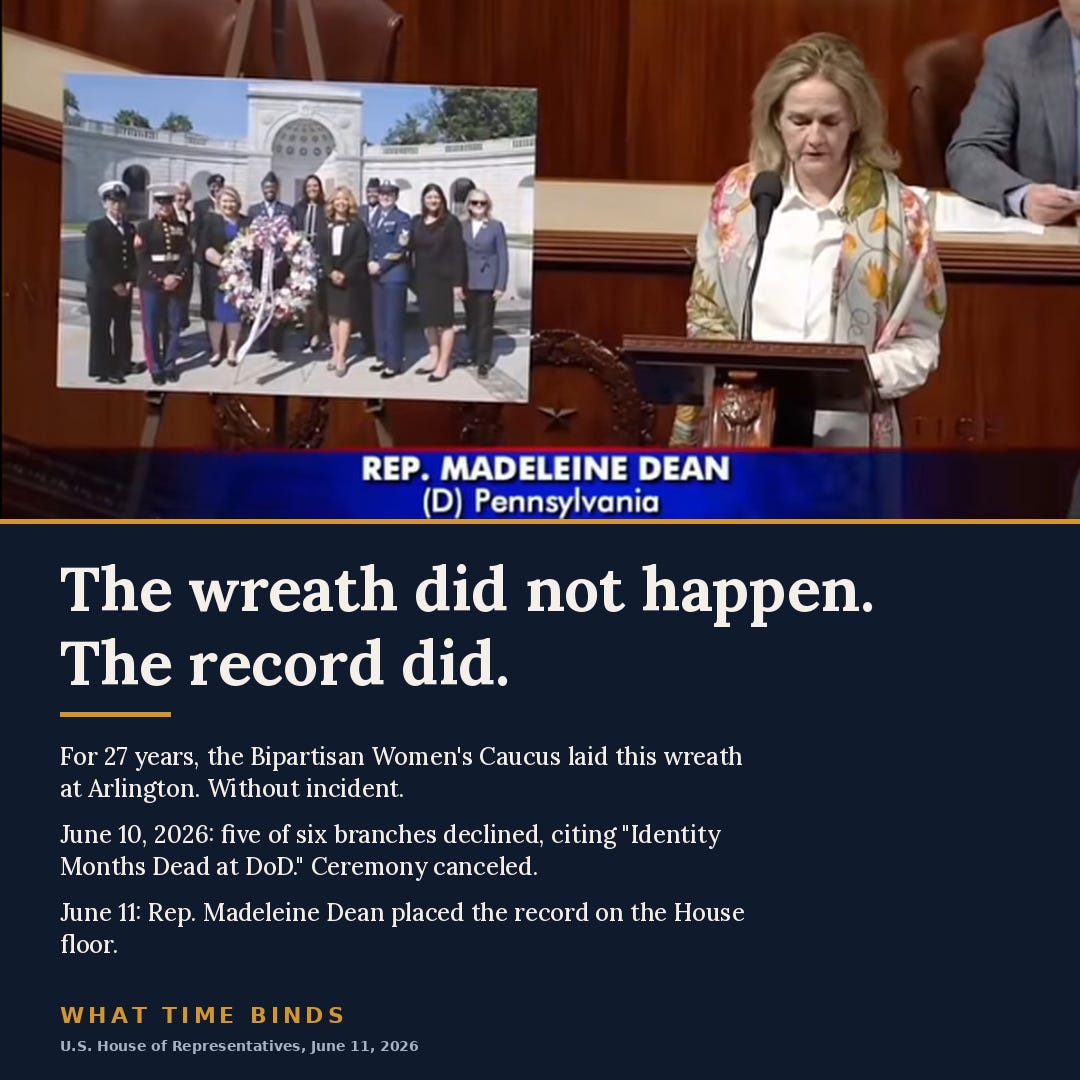
Return to the plaza. It is June 10, 2026. The Women in Military Service for America Memorial sits at the ceremonial entrance to Arlington National Cemetery. The wreath stand is set up. The photographer is there. The Bipartisan Women’s Caucus is there. The Marines had planned to attend. Five services did not send anyone. The ceremony did not happen.
Behind the empty plaza sat twenty-seven ceremonies that did. Every June for twenty-seven years, invitations went to all six services. Representatives arrived. The wreath was laid. Family members traveled from across the country. Members of Congress showed up. The ceremony was short. The heat was real. Photographs were taken. Then everyone went home.
Nothing about any of those twenty-seven ceremonies made the news. The service being honored was already honored. The Memorial’s register carries names from every American war since Vietnam. Sgt. Nicole Gee, USMC. Sgt. Johanny Rosario Pichardo, USMC. Both killed at Kabul airport on August 26, 2021, during the evacuation. The wreath was laid, and the country kept turning.
Hayakawa noticed this shape in 1953. On Fourth of July weekend, 9,999 cars come home safely, and one crash makes the paper. He was explaining why the quiet progress of integration stayed invisible. The figure cuts a second way. The 9,999 safe arrivals produce no file. No editor is tasked with the annual index of nothing-happened. Museums do part of this work — the Memorial itself holds a Register of 350,000 women who served. What no bureaucracy consolidates is the specific run of years the room was open, the wreath was laid, and the country turned. The success is distributed across many small facts, and no institution owns the aggregate.
That distribution was the wreath-laying’s structural weakness. The Caucus knew its own record. The veterans knew. The families knew. The photographers knew. The Memorial’s own program office knew. But no one at the Department of Defense had a consolidated file with twenty-seven photographs, twenty-seven programs, twenty-seven attendance lists, and twenty-seven quiet years of the branches sending someone. Or they did not bother to look. When the officials who read the “Identity Months Dead at DoD” memorandum decided that the prohibition was broad and the encouragement narrow, no file rose to meet them. Nothing on the desks in the offices where the reading was made contradicted the reading. The twenty-seven years lived in the memories of the people who arrived. They did not live in the paperwork of the people who did not.
By June 11, the record had begun to consolidate. The Caucus wrote its open letter. Reporters filed. Photographs of the empty space at the Memorial circulated. Members of Congress made statements. The twenty-eighth year, the absent one, produced the file the twenty-seven present ones had not. The record arrived after the loss it recorded.
The Record Under Pressure
The other kind of record gets kept while the room is still open. It looks like a Facebook thread.
Two days ago I posted a photograph that Harmeet Dhillon shared herself. She had labeled the group her “civil rights warriors.” She now runs the Civil Rights Division of the Department of Justice. In the months after her arrival, roughly 300 of the division’s 400 attorneys left. The division dropped or withdrew from nearly 30 cases, including voting rights actions and hiring-discrimination cases. New section mission statements read “Keeping Men Out of Women’s Sports” and “Eradicating Anti-Christian Bias.” Zero Title VI cases were opened for Black students in 2025. The Civil Rights Division was created in 1957 to enforce federal civil rights law. The phrase “civil rights” had not changed. What it protected had.
I posted two sentences. Look at the room. Then look at what the division does now.
A commenter arrived with a question phrased as a claim. Does the author know DEI is a form of segregation? The move is old and well-made. It asserts through interrogation. It transfers the burden of proof to the person questioning it. It relies on the interrogator not having to name a statute.
I answered with the statute. Segregation was law-mandated racial exclusion, ended by Brown v. Board and the Civil Rights Act. DEI names access programs: outreach under Section 503 of the Rehabilitation Act and VEVRAA, barrier review under EEOC and Griggs v. Duke Power, accommodations under the ADA and the Pregnant Workers Fairness Act. Two different designs, built for opposite purposes.
Then I put a demand into the record. Cite the statute, regulation, or court ruling that defines DEI as segregation.
He did not cite it. He substituted an axiom for an argument. He asked a follow-up designed to force a race-based answer. He accused me of backtracking on a position I had never taken. I asked for the citation a second time. He shifted the frame again. I asked a third time.
No citation ever arrived.
The silence became the argument. In the moment, the exchange looked like debate — one person making assertions, another asking for evidence, back and forth. Read the thread now and you see a claim without a source, repeated with variations, and a citation demand held three times. Anyone who scrolls the thread today can see what was there and what was not.
That is what the record does when the room is still open. It documents the missing thing. It puts the absence on the same page as the presence.
The record kept while the fight is still going on has a mirror on the other side of time.
The Record Written Before the Event
The other kind of record is written before the loss. It changes the order. The retrospective record documents what happened. The prospective record documents what will happen, before it happens. Put the prediction in the file first, and the event settles the record.
Arimitsu has been thinking about this shape at scale for months, publishing on Substack in parallel with this series, on a frame of their own. The voice is quiet enough that a second reading catches how much is being carried. Two of their recent essays sit directly under Part 3’s argument. In The Fire That Never Caught, Arimitsu named the trap: prevention leaves no mark. A fire that never caught looks to everyone else like nothing happened. Upstream sees the water change color first; downstream reports the symptom. The firefighter who traces the purple back gets credit. The upstream watch who never let a drop leave the source does not. In The Office of Being Disbelieved, Arimitsu proposed the counter-move. Change the order. Have the person who notices early write down what they see, before the event resolves. Have them name what they will do about it. Then the record can be checked. “That person said it would go this way, moved like this, and it actually changed like that.” The prediction becomes the file the evaluator holds.
Arimitsu reached back for a working example. In ancient China, the jianguan were remonstrance officials — officers whose job was to object to the ruler’s decisions, to say to the ruler’s face that he was wrong. They made criticism into an institution. Wei Zheng served Emperor Taizong of Tang and objected without reserve, sometimes to the emperor’s face and displeasure. Taizong did not push him away. He took much of it into governance. When Wei Zheng died, Taizong said he had lost a mirror. A person can be a mirror in which a ruler sees his own gains and losses. When the mirror is gone, the seeing goes with it.
The office does not always survive its holder. Bi Gan of the Shang held the same post, remonstrated with a tyrant, was correct, and was killed. Holding the office does not protect the person when the structure has no intention of listening.
Arimitsu named honestly what the office cannot solve. First, causation. The prediction was made. The intervention was taken. The event did not happen. Whether the intervention stopped the event, or whether the event was never going to happen, cannot always be separated. Second, gaming by hit-count. If the reward runs on the number of correct calls, the incentive is to call only the easy ones. The person who raises a hand on the fifty-fifty misses sometimes, and the person who bet nothing looks clever. Third, the largest scope is the least measurable. “One customer will get angry” can be confirmed. “The company would have tipped over” cannot. The bigger the disaster prevented, the harder it is to prove.
None of the three closes the case. All three make the practice more precise. The discipline holds: put the prediction in writing before the event, and let time do the rest of the work. The record precedes the loss.
The Two Records
The two records are one instrument. The record filed before the event and the record filed after are the same tool used at different points in time. Both are dated. Both are written down. Both leave the room in a form the room cannot revise.
That is what makes the record hold across the inversion. Words drift. Meanings loosen, tighten, migrate. The vocabulary of equality can be spoken fluently while the rooms that once tested it are closed. But a dated file resists drift the way an anchor resists current. A file has coordinates in time. It says: on this date, in this office, this person wrote this. A year later, the office can be run by someone with a different reading. The file still says what it says.
Records travel from room to room. Memory does not. What lived in twenty-seven veterans’ knowledge, in family photo albums, in the Caucus’s own inbox, could not reach the desk where the memorandum was drafted. A consolidated file, in the same case, would have walked across the room on its own. A record is portable. A record can be filed by one person and read by another. A record can outlast the author, the reader, and the office in between.
Records hold against fluent misuse. When a claim is made and no citation follows, the missing citation is on the page for as long as the page exists. Anyone who scrolls the thread in 2027 will find what was there in 2026: a definitional charge repeated with variations, a citation demand held three times, and nothing between the demand and the next comment. The silence is preserved. The silence is legible.
Records hold against redefinition after the fact. A prediction dated before the event, left in writing, cannot be turned into a summary of what happened after. It is what the person said would happen. The event does the rest of the work.
That is what a record is for. To carry the meaning the words cannot. To persist across the drift. To let a person in a later room see what was written in the earlier one, and check.
The Locus of Repair
That answers what a record is for. It leaves the other half of the question Part 2 closed with. Where does the work of repair belong?
The work belongs with the person carrying the record. It belongs with the veteran who saved every ceremony program in a folder. It belongs with the Caucus staffer who wrote the open letter by June 11. It belongs with the person on a Facebook thread who typed the citation demand a third time and left it in the record. It belongs with the remonstrance official who wrote the warning down before the event and dated the page. It belongs wherever a person builds and files the record that outlasts the room.
The locus is not scale-dependent. It sits in a small room, a thread scrolled by a hundred readers, a folder in a Caucus staffer’s inbox. It sits in a big room, a published essay, a court filing, a Congressional Record entry, an open letter with two hundred signatures. Both rooms carry the same instrument. Both rooms count.
The disciplines are simple to name and hard to hold. Write the prediction down before the event, so the record precedes the loss. Document what happened while the actor is still fluent enough to be quoted, so the words on the page match the words in the room. File the record where someone in a later year can find it, so the paper can walk across time. Keep doing this whether or not anyone reads it. The record’s value is not decided by its readership.
Parts 1 and 2 asked where the work of repair belongs and what a record is for. The answer is one sentence. The work belongs with the person keeping the record. The record is the tool. The person is the locus.
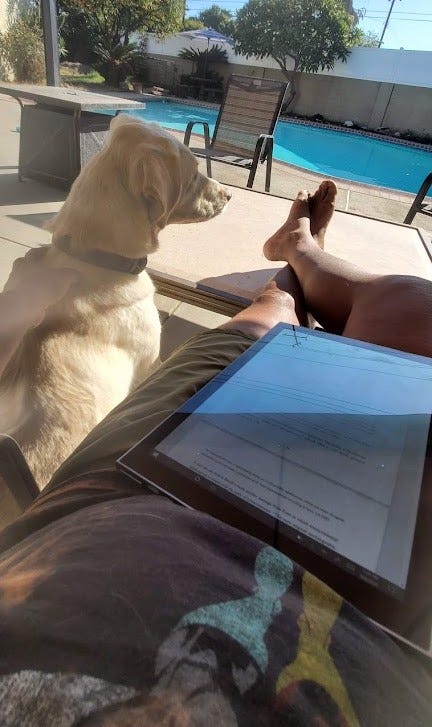
I moved to the porch to finish. Sammie is beside me, watching the pool the way she watches for weather. The fireworks stopped a week ago. She has settled. The third folder is nearly done.
The maxim closes the series.
You refuse to know. The record remembers. I refuse to forget.
Part 1 named the refusal. Part 2 named the exposure that made the record necessary. Part 3 named the discipline of the witness. Three clauses, three essays, one instrument. The record is the middle clause because it carries what neither the refuser nor the witness can carry alone.
Sammie put her head down. The light is going. Time to file the page.
Jerry W. Washington, Ed.D., is a Marine combat engineer veteran, independent researcher, and instructor at UCI Division of Continuing Education. He writes What Time Binds on Substack. The Hayakawa series ran from June 29 through today. Thanks to Arimitsu, whose two June essays sit beside this one and made half the argument possible.
If this essay named a discipline you had been keeping without a name for it, keep going. Share the series with one person who is building a file of their own. The series ends here. The practice does not.
Sources
Hayakawa, S.I. (1953). The Semantics of Being Negro. Address to the Urban League of St. Louis, February 12, 1953. ETC.: A Review of General Semantics, Vol. X, No. 3 (Spring 1953), 163–175.
Bipartisan Women’s Caucus (2026). Open letter regarding the cancellation of the 2026 Women Veterans Recognition Day wreath-laying ceremony.
Task & Purpose (June 2026). Event honoring servicewomen canceled after most branches decline to attend. https://taskandpurpose.com/news/women-service-event-canceled/
Military Times (June 11, 2026). Air Force cites DEI ban in cancellation of wreath-laying honoring women vets. https://www.militarytimes.com/news/pentagon-congress/2026/06/11/air-force-cites-dei-ban-in-cancellation-of-wreath-laying-honoring-women-vets/
Department of Defense (January 31, 2025). “Identity Months Dead at DoD” memorandum.
Executive Order 14185, Restoring America’s Fighting Force.
Arimitsu (June 24, 2026). The Fire That Never Caught.

Arimitsu (June 28, 2026). The Office of Being Disbelieved.
Zhenguan Zhengyao (Tang dynasty). Compilation of exchanges between Emperor Taizong and Wei Zheng.
Civil Rights Act of 1964, Title VII.
Rehabilitation Act of 1973, Section 503 (41 CFR 60-741).
Vietnam Era Veterans’ Readjustment Assistance Act of 1974 (41 CFR 60-300).
Americans with Disabilities Act of 1990.
Pregnant Workers Fairness Act of 2022.
Brown v. Board of Education, 347 U.S. 483 (1954).
Griggs v. Duke Power Co., 401 U.S. 424 (1971).
Washington, J.W. (June 8, 2025). Same Words, Different Worlds. What Time Binds.
Washington, J.W. (June 29, 2026). At the Level of Words, At the Level of Facts. What Time Binds.
Washington, J.W. (July 6, 2026). The Asymmetry of the Prophecy. What Time Binds.
First, hi Sammie, lucky pup!
This took me a bit to get through and what stuck with me the most was the wreath-laying example: 27 years of the ceremony working produced no file, but the one year it failed produced an open letter, news coverage, and a paper trail within 48 hours. That gap of a working system leaving no trace but a broken one creating tons of documentation explains why nobody had anything to push back with when the policy got reinterpreted. For me, this was a good reminder and prompting in the area of professionalism and culture too: when no one stops to ask the questions or define/document over time, the behaviors or happenings just become part of the unchecked flow.
The Facebook thread example works the same way from the other direction, treating an unanswered citation demand as evidence you can point to later, rather than just a dead-end exchange, and it pairs well with the ancient officials whose job was to formally object to the ruler, since writing a prediction down beforehand and documenting what happened after turn out to be the same move, just running in opposite directions in time. We've talked about this too, at some point it's just time-consuming and tiring to keep conversing (debating?) with someone who doesn't see logic or can't use it (or refuses to use it), and that's exactly where the record does the work you don't have the energy to do over time. You stop trying to convince the person in front of you and let the page convince whoever reads it later. Honestly, the whole series for me came down to the one line where you share "the record is the tool, but it's the person who actually has to sit down and keep it." That was the mic drop moment, b/c of all of the implications that can have; it is both a great stand alone note and/or it can open the door for the first question that popped into my mind immediately after reading it: who keeps the record and who does the record serve.
Thank you for quoting my essays, Jerry. Seeing them next to your logbook and the twenty-seven ceremonies, I didn't expect them to find a place in a room like that.
In Japan there's a custom called mushiboshi—airing books. You take them out of storage regularly and let them see the sun, so damp and dust don't ruin them. The interesting part is the phrase we use for it. Hi no me o abiru—"to bathe in the sun's eye"—carries two meanings at once. Literally, it's the airing that preserves a book. Idiomatically, it's when something that has remained hidden finally comes to light. Care and recognition, held together in the same expression.
Left in a drawer, even a carefully filed record can quietly gather dust or mold. Reading this series, I found myself thinking that some records which had spent years out of sight were finally getting their airing—the twenty-seven ceremonies, the 1953 speech, your logbook. Bringing a file out into the sun, where preserving it and bringing it into view become part of the same act, felt like one of the quiet threads running through all three essays.