


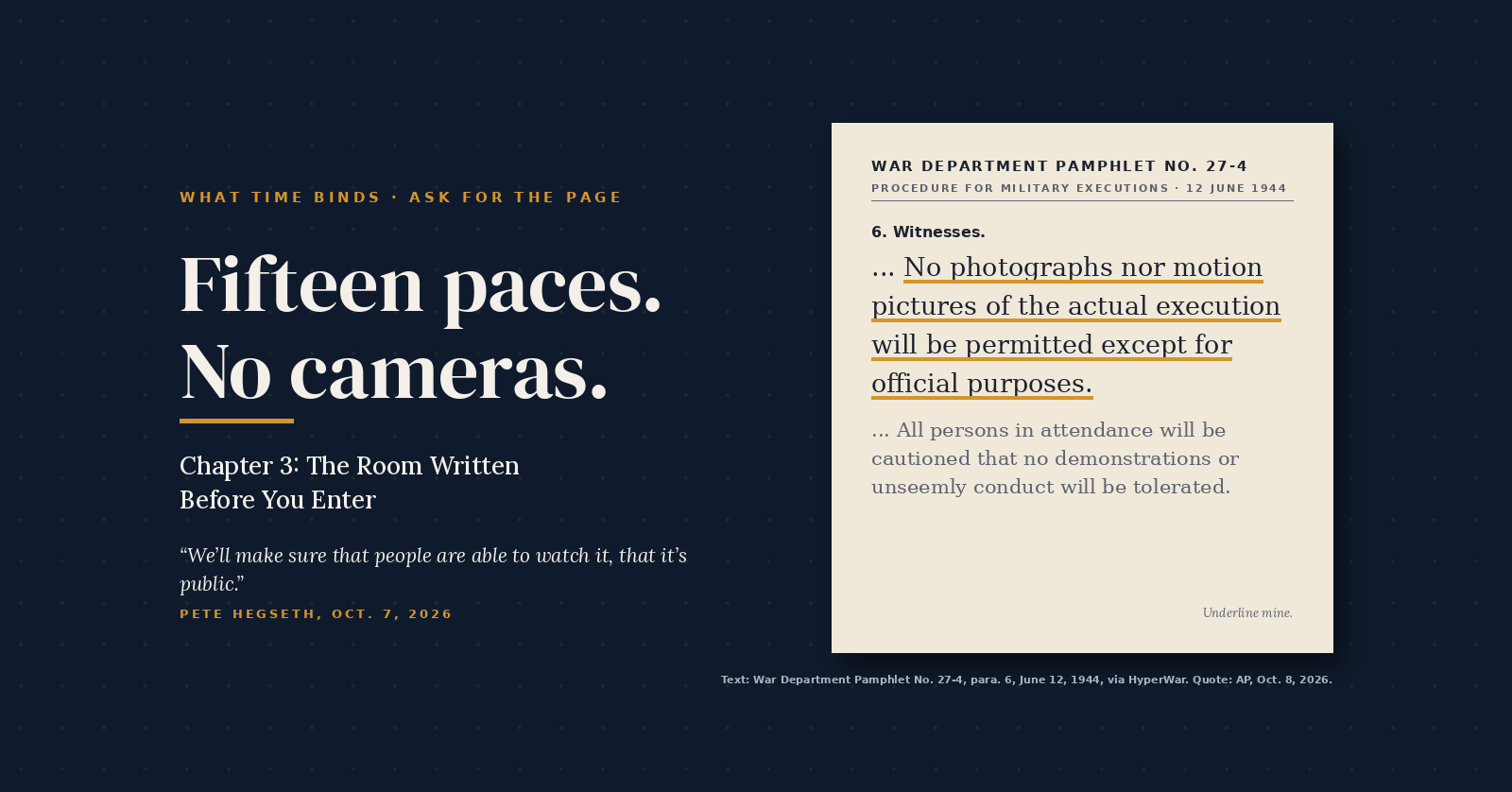
A chapter draft of the book in progress.
The page
On June 12, 1944, six days after D-Day, the War Department published Pamphlet No. 27-4, Procedure for Military Executions, over the name of George C. Marshall, the Army’s Chief of Staff.
It lays out the ground pace by pace. Troops sent to observe an execution by musketry are formed into “the three sides of a hollow rectangle, facing inward.” The execution party is “twelve men and one sergeant.” It halts “15 paces from and facing the position to be taken by the prisoner.” The main guard forms five paces behind it. The rifles are loaded in an officer’s presence, and “Not more than four nor less than one will be loaded with blank ammunition.”
It even writes the mood. “All persons in attendance will be cautioned that no demonstrations or unseemly conduct will be tolerated.” The troops stay at attention “until the conclusion of the ceremony.” And one sentence decides who sees it: “No photographs nor motion pictures of the actual execution will be permitted except for official purposes.”
The Justice Department wrote its own version in 1993, for federal civilian executions. The prisoner may bring one spiritual adviser, two defense attorneys and three adult friends or relatives. The Bureau of Prisons may add up to eight citizens and ten reporters. No one under 18 may watch. And the rule ends where Marshall’s did: “No photographic or other visual or audio recording of the execution shall be permitted.”
Two departments, 49 years apart, set the same conditions: witnesses present, cameras barred. Everyone who came under those rules came to a scene someone else had already scripted, and the page was there to read before they arrived.
Fort Hood
On Nov. 5, 2009, Maj. Nidal Malik Hasan opened fire at Fort Hood, Texas. He killed 13 people: 12 soldiers and one civilian. An Army court-martial convicted him and sentenced him to death in 2013. In 2025 the Supreme Court declined to review the conviction. On Oct. 2 of this year, the President approved the sentence. On Oct. 6, Acting Army Secretary Adam Telle signed the execution order: firing squad, at Fort Hood, on Dec. 3, at 1 p.m. Central. ABC News reports it would be the military’s first execution by firing squad since 1945.
Every one of those steps has a page. A verdict. An appellate record. An approval. An order with a date, a place and a method.
The next step has an interview. On Wednesday, Oct. 7, aboard the USS Abraham Lincoln, Defense Secretary Pete Hegseth said: “We’ll make sure that people are able to watch it, that it’s public, because people need to understand that there’s serious consequences for these types of things.” On Thursday, Pentagon officials confirmed the execution would be livestreamed. The Associated Press reported that “more details would follow.”
Then people started answering on the record.
Rep. Adam Smith of Washington, the ranking member of the House Armed Services Committee, put out a statement Thursday: “Calling for a livestream of the execution of Maj. Nidal Malik Hasan is disturbing and makes a mockery of our legal system.”
On Friday, Rep. Austin Scott, a Georgia Republican, posted: “I absolutely support the sentence of death, but live-streaming executions is what jihadists do.” Sen. Thom Tillis of North Carolina, also a Republican, called the plan “beyond disgusting” and said, “Public executions are what oppressive dictatorships like Iran and Afghanistan do.”
The same day, a reporter asked the President whether he wants the execution streamed. “They’re making a determination about that,” he said. The Vice President was plainer: “if it’s all through livestream, I’m not going to be watching it.”
On Saturday, ABC News reached two of the people Hasan shot.
Hasan shot Alonzo Lunsford seven times that day, including in the head and the stomach. Lunsford plans to be at the execution. He wants to “lock eyes” with Hasan. “I want him to be able to look at my eyes and to let him understand I won’t be defeated, can’t be defeated,” he said. “I am no longer a victim, his victim. I am a survivor.”
He said two more things. “I don’t want this to be viewed upon as a spectacle, like a pay-per-view event, or like going to a basketball tournament.” And: “We’re not trying to meet a standard — we’re trying to set a standard for the free world.”
Dayna Ferguson, also wounded that day, told ABC the news surprised her. “It’s not completely shocking, given that death and war have historically always been documented through photographs and video,” she said. “But it’s just not something I expected to hear.” Then: “I hadn’t really thought about if I agree with the decisions being made, but it doesn’t make a difference in what happens to him.”
Two survivors. Two readings. Neither of them decided how Dec. 3 will look.
The absent author
On Feb. 12, 1953, S. I. Hayakawa spoke at the annual dinner of the Urban League of St. Louis. He told his audience that the man who walks into a meeting holds more than he knows: “However he acts, the power to determine the atmosphere of the meeting lies with him, although he may not know it.” In his telling, that power works because the other side can see him. Face to face, with both people present, he was right.
That power needs a witness. It works when the person who decides can see you.
Many of the places that decide things now were set up before anyone walked in. Call the person behind them an absent author: someone who set the terms on paper, before you arrived, and does not have to be there to see you. When an absent author holds the pen, Hayakawa’s power goes with it. You are present. The author is not. The page outweighs anything you carry through the door.
Chapter 1 read one Pentagon page for its two sentences. Read it once more, for who was not there. On June 10, the 28th wreath-laying at the Women in Military Service for America Memorial never happened. For 27 years the Bipartisan Women’s Caucus had laid that wreath. The 28th needed service representatives. A spokesperson for the caucus’s Democratic side said the Navy and the Air Force, answering for the Space Force, declined, citing White House and Pentagon policy. The caucus brought 27 years of fair expectation to Arlington. Nobody who wrote the guidance stood on the plaza that morning. Nobody had to. The decision had sat on paper since Jan. 31, 2025, more than 16 months before anyone made the trip.
Fort Hood has two authors. The sentence came through a court-martial, an appeal, an approval and an order, and each one left a page. The stream came through an interview aboard an aircraft carrier, 57 days before the day it describes. Lunsford will bring his own expectations to that post on Dec. 3. Hayakawa’s power will not be his. It belongs to whoever writes the page, and so far the page is one sentence spoken to a camera.
The sentence has a page, and the stream, so far, has an interview. Every Monday I take one word an institution bent and show the page it bent on. Subscribe and the next one is in your inbox, free.
Who will be there
Count who will stand on that post on Dec. 3, and how each one got there.
Lunsford, by choice. He wants Hasan to see his eyes.
The detail, by orders. ABC News reports that eight service members will carry out the sentence. In 1944 the Army wrote between one and four blank rounds into the rifles on the line. Whatever the 2026 plan writes for the people holding them has not been made public.
Hasan, by sentence.
And everyone with a screen, if the stream goes ahead. Each of those viewers tunes in to something planned 57 days ahead. They can close the window. The Vice President says he won’t be watching. Lunsford has no window to close. He will stand inside whatever atmosphere the page sets, in front of whatever audience it brings.
Hayakawa’s power belongs to the person who wrote that page, wherever he stands that afternoon. A viewer at home holds more of it than the survivor at the post.
The case for the camera
The strongest case for the stream comes from the man who announced it: “people need to understand that there’s serious consequences for these types of things.” Punishment in public is one of the oldest arguments for deterrence. And the sentence the stream would show came through every step the law requires.
A second case comes from the other direction. A sentence carried out in the public’s name is the public’s business, and a country that executes a man should have to look at what it did. Ferguson came close to it on her own: death and war “have historically always been documented through photographs and video.”
The habit does not settle that argument. It asks who did the writing, and for whom. Marshall kept the camera for “official purposes.” The Oct. 7 interview points it at everyone, and the reason it gives is the audience.
Taking notes
In 2005, I was a mid-level manager at a Marine Corps logistics command in Japan, reporting to the Chief of Staff. The directive on the table at a project governance meeting was a multi-decade relocation plan. The American side said they were aligned on it. I was taking notes.
What “aligned” meant at that table depended on where you sat. The Washington headquarters needed it to mean strategic posture. The local command needed it to mean operational logistics: which buildings would close, which would open, which would transfer. The host government needed it to mean sovereignty and economic acceptance. Which prefectures. Which workforce. What compensation. Whether the relocation could survive a local election and the next one.
Three readings of one word. The directive arrived already written, and our job was to carry it, one Tuesday afternoon at a time. The meeting closed with everyone saying they were aligned. Eighteen years later, a new base opened.
I wrote down what was said. It took me twenty years to learn what belonged at the top of the page: who set it up, and were they there?
The habit
The pin: an absent author. Someone who set the terms on paper, before you arrived, and does not have to be there to see you.
What it includes: The broadcast plan for Dec. 3. The guidance that emptied the wreath stand on June 10. A denial letter. A software screen. A policy nobody in the building wrote. The ballot you will carry into the booth on Nov. 3.
What it cannot be read to say: It cannot be read to say every absent author is wrong. Marshall was one. His pamphlet kept out every camera but the Army’s own. The Justice Department’s 1993 rule kept cameras out too. Both were written for the people who would be there. The Oct. 7 interview speaks to the people who won’t be, because “people need to understand that there’s serious consequences.” The page tells you which kind you are dealing with.
It cannot be read to say the person who shows up chose the outcome. And it cannot be read to say how you carry yourself does not matter. Where the person who decides can see you, Hayakawa still holds.
The question: Before you walk through a door, ask who wrote what’s waiting on the other side. Then ask whether the writer will be there. Then ask who it was written for.
On Nov. 3 you will meet an absent author in the booth: the ballot. Someone wrote every line of it before you arrived. Read it before you go in, every race and every measure, at vote411.org.
Update, Oct. 12: After this went out, a reader asked whether I had read the most recent regulation. The rule in force today is Army Regulation 190-55, revised in 2019 and certified current Oct. 30, 2023. It lists who is “authorized to be present,” including at least two news media representatives, and bars anyone under 18. It says nothing about cameras. The 1944 camera sentence is gone. The page names who may watch. The interview filled the silence about everyone else.
The pages
War Department Pamphlet No. 27-4, Procedure for Military Executions, June 12, 1944 (HyperWar transcription)
Army Regulation 190-55, Procedures for Military Executions, certified current Oct. 30, 2023 (Army Publishing Directorate)
U.S. Army, “Army Sets Execution Date for Convicted Murderer Nidal Hasan,” Oct. 7, 2026
S. I. Hayakawa, “The Semantics of Being Negro,” ETC. 10, no. 3 (Spring 1953), p. 167
This essay is chapter 3 of Ask for the Page, the book What Time Binds is writing in public, one chapter a Monday through December 7. The comments are the appendix: tell me where the record is wrong and I will show the page or fix the line. Paid subscriptions open at 500 readers, and the paid product is Coded Threads, the codebooks built from these comment sections. A pledge now is a vote for that.
Jerry W. Washington, Ed.D., is a Marine Corps veteran of twenty-three years, a combat engineer by trade, an instructor at UC Irvine’s Division of Continuing Education, and the writer of What Time Binds, a record of how institutions bend words and how the page holds them to account.
What Time Binds runs on readers. If this piece told you something you did not already know, forward it to someone who needs to read it. If you want the next one, subscribe below.