

A chapter draft of the book in progress.
The page
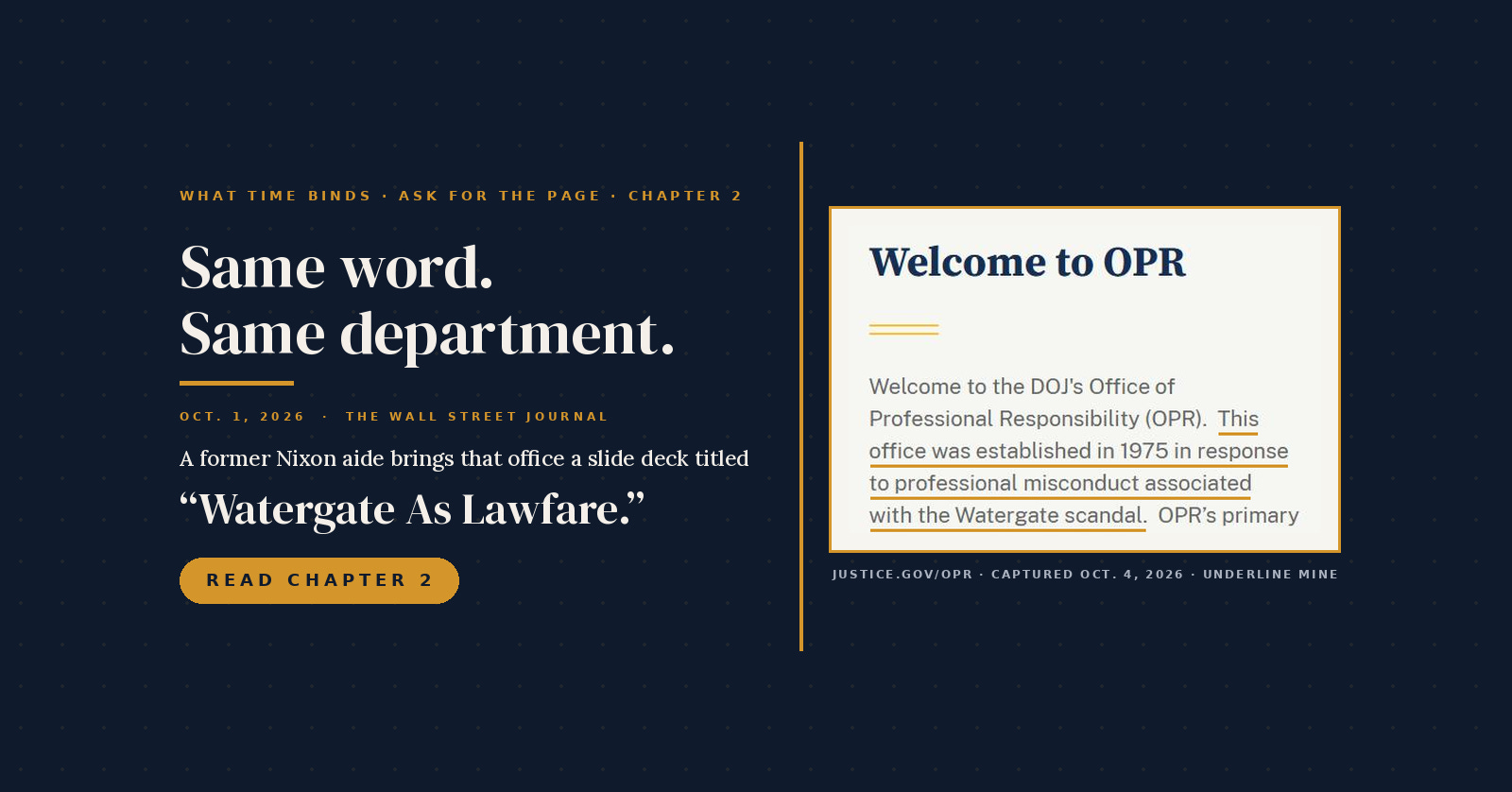
The Justice Department keeps a web page for its Office of Professional Responsibility. The page opens with one sentence about where the office came from.
“This office was established in 1975 in response to professional misconduct associated with the Watergate scandal.”
That is the department’s own definition of Watergate, on its own server. Watergate is the misconduct. The office is the repair. The department built a unit to examine misconduct by its own lawyers, because in the Watergate years the misconduct reached its own leadership. The department’s own history says so. Attorney General Edward Levi created the office in 1975 “following revelations of ethical abuses and serious misconduct by senior Department officials during the Watergate scandal.” John Mitchell, attorney general until 1972, was convicted on January 1, 1975, of conspiracy, obstruction of justice and perjury. His successor, Richard Kleindienst, pleaded guilty in May 1974 to a misdemeanor for failing to answer Senate questions fully about the ITT antitrust case, a charge the Watergate special prosecutor brought.
See for yourself. Open justice.gov/opr and read the first sentence under the office’s name.
The deck
On October 1 the Wall Street Journal reported that Geoff Shepard, in the paper’s words “a former Nixon aide turned Watergate historian and revisionist,” had given a two-hour presentation at Justice Department headquarters. A senior department official had invited him the month before to make his case to the Office of Professional Responsibility. The Journal printed the title of his slide deck.
“Watergate As Lawfare.”
Same word, same department. The 1975 page says Watergate is the misconduct that made the office necessary. The deck says the misconduct belonged to the prosecutors who brought the case. One word now points two opposite ways inside one building.
The department answered the Journal in writing. Its statement says the office turned down Shepard’s request for an investigation in 2022, under the previous administration. Then:
“Given his expertise and scholarship on Watergate, he was recently invited to give a presentation to OPR, but that presentation does not constitute an investigation.”
Read it at both levels, the way Chapter 1 asked. At the first level, a presentation is not an investigation. At the second, people familiar with the matter told the Journal the department “is reviewing whether the special prosecutor’s office that investigated the famed Watergate break-in committed misconduct.” The statement’s noun is presentation. The sources’ noun is review. Both sentences can stand, and the statement never says a review does not exist. The Journal’s reporting leaves open whether it becomes a full investigation.
Two more dates sit inside the statement. In 2022 the office said no to Shepard. In 2026 it invited him in. The statement names his expertise and scholarship as the reason. It names no new document.
Objection came from the right too. On October 1, National Review ran a piece by Jim Geraghty under the headline “No, We Don’t Need to Spend Taxpayer Dollars to Review Whether Nixon Got a Raw Deal.”
See for yourself. Put the department’s sentence beside the Journal’s. Circle the noun in each.
Yorba Linda
The Nixon Library sits in Yorba Linda, a short drive from where I write in Anaheim. On June 25, Vice President JD Vance spoke there. He said Watergate would be “a 12-hour news story” today, and he called it a “story of how the deep state took down Nixon.”
The next day I posted a card with the record beside his words: the Supreme Court’s 8–0 ruling on the tapes, the articles of impeachment, the resignation. Under it I promised you a Monday essay that would take the whole thing apart. I never wrote it. I’m owning that here, on the page, because the gap belongs to the record too. In June the new meaning lived at a podium. Ninety-eight days later the Journal reported it had been given a meeting at headquarters.
The building has carried this word before. When a private foundation ran the library, its Watergate exhibit called the scandal a coup. The Associated Press quoted the wall text in 2011: “Allegations took on the weight of fact in the minds of those who were determined to engineer a coup of their own.” The National Archives took over the library in 2007. On March 31, 2011, it opened a new Watergate gallery built from the White House tapes, the documents and 131 oral history interviews.
On October 1, the day the Journal story ran, Rep. Riley Moore of West Virginia spoke at the Nixon Foundation’s Grand Strategy Summit. He said Nixon was “couped out of office” and “framed.” The Archives retired the word from the wall. Fifteen years later it came back through a microphone.
The magnet word
I have a name for a word like this. A magnet word pulls more than one meaning to itself, so people hear the same sound and walk away holding different things. I started using the term in February. In a strip about the word “aligned”, a room full of people nodded at one word and heard five different contracts.
Most magnet words collect their meanings by accident. Busy people talk fast and nobody stops to ask. Watergate is the other kind. Its second meaning is being built on purpose, by people with titles, in a building with a seal on the wall.
Weigh what each meaning has behind it. The first has the Supreme Court’s 8–0 ruling in United States v. Nixon on July 24, 1974. It has the tape of June 23, 1972, in which Nixon approved a plan to have the CIA ask the FBI to halt its investigation. It has an office the Justice Department built in 1975 in response to it. The second meaning has a slide deck.
On October 4, the day before this chapter went out, the President posted an image on Truth Social. Two presidents side by side, and one line: “One of these men is the most corrupt president in the history of the United States. The other is Richard Nixon.” The line only works if you still hear the first meaning. Nixon is the yardstick for corrupt, and the post borrows that meaning to make its point. A widely shared repost on Facebook ran it under a caption calling the Nixon story “fake news.” One post, both meanings of the same name.
Give Shepard his strongest case. In October 2021 he filed a misconduct complaint with the Office of Professional Responsibility. The release announcing his book that month said the special prosecutors “held a series of secret meetings with Watergate judges” and were “wrongfully suppressing evidence favorable to the defendants.” Grant every point. Nixon himself was never tried. President Ford pardoned him on September 8, 1974. A misstep in the trials of his aides cannot reach back and change what is on his own tape.
See for yourself. The Nixon Library posts the tapes played in the Watergate trials, the June 23, 1972 conversation among them, listed as the “Smoking Gun.” Read the page before you read anyone’s summary of it, mine included.
The second room
Watergate is the national case. The same mechanism runs at the county level, on the ballot you are about to cast.
On August 18, Wyoming held its primary. That day the Justice Department put out release 26-939, titled “Justice Department to Conduct Election Monitoring in Florida and Wyoming Primary Elections.” It said the department was “monitoring polls” in Laramie County “with two Civil Rights Division attorneys.”
Debra Lee, the Laramie County clerk, met them at the door. In a written statement reported by Cowboy State Daily, she said they “did not offer their credentials until I requested they do so.” They “intended to interview voters,” and she refused: “We do not allow interviews to be conducted in polling places.” They wanted to examine her tabulators. Her verdict: “Wyoming law has no provision for election monitoring.”
On August 26, at the State Canvassing Board, Gov. Mark Gordon said the officials’ behavior “seemed to exceed what the authority that Congress had given them was.” Secretary of State Chuck Gray answered him. According to WyoFile, Gray said state law “provides for observation of the election process.”
Hold the two lines side by side. One visit got two names. Observation is the word Wyoming law provides for. Monitoring is the word on the department’s release, and the word the clerk said the law does not contain. Whichever name sticks decides whether the law covered what happened at her door. Gray chose the word the statute permits. Lee chose the word that matched what she saw.
The department’s own release keeps the two words apart. It speaks of “an open flow of communication between poll observers and election monitors,” two roles in one sentence. Watergate shows a magnet word pulling two meanings. Laramie shows the other direction: one act pulling two words, each carrying a different legal answer.
See for yourself. Open release 26-939 and count the times it says “monitor.” Then find your county’s rule on who may be present at a polling place, and the word it uses.
Reading the terrain
Marines read terrain before they move. One point on a map tells you where something is. Plot enough points and you can see which way it runs.
On June 26 I had one point. The Vice President stood in Yorba Linda and called Watergate a story about the deep state, and I wrote that the word was being recoded. I promised you an essay and never wrote it. One point is not a route.
By October 4 I had four. A senior official invites a former Nixon aide to the office Watergate built. The aide’s slide deck calls Watergate lawfare. A congressman says Nixon was “couped out of office.” The President uses Nixon as the yardstick for corrupt and aims it at someone else. Each one stands on its own page. Plotted together, they run one direction.
I’m not claiming I called it. I wrote down a date, and the dates kept arriving. That is the whole method of this book.
In March 2025, before What Time Binds existed, I wrote a short piece about a different policy. One line from it holds here: “intentions are not enough. Policies and actions must be judged by their real-world impact.” The department’s statement gives the intent: a presentation, not an investigation. The terrain gives the outcome. The office created in response to Watergate gave the case that Watergate was lawfare two hours at headquarters.
A republic reads its terrain the same way. It keeps the record.
The habit: pin the word
When a word starts doing two jobs, pin it to a page before you argue about it. The pin has four parts. Here is Watergate, pinned.
The pin. Watergate: the June 17, 1972 break-in at the Democratic National Committee’s offices in the Watergate complex, by men tied to the Committee for the Re-Election of the President, and the cover-up that followed. The pages: the articles of impeachment the House Judiciary Committee approved July 27 to 30, 1974, and United States v. Nixon, 418 U.S. 683.
What it includes. The break-in. The cover-up. The tape of June 23, 1972. The convictions of John Mitchell, H. R. Haldeman and John Ehrlichman. The resignation on August 9, 1974.
What it cannot be read to say. That every prosecutor in every trial was without fault. The pin holds what the president did, which his own tape records. How his aides were tried is a separate question, and it needs its own page.
The question. When someone uses the word to mean the other thing, ask them which page they are reading.
Watergate began as a burglary aimed at an election. Twenty-nine days from now you cast a ballot of your own. Pin its words the same way: read the measure’s text before the ad about it, and look up your polling place and your sample ballot at vote411.org.
The Justice Department’s own page still defines Watergate the way the tapes do. Every Monday I take one word an institution bent and show the page it bent on. Subscribe and the next one is in your inbox, free.
Author’s note. This chapter was built to open in Laramie County, Wyoming, with one federal visit and two names for it. Then came October 1 through 4. The Wall Street Journal reported a slide deck titled “Watergate As Lawfare.” A congressman said Nixon was “couped out of office.” The President posted a meme that only works if Nixon still means corrupt. All three ran back to a card I posted on June 26. So I turned the chapter. Watergate took the first room, and Laramie moved to the second. That is what writing a book in public looks like: the record moves, and the chapter moves with it.
This essay is chapter 2 of Ask for the Page, the book What Time Binds is writing in public, one chapter a Monday through December 7. The comments are the appendix: tell me where the record is wrong and I will show the page or fix the line. Paid subscriptions open at 500 readers, and the paid product is Coded Threads, the codebooks built from these comment sections. A pledge now is a vote for that.
Jerry W. Washington, Ed.D., is a Marine Corps veteran of twenty-three years, a combat engineer by trade, an instructor at UC Irvine’s Division of Continuing Education, and the writer of What Time Binds, a record of how institutions bend words and how the page holds them to account.
Sources
U.S. Department of Justice, Office of Professional Responsibility, home page (opened Oct 3, 2026)
U.S. Department of Justice, About OPR
Deseret News, “John Mitchell, 75, Watergate Conspirator, Dies”, Nov 10, 1988
Associated Press in The Michigan Daily, on Kleindienst’s plea, May 17, 1974
The Wall Street Journal, “Decades After Watergate, Justice Department Reviews Whether Nixon Got a Raw Deal,” Oct 1, 2026
The Daily Beast, the department’s statement in full, Oct 1, 2026
The Western Journal, on the invitation and the review, Oct 2, 2026
National Review, Jim Geraghty, “No, We Don’t Need to Spend Taxpayer Dollars to Review Whether Nixon Got a Raw Deal,” Oct 1, 2026
The Hill, Rep. Riley Moore at the Grand Strategy Summit, Oct 1, 2026
Associated Press via U.S. News, Vance at the Nixon Library, June 25, 2026; RealClearPolitics video, June 26, 2026
Truth Social, Donald J. Trump, image post, Oct 4, 2026, 1:03 PM ET; archived copy
Geoff Shepard, media advisory on The Nixon Conspiracy and his OPR complaint, Oct 16, 2021
Richard Nixon Presidential Library, Watergate trial tapes
Associated Press via HeraldNet, “Nixon library offers candid new take on Watergate”, April 1, 2011
National Archives, press release on the Watergate Gallery, March 31, 2011
U.S. Department of Justice, release 26-939, Aug 18, 2026
Cowboy State Daily, Debra Lee’s statement, Aug 27, 2026
WyoFile, Maggie Mullen, the State Canvassing Board, Aug 26, 2026
What Time Binds, Chapter 1: Two Levels; Show Your Work, Aug 31, 2026; Pinned Terms, Ep. 001: “Aligned”, Feb 19, 2026
Jerry W. Washington, “Intent vs. Outcomes,” Medium, March 2025