

A chapter draft of the book in progress.
Ten days
At 4:52 on the afternoon of Monday, Oct. 19, a message came in from my friend Matt.
“I am surprised you haven’t written about the president making a deal with Russia for diesel and then suspending sanctions.”
We traded messages for most of an hour and agreed there should be an impeachment.
At 5:41 I gave him the position I still hold. “Impeachment is not enough, brother. They need a conviction, and the current House and Senate won’t make that happen. Vote Nov. 3 for who will hold him accountable. Anything else is theater.”
Then I read his first sentence again. He was surprised I had not written about it. He had reason to be.
This chapter was due that day. I had most of it: the pages, the dates, a pattern I have tracked in this newsletter since February. I did not have the way in, and I had not published. The diesel license went up on Oct. 9. For ten days it sat on the Treasury Department’s website, dated and public. In those ten days I published a chapter on a firing squad at Fort Hood, a Field Guide on corrections, and the first episode of a podcast. I was busy, and I was struggling with this chapter.
A quiet change counts on exactly that. In July I wrote, “The quiet change depends on nobody coming back.” On Oct. 19 a reader came back before I did.
At 6:01 I told Matt he had just handed me the opening for this chapter. Then I did what this book asks of you. I asked for the page.
The page
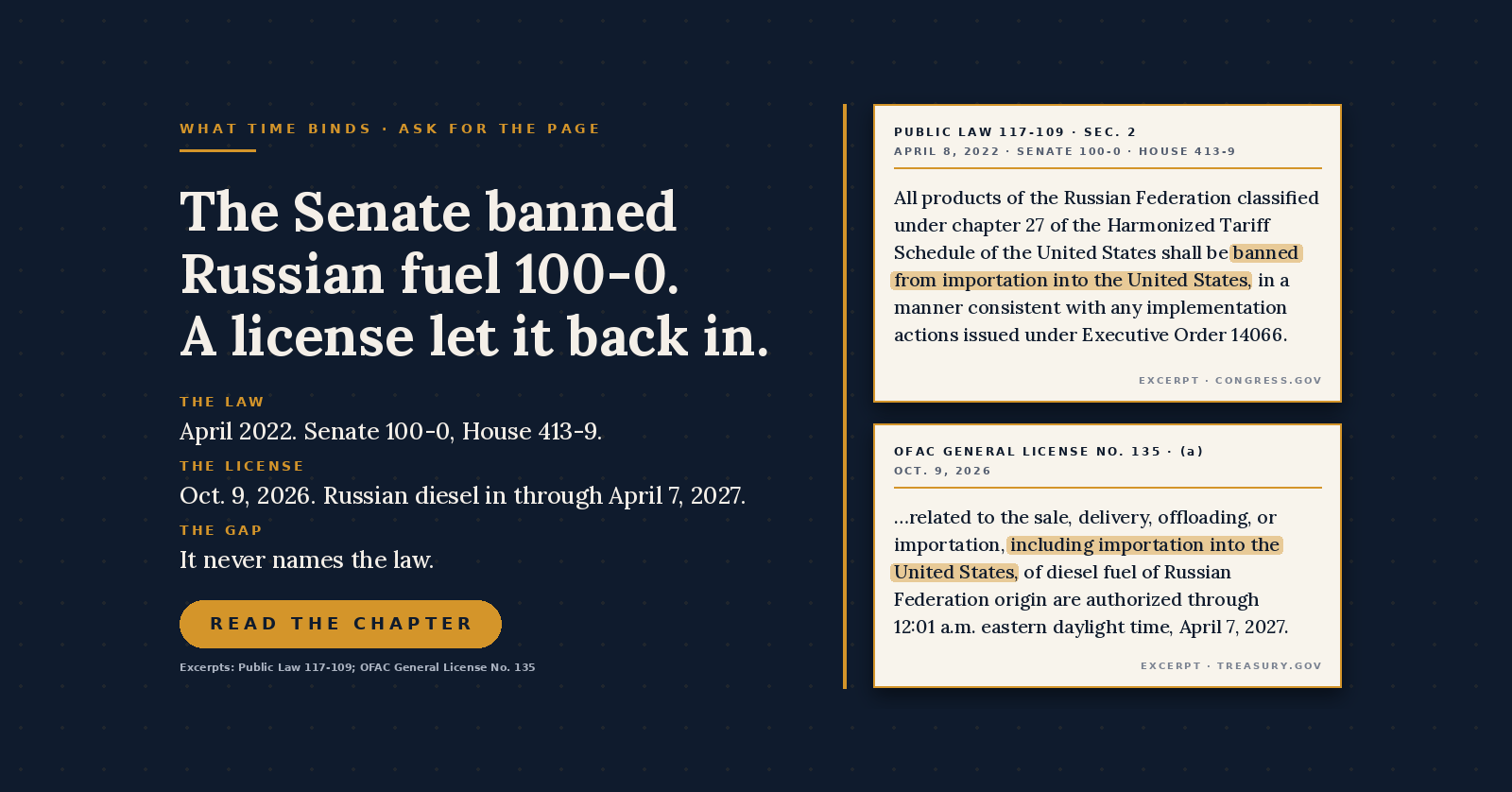
The Treasury Department’s Office of Foreign Assets Control posted General License No. 135 on Oct. 9, 2026. Its title says what it does: “Authorizing Transactions Related to the Sale, Delivery, Offloading, and Importation of Diesel Fuel of Russian Federation Origin.” Its first paragraph allows those deals, “including importation into the United States,” until 12:01 a.m. Eastern on April 7, 2027.
The license rests on two sets of Treasury regulations, 31 CFR part 587 and 31 CFR part 589. It cites no statute. It never mentions the law that bans what it allows.
That law passed the Senate 100-0 on April 7, 2022. The House agreed to the Senate’s version 413-9 the same day, and President Biden signed it the next day as Public Law 117-109, the Ending Importation of Russian Oil Act. Section 2 reads: “All products of the Russian Federation classified under chapter 27 of the Harmonized Tariff Schedule of the United States shall be banned from importation into the United States, in a manner consistent with any implementation actions issued under Executive Order 14066.” Diesel sits in chapter 27. Executive Order 14066 is the March 8, 2022, order that started the ban a month before Congress wrote it into law.
Section 3 sets the only way to end the ban. The president has to certify that Russia “has reached an agreement to withdraw Russian forces and for the cessation of military hostilities” that “is accepted by the free and independent government of Ukraine.” He has to certify that Russia poses no immediate military threat to any NATO member and recognizes the right of Ukrainians to choose their own government. At least 45 days before that certification, he consults four committees and reports the basis for it. The ban then holds for 90 more days, long enough for Congress to pass a resolution blocking the change. The act has no other door. It contains no waiver, no suspension and no licensing power.
No one claims any of those steps has happened.
Open the license and the law side by side. Find the two regulations the license names. Then look for the law.
A Treasury office posted on X that the license was “in compliance with all applicable laws.” Secretary Scott Bessent told Fox News, “We’re going to do it with all the legal authorities we have.” Neither named the authority. If a defense lives in the text, it lives in the last clause of Section 2, the one that ties the ban to actions “issued under Executive Order 14066.” Treasury has not pointed to that clause or named any other authority.
The law reads today the way Congress passed it. The license changed what it does. That is the quiet edit: a change to what a record says or does that leaves no note where a reader would look.
The law still says no, and a license dated Oct. 9 says yes without identifying it.
Every Monday I take one word an institution bent and show the page it bent on. Subscribe and the next one is in your inbox, free.
The loud part
The deal made noise on purpose. On Oct. 9, after a call with Vladimir Putin, the president posted: “Russia will immediately supply over 300,000 Tons of Diesel Fuel to the American and Global Marketplace, another 500,000 Tons during the month of November, and 1,000,000 Tons immediately thereafter …” He promised diesel prices “COMING DOWN, IN RECORD NUMBERS, AND FAST!”
Congress answered across the aisle. On Oct. 11, seven senators, four Republicans and three Democrats, said the license “runs directly counter to that law.” On Oct. 12, Rep. Lloyd Doggett, the Texas Democrat who sponsored the 2022 ban, wrote that “Trump is directly violating that law.” On Oct. 13, six Republican senators and six Democrats asked him to withdraw it. Mitch McConnell and John Cornyn signed. “This deal is a gift to our adversary and a betrayal of our Allies; it should be rescinded.” The same day Clyde & Co, a law firm that advises on sanctions, wrote in a client alert that the license “sits in tension with the Russian Oil Act and may therefore be subject to legal challenge.”
The best defense came from outside the administration. Edward Swaine of George Washington University Law School told Time the administration could argue that “the general license isn’t [a] termination of the statutory prohibition; it’s a suspension.” Kristen Eichensehr of Harvard Law School told Time the law’s conditions are “not certifications that the President could make at the current moment.”
Take that argument at full strength. The suspension runs from Oct. 9 to April 7, 2027. For six months, Russian diesel can come into the United States under a law that bans it and has not changed a word. The law offers no suspension. Section 3 is its only exit, and the license did not take it.
On Oct. 13 the president held a rally in Wasilla, Alaska. He said nothing about Russia, Putin or the diesel deal.
The noise went to the deal. The license stayed up.
The play
I first watched this play in March 2025, on one page about one soldier.
The Defense Department kept a tribute page for Maj. Gen. Charles Calvin Rogers, a Medal of Honor recipient. On March 14, 2025, the page came down, with “dei” in its web address. The removal drew cameras, then backlash. Three days later the page was back, and the story everyone remembers ends there: restored.
The editing came after. By the April 5 capture, five sentences were gone. Same headline. Same byline. Same 2021 dateline. No correction note. One of the missing sentences read, “To this day, he is the highest-ranking Black Medal of Honor recipient.”
The page stood that way for fifteen months before anyone went back to check. When the two versions went up side by side this summer, the thread under my post drew 264 comments. The Pentagon removed five sentences. The thread produced five witnesses, men who had shaken his hand, served under him or recovered beside him in a hospital in Japan.
Open the March 5, 2025 capture and the page as it stands today. Count the sentences.
That is the quiet edit run as a play, in three beats. The loud removal absorbs the backlash. The restoration banks the credit. The real edit lands after attention moves, with no note.
The Rogers play took three weeks. The diesel play took one day. The posts drew the fire, and the license, dated the same day, did the work on a page most readers of the law will never open.
The passports
In 2009, back on Okinawa after a tour in Iraq, I was a gunnery sergeant. My wife, our children and I lived off base near Kakazu Takadai Park. I had signed on for another tour on the island, an in-place consecutive overseas tour, IPCOT in the paperwork. It came with a month of leave in the States, the flights paid and the dates written into orders. The Marine Corps bought the plane tickets. The orders said when we would fly.
Right before we left, we could not find the passports. Mine did not matter; I could travel on my military ID. My wife and our children had come to Okinawa on their passports, and those passports were gone.
So we started over, on paper. The U.S. Consulate General Naha sat a walk from our house, in Urasoe, on the route of my morning runs. We needed new passports fast enough to keep the orders, and it took most of a week. The flight dates moved, and the orders and the tickets needed written amendments to move with them.
Every part of that fix went on paper with a date: the new passports, the amended orders, the rebooked flights. The State Department’s form for a lost passport puts its rule in capital letters: “ONCE REPORTED, THE VALID LOST OR STOLEN PASSPORT IS ELECTRONICALLY CANCELLED AND CANNOT BE USED FOR TRAVEL.” A lost passport ends in a note and a cancellation, on the record, with a date.
My wife and I learned to plan early, check often, and keep important papers in one place we both know. One of the passports the consulate issued that week is still in that place. Its date of issue is June 26, 2009. That date is the receipt.
A family’s lost passports took all of that. A license that changed what a 100-0 law does never named the law.
The log Congress wrote
Congress has written the log into Russia law before, and it did it across party lines.
In July 2017 the House voted 419-3 and the Senate 98-2 for a sanctions law that put Congress in the chain for easing Russia sanctions. Before “a licensing action that significantly alters” U.S. policy toward Russia, the president has to send Congress a report. The action then waits 30 days while Congress can block it. The president signed that law on Aug. 2, 2017, and called it “seriously flawed.” The president was Donald Trump.
General License 135 lifts bans under one of the programs the 2017 law covers. I have not found a report to Congress on it, or any word on whether Treasury counts the license as routine, which the law exempts. That report, or its absence, is a page.
In April 2022 Congress wrote the log into the ban itself: the certifications, the report 45 days ahead, the 90 days. That is Section 3, above.
This year it wrote a sanctions law with an off switch and no vote on its use. The Senate passed the Lindsey O. Graham Sanctioning Russia and Iran Act 86-11 on Aug. 7, nearly four weeks after Graham died. The House cleared it 262-159 on Sept. 16, and the president signed it Sept. 18. Its Section 115 lets him waive its sanctions with “a certification in writing that the issuance of the waiver is in the national interests of the United States” and a report explaining why. The act’s review and disapproval process covers terminations under Section 117. Waivers fall outside it.
Late on Friday, Oct. 16, two days before those sanctions were due to take effect, an executive order used the switch. Its title reads “Implementing the Lindsey O. Graham Sanctioning Russia and Iran Act of 2026.” Its waivers carry no end date. They stay in effect until the president or the secretary of state “determine that further action is appropriate.” The order says a certification and a report went to Congress. I have not found either in public. Sen. John Cornyn posted on X, “Lindsey would be appalled.”
That waiver is legal on its face. Congress built the switch with a certification, a report and no vote. The 2017 Congress made a president wait for its review before easing Russia sanctions. The 2026 Congress gave up that wait for its own.
On Oct. 19, the day Matt wrote to me, the ranking Democrats on the House Foreign Affairs, Armed Services and Intelligence committees, Gregory Meeks, Adam Smith and Jim Himes, issued a joint statement after a call between President Zelenskyy and a bipartisan group of members. They committed to advance legislation “to fix the Graham Act and prevent President Trump from unilaterally importing Russian energy.” When the fix reaches paper, read it for one thing: whether the next waiver has to carry a log.
The habit
The pin: the quiet edit. A change to what a record says or does that leaves no note where a reader would look.
What it includes: A license that allows what a law bans and does not consult the law. A tribute page rewritten under the same headline, byline and date. A casualty file that adds a name with no notice. A rule taken out of the federal code without public notice.
What it cannot be read to say: It cannot be read to say every license dodges a law. Most licenses are routine, and the 2017 law says so in its own text. It cannot be read to say a court has ruled the diesel license unlawful. No court has ruled on it, and no lawsuit had surfaced by Oct. 19. It cannot be read to say the Oct. 16 waiver broke the law. Congress wrote Section 115, and the order is public and signed. And it cannot be read to say anyone hid anything. Both pages sit in public. The quiet edit works in the open, on readers who have moved on.
The question: When a rule changes what it does, ask for the log. Where is the certification? Where is the report, and what date did it reach Congress? If no one can show you the page, write that down with the date you asked.
Then date the page and keep the receipt. Save General License 135 today, with the date you saved it. If it changes, you will hold the before.
Find your representative and ask one question: did a report on General License 135 reach the committees, and on what date?
I told Matt to vote on Nov. 3 for who will hold him accountable. Every House seat is on that ballot, including the members who would vote on Rep. Gregory Meeks’s bill to void the license, cosponsored by Rep. Don Bacon, a Nebraska Republican. Vote for accountability. Read your ballot before you go, every race and every measure, at vote411.org.
The pages
Office of Foreign Assets Control, General License No. 135, Oct. 9, 2026
Public Law 117-109, the Ending Importation of Russian Oil Act, April 8, 2022
22 U.S.C. 9511, congressional review of Russia sanctions actions, 2017
Statement on signing the Countering America’s Adversaries Through Sanctions Act, Aug. 2, 2017
Public Law 119-111, the Lindsey O. Graham Sanctioning Russia and Iran Act of 2026
Time, Tiago Ventura, legal experts on the license, Oct. 13, 2026
Clyde & Co, client alert on General License 135, Oct. 13, 2026
Alaska’s News Source, the senators’ letter and the Wasilla rally, Oct. 13, 2026
House Foreign Affairs Committee Democrats, the Meeks bill, Oct. 16, 2026
Joint statement of Reps. Meeks, Smith and Himes, Oct. 19, 2026
This essay is chapter 4 of Ask for the Page, the book What Time Binds is writing in public, one chapter a Monday through December 7. The comments are the appendix: tell me where the record is wrong and I will show the page or fix the line. Paid subscriptions open at 500 readers, and the paid product is Coded Threads, the codebooks built from these comment sections. A pledge now is a vote for that.
Jerry W. Washington, Ed.D., is a Marine Corps veteran of twenty-three years, a combat engineer by trade, an instructor at UC Irvine’s Division of Continuing Education, and the writer of What Time Binds, a record of how institutions bend words and how the page holds them to account.
What Time Binds runs on readers. If this piece told you something you did not already know, forward it to someone who needs to read it. If you want the next one, subscribe below.
It reminded me of shēng dōng jī xī — "make noise in the east, strike in the west" — or a magician's hands. The loud part draws the eyes; the quiet part does the work.
People say this kind of quiet edit is common in Japan too. Our version is usually said to be a distraction by some other news item, though I can't vouch for how true that is. Closer to home, I feel I've seen the same shape: a rule left standing as a hollow form while what's inside it changes a great deal. In workplaces, even in families. And sometimes everyone behaves as if the new rule were obvious — as if it had always been that way.
Personally, being quietly told it never happened leaves more distrust in me than an open change would. One person's distrust is probably a small thing. Still, if something small keeps moving, something changes.