


Updated Nov. 20, 2026. The list at the end shows what changed.
Where it stands, Nov. 20, 2026
The order: Executive Order 14434, signed Sept. 29, tells the executive branch to say "Super Intelligence" and "SI" in place of "Artificial Intelligence" and "AI," "to the maximum extent permitted by law." It defines the new name with the 2020 statute's definition of artificial intelligence.
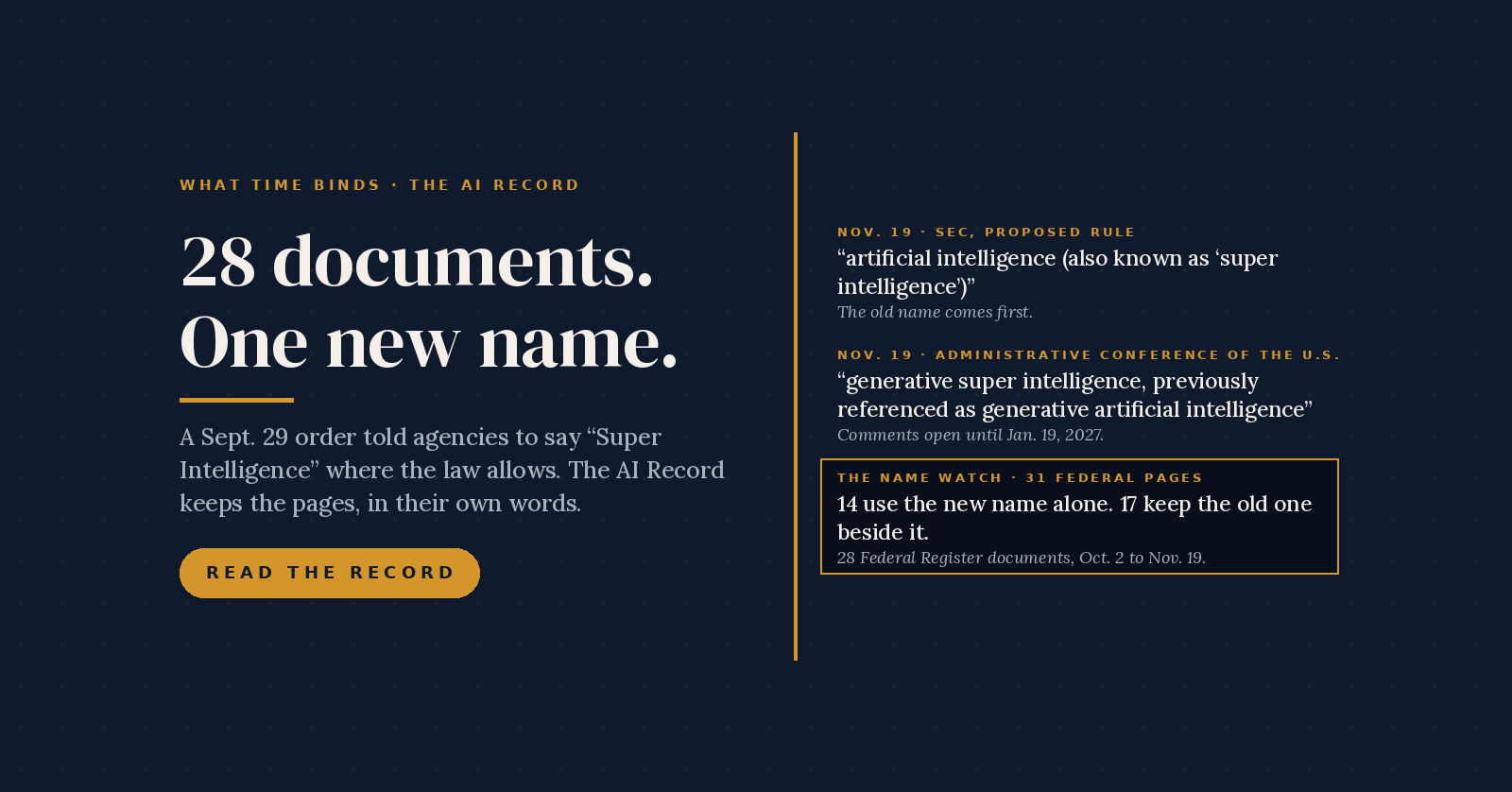
The Name Watch: 28 Federal Register documents carried the new name from Oct. 2 to Nov. 19, the order among them, and the staff has read all of them. Of the 31 federal pages in the list below, 14 use the new name alone and 17 use both names.
Next date: Nov. 28, the order's deadline for proposed legislative language on a federal definition.
Last check: Nov. 20, 2026.
Get an email when this Record changes.
The Name Watch
Seventeen of the 31 federal pages read so far still use the old name beside the new one. Newest first; each entry links the page itself.
Nov. 19, 2026. Administrative Conference of the United States, request for comments on generative super intelligence in agency adjudication, 91 FR 74534. Request for comments.
In its words: "policies regarding the use of generative super intelligence, previously referenced as generative artificial intelligence"
The old name: In the same sentence, and in the titles of reports it cites, such as GAO's "Artificial Intelligence: Generative AI Use and Management at Federal Agencies."
Nov. 19, 2026. HHS, final rule changing the HIPAA Privacy Rule, 91 FR 74929. Final rule.
In its words: "a covered entity could implement technology, such as super intelligence (SI), in a manner that is compliant with the Privacy and Security Rules"
The old name: None. No "artificial intelligence" or "AI" anywhere in the rule.
Nov. 19, 2026. Commerce Department, Bureau of Industry and Security, interim final rule on remote access to advanced semiconductors, 91 FR 74970. Interim final rule.
In its words: "using U.S. advanced Super Intelligence (SI) semiconductors to train advanced SI models"
The old name: In names, and in footnote 1's statement of the rename. The rule rescinds the "AI Diffusion Rule," formally "Framework for Artificial Intelligence Diffusion," and lists a contact in the "AI, Computers, and Telecommunications Division."
Nov. 19, 2026. Securities and Exchange Commission, proposed rule on executive compensation disclosure, 91 FR 75126. Proposed rule.
In its words: "enhancing artificial intelligence (also known as 'super intelligence') capabilities"
The old name: It comes first. The release puts the new name in parentheses after "artificial intelligence," cites Executive Order 14434 in a footnote, and elsewhere says "generative AI tools."
Nov. 18, 2026. Labor Department, Bureau of Labor Statistics, new questions for the American Time Use Survey, 91 FR 74206. Notice (information collection).
In its words: "American Time Use Survey (ATUS) Super Intelligence (SI) Questions"
The old name: The new questions were tested with "question wording that referred to 'Artificial Intelligence (AI)'" before "terminology was updated to SI."
Nov. 17, 2026. NIH, draft update to its data and safety monitoring policy, 91 FR 73769. Notice (draft policy).
In its words: "large language models (LLMs) or Super Intelligence (SI) in data and safety monitoring"
The old name: None. No "artificial intelligence" or "AI" anywhere in the notice.
Nov. 16, 2026. FDA, page on its use of the new terms. Web page.
In its words: "will use 'Super Intelligence' and 'SI' in newly issued public-facing documents and communications, as applicable and permitted by law"
The old name: Kept where a statute or regulation uses it: FDA "will continue to quote and cite those terms as written."
Nov. 13, 2026. Education Department, Institute of Education Sciences, request for information, question 6, 91 FR 73219. Request for information.
In its words: "Super Intelligence or SI (formerly referred to as Artificial Intelligence or AI)"
The old name: In parentheses.
Nov. 13, 2026. FBI, FLASH-20261113-001 on the ARTEX tool. Advisory.
In its words: "specialized super intelligence (SI) agents"
The old name: None in its own text. Three of the 11 reports it cites say "AI" in their titles; none says "SI."
Nov. 12, 2026. FDA, request for information on real-world data in drug submissions, 91 FR 72876. Request for information.
In its words: "innovative methods (e.g., super intelligence, digital health technologies, and RWD)"
The old name: None in the notice.
Nov. 12, 2026. Justice Department, request for information on the Attorney General's English-language memorandum, 91 FR 72923-24. Request for information.
In its words: "super intelligence tools"; the memorandum also writes "superintelligence and machine translation programs"
The old name: None. The guidance "was subsequently revised on October 22, 2026, in light of Executive Order 14434."
Nov. 10, 2026. HUD, reorganization notice, sec. II.B.6, 91 FR 72552-53. Notice.
In its words: "a division for data and super intelligence (SI)"
The old name: None. No "artificial intelligence" in the notice.
Nov. 9, 2026. CMS, 2027 physician fee schedule, footnote 76, 91 FR 71172. Final rule.
In its words: "used herein to refer to what was formerly called Artificial Intelligence or AI"
The old name: In the same footnote, and in CMS's own heading on primary care, "Changes to Primary Care and Care Management Due to Technology and Clinical AI" (p. 71176).
Nov. 9, 2026. CMS, 2027 home health payment rule, 91 FR 72134. Final rule.
In its words: Summarizing a comment: "CMS should use super intelligence-assisted pre-payment claims analytics"
The old name: None in the rule.
Nov. 6, 2026. CMS, 2027 outpatient payment rule, footnote 173, 91 FR 70613. Final rule with comment period.
In its words: Summarizing a comment: "super intelligence-enabled comprehensive clinical trial eligibility analysis"
The old name: In footnote 173 ("formerly called Artificial Intelligence or AI"), in a product's name, and in a billing code's description the rule quotes.
Nov. 6, 2026. Energy Department, notice of a meeting of the President's science advisers (PCAST), 91 FR 70079. Notice (rescheduled meeting).
In its words: "requests from the Super Intelligence Force"
The old name: None. The Oct. 22 notice for the same council says "Super Intelligence Task Force."
Nov. 5, 2026. Education Department, proposed supplemental priorities, 91 FR 69738. Proposed priorities.
In its words: "proposing to rename the definition of 'AI literacy' to 'SI literacy'"
The old name: Named in the rename.
Nov. 3, 2026. Pipeline and Hazardous Materials Safety Administration, proposed rule on liquefied natural gas facilities, 91 FR 69317. Proposed rule.
In its words: "electric generation capacity supporting super intelligence and data centers"
The old name: None in the rule.
Oct. 30, 2026. Education Department, accreditation rule, 91 FR 68634. Final rule.
In its words: Summarizing a comment: "assessment models assume super intelligence (SI) availability"
The old name: Footnote 9 says the rule "uses the term 'Super Intelligence' or 'SI' instead of 'Artificial Intelligence' or 'AI'"; another comment summary, on page 68643, keeps "artificial intelligence."
Oct. 29, 2026. Education Department, National Center for Education Statistics, request for information, question 4, 91 FR 68120. Request for information.
In its words: "Super Intelligence or SI (formerly referred to as Artificial Intelligence or AI)"
The old name: In parentheses.
Oct. 28, 2026. HHS, Office of the National Coordinator for Health Information Technology, deregulatory rule on health data, 91 FR 67917. Final rule.
In its words: "super intelligence (SI)-enabled interoperability solutions"
The old name: In an office title, "Chief Super Intelligence Officer (previously Chief Artificial Intelligence Officer)" (p. 67976). A footnote cites the order.
Oct. 28, 2026. National Credit Union Administration, draft 2027-2028 budget, 91 FR 67864. Notice.
In its words: "a forward-looking super intelligence/artificial intelligence (SI/AI) strategy"
The old name: Side by side: "SI/AI."
Oct. 28, 2026. White House, Executive Order 14438 of Oct. 22 on housing costs, 91 FR 68007. Executive order.
In its words: "technologies that incorporate Super Intelligence"
The old name: None.
Oct. 26, 2026. Treasury, outbound investment proposed rule, 91 FR 67402. Proposed rule.
In its words: "what was defined as AI systems in the Part 850 Regulations and is referred to as 'super intelligence systems' (SI systems) in the Proposed Rule"
The old name: Kept for the rules in force today.
Oct. 26, 2026. Coast Guard, notice on a research agreement, 91 FR 67324. Notice.
In its words: "Super Intelligence (SI) Situational Awareness Tools"
The old name: In the notice's discussion, "artificial intelligence enabled situational awareness tools" (p. 67325).
Oct. 23, 2026. Office of the Comptroller of the Currency, rule implementing the stablecoin law, 91 FR 67075. Final rule.
In its words: Summarizing comments: "specific technologies, such as smart contracts or super intelligence"
The old name: None in the rule.
Oct. 22, 2026. Energy Department, notice of a meeting of the President's science advisers (PCAST), 91 FR 66695. Notice (meeting).
In its words: "requests from the Super Intelligence Task Force"
The old name: None.
Oct. 13, 2026. White House, Proclamation 11072 of Oct. 7, National Energy Dominance Month, 91 FR 65073. Proclamation.
In its words: "lead the world in manufacturing, super intelligence, and advanced technology"
The old name: None.
Oct. 2, 2026. White House, Executive Order 14432 of Sept. 29 on America.gov, 91 FR 63121. Executive order.
In its words: "ensure that super intelligence used in connection with America.gov is accurate, reliable, and transparent"
The old name: None. Signed the same day as the order.
Sept. 30, 2026. NIST, its standards center's page. Web page.
In its words: "Center for Advancing Innovation and Standards for Super Intelligence (CAISSI)"
The old name: A July 23 item on the same page keeps "Center for AI Standards and Innovation (CAISI)."
Sept. 29, 2026. White House, fact sheet on the order. Fact sheet.
In its words: Calls the White House's March framework a "National Super Intelligence Policy Framework"
The old name: The March document's cover reads "Artificial Intelligence," and the fact sheet sets the new name against "the term 'Artificial Intelligence.'"
The count of 28 comes from a full-text search of the Federal Register for the phrase, run Nov. 20. The list holds all of them but the order itself, plus four agency pages from outside the Register.
The definitions
The order changed the name and borrowed the old definition. These are the three texts readers will meet, word for word.
The statute. 15 U.S.C. 9401(3), from the National Artificial Intelligence Initiative Act of 2020:
The term "artificial intelligence" means a machine-based system that can, for a given set of human-defined objectives, make predictions, recommendations or decisions influencing real or virtual environments. Artificial intelligence systems use machine and human-based inputs to— (A) perceive real and virtual environments; (B) abstract such perceptions into models through analysis in an automated manner; and (C) use model inference to formulate options for information or action.
The order. Executive Order 14434, Sec. 3(a), signed Sept. 29, 2026:
For purposes of this order, and except where otherwise provided by law, the terms "Super Intelligence" and "SI" mean the technologies and systems encompassed by the term "artificial intelligence" as defined in section 9401(3) of title 15, United States Code. This definition shall govern the implementation of this order unless and until superseded by subsequent Presidential action consistent with applicable law or by an Act of Congress.
The European Union. Regulation (EU) 2024/1689, the AI Act, Article 3(1):
'AI system' means a machine-based system that is designed to operate with varying levels of autonomy and that may exhibit adaptiveness after deployment, and that, for explicit or implicit objectives, infers, from the input it receives, how to generate outputs such as predictions, content, recommendations, or decisions that can influence physical or virtual environments;
None of the three definitions compares these systems to human ability. The order's Sec. 1 does: "The capabilities of today's frontier systems do much more than imitate or automate discrete aspects of human intelligence." Its Sec. 3(b) gives the President's science adviser until Nov. 28 to send proposed legislative language for a federal definition "that reflects the capabilities described in section 1 of this order." The Nov. 18 Field Guide sets the statute and the order beside the older meaning of "superintelligence" in research and in Congress: What Do You Mean by "Super Intelligence"?
Your turn on the record
Fifteen documents that carry the new name take public comments, per their Federal Register records read Nov. 20.
Closes Nov. 25, 2026. Coast Guard, notice on a cooperative research and development agreement. Comment through 2026-21723.
Closes Nov. 30, 2026. National Credit Union Administration, draft 2027-2028 budget. Comment through 2026-21948.
Closes Dec. 3, 2026. Education Department, National Center for Education Statistics, request for information. Comment through 2026-22047.
Closes Dec. 7, 2026. Treasury, outbound investment proposed rule. Comment through 2026-21786.
Closes Dec. 7, 2026. Education Department, proposed supplemental priorities, the "SI literacy" rename. Comment through 2026-22615.
Closes Dec. 11, 2026. Education Department, National Center for Education Evaluation and Regional Assistance, request for information on special education. Comment through 2026-23155.
Closes Dec. 18, 2026. Bureau of Labor Statistics, new American Time Use Survey questions on the role of SI in daily life and work. Comment through 2026-23506 (comments go to OMB).
Closes Jan. 4, 2027. Pipeline and Hazardous Materials Safety Administration, proposed rule on liquefied natural gas facilities. Comment through 2026-22396.
Closes Jan. 4, 2027. CMS, outpatient final rule with comment period. Comment through 2026-22739.
Closes Jan. 6, 2027. NIH, draft data and safety monitoring policy. Comment through 2026-23300.
Closes Jan. 11, 2027. FDA, request for information on real-world data in drug submissions. Comment through 2026-22996.
Closes Jan. 11, 2027. Justice Department, request for information on the Attorney General's English-language memorandum. Comment through 2026-22966.
Closes Jan. 19, 2027 (10 a.m. ET). Administrative Conference of the United States, request for comments on generative super intelligence in agency adjudication. Comment through 2026-23539.
Closes Jan. 19, 2027. Bureau of Industry and Security, interim final rule on remote access to advanced semiconductors. Comment through 2026-23529.
Closes Jan. 19, 2027. Securities and Exchange Commission, proposed rule on executive compensation disclosure. Comment through 2026-23555.
The order's own date to watch is Nov. 28. Its Sec. 3(b) sends the proposed definition to the President and names no public step.
The companies on the record
The order binds federal agencies. Companies enter this Record through what they sign and what they file.
Sept. 29, 2026: the White House Accord on Super Intelligence. The President signed it with six company leaders: Sundar Pichai of Google, Dario Amodei of Anthropic, Mark Zuckerberg of Meta, Greg Brockman of OpenAI, Elon Musk of xAI and Jensen Huang of Nvidia. One commitment reads, "Partner with an independent external auditor or evaluator to carry out independent assessments of whether the controls, monitoring, and detection are operating as intended." The text names no penalty. (The American Presidency Project)
Oct. 26, 2026: Anthropic's Form S-1. Nearly four weeks after the order, Anthropic's IPO filing defines "pacing the frontier" on page 234 as "establishing industry-wide standards primarily related to the use of AI to accelerate AI development, so that AI capabilities do not advance faster than the safety, alignment, and security practices needed to support them." The same page says the call "does not describe our own model development or release timelines." Page 111 counts the company's decisions to slow AI development among choices that may not maximize stockholder value. Anthropic amended the filing on Nov. 2, Nov. 10 and Nov. 17. The registration took effect Nov. 18, and the final prospectus, dated that day, keeps all three passages. It sets the offering price at $83.00 a share, with the stock approved to list on the Nasdaq Global Select Market as ANT. (Form S-1; final prospectus) Chapter 7: The Cycle reads the filing against the company's calendar.
I write What Time Binds with Claude, Anthropic's model.
What this Record watches
The order changed the government's word for AI and kept the law's meaning. This page keeps the record of both, each entry dated and each one sourced.
A document enters when the White House, a federal agency, Congress, a court, a state or an AI company puts it on the public record and it names the technology. Each entry gives the date, the document, its stage (order, proclamation, rule, notice, filing, advisory, fact sheet or web page) and its exact words. A news report alone sends the staff to the page, and the entry waits until they open it.
The page updates when:
a federal document uses the new name in a new way, or the count moves;
the proposed federal definition due Nov. 28 appears, or Congress acts on one;
a comment window opens or closes;
a court rules on the order, or on a rule that uses the new name;
a company signs or files something that names the technology.
From my desk
I read about AI for years before I wrote about it. My account, as it ran in Chapter 7:
In 1999 The Matrix came out. I still remember where I watched it: the Kaleidoscope in Mission Viejo, California. The film sparked my interest in computers, artificial intelligence and the nature of reality. I toyed with computers for years, and when I was stationed in Okinawa, I began building them.
I kept reading about AI, and I read Geoffrey Hinton. There was the 1986 paper on back-propagating errors he wrote with David Rumelhart and Ronald Williams. There was his 1992 Scientific American article on how neural networks learn from experience. And there were his two 2006 papers on deep networks. I didn't understand them back then. I read them anyway, with a dictionary beside me.
My published record on AI starts in August 2023. Here is a selection, by the question each piece asks, newest first.
The words institutions use for AI
What Do You Mean by "Super Intelligence"?, Nov. 2026
Friday Binding: Referred To As, Oct. 2026
What Do You Mean? — Use, June 2026
What Do You Mean, "The Honor System"?, May 2026
The Word in the Middle of the AI Fight, May 2026
Anthropic Said Its New AI Is "Too Dangerous." Five Newsrooms Heard Five Different Warnings., Apr. 2026
Who governs AI, and who pays
What Do You Mean, 'AI Governance'?, May 2026
When AI Gets Gerrymandered, Nov. 2025
The AI We Deserve, Nov. 2025
The companies' calendar
Chapter 7: The Cycle, Nov. 2026
The Word for Slow, Sept. 2026
AI at work and in school
Research and talks
Spark AI Lab Virtual Teaching Practice Roundtable, working session, Apr. 30, 2026
"Technological Stewardship: Reframing Ethics, Perception, and Culture in Technology Design and Governance," with Tony Washington, SSRN, Oct. 2025 (paper)
Technological Stewardship paper, presented with Tony Washington, Research Ethics Colloquium, University of Oxford Department for Continuing Education, 2025
Simulated Realities: Generative AI and the Remanufacture of Professionalism, book, 2023 (Amazon)
"AI and Philosophy: Exploring the Complex Relationship between Worldviews and Technology Development for an Inclusive and Ethical Future," SSRN, Dec. 2023 (paper)
"Combating Misinformation and Fake News: The Potential of AI and Media Literacy Education," SSRN, Nov. 2023 (paper)
"The Impact of Generative Artificial Intelligence on Writer's Self-Efficacy: A Critical Literature Review," SSRN, Aug. 2023 (paper)
My six SSRN papers have been downloaded 6,816 times and cited 26 times (author page, Nov. 15, 2026).
How this Record is kept
I write What Time Binds with Claude, Anthropic's model. Every claim carries its page, and I approve every line.
This Record runs on that method, split into roles. A record watch reads the Federal Register and agency pages every Monday and Thursday and logs each document that names the technology. A research editor opens each page and enters its exact words, its stage and its date in a source ledger. A standards editor who did not draft the change checks it against the pages before I see it. Nothing on this page posts without my yes.
The staff behind it is eight roles in five departments, each running on Claude under a written brief. Each dated change at the end names who read it, who checked it and when I approved it. How I work: How the bread gets made.
Last check: Nov. 20, 2026.
Read your next ballot the way you read the record: every race, every proposition. vote411.org
The AI Record is one of the WTB Records, living pages that keep a dated, sourced account of one institution or case.
Subscribe free for a new piece every Monday, Wednesday and Friday.
Jerry W. Washington, Ed.D., is a Marine Corps veteran of twenty-three years, a combat engineer by trade, an instructor at UC Irvine's Division of Continuing Education, and the writer of What Time Binds, a record of how institutions bend words and how the page holds them to account.
Changes to this page
Nov. 20, 2026: published, with the four Federal Register documents of Nov. 19 added. Library and Name Watch rows read by the research editor, Oct. 28 to Nov. 20; checked by the standards editor, Nov. 20; approved by Jerry, Nov. 20.