

On Sept. 29, the President signed Executive Order 14434. Its policy sentence says that, “to the maximum extent permitted by law, the executive branch shall use the terms ‘Super Intelligence’ and ‘SI’ in place of ‘Artificial Intelligence’ and ‘AI’ and will not acknowledge the usage of ‘Artificial Intelligence’ and ‘AI’ in any applicable setting.”
Section 3(a) says what the new name means:
“For purposes of this order, and except where otherwise provided by law, the terms ‘Super Intelligence’ and ‘SI’ mean the technologies and systems encompassed by the term ‘artificial intelligence’ as defined in section 9401(3) of title 15, United States Code.”
Open the order to Section 3(a). Then open the statute it names. The new word stands on the old word’s definition.
On Tuesday I posted a card on what federal agencies have done with the new name. By afternoon, one reader had called the rename meaningless. I answered with a question, and it is the question for this Field Guide: if Super Intelligence means artificial intelligence, why use Super Intelligence?
Two Words, One Definition
Outside the order, “superintelligence” names something far bigger. In a 1998 paper, the philosopher Nick Bostrom defined it as “an intellect that is much smarter than the best human brains in practically every field.” A public statement hosted by the Future of Life Institute calls for a prohibition on developing superintelligence until there is “broad scientific consensus that it will be done safely and controllably” and “strong public buy-in.”
Left and right use the word that way. A release summary from Sen. Bernie Sanders and Rep. Greg Casar for a “Ban Artificial Superintelligence Act” describes an artificial intelligence system “that exhibits or can easily be modified to exhibit capabilities that match or exceed human cognitive performance and capabilities across a broad range of domains or tasks.” The New American, a conservative magazine, wrote on Oct. 6 that the order “applies a term once reserved for a hypothetical superior intelligence to AI systems already operating today.”
Inside the order, the word means whatever the National Artificial Intelligence Initiative Act of 2020 already calls artificial intelligence: “a machine-based system that can, for a given set of human-defined objectives, make predictions, recommendations or decisions influencing real or virtual environments.” The statute adds that such systems use machine and human-based inputs to perceive real and virtual environments, abstract those perceptions into models and use model inference to formulate options for information or action. That definition sets no bar above human ability. A fraud filter or a scheduling tool that met it on Sept. 28 met it on Sept. 30.
The name now makes a claim the definition never makes.
The order swapped the word and kept the definition, and seven weeks of federal pages show some agencies still explaining the new word with the old one. Every Wednesday I take one word an institution bent and show the page it bent on. Subscribe and the next one is in your inbox, free.
Look It Up
Section 1 of the order gives its reason: “The extraordinary technologies being pioneered by American innovators far exceed what was envisioned when the term ‘Artificial Intelligence’ first came into use.” It adds: “The capabilities of today’s frontier systems do much more than imitate or automate discrete aspects of human intelligence.”
Section 1 also credits the American scientists who “first gave the field its name.” They named it in a proposal for a summer study at Dartmouth College, dated Aug. 31, 1955, from John McCarthy, Marvin Minsky, Nathaniel Rochester and Claude Shannon. Here is what they envisioned:
“The study is to proceed on the basis of the conjecture that every aspect of learning or any other feature of intelligence can in principle be so precisely described that a machine can be made to simulate it. An attempt will be made to find how to make machines use language, form abstractions and concepts, solve kinds of problems now reserved for humans, and improve themselves.”
Read the 1955 paragraph, then read Section 1 again. Section 1 measures today’s systems against the imitation of “discrete aspects” of intelligence. The 1955 page aimed at every aspect, language and self-improvement included.
The White House fact sheet issued with the order made a second change. It says: “In March 2026, the White House unveiled a commonsense, comprehensive National Super Intelligence Policy Framework with legislative recommendations to ensure that every American benefits from this technological revolution.” Now open the document the White House published in March. The document calls itself “A National Policy Framework for Artificial Intelligence,” and the words “Super Intelligence” do not appear in it.
The order does not require changes to documents like that one. Section 2(b): “Nothing in this section requires the alteration of previously issued regulations, Presidential actions, contracts, grants, or other historical documents.” The March PDF still says what it said in March. The fact sheet’s sentence gave it a name it never carried.
Seven Weeks of Pages
A full-text search of the Federal Register for the phrase “super intelligence” returns 23 documents published from Oct. 2 through Nov. 17. Across those documents and other federal pages, agencies handle the new name three ways.
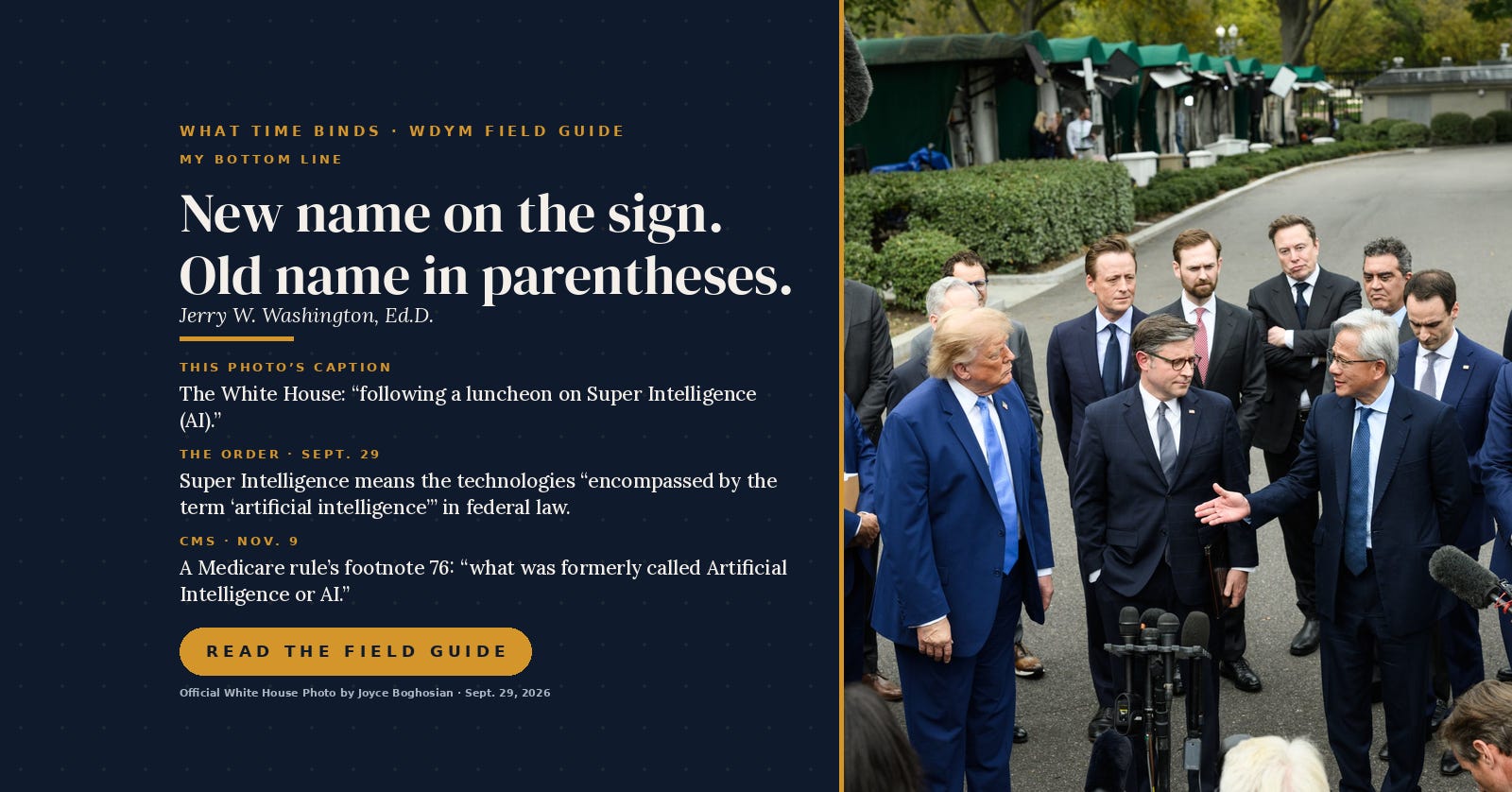
Some print the old name beside the new one, the White House included. Its photo gallery from Sept. 29 says the President spoke to the press “following a luncheon on Super Intelligence (AI).” A CMS final rule on Medicare physician payment (Nov. 9) says in footnote 76 that the new terms “are used herein to refer to what was formerly called Artificial Intelligence or AI.” An Education Department request for information (Nov. 13) asks how data collection and dissemination could be optimized for future “Super Intelligence or SI (formerly referred to as Artificial Intelligence or AI) applications and uses.” An FDA web page says that “beginning November 16, 2026,” the agency “will use ‘Super Intelligence’ and ‘SI’ in newly issued public-facing documents and communications, as applicable and permitted by law.” The same page defines the new terms by the statute’s definition of artificial intelligence, and it says: “Where a statute or regulation uses ‘artificial intelligence’ or ‘AI,’ FDA will continue to quote and cite those terms as written.”
Some print the new name alone. A HUD notice of intent to reorganize (Nov. 10) plans “a division for data and super intelligence (SI),” and the old term does not appear in it. An NIH notice published Nov. 17, on a draft update to its data and safety monitoring policy, asks for existing methods, tools and best practices on topics that include the use of “large language models (LLMs) or Super Intelligence (SI) in data and safety monitoring.” Neither “artificial intelligence” nor “AI” appears in it.
The FBI shows the split inside one advisory. Its Nov. 13 FLASH on a hacking tool called ARTEX says the tool turns plain-language goals into “actionable machine commands executed by specialized super intelligence (SI) agents.” The same advisory says “ARTEX does not include its own SI model but integrates with external LLM providers, including frontier models (Anthropic Claude, OpenAI GPT) and open-source or Chinese-origin models (DeepSeek, GLM, Grok, Kimi).” Three of the 11 reports the FBI cites put “AI” in their titles. None puts “SI” in its title.
A reader on Tuesday’s card called the rename a waste of time and money. I found no dollar figure for it on the record. CMS spends a footnote, the Education Department a parenthesis and the FDA a web page explaining the new word with the old one.
The Strongest Case for the New Name
The order’s case deserves its full weight. Section 1 says “The terminology used by the Federal Government should reflect the transformative capabilities of these technologies and the limitless opportunities they create for the American people.” The fact sheet says “The name Super Intelligence conveys the true capabilities of the technologies being developed today,” technologies “not simply imitating or automating human intelligence as is implied by the term ‘Artificial Intelligence.’” The dictionary leaves room for that reading. Merriam-Webster’s first sense of the word is “an entity that surpasses humans in overall intelligence or in some particular measure of intelligence.” Under that sense, a system that beats people at one particular measure qualifies.
The order also keeps the law in place in its own text, and it says how the gap would close. Section 3(a) says the borrowed definition governs “the implementation of this order unless and until superseded by subsequent Presidential action consistent with applicable law or by an Act of Congress.” Section 3(b) gives the Assistant to the President for Science and Technology 60 days, which run out Nov. 28, to send the President “proposed legislative language to establish a Federal definition of ‘Super Intelligence’ and ‘SI’ that reflects the capabilities described in section 1 of this order.”
So the order sets the name ahead of its definition, with a deadline to catch up. The order does not say whether or when the public will see that proposal. Until something supersedes it, Section 3(a) governs, and the new word covers exactly what the old one covered.
My Bottom Line
This order is a strange way to move toward meaning closure.
Scholars who study how technologies get their meanings call the end of an argument over what a thing is closure. Trevor Pinch and Wiebe Bijker developed the idea in a 1984 paper, illustrated by a study of solar physics and a history of the bicycle. Closure usually comes when the people who build, buy and use a technology settle what it is. This order settles the name by signature. It closes the name inside the executive branch where the law allows, and it leaves the meaning where the 2020 statute put it.
Two readers under Tuesday’s card compared it to X, formerly known as Twitter. Call it the X school of rebranding: new name on the sign, old name in parentheses. CMS puts the old name in a footnote, and the Education Department puts it in parentheses. Even as a rebrand, it falls short. A rebrand usually does more than a rename. This one changed the name, kept the definition and made nothing smarter overnight. It is a rebrand with the receipt stapled to it.
To me it looks more like a control mechanism. Section 1 says that, to the maximum extent permitted by law, the executive branch “shall use” the new terms. It “will not acknowledge the usage of” the old ones “in any applicable setting.” Section 3(a) keeps the old meaning. The only thing the new word changes is who is saying it. CMS’s footnotes and the Education Department’s parenthesis show agencies wearing the new word while still writing the old one so readers can follow.
So if Super Intelligence means artificial intelligence, why use Super Intelligence?
The Pin
Super Intelligence, in a federal document on or after Sept. 29, 2026: the technologies and systems federal law calls artificial intelligence under 15 U.S.C. 9401(3), under the name Executive Order 14434 requires where the law allows.
What it includes. Every system that meets the statutory definition of artificial intelligence, from a fraud filter to a frontier model.
What it cannot be read to say. That the system on the page exceeds human intelligence. That the statute changed. That every agency uses the name the same way.
The habit.
When a page says “Super Intelligence,” find the definition it uses.
Check whether the page explains the new word with the old one.
Ask what the name tells you that the definition does not.
The question. When a federal page tells you a system runs on super intelligence, what do you picture? Now read 15 U.S.C. 9401(3). Does your picture match the law?
Your Turn on the Record
Comment windows are open on at least 10 of the 23 documents, including these four. Treasury’s proposed outbound investment rules take comments through Dec. 7 (docket TREAS-DO-2026-0595). The Education Department’s proposed supplemental priorities take comments through Dec. 7 (docket ED-2026-OS-3169). Among other changes, that notice proposes “to rename the definition of ‘AI literacy’ to ‘SI literacy.’” The department’s Nov. 13 request for information, from its evaluation center, asks what to study about special education under the Individuals with Disabilities Education Act; it takes comments through Dec. 11 (docket ED-2026-IES-3268). NIH’s notice on a draft update to its data and safety monitoring policy takes comments through Jan. 6, 2027.
If you comment on the priorities, cite the order as E.O. 14434. The notice prints it that way once and as E.O. 14344 in four other places.
Teachers, district staff and college leaders could meet these words in grant notices, in any year the department chooses to use the final priorities. The comment box is where anyone can ask the department to say what it means by them.
Before the Next Ballot
Read your next ballot the way you read the record: every race, every proposition. vote411.org
My Oct. 30 Binding, Referred To As, reads how Treasury handled the same switch. Chapter 7 of Ask for the Page, The Cycle, reads Anthropic’s IPO filing on the pace of the frontier. The fact sheet calls the March framework “commonsense.” I read that word in my Nov. 4 Field Guide on “common sense”.
I write What Time Binds with Claude, Anthropic’s model. The FBI advisory above names Claude, and Chapter 7 reads Anthropic’s filing. Every claim carries its page, and I approve every line. How I work: How the bread gets made.
The comments are the appendix: tell me where the record is wrong and I will show the page or fix the line. Paid subscriptions open at 500 readers, and the paid product is Coded Threads, the codebooks built from these comment sections. A pledge now is a vote for that.
Jerry W. Washington, Ed.D., is a Marine Corps veteran of twenty-three years, a combat engineer by trade, an instructor at UC Irvine’s Division of Continuing Education, and the writer of What Time Binds, a record of how institutions bend words and how the page holds them to account.
Sources
Executive Order 14434, “Inaugurating the Era of Super Intelligence,” signed Sept. 29, 2026, 91 FR 63129-63130 (Oct. 2, 2026): whitehouse.gov and GovInfo PDF
15 U.S.C. 9401(3), definition of artificial intelligence, Cornell LII
White House fact sheet on Executive Order 14434, Sept. 29, 2026
The White House, photo gallery, “President Donald J. Trump hosts a luncheon on Super Intelligence, September 29, 2026,” caption and photo credit
A National Policy Framework for Artificial Intelligence: Legislative Recommendations, the White House, March 2026
John McCarthy, Marvin L. Minsky, Nathaniel Rochester and Claude E. Shannon, “A Proposal for the Dartmouth Summer Research Project on Artificial Intelligence,” Aug. 31, 1955; reprinted in AI Magazine 27, no. 4 (2006). On the proposal as the OED’s first use of the term: Mark Liberman, “The history of ‘artificial intelligence,’” Language Log, Nov. 13, 2023
Trevor J. Pinch and Wiebe E. Bijker, “The Social Construction of Facts and Artefacts,” Social Studies of Science 14, no. 3 (1984): 399-441
Nick Bostrom, “How Long Before Superintelligence?” (1998)
Statement on Superintelligence, hosted by the Future of Life Institute
Sen. Bernie Sanders and Rep. Greg Casar, Ban Artificial Superintelligence Act release summary
Veronika Kyrylenko, “From AI to ‘Super Intelligence’: Are Machine Rights Next?” The New American, Oct. 6, 2026
Federal Register full-text search for “super intelligence”, 23 documents from Oct. 2 to Nov. 17, 2026, searched Nov. 17
CMS, CY 2027 physician fee schedule final rule, FR Doc. 2026-22743, Nov. 9, 2026, footnote 76
HUD, Notice of Intent To Reorganize HUD and Revise Headquarters and Field Operating Model, FR Doc. 2026-22838, 91 FR 72552-53, Nov. 10, 2026
Education Department, Institute of Education Sciences, Request for Information, FR Doc. 2026-23155, 91 FR 73218-73219, Nov. 13, 2026, question 6
NIH, Draft Policy Update to the NIH Policy for Data and Safety Monitoring, FR Doc. 2026-23300, 91 FR 73764, Nov. 17, 2026
FDA, web page on its use of “Super Intelligence” and “SI” under Executive Order 14434, content current as of Nov. 16, 2026
FBI, FLASH-20261113-001, “Threat Overview of ARTEX Autonomous Penetration Testing Framework”, Nov. 13, 2026 (TLP:CLEAR)
Education Department, Proposed Priorities and Definitions: Secretary’s Supplemental Priorities and Definitions, FR Doc. 2026-22615, 91 FR 69736, Nov. 5, 2026
Treasury, Outbound Investment Security Program Regulations (proposed rule), FR Doc. 2026-21786, 91 FR 67396, Oct. 26, 2026
Thanks again Jerry for a clear explanation of the "words" here. Just a quick note based on this line:
“In March 2026, the White House unveiled a commonsense, comprehensive National Super Intelligence Policy Framework with legislative recommendations to ensure that every American benefits from this technological revolution.”
I believe this falls into the definition of a Oxymoronic double entendre:
White House - Common sense and Common Sense - Super Intelligence Policy....
Just saying
The old name has soaked in too deep, so the people around it can't keep up with the new one. And I suppose the next generation will be Hyper, and the one after that Ultra Intelligence.
I do understand the pull, though. A new word makes it feel as if something has changed — a fresh start. It's like yaoya, the neighborhood greengrocer, becoming seikaten, "produce store," in formal use. Everyone grew up with yaoya, so that's still the word that slips out. And nobody much cares why it changed.
My guess is the people actually doing the work aren't calling it SI either.