

In April, someone fired thirteen rounds at an Indianapolis city councilman’s house and left a note under the doormat. Two words: NO DATA CENTERS. Lila Shroff reported it in The Atlantic on May 13. Days later, a man threw a Molotov cocktail at Sam Altman’s home and went to OpenAI’s offices, threatening to burn the building down. Online, some people cheered.
That is where the AI conversation is in May 2026. Rounds through a window.
If you are new here, I spent twenty-three years in the Marine Corps. That institution teaches one thing early: you do not step off until everyone in the formation shares the same picture of the mission, the rules of engagement, and the terrain. When the picture fractures, people die from friendly fire and from hesitation. The civilian world rarely names this discipline. It still pays the price when the picture fractures.
The AI fight is a fractured picture. The word at the center of it carries incompatible meanings, and the people using it rarely stop to say which one they mean. Part of that fight is real and will not dissolve, no matter how carefully anyone defines a term. Part of it exists only because a single word is doing the work of five. Telling those two parts apart is the whole task. The public fight never gets to it.
What everyone in the fight is actually saying
Shroff documents a coalition that should not exist. Bernie Sanders and Steve Bannon, arriving from opposite ends of American politics, both describe AI as a machine for taking from workers and concentrating the gain. Maine’s legislature passed the country’s first statewide data-center moratorium. A record number of data-center projects were canceled in the first quarter of this year after local opposition. The Soufan Center tracks a rise in direct threats against people connected to the industry.
This week, a post went viral on LinkedIn arguing that AI is society’s way of telling working people they do not matter. On my last check, it had close to two thousand reactions. The author writes engineered-for-spread posts and teaches the method, so the packaging is deliberate. The grievance underneath is genuine. Both things are true.
Read that post next to the Atlantic piece, and you see the same emotion in two registers. One is reported journalism. One is raw public grief and the rage is accurate. People are losing standing and being told to be grateful for it.
The objection that deserves a straight answer
Some of that rage is not confusion. The employee who hears “run everything through GPT” and reads it as a threat often understands the executive perfectly. The interests are real and opposed. Pinning the word changes none of that. A worker who grasps exactly what a rollout means for their standing has read it correctly, and the loss they see coming is real.
I am not going to claim that careful language settles that fight. It does not. What meaning repair does is narrower, but it's still worth the effort. It clears the part of the conflict that drift invents, the argument that runs only because two people are using one word for two different things, so the real disagreement stands in the open where it can be named. A conflict that people can see is one they can negotiate. A conflict buried under a word everyone assumes they share only grows, and it grows in the direction of that councilman’s window.
The word doing the damage
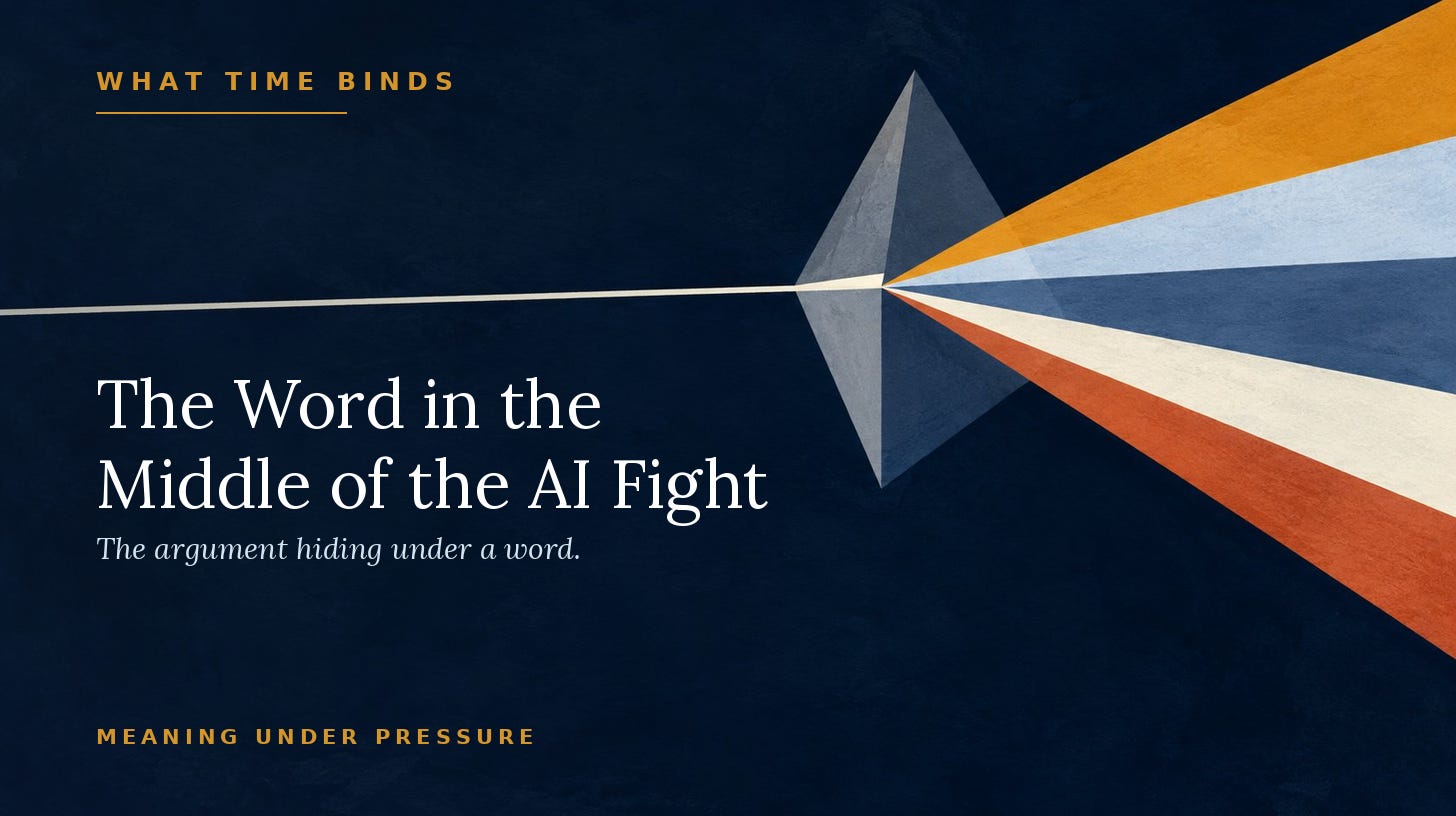
“AI” is a magnet word. It pulls different meanings toward it depending on who hears it. The word stays the same on the page. The thing it names changes person to person, and the change stays invisible until the work breaks or the window does.
When an executive says “run everything through GPT,” that person hears a productivity instruction. The employee who spent twenty years on the craft hears the same four words as a verdict on their judgment. Same sentence and two meanings. No mechanism in the room to catch the gap. The executive reads the silence as agreement. The objection went unspoken because the power difference made the question expensive to ask.
That is how a planning meeting and a councilman’s front window end up on the same line. Drift in the word, then silence around the drift, then a decision built on a disagreement not surfaced.
Five rooms, one word
There are five recognizable ways people hear “AI.” Each one runs a different test for what makes a claim true.
The Scientist accepts a claim only when it is measured. To this reader, a claim of benefit with no measurement behind it does not count as a claim at all. The Builder judges by what the tool and the people do to each other over time. The Justice Advocate accepts nothing on efficiency alone and asks who is exposed and who is held accountable. The Liberator reads the present against history, and the test is who owns the knowledge and who decides, because the pattern has repeated before. The Problem-Solver accepts one kind of evidence: it worked, here, in a setting close enough to this one to count.
Five readers. Five different standards of proof. The argument cannot be settled by bringing more evidence, because the five are not running the same test on the evidence in front of them. The viral post is the Liberator and the Justice Advocate at full volume. The executive inside that post is the Problem-Solver who never learned the other four exist. Each one is accurate from inside its own room. None of them is lying.
Why the national argument cannot be repaired
A conversation gets repaired when someone has the standing to stop it and ask what a word means. A meeting has a chair, a unit has a commander, and a classroom has an instructor. The unspoken objection at the planning table and the silence across the whole country are the same mechanism at two scales. Someone sees the gap and does not name it, because naming it is expensive or because no one is positioned to. The national AI conversation has no chair and no one who can call the question. So it keeps producing the Indianapolis pattern: meaning splits, nobody surfaces it, the pressure finds a target.
The repair does not happen at the national scale. It happens at the scale where someone can still call the question. That scale is your table.
What you can do at your own table
You cannot pin the word for the country. You can pin it for the decision in front of you. Before your team commits to anything with “AI” in the sentence, run this:
Ask each person to finish the sentence “When I say AI here, I mean ___.” Out loud. No editing.
Write the answers where everyone can see them. Do not resolve them yet. Make the spread visible first.
Name what kind of proof each answer is asking for: a measured result, a working relationship, a harm accounted for, a question of who decides, or a win in a comparable setting.
Decide which meaning governs this specific decision. State it in one sentence. “For this rollout, AI means the internal tool, scoped to drafting, with a person reviewing every output.”
Write down what that definition includes and what it excludes.
Set the date you revisit it, because the word will drift again.
Put the definition where the next person inherits it, not in someone’s memory.
Seven steps. Fifteen minutes. The cost of skipping them shows up months later, when the work delivers something nobody in the room thought they had agreed to and the CFO does not see ROI.
Go back to the note under the doormat. Two words, no verb, no argument. NO DATA CENTERS. By the time meaning collapses that far, the conversation is over, and only the target is left.
No one can win the national argument. The work is smaller, and it holds. A word is something you keep in trust for the people who come after you in the conversation: the next shift, the next hire, the next administration. When you pin it at your table and write down what it includes and excludes, you clear today’s confusion, and you leave a usable map for whoever inherits the decision. The word drifts again. It always does. So you pin it again, and you hand the new version forward. That is the maintenance the work requires, and almost no one is doing it while the windows break.
Jerry W. Washington, Ed.D., is a retired Marine Corps Master Sergeant with a doctorate in Organizational Change and Leadership from USC Rossier. He teaches at the UC Irvine Division of Continuing Education and writes What Time Binds, where he examines how meaning holds and breaks under pressure. His research on AI governance and democratic accountability is available on SSRN.
The five readers are each right in their own way, and at the same time, each one is incomplete on its own. The "rightness" one of them holds doesn't overlap with the "rightness" another holds.
Take a cake being cut, and imagine five people each judging whether it was cut fairly. One looks at the equality of the angles. Another at the amount of cream. Another counts the strawberries. Another weighs each slice. Another looks at how the decorations on top are distributed. Each can judge accurately within their own standard. But because the standards don't overlap, no single cut exists that all five would call "fair." This feels like the same structure your piece names: "each one is accurate from inside its own room. None of them is lying."
In theory, the ideal would be a cut that satisfies all five standards at once. In practice that cut doesn't exist, and what you actually have is a scattered field of partial ideals. Which is why something has to happen between the ideal and the real: a single sentence that decides which "rightness" applies in this specific case, and which "rightnesses" get set aside for now. That sentence is where the conversation lands, and that's where the pin gets placed.
The pin doesn't get placed by all five readers together. The person who has the standing to call the question places it — a meeting chair, a unit commander, the one who paid the most into the work. That part is structural and doesn't dissolve. What the cake makes visible is what that person then has to do. Trying to take everything — the largest angle, the most cream, all the strawberries — breaks the cut. The room won't accept it. The move that holds is the opposite one: they name the single thing they cannot give up, and let the rest stay open. "I need the slice with the most cream" leaves the angles and the strawberries on the table for others to argue over. Each of the other four can do the same. The pin settles around five sharpened claims rather than five maximal ones, and that narrowing is itself the excludes.
The move you describe — writing down what's included and what's excluded — is the same work as placing the pin at that landing point. Once the pin is in, the direction the conversation has to go from there becomes visible — until the word drifts again, which it will.
If only more of us would pause, more often, and ask “what do you mean by ______?” Wait for the response, and be willing to have a conversation.
Thank you, Jerry, for being the champion for having more meaningful conversations that repair our understanding of each other. It happens one person at a time sitting at the same table with another person.