

Someone tells you they use AI. You say, Okay. You have just learned almost nothing. Did the machine do the work, or did it stand next to them while they did it? Those are opposite arrangements. There is one small word that covers both.
Monday, I took the team-scale fight over the word “AI,” master it against kill it, and showed how naming the use dissolves the whole argument. Today, the word is smaller and closer. Use. The verb you reach for when someone asks how AI fits into your day.
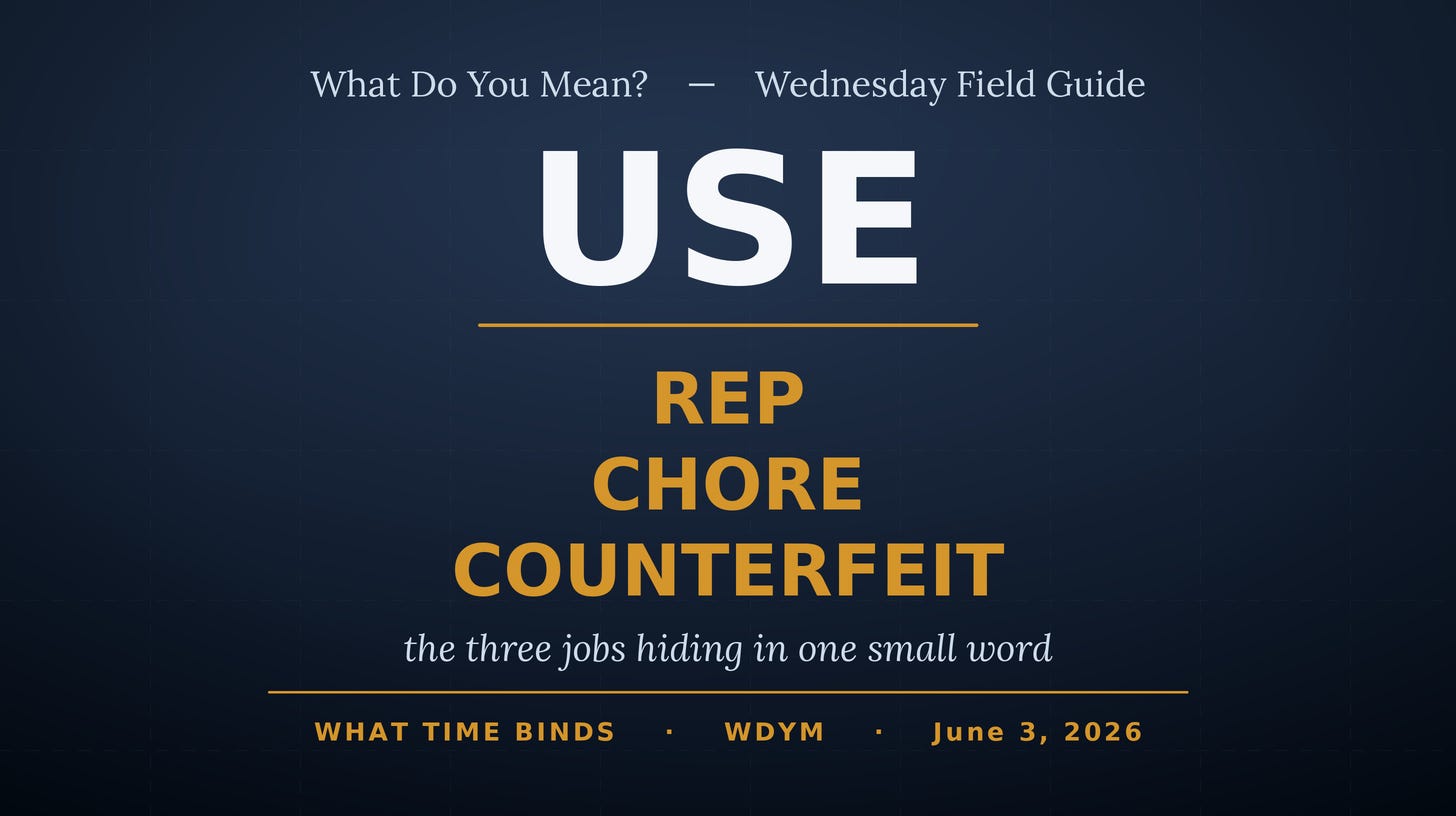
“I use AI” pulls toward three different jobs, and they do not belong in the same sentence.
The rep. The task where the doing is the point. Writing the hard paragraph. Working the problem until it cracks. The output matters less than what producing it builds in you.
The chore. The task where the doing teaches nothing. Reformatting a table. Cleaning up a transcript. Hand it over, and you lose nothing worth keeping.
The counterfeit. A rep wearing the chore’s clothes. It feels like busywork, so you hand it off without a thought, and it quietly takes a capability you needed. You notice nothing, because the output looks fine.
What goes wrong
Trouble starts when you treat all three as one “use.” You hand off reps believing they are chores. The work still ships, so the dashboard says you are doing great. Meanwhile the thing that made you good at the work drains out, one handoff at a time.
I spent a long review on this a few years back, on what generative tools do to a writer’s belief in their own ability. The short version: ability is built by doing hard things and finding out you can. Skip the doing, and you keep the proof while you lose the thing it was proving.
The sorting question
Before you hand any task to the machine, run one question.
If the tool vanished tomorrow, could I still do this, and would I know if I did it badly?
That sorts the three.
Yes to both. It is a chore or a skill you already own. Hand it off. You are buying time. The ability was already yours.
The doing is how you would build the skill in the first place. That is a rep. Keep it. Let the tool spar with you, react to your rough draft, push back. Keep your hand on the first sentence.
You cannot answer the second half, because you would not know good work from bad. That is the counterfeit, and it is the one to watch. Not knowing whether you could judge the output is the signal that you are about to hand away the judgment.
Watch it land
Three ordinary moments.
The email sitting in your drafts. Most email is a chore. The reply that confirms a time, the note that forwards a file. Hand those over and save the minutes. The hard one is different. The apology. The pushback to your boss. The message where the wording is the relationship. There, the writing is the thinking. Draft that one yourself.
The paragraph you cannot start. The blank screen is the rep. Learning to start is a skill, and you build it only by sitting in the discomfort until a bad sentence comes. Hand the opening to the machine, and you will need it again tomorrow, and the day after, because you never built the muscle. Let the tool argue with your bad sentence. Keep the bad sentence yours.
The homework your kid swears they finished. This is the counterfeit in its purest form. The assignment was the rep, the struggle that builds the mind that can do the next one. The kid used the tool, kept the grade, and lost the learning. Here is the trap: the kid cannot tell. The judgment that would catch the gap is exactly the judgment the shortcut skipped. Chieng’s friend speedran Buddhism and did not reach enlightenment. Your kid speedran the worksheet and cannot tell that anything is missing.
The one-minute install
Say it out loud before you hand something over.
To yourself: Is the doing the point here? If the tool disappeared, could I still do this, and would I know if I botched it?
To your kid: Did the AI do it, or did it help you do it? Can you do the next one without it?
That second question is the whole game. “Can you do the next one without it” is the line between a tool and a crutch.
Log it
Keep a short list. Your recurring tasks, sorted into rep, chore, and counterfeit. Read it again every few months, because the line moves. As the tool gets better, today’s honest chore can become tomorrow’s counterfeit, good enough now to hide the loss. The stronger the machine gets, the more carefully you have to name the use.
Questions for the week
What did you hand to AI because it felt like a chore, and was it?
What could you do a year ago that you would now reach for the tool to finish?
If the tool went dark tomorrow, which of your “uses” would expose a skill that quietly drained?
If you are raising or teaching someone, what rep is the assignment actually for, underneath the answer it asks for?
What we hand forward
Chieng’s whole speech came down to one line: the work makes the person. A tool that removes the work removes the formation. That holds at your desk, and it holds at your kid’s.
What we pass to the people coming after us is not the output. We pass them, whether we kept the reps that build judgment or counterfeited our way through, leaving them a world full of confident people who cannot grade their own work.
Name the use. Keep the reps that matter. Give the chores away without guilt. Stay in the driver’s seat, and teach the next driver to do the same.
Jerry W. Washington, Ed.D., is a retired Marine, a UCI instructor, and the publisher of What Time Binds. Monday’s companion piece, on how this same cut works at team scale, is here. The research on AI and a writer’s belief in their own ability is in “The Impact of Generative AI on Writer’s Self-Efficacy” (SSRN 4538043, 2023).
Great Eassay and understanding of the potential AI curse. The last paragraph says it all: "Name the use. Keep the reps that matter. Give the chores away without guilt. Stay in the driver’s seat, and teach the next driver to do the same." Thank you...