

The Friday Binding · November 20, 2026
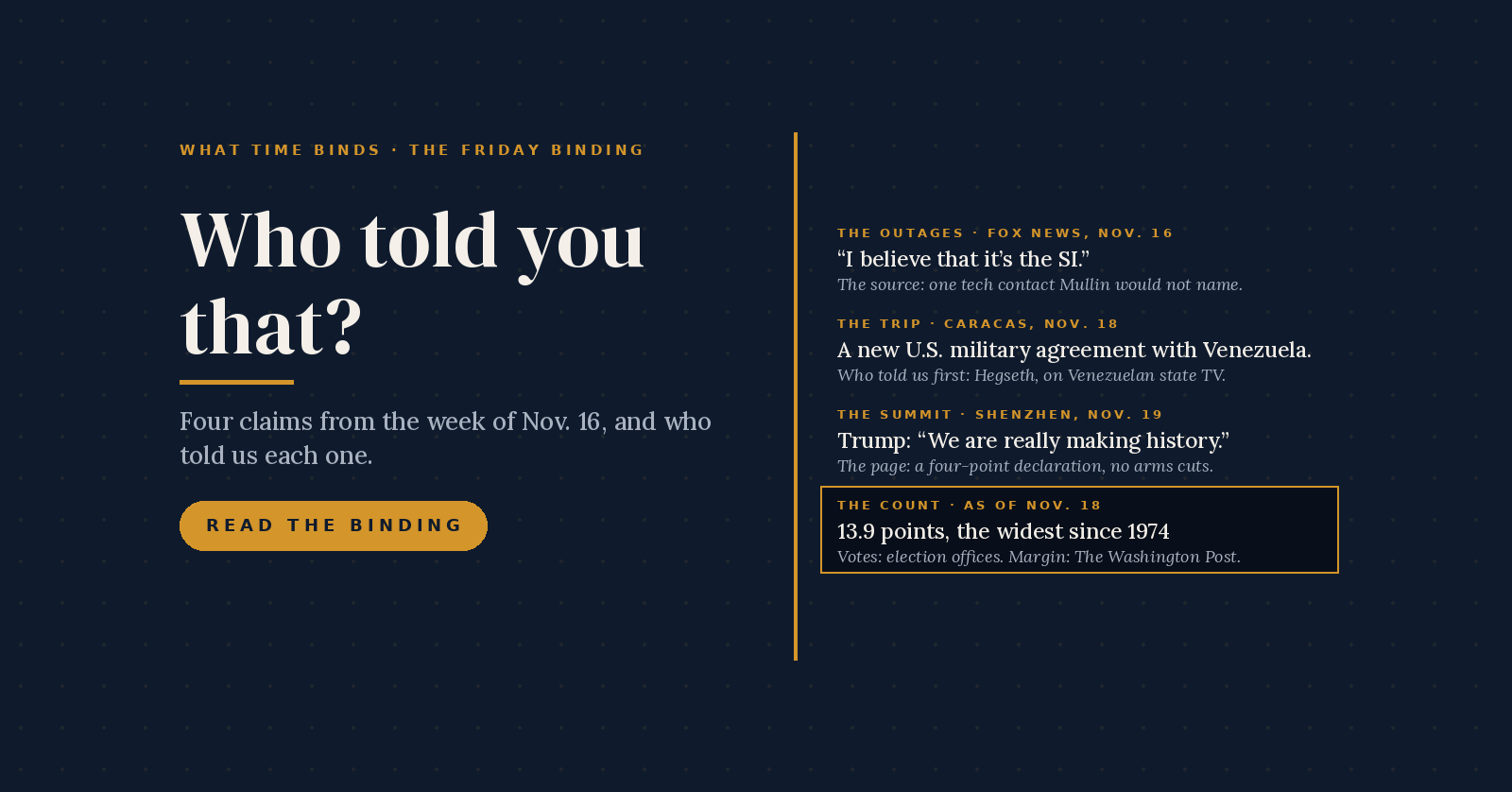
On Monday night, Nov. 16, Homeland Security Secretary Markwayne Mullin sat down with Sean Hannity to explain a run of breakdowns: Microsoft’s email, the FAA’s nationwide ground stop, United’s departures, Chase’s logins. “So I started talking to the tech industry and one guy that’s very smart with tech, he asked not to mention his name,” Mullin told viewers. The man’s answer: “I believe that it’s the SI.” Mullin added his own reason for buying it: “that kind of makes sense to me, because I can tell you with 98% certainty, we’re not seeing a cyber attack.” (Daily Wire; IBTimes)
SI means “super intelligence.” The word has a page. The White House fact sheet of Sept. 25 says President Trump and President Xi “agreed to use the term ‘super intelligence’ rather than ‘artificial intelligence.’” (White House) Seven weeks later, a cabinet secretary used that term on national television to explain a week of failures, on the word of a man he would not name.
The feeds had a word for it by Tuesday. The Daily Beast headlined Mullin’s account a “chaos theory.” CNN’s Brian Stelter wrote that Mullin was passing along speculation from “one guy” to millions of Fox viewers. (Fortune) I reached for the same word. The chaos part hit me in Tucumcari, New Mexico. Things felt all over the place, and my first question for this Binding was whether chaos is the week’s through line.
Chaos is how the week felt. On Wednesday, Defense Secretary Pete Hegseth signed a military agreement in Caracas and announced it on Venezuelan state television while the Pentagon stayed quiet. On Thursday, President Trump sat down with Xi Jinping and Vladimir Putin in Shenzhen, and the three agreed on a four-point “peace declaration.”
Under the feeling sits a pattern you can check. The week’s biggest claims came from a source you couldn’t see, or a page that wasn’t there. One number came with millions of witnesses. As of Nov. 18, Democrats led the national House vote by 13.9 points, the widest margin for either party since 1974, the fall after Richard Nixon resigned. (The Washington Post, charting Ballotpedia’s totals)
So this week’s question is the oldest one a reader owns. Who told you that?
Every Friday I bind the week: five reads around one question, or one argument end to end when the news demands it. Subscribe and the next one is in your inbox, free.
This week’s picks
1. Wake up! America’s infrastructure is melting. And AI appears to be partly responsible. (Gary Marcus, Marcus on AI, Nov. 17)
Marcus has spent years warning that AI systems fail in ways their makers can’t predict. This week he had a stake of his own: Fortune reports he was stuck in Newark for almost 48 hours. He told Fortune, “I doubt we are getting full candor for these incidents, and doubt any have been fully investigated.” (Fortune)
Read him against the question and he answers it. He told Fortune his intuition matches the one Mullin’s contact has, and he wants the government to insist on candid, timely reports on each incident. One owner has already put words on the record. Microsoft said, “This was a technical issue not related to cyber or AI / agents.” (PCWorld) Its preliminary incident report blames network changes and server failures. (TechRepublic) That’s the company that owns the failure, on the record.
2. AI Hacking Agents Are Already Loose (Aaron Baker, Know the Times, Nov. 18)
Baker walks through the failures and the owners’ explanations. “Every official explanation so far points inward,” he writes. Then he sets Mullin’s account beside the FBI’s written alert of Nov. 13 about an AI hacking tool called ARTEX. (FBI)
His piece links no source for each outage. So take the step yourself. See for yourself: pick one outage, find the owner’s own statement, and write down who said it, when, and the exact words. The FAA’s is short. Its ground stop came “following communication issues impacting multiple Air Route Traffic Control Centers.” Transportation Secretary Sean Duffy first said, “Our switches, our routers, actually got overloaded with data,” and later, “We haven’t determined what the fault was.” (compiled here, with its sources named)
3. The Axis of Evil Got an Upgrade (Jonathan V. Last, The Bulwark, Nov. 17; partly paywalled)
Last wrote before the meeting, and he wrote opinion. His argument: Putin and Xi have swapped Iran for Donald Trump’s America as the third member of their axis. Weigh that as you like. Here is the page the meeting produced. On Thursday the three leaders agreed on a four-point “peace declaration,” and Xinhua and the Kremlin released the text. One point affirms that nuclear war should never be fought, and the leaders agreed to a dialogue on reducing nuclear risk. They announced no commitments to cut their arsenals. (ABC News) At the start, Trump said, “We are really making history.” (Reuters, via The Moscow Times)
History is a claim. The declaration is the page. One more page belongs beside it. In September the White House wrote that the U.S.-China Super Intelligence Dialogue would hold its next exchange “by November 2026,” and that the two countries would set up “a bilateral communication channel for SI incidents.” (White House) It’s November, and a week of outages just got blamed on “the SI.” Ask the White House for the readout.
4. Venezuela a ‘compliant security partner,’ Hegseth says as he announces military deal with Caracas (Michael Rios, CNN)
Hegseth flew to Caracas on Wednesday without notice, met acting President Delcy Rodríguez, and signed an agreement to restore military ties, more than ten months after U.S. forces seized Nicolás Maduro. “Venezuela has gone from our most aggressive regional threat to a compliant security partner,” he said. The first pictures came from Venezuelan state television. The Washington Post’s Pentagon reporter, Dan Lamothe, posted: “No, the Pentagon is not acknowledging it at the moment.” (Mediaite)
Amy McGrath, a Marine veteran, asked this Binding’s question in one line: “Why are we learning about new U.S. military agreements with Venezuela’s authoritarian government from Venezuelan state television?” (Daily Beast) Will word of it reach the troops? They’re more worried about what’s in front of them right now, and they may not be paying attention. So the question falls to the rest of us. Who told you? Hegseth himself, on a foreign government’s broadcaster, while his own department stayed quiet. The page is the agreement itself, and I haven’t found its text published.
5. After an extraordinary wave, what comes next? (Nate Silver, Silver Bulletin, Nov. 4)
Silver wrote the day after the election and called it “the second-biggest midterm swing since World War II.” Two weeks of counting later, The Washington Post charted the margin from Ballotpedia’s totals: Democrats ahead in the national House vote by 13.9 points as of Nov. 18, the most for either party since 1974. I checked the closest rival in the same source. Ballotpedia’s table puts 1976 at 55.5 percent to 42.2, a 13.3-point margin. (Ballotpedia) The 2026 number tops it, and states are still certifying.
Who told you that? The votes come from election offices, one district at a time, on pages anyone can open, and the Post charted Ballotpedia’s totals. See for yourself: find your House district on your state election office’s results page. That line is one of the races in the 13.9.
The small install: ask who told you
A claim reaches you through somebody. Before you pass it on:
Write the claim in one line, with the name of the person who made it.
Ask what it rests on: a document, a count, a record, or another person. If it’s a person, can you name them?
If you can’t find the page, share it as a claim with the name attached, or keep it to yourself.
What the five show
The other side’s case comes first. Mullin’s central claim, that the outages weren’t an attack, matches what the nation’s intelligence chief said Tuesday. “We do not see the indicia of a coordinated cyberattack,” Director of National Intelligence Jay Clayton told Fox Business. (Daily Wire) Microsoft, Chase, United and the FAA each pointed to their own systems. (compiled here) The Pentagon’s side deserves its strongest form too. A defense secretary’s trip to Caracas ten months after a raid carries real risk, and unannounced travel protects the people on the plane. And the White House can call Shenzhen a start: three nuclear powers put nuclear war in writing and agreed to talk about reducing nuclear risk.
Here is where I land. The chaos was real. Flights stopped, banks stalled, and the news moved faster than anyone could check it. Chaos is also the hour when people get asked to take words on trust. One unnamed man’s theory reached millions of viewers through a cabinet secretary. A military agreement reached Americans through Venezuelan state TV. A president called the summit history, and its declaration ran four points.
The count asked for nothing. Voters cast it, election workers tallied it, and the totals sit on public pages. That number is the week’s page. Hold the others to it.
You refuse to know. The record remembers. I refuse to forget.
A question for the comments
Which claim from this week did you take on someone’s word? Tell me who told you, and whether you found the page.
One more
What Do You Mean by “Super Intelligence”? ran Wednesday, two days after Mullin’s interview. On federal pages, it shows, the new term means what federal law already calls artificial intelligence, under Executive Order 14434 of Sept. 29. If you heard “the SI” this week and wondered what it meant, start there. The AI Record, new this week, keeps the federal documents that use the new name, each in its own words. The same question ran through Thursday’s two cards: an Anthropic researcher’s forecast that nearly all of us will become “permanently unemployable,” and Harmeet Dhillon’s new words on bigotry beside her record. (Anthropic makes Claude, the AI I write with.)
Author’s note. I was in Tucumcari, New Mexico, listening to the news at 3 a.m. on the road between California and Kansas. I wouldn’t be able to write all this without my staff. If you want to know more about my staff, direct message me.
The comments are the appendix: tell me where the record is wrong and I will show the page or fix the line. Paid subscriptions open at 500 readers, and the paid product is Coded Threads, the codebooks built from these comment sections. A pledge now is a vote for that.
That 13.9 is ballots, counted where anyone can check. Read your next ballot the way you read this piece, every race and every proposition, at vote411.org.
I write What Time Binds with Claude. Every claim carries its page, and I approve every line. How I work: How the bread gets made.
Jerry W. Washington, Ed.D., is a Marine Corps veteran of twenty-three years, a combat engineer by trade, an instructor at UC Irvine’s Division of Continuing Education, and the writer of What Time Binds, a record of how institutions bend words and how the page holds them to account.
I advise school districts, community colleges, workforce boards, and veteran-service organizations when the words move faster than the coordination. AI adoption is the most common case. See the five ways to work together at jerrywwashington.com, or hit reply if you would like to talk.