

The table
On the morning of Election Day, my wife, my oldest daughter and my youngest sat down at the table with their ballots. The rest of the day was spoken for. I had a meeting at 10 a.m., my middle daughter had school, and both of her sisters had work. We planned to drop the ballots off together that afternoon.
They looked up the propositions as they went, to make sure they understood what they were voting for. Somebody said, “Wow, there’s a lot of propositions on this ballot.” I went in and out of my office around the meeting and finished mine, and they read it too, to see where we overlapped and where we differed.
My middle daughter came in before school. She wanted to understand the propositions better, so she and I looked them up together while she worked through the rest of her ballot. The house was full of talk, and somewhere in it she filled in the block for a candidate she did not want. She stopped.
She read the ballot to see what she could do and worked out that she would have to go to a vote center. When she got to school, she looked it up, found one on her campus and cast a provisional ballot there.
The overlaps turned up because everyone had the same page in front of them. The mistake came out of the best part of the morning, the talk and the looking up, at the one moment the page needed her full attention. We read together, and each of us marks alone.
The count
That night I watched the returns. The Associated Press called the Senate for Democrats late Tuesday and the House in the early hours of Wednesday (TIME). By Wednesday morning, Democrats had gained at least seven Senate seats, with two races still uncalled (Ballotpedia).
The firsts did not sort by party (AP). Georgia elected Keisha Lance Bottoms, who will be the country’s first Black woman governor. Florida, Wisconsin and Nevada each elected its first Black governor: Byron Donalds, a Republican, and David Crowley and Aaron Ford, Democrats. Tennessee elected Marsha Blackburn, a Republican, as its first woman governor. Peggy Flanagan of Minnesota and Deb Haaland of New Mexico will be the first Native American women to serve as a senator and as a governor. Michigan elected Abdul El-Sayed, who will be the first Muslim American to serve in the Senate, and New Hampshire elected Chris Pappas, who will be the first openly gay man in the Senate. In Texas, Gina Hinojosa beat Gov. Greg Abbott. She will be the state’s first Latina governor and its first Democratic governor since Ann Richards lost to George W. Bush in 1994 (Texas Tribune).
The AP’s voter poll put numbers on the mood. About two-thirds of midterm voters said Trump’s policies had worsened economic conditions, “while only about 3 in 10 say they’ve improved things.” About three-quarters said they felt “angry” or “dissatisfied” with the country’s current trajectory. Dissatisfaction “was particularly high in blue states like California and Massachusetts, but even in deep-red states, a majority of voters were at least ‘dissatisfied.’”
At 10 p.m. Central, at his watch party in Austin, Abbott conceded. He said he had just gotten off the phone with Hinojosa to congratulate her (Texas Tribune). A loser accepting the count is the oldest common ground I know in an election. That much we can count.
The word
Common sense is harder to pin down, and the people who use the phrase do not mean the same thing by it.
In her Nov. 3 explainer on the midterms, the historian Heather Cox Richardson said the common ground “Democrats and Democrat aligned people on the ground” were finding “is basically that they are looking to return sort of common sense to the government.” Earlier in the same explainer she described their “enormous sense of urgency to fix things” and named what it looks like: expanding Medicare and Medicaid coverage, expanding the Affordable Care Act’s marketplace subsidies, and bringing back the SNAP benefits cut under the One Big Beautiful Bill Act.
In January 2025, President Trump made the phrase a promise. In his inaugural address on Jan. 20, he said, “With these actions, we will begin the complete restoration of America and the revolution of common sense.” And: “It’s all about common sense” (transcript). That spring, two of his executive orders put the phrase in their titles. Executive Order 14275, “Restoring Common Sense to Federal Procurement,” set out to cut a Federal Acquisition Regulation that “has swelled to more than 2,000 pages of regulations.” Executive Order 14286, “Enforcing Commonsense Rules of the Road for America’s Truck Drivers,” said English proficiency “should be a non-negotiable safety requirement for professional drivers.” After sentences about reading traffic signs, talking with checkpoint officers and taking directions in English, it says, “This is common sense.”
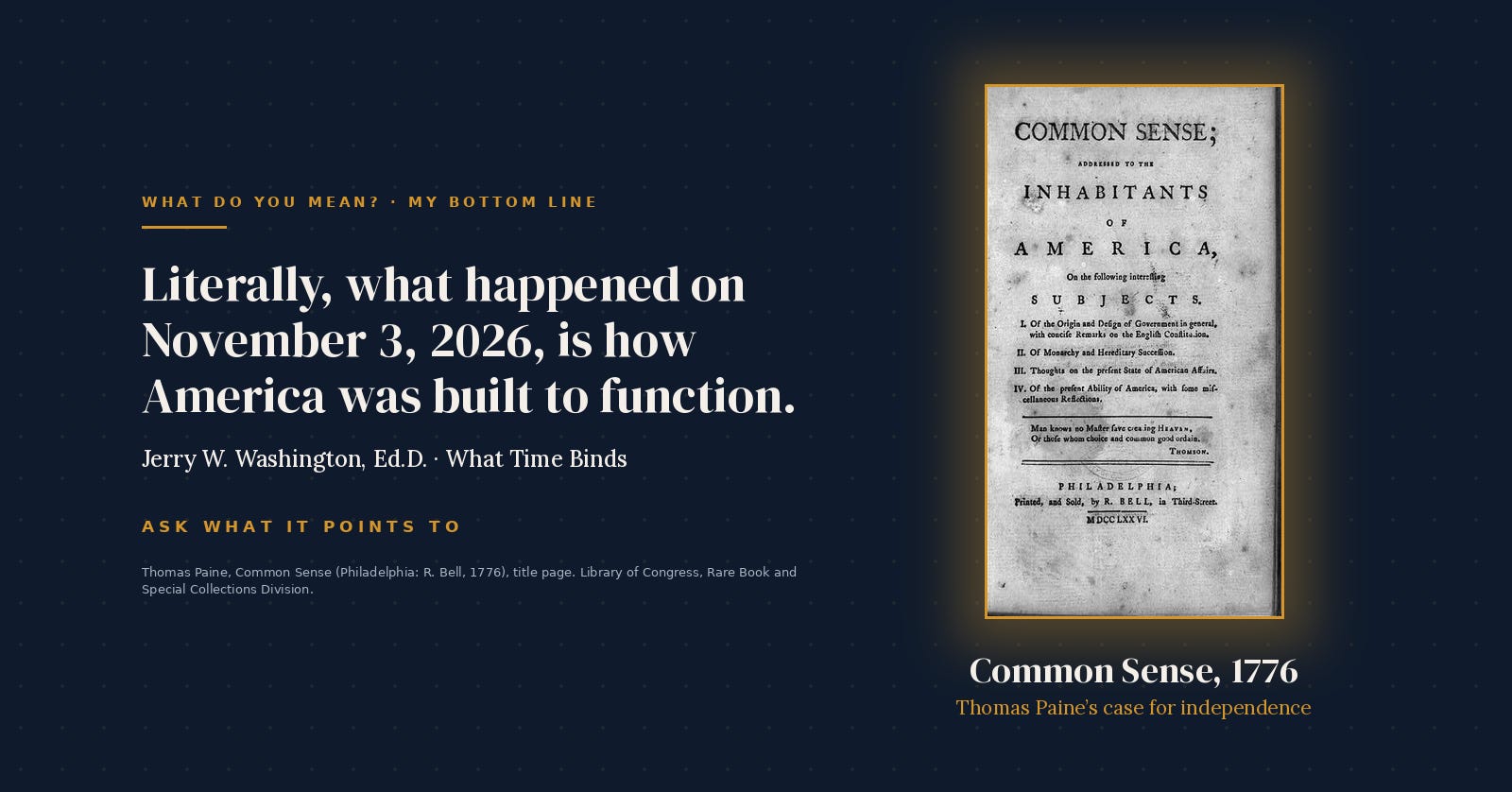
The phrase is older than both of them. In 1776 Thomas Paine put it on the cover of the pamphlet that argued for independence. In the first paragraph of his introduction he warned about custom: “a long habit of not thinking a thing WRONG, gives it a superficial appearance of being RIGHT” (text). Paine’s common sense was an argument against a habit.
In all three mouths, the phrase says the thing should be obvious. It never says what the thing is. For that you read what the words are attached to: a procurement rule, an English requirement for truck drivers, health coverage, food benefits, a break with a king. The phrase stays the same while the referent changes.
Every use of “common sense” should point at a page, and the page tells you what you are being asked to accept. Every Wednesday I take one word an institution bent and show the page it bent on. Subscribe and the next one is in your inbox, free.
What my threads show
I read my comment sections closely. Since July, I have sorted 2,635 Facebook comments by the side each took and how it argued. Most sit under my own posts. I want to know which arguments open a conversation and which ones end it, mine included. When I quote a comment, the name stays off. The comments are not a random sample, and they do not speak for the country.
Seven percent took no side: sincere questions and both-sides comments. My codebook calls comments like these the most persuadable. About a quarter were hostile, and the hostility ran in both directions. About a third argued the other side without insults. In the two codebooks that track the moment someone grants an opponent a point, it happened four times in 519 comments.
One code matters most for this piece. Under a post by Rep. Nancy Mace in August, my codebook counts 11 comments that called her position logic, facts, biology or reality itself and offered no argument. One said, “Someone who still uses logic.” The codebook files them under COMMON-SENSE-CLAIM. The phrase did in a comment what it does in a speech. It closed the conversation before anyone opened the page.
Common ground did show up. Under my post on Lt. Gen. Brett Sylvia’s removal, 17 comments weighed both sides. Three of them made it a condition: if the reason for his removal holds up, he answers for it. That is a rule of evidence people on either side can hold. In a September thread, 27 comments came from independents or readers on the other side who took the argument on its merits.
The hardest finding is about me. A reader who often argues with my cards wrote, under one about armed federal agents at polling places, “Intimidation should not occur at the polling place.” That was the card’s own claim. Five days later she wrote, “Yes, words create worlds, but they do that on both sides of the political aisle.” That is this newsletter’s thesis, and her second half is the test this piece runs. Both lines sat inside longer comments that argued with me. My reply under the first card had already said that private intimidation falls under other laws. We agreed, and neither of us said so.
The label and the referent
Language has to describe the thing it names. When the word and the thing come apart, you get lies, and agendas that go unaccomplished. Identity is often what pulls them apart.
Watch what happened to one word. On Nov. 11, 2025, Trump posted that Abbott “has my Complete and Total Endorsement for Re-Election” and promised, “HE WILL NEVER LET YOU DOWN!” (Fox News). On Election Day, the Texas Tribune reports, he “reiterated his endorsement” of the “strong and highly respected” governor. Then, shortly after Abbott conceded, Trump posted, “If Greg Abbott, the Governor of Texas, hadn’t become a RINO in the last six months of his Political Life, he wouldn’t have lost” (Texas Tribune; Raw Story).
RINO means Republican in name only. The Texas Tribune reports that Abbott began his career as a business-oriented Republican and “tacked to the right in recent years.” In Trump’s post, the word measures distance from the man who wrote it. A label that sorts people by loyalty can flip in a single day.
My threads show the same thing from the other direction. In March I wrote about a fellow Marine who argued for two years that DEI puts identity ahead of performance, then proposed targeted outreach to broaden a talent pool, which is what a DEI program does (The Definition Gap). With the label gone, he backed the thing.
Labels run both ways. In October I put up a “No Kings: Vote Early” post with nine photos from Huntington Beach. One showed a sign that read “KEEP THE IMMIGRANTS / DEPORT THE RACISTS.” Under that photo, and only that one, a commenter wrote, “it’s gotta be exhausting being a liberal.” When I noted which photo the comment sat on, the reply came back, “thank you for proving my point, you gotta be exhausted.” The sign sorted people with a label, and so did the comment. The comment’s label was built so that any answer would prove it.
By Wednesday morning, I had seen two verdicts on the same night. One card said Democrats were “poised to win back the Senate — sending a Methodist pastor, a Presbyterian seminarian, a Muslim doctor, and a Catholic Native American to Washington while reelecting a Jewish Southerner in Georgia.” Its last line: “This is America at its best.” Another showed a donkey and an elephant standing rear to rear, captioned “Two cheeks. Same ass. …” The first card told the night through identity. The second gave both parties one label. Each claims to be obvious, and neither names one thing any of these people will do in office. The meme offers the cheapest common ground there is: everyone can share it without reading anything.
My codebooks also found that the same audience behaves differently depending on what a post calls up. One reader shows it plainly. Under one post, that reader traced a video back to its single source. Under another, the same reader generalized about a whole group of people. I suspect identity works this way too, and that the post a reader meets calls up the common sense the reader brings.
In April I wrote that “we treat emergent patterns as if they were objects with fixed properties” (The little word “is” has its tragedies). A label is the shortcut that lets us do it. It says what a person is, so nobody has to check what the person did.
The strongest case
Each use of the phrase has a real referent behind it, and each deserves its best case before mine.
Trump’s common sense names a frustration people know from work. A procurement rule book that “has swelled to more than 2,000 pages of regulations” is hard to defend. The truck-driver order rests on a plain safety claim: drivers should be able to “read and understand traffic signs.” His RINO post has a referent too. In August, Abbott paused approvals for data centers seeking to connect to the state’s power grid, and Trump called the moratorium “a mistake.” Abbott’s office said, “Simply put Texans must come first” (CBS Austin). On Oct. 7, Abbott stayed away from Trump’s rally in San Antonio and was scheduled to dedicate a hospital about 330 miles away; the Associated Press called his absence “a sign of Trump’s poor standing” (AP). Distance from Trump on one policy and one stage is still distance.
Richardson’s common sense has referents a reader can check: who is covered, what the subsidies pay, which SNAP benefits were cut. That is to her credit. It is also a party’s program, and calling it common sense asks readers to skip the argument the same way the inaugural did.
Democratic leaders reach for the word too. In June 2022, Senate Majority Leader Chuck Schumer said the Supreme Court “strikes down commonsense gun safety measures” in a New York case (Senate Democrats).
The common ground in the count has limits too. Florida and Tennessee elected Republican firsts. Every one of these races had a loser and the voters who chose that candidate. A result settles who governs. The argument over how started before the count was done. On election night Trump posted a picture of his red cap with “VETO” stitched on it, and by morning he had told Fox News that Democrats “did a good job” (AP).
On Wednesday, Florida’s Republican governor, Ron DeSantis, called the night “close to an extinction-level event” for his party and a “rejection of Republicans in Washington.” He also said Democrats “did not earn a mandate to indulge all their left-wing fantasies” (Fox News). The governor who held Florida granted the anger. He drew his line at the mandate.
My bottom line
In November 2016, Oxford Dictionaries named “post-truth” its word of the year. It defined the word as “relating to or denoting circumstances in which objective facts are less influential in shaping public opinion than appeals to emotion and personal belief.” Casper Grathwohl, then president of Oxford Dictionaries, said he “wouldn’t be surprised if post-truth becomes one of the defining words of our time” (CNBC). We have been living through it for 10 years. Calling a thing common sense and stopping there is post-truth talk. It trades the fact for the feeling.
Tuesday showed the opposite twice. My family looked up what the propositions would do before we marked them. Greg Abbott accepted a count that went against him and congratulated the woman who beat him. Literally, what happened on November 3, 2026, is how America was built to function. Let’s stop. Listen to each other. Connect our words to something real.
Ask what it points to
The habit for this week is short. When someone tells you a thing is common sense, ask what it points to: a rule, a benefit, a test, a person. Then go read that page. If nobody can name the page, you have found a feeling dressed up as an argument.
My middle daughter ran the habit before I named it. She stopped, read the ballot to see what it let her do, and found the place where she could fix it. That is the common sense I trust, the kind a family builds when everyone reads the same page and each of us still marks our own.
California counts mail ballots postmarked by Election Day that reach county offices by Nov. 10. Read your next ballot the way you read the record: every race, every proposition. vote411.org
The count was one night. The record keeps going, and I keep it in my Records section: living pages that keep a dated, sourced account of one institution or case. When the record changes, the page does too.
I write What Time Binds with Claude. Every claim carries its page, and I approve every line. How I work: How the bread gets made.
The comments are the appendix: tell me where the record is wrong and I will show the page or fix the line. Paid subscriptions open at 500 readers, and the paid product is Coded Threads, the codebooks built from these comment sections. A pledge now is a vote for that.
Jerry W. Washington, Ed.D., is a Marine Corps veteran of twenty-three years, a combat engineer by trade, an instructor at UC Irvine’s Division of Continuing Education, and the writer of What Time Binds, a record of how institutions bend words and how the page holds them to account.
Sources
Heather Cox Richardson, “Democrats in This Moment and What’s Next | Explainer”, Nov. 3, 2026
Donald J. Trump, inaugural address, Jan. 20, 2025 (CBC transcript)
Executive Order 14275, Restoring Common Sense to Federal Procurement, 90 Fed. Reg. 16447 (Apr. 18, 2025)
Executive Order 14286, Enforcing Commonsense Rules of the Road for America’s Truck Drivers, 90 Fed. Reg. 18759 (May 2, 2025)
Thomas Paine, Common Sense, Introduction (1776)
TIME, Democrats Win Control of Both House and Senate, Nov. 4, 2026 (the AP’s calls)
Ballotpedia staff, Democrats win U.S. House and Senate majorities, Nov. 4, 2026 (results as of 1:30 a.m. EST; seven Senate pickups)
Associated Press, historic firsts, Nov. 4, 2026 (via MPR News)
Associated Press, Aaron Ford becomes Nevada’s first Black governor, Nov. 4, 2026 (via FOX5 Las Vegas)
Associated Press, AP Voter Poll, Nov. 3, 2026, 6:26 PM EST, updated 7:55 PM EST (via PBS)
Associated Press, Trump says Democrats “did a good job”, Nov. 4, 2026 (via PBS)
The Texas Tribune, Hinojosa defeats Abbott, Nov. 3, 2026, updated 11:45 p.m. Central
The Texas Tribune, Greg Abbott lost because he became a RINO, Trump says, Nov. 3, 2026, 11:33 p.m. Central
Raw Story, Trump’s posts on Abbott, Nov. 3, 2026
Fox News, Trump’s endorsement of Abbott, Nov. 11, 2025
CBS Austin, Trump criticizes Abbott moratorium on Texas data centers, Aug. 9, 2026
Associated Press, Trump rally in San Antonio, Oct. 7, 2026 (via Spectrum News)
Oxford Dictionaries, Word of the Year 2016: Oxford’s own Word of the Year retrospective, Oct. 1, 2024; the definition and Casper Grathwohl’s words as reported by CNBC, Nov. 16, 2016; the definition as quoted on OUPblog, Mar. 11, 2017
Heather Cox Richardson, Letters from an American (Substack)
Fox News (Greg Norman-Diamond), DeSantis on the GOP’s midterm losses, Nov. 4, 2026
Senate Democrats, Schumer statement on the Bruen decision, June 23, 2022
California Secretary of State, key dates for the Nov. 3, 2026 general election (mail ballots postmarked by Election Day and received by Nov. 10)
Two shared posts, Nov. 4, 2026: a Notice News card (”This is America at its best”) and an unattributed donkey-and-elephant meme; quoted from screenshots
What Time Binds, The Definition Gap, Mar. 14, 2026, and The little word “is” has its tragedies, Apr. 20, 2026
What Time Binds codebooks, July 20 to Oct. 30, 2026: seven coded threads, counts from each workbook’s Frequencies and Code Book sheets
"Common sense" often works by making the listener feel that something is obvious to everyone — the grown-up version of a child's "everyone says so." A lot of it really is shared, of course: majority views, manners everyone knows.
But I've also seen someone take a personal, often minor rule of their own, present it as common sense, and use it to pressure the people around them. And it works. Told "this is just common sense," you start to wonder whether you're the one who doesn't know how the world works. Wait — am I simply wrong here, or did I miss something?
Then there's the local version: the custom of a trade or a place you don't know. "That's just common sense around here; if you didn't know, that's on you." The one who gets taken in becomes the one at fault.
An astronaut once posted a video from a chamber simulating 63,000 feet, where water boils on its own. A stranger replied that it wasn't spontaneous — "simple thermo." The expert got common sense explained to her.
Common sense can become a convenient free pass. It serves as a weapon in one hand and armor in the other.