


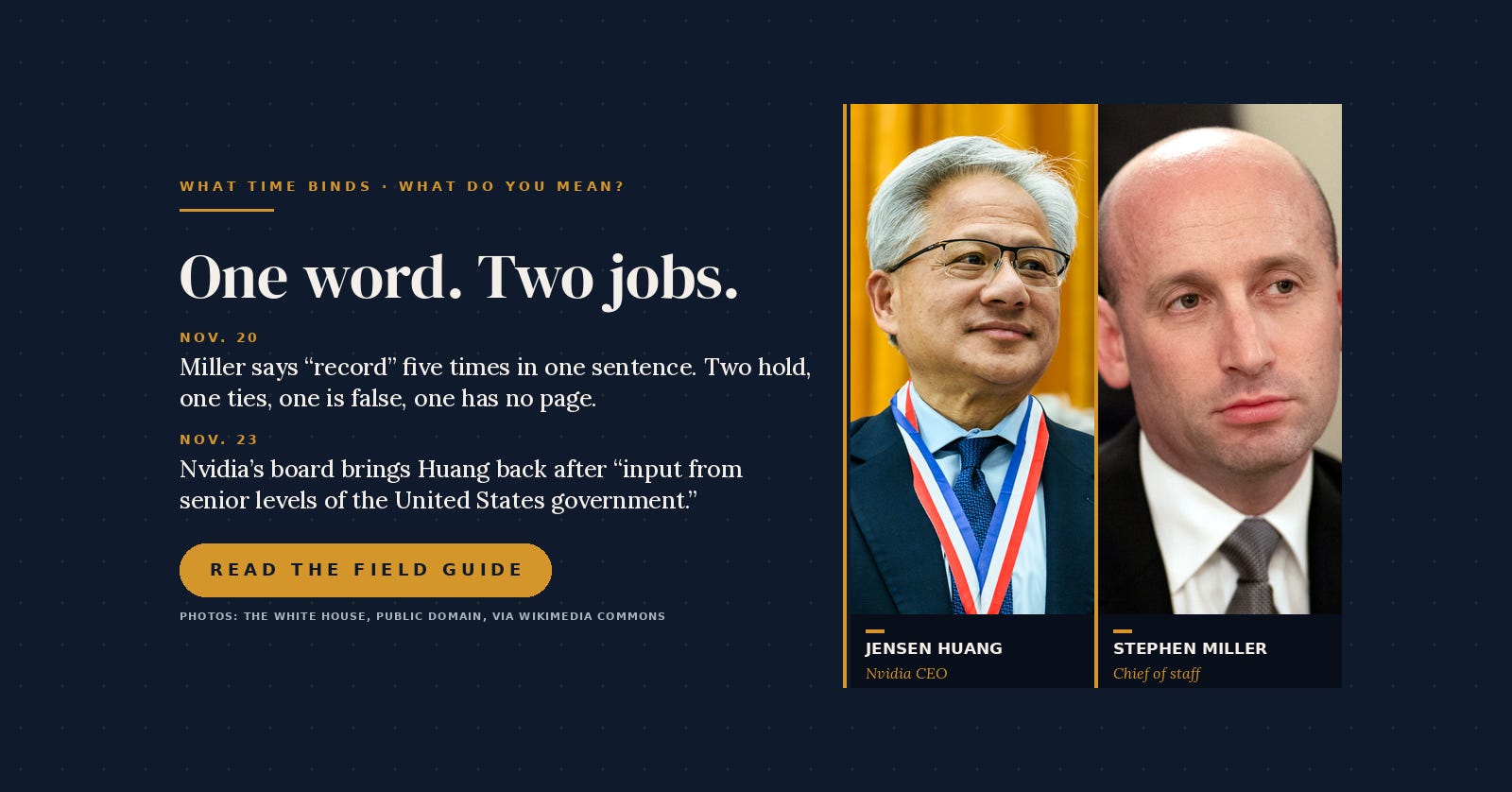
On Nov. 20, in the White House briefing room, the President said this of his new chief of staff: “By the way, we have the most powerful man in the world in the room right now.”
Stephen Miller then spoke for about two minutes. He had held the job for 11 days. One sentence carried the word “record” five times: “record deportations, record low crime, record low murder rate, record production of American fossil fuels, record production of American coal.”
Three days later, Nvidia’s board filed a different kind of record. On Nov. 23 it reinstated Jensen Huang as president and chief executive, effective immediately, 11 days after he resigned. The board’s release says it “received input from senior levels of the United States government.” On the strength of that input, the board says, Huang’s return carries no risk to national security. Its own investigation will run to the end.
Open the board’s release and find the sentence about the government. Then look for a name.
The Word Doing Two Jobs
Chapter 2 of my book, Ask for the Page, circled a mechanism: one word doing two jobs. “Record” is doing two this week.
In Miller’s sentence, a record is a best-ever mark, a number that beats every number before it. In the board’s release, a record is the written account that stays on file after the speaker leaves the room. A best-ever mark lives for a news cycle. The written account keeps adding entries for years, and it sets the speaker’s own words beside whatever happened next.
This Field Guide reads the second kind. It asks three questions of any leader’s record. What did they say, and did it hold up later? Who did they build to replace them? What did they do with their influence? Huang’s record answers the first two. Miller’s answers the first and the third.
The most powerful man in the room can announce the first kind of record, and he still answers to the second. Every Wednesday I take one word an institution bent and show the page it bent on. Subscribe and the next one is in your inbox, free.
Huang: Did His Words Hold? Who Did He Build?
Start with what holds. Huang co-founded Nvidia and led it to the top of the market. When Lex Fridman posted their interview in March, he called it the world’s most valuable company. My family doctor once held Huang up to me as a success story. The story was true when the doctor told it.
Now the first question. On May 17, 2025, in Taipei, Huang said, “There’s no evidence of any AI chip diversion.” The government’s own statement, released Nov. 16, never mentions him. Set its dates beside his words. Commerce opened an export-control case on Megaspeed, a Singapore company that bought Nvidia chips, in 2024. In May 2025, the month he spoke, Commerce investigators asked Nvidia for records of its direct or indirect sales to Megaspeed. In June, Nvidia put Megaspeed on its “no sell” list. In March of this year, a federal indictment charged three men tied to Supermicro, a server maker. The charges include conspiring to smuggle servers with Nvidia chips to China in 2024 and 2025.
What that record cannot show matters as much. It can’t show what Huang knew on May 17; the statement gives only the month. Neither he nor Nvidia is charged. On Nov. 8 he told his staff he had been unfaithful to his wife, after The New York Times reported a U.S. intelligence finding that the woman involved was gathering information for Beijing. China denies it, and no one is charged with spying. His board said that day it had no reason to believe national security or Nvidia’s secrets were compromised. The Senate Banking Committee’s chair, Tim Scott, says Huang has agreed to appear. The committee has set his public hearing for Dec. 3. That testimony goes on the record in his own words.
The second question is who he built. He told Fridman that 60 people report to him directly and that he holds no one-on-ones with them. He ties that design to the work: the experts on each part of Nvidia’s systems solve problems together, in one room. Asked whether he fears death, he said, “I’m famous in saying that I don’t believe in succession planning.” His answer to the worry is to pass on what he knows to the people around him, as fast as he can. In January, Jodi Shelton asked him on her podcast whether there could really be a next CEO of Nvidia. “Well, there will never be one like me,” he said, because the company raised him. A post I read this month praised him for exactly that: making himself so needed that no one could replace him.
November ran the test. On Nov. 12 he resigned, effective immediately. The board made Colette Kress, the chief financial officer, interim CEO, and she kept the finance job too. The board said it would weigh internal and external candidates. On Nov. 17 its chair said the board did not intend to bring him back. On Nov. 23 he was back.
That’s the record answering the post. The fair line goes with it. Nvidia’s results under Huang are real, and his intentions sit outside the record. The record holds a company that lost its chief, put its finance chief in the chair and took him back in 11 days. That’s what a company built around one man looks like.
Another post I read Tuesday called November a coordinated attack by Washington and the press to take him down. The board’s release, quoted above, says Washington’s input is why it sees no national security risk in his return. Both posts start from a story about the man and read the record to fit it. Scholars have a name for that pull. In 1985, James Meindl, Sanford Ehrlich and Janet Dukerich called it the romance of leadership: the bigger the result, the more of it we credit to one person.
Miller: Did the Records Hold? What Did He Do With His Influence?
Score his list both ways. The record splits, and a fair reader credits what holds as plainly as they mark what fails.
Deportations hold, as the Department of Homeland Security counts removals. ICE said it removed 483,200 people in fiscal 2026, 9 percent above its previous high a year earlier, the Associated Press reported. AP calls these counts “notoriously fuzzy.”
Oil and gas hold. EIA reports record crude oil and natural gas output in 2025, the fourth straight year of record total energy output.
The murder rate ties. The FBI puts 2025 in a tie for the lowest rate since national estimates began.
Coal is false. U.S. mines produced 533 million short tons in 2025, below 2023’s total, which EIA had already put at less than half of the 2008 peak.
Overall crime has no page under it. The FBI’s 2025 report shows violent crime’s largest one-year drop since estimates began in 1936, and 20-year lows in robbery, burglary and theft. It claims no record low overall.
Two hold, one ties, one fails, and one has nothing under it. Open EIA’s May 11 page and the FBI’s 2025 report, and score the list yourself.
Score the deportation record a second way. A count tells you how many. The record also asks who.
The President campaigned on targeting the “worst of the worst.” The same AP story puts numbers beside the promise. In July, about one in four people deported had a criminal conviction, and more than half were not facing any criminal charge, according to the Deportation Data Project. The department’s announcement of the record never said how many had criminal histories.
The Migration Policy Institute counted about 980,000 removals and returns by ICE and CBP from Jan. 20, 2025, through July 31, 2026. Among deportations of people who had lived here two years or more, 71 percent had no criminal conviction.
The third question asks what he did with his influence. In August 2025 he said of the Democratic Party on Fox News, “It is a domestic extremist organization,” as AP’s profile of him records.
The gravest entry came in January. On Jan. 24, Border Patrol officers in Minneapolis shot and killed Alex Pretti, a 37-year-old intensive care nurse. That day Miller posted on X, “A would-be assassin tried to murder federal law enforcement.” In the same post he accused the Democrats’ official account of siding with terrorists. Replying to Sen. Chris Murphy, he wrote, “An assassin tried to murder federal agents.”
The videos told it another way. They showed Pretti “had only his mobile phone in his hand” as officers tackled him, AP reported. One officer pulled a handgun from the back of Pretti’s pants as another began firing into his back. Pretti held a state permit to carry the gun, and the videos never show him reaching for it. On Jan. 30 the deputy attorney general said the Justice Department had opened a federal civil rights investigation into his death.
On Jan. 28, ABC News quoted Miller: “We are evaluating why the CBP team may not have been following that protocol.” As of Nov. 24, I found no retraction of the word “assassin.”
In September I wrote, “Leaders listen to the argument. Pseudo-leadership avoids it, calls it names, discredits it.” Calling a dead man an assassin, and leaving the word standing after the videos, is that name-calling at the highest stakes there are.
A Thought Experiment on “Measure”
Both men in this piece score high on the measure many leadership books start with: influence. One was called the most powerful man in the world. The other was praised as impossible to replace.
Here is a test I run on myself. Picture two readers arguing over one line from John Maxwell, the leadership writer.
The first reader opens Maxwell’s 1993 book, Developing the Leader Within You: “Leadership is influence. That’s it. Nothing more; nothing less.”
The second opens his 1998 book, The 21 Irrefutable Laws of Leadership: “The true measure of leadership is influence—nothing more, nothing less.”
Each reader quotes the page correctly. They still disagree, and the gap sits in one word.
Ask what “is” lets in. If leadership is influence, anyone whose word moves people is a leader. Maxwell follows that road himself. In a 2018 revision of the 1993 book, he quotes a consultant’s test that sets moral questions aside and counts anyone who gains followers. By that test, he concludes, one of history’s worst tyrants was a leader.
Now ask what “measure” changes. A measure reads one property of a thing. A thermometer reads a room’s temperature. It can’t tell you how the room got hot. Influence tells you how far a person’s word travels. It can’t tell you whether the word held, who it hurt or who comes next.
The second reader still has a problem. The 1998 sentence ends “nothing more, nothing less,” and that tail makes influence the only gauge. So a third reader takes one more step: influence is one measure of a leader, read beside the record. That’s where I stand.
This Field Guide’s habit: when the record grows, open the page again.
Every Verdict Carries a Date
This newsletter takes its name from Alfred Korzybski’s idea of time-binding. In 1921 he called the human being “the heritor of the by-gone ages and the trustee of posterity.” We inherit what earlier people wrote down, and we add to it. His students kept a small tool for that work: write the date on the word. As one summary of his methods puts it, “dating is just indexing in time.”
A leader is a verdict with a date on it.
I tested that line against another on Tuesday, on Facebook and in a Substack Note. Most readers who answered chose it.
“Huang, the success story” was true when my doctor told it. “Huang, Nov. 12 to Nov. 23” is true too. The second entry adds to the first and erases nothing.
Some measures read fast. Influence and following show up today. Growth shows up within a few years. The three questions in this Field Guide read slow. Whether a claim held waits for the data. Who a leader built waits for the day they step back. What happens after them takes years.
The record has re-dated big verdicts before. In 2001, Jim Collins put Circuit City and Fannie Mae among the 11 companies in Good to Great. By November 2008, Circuit City had filed for bankruptcy and the federal government was rescuing Fannie Mae. Collins then studied how great companies fall. Eisenhower moved the other way. A 1962 poll of historians placed him 22nd. By 1994 he ranked eighth, his standing rising “as more records and papers have become available.”
A warning goes with this. In the late 1990s, observers praised Cisco’s strategy and management. After the bubble burst, the same observers faulted the same things, though the company had changed little. Phil Rosenzweig calls this the halo effect. A late verdict can be as wrong as an early one when it reads only results. Read what the leader did, then what came of it.
I hold myself to the same rule. I put Elon Musk on a pedestal around 2008, when he took over as Tesla’s chief executive. The record has added entries since, and my reading changed with them.
My Bottom Line
The same President vouched for both men this month. On Nov. 9 he said of Huang, “I just think he’s a very honorable man.” On Nov. 20 he called Miller the most powerful man in the world. A vouch tells you whose word moved. The record tells you whether the word held.
I built computers on the side when I served on Okinawa. A corrupt file still opens. It just no longer matches the original, and the only way to know is to check the copy against the source. Both of these records need that check, entry by entry, with a date on it.
Here is my verdict, as the record stands on Nov. 24. Calling a dead nurse an assassin, and leaving the word standing after the videos and a federal civil rights investigation, is a moral failure. It corrupts the record a powerful office keeps for the public. Telling the world there was “no evidence” of diversion would be the same failure if evidence had reached him by May 17. The record shows only a records request that month. It hasn’t settled the “if.”
The questions start next week. Huang has agreed to a closed-door interview with three House committees on Dec. 1, and their chairs asked Nvidia’s general counsel for Dec. 2. The public Senate hearing follows on Dec. 3 at 10 a.m. Eastern. Watch it with the three questions in hand.
Miller’s record in this job is weeks old. Huang’s runs back to Nvidia’s founding. Date both, and check both again when the next entries land.
The Pin
“Record.” A word doing two jobs. One is a best-ever mark, read the day someone announces it. The other is the written account of what a leader said and did, read for as long as the paper lasts.
What it includes. The leader’s own words, set beside the documents that came later. The people they built to carry on without them. What they did with their influence over people who could not answer back. The date on every entry, and on every verdict.
What it cannot be read to say. What a leader knew on a given day, unless a document shows it. Guilt, which belongs to a court; Huang and Nvidia face no charges. A clean list from one true record, or a ruined leader from one false one. A verdict past the date you wrote it.
The habit. Before you call someone a leader, ask the record three questions, and write today’s date beside your answers.
What did they say, and did it hold up later?
Who did they build to replace them?
What did they do with their influence?
The question. Name a leader you worked for who built their replacement. What did they do?
Before the Next Ballot
Read your next ballot the way you read a leader’s record: every race, every proposition, with a date on your verdict. vote411.org
I write What Time Binds with Claude, Anthropic’s model. Nvidia, the company in this piece, announced in November 2025 that it would invest in Anthropic. Every claim carries its page, and I approve every line. How I work: How the bread gets made.
The comments are the appendix: tell me where the record is wrong and I will show the page or fix the line. Paid subscriptions open at 500 readers, and the paid product is Coded Threads, the codebooks built from these comment sections. A pledge now is a vote for that.
Jerry W. Washington, Ed.D., is a Marine Corps veteran of twenty-three years, a combat engineer by trade, an instructor at UC Irvine’s Division of Continuing Education, and the writer of What Time Binds, a record of how institutions bend words and how the page holds them to account.
Sources
The opening
President Trump Hosts a News Conference, White House video, Nov. 20, 2026 (1:28:18). Quotes from the Singju Post transcript: the President at 01:19:45, Miller at 01:21:03 to 01:23:13.
Alternet, Nick Hilden, Nov. 20, 2026 (the briefing room).
CBS12, via TNND, Nov. 6, 2026 (Miller’s start date, Nov. 9).
Nvidia release on Huang’s reinstatement, filed with the SEC, Nov. 23, 2026.
Huang
Lex Fridman Podcast #494, Mar. 23, 2026, and its transcript: staff of 60 at 00:05:36; succession at 02:17:42 to 02:19:23.
Bloomberg, via Free Malaysia Today, May 17, 2025.
Joint statement of the Commerce and Justice Departments on Megaspeed, Nov. 16, 2026.
U.S. Attorney’s Office, Southern District of New York, Mar. 19, 2026 (the Supermicro indictment).
NBC News, Nov. 8, 2026 (Huang’s message to staff; the board’s statement).
The Associated Press, Nov. 10, 2026 (the Times report; the President’s remarks).
A Bit Personal with Jodi Shelton, Jan. 15, 2026, at 15:13 to 15:31.
Nvidia Form 8-K, Exhibit 99.1, Nov. 12, 2026.
NPR, via KUOW, Nov. 17, 2026.
Al Jazeera and AP, Nov. 13, 2026 (the hearings).
The Next Web, Ana-Maria Stanciuc, Nov. 18, 2026 (Huang agrees to appear).
Senate Banking Committee, “Protecting America’s AI Advantage: Oversight of U.S. Export Controls,” hearing notice for Dec. 3, 2026.
James R. Meindl, Sanford B. Ehrlich and Janet M. Dukerich, “The Romance of Leadership,” Administrative Science Quarterly 30, no. 1 (1985).
Miller
The Associated Press, via the AJC, Tim Sullivan, Nov. 12, 2026.
Migration Policy Institute, “Deportations During First 18 Months of Trump Administration Reach Highest Level in Years, Albeit Short of All-Time Highs,” data through July 31, 2026.
EIA, Today in Energy, May 11, 2026 and April 8, 2025.
FBI, Summary of Reported Crimes in the Nation, 2025, August 2026.
The Associated Press profile, Will Weissert and Moriah Balingit, Nov. 7, 2026.
Fox News, Alexandra Koch, Jan. 24, 2026.
The Associated Press, via PBS, Michael Biesecker and Rebecca Santana, Jan. 30, 2026.
ABC News, Rachel Scott and Luke Barr, Jan. 28, 2026.
Leaders Listen. Pseudo-Leaders Say “I Don’t Care.”, What Time Binds, Sept. 12, 2026.
Measure
John C. Maxwell, Developing the Leader Within You (1993); The 21 Irrefutable Laws of Leadership (1998), Law 2; Developing the Leader Within You 2.0 (2018), excerpt.
Dates
Alfred Korzybski, Manhood of Humanity (1921), Project Gutenberg.
Ralph E. Kenyon Jr., “Extensional Devices” (2007).
CBS News on Circuit City and Good to Great; Jim Collins, How the Mighty Fall (2009).
Dwight D. Eisenhower: Impact and Legacy, University of Virginia.
Phil Rosenzweig, “The Halo Effect, and Other Managerial Delusions”, McKinsey Quarterly, Feb. 2007.
Fortune, Michael V. Copeland, Oct. 15, 2008 (Musk takes over as Tesla’s CEO).
Disclosure
Microsoft, NVIDIA and Anthropic announce strategic partnerships, Anthropic, Nov. 18, 2025.