


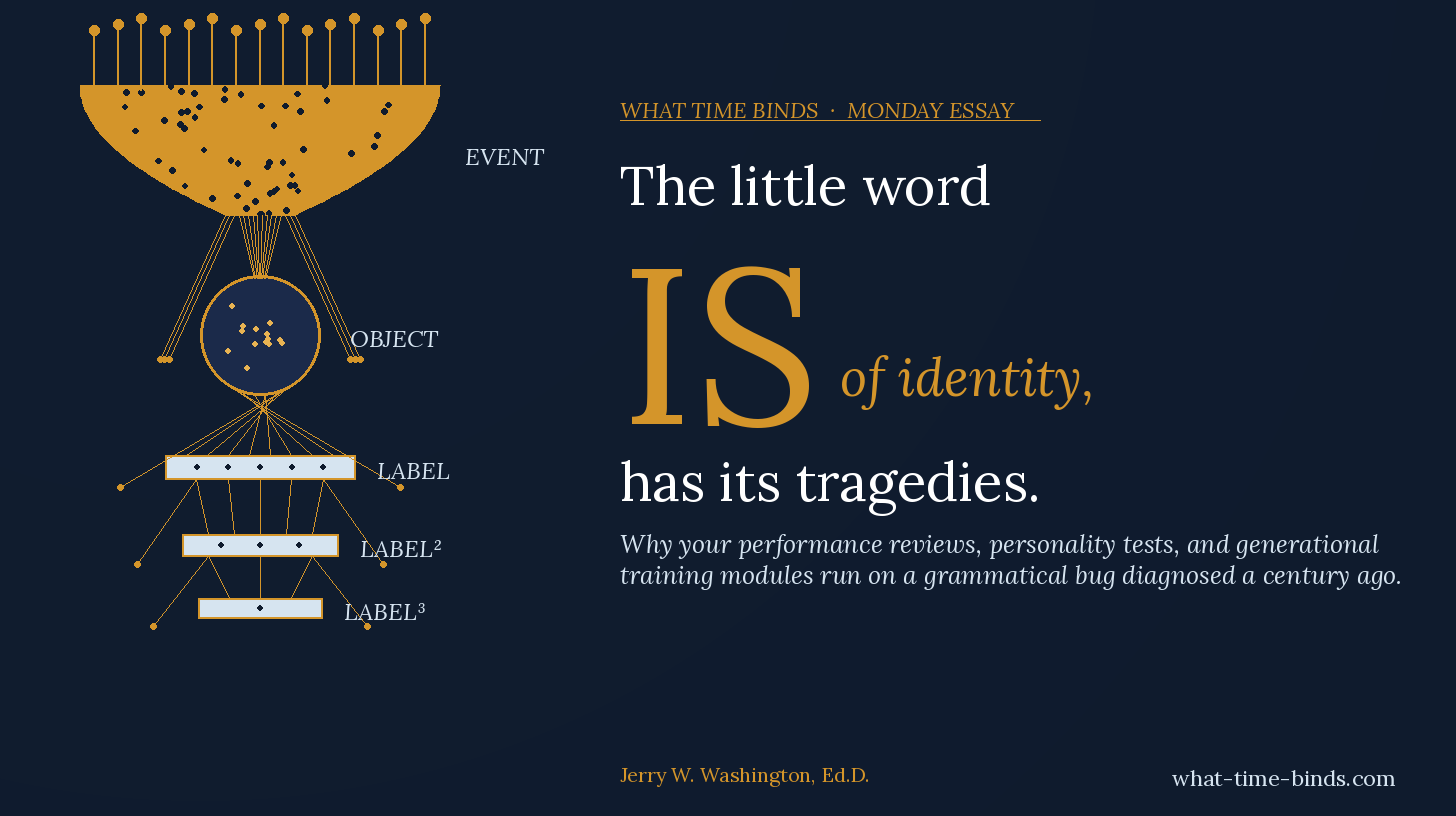
In 1923, George Santayana wrote that “the little word ‘is’ has its tragedies: it marries and identifies different things with the greatest innocence; and yet no two are ever identical.” A hundred and three years later, most leadership coaching, DEI workshops, generational training, and performance review calibrations still haven’t fixed what he diagnosed. A single three-letter verb quietly collapses the distance between what a person does and who a person supposedly is, and every org chart, every 360, every “he’s just not a team player” comment rides that collapse downhill into decisions that harden and compound.
This essay is for L&D and OD practitioners who already sense that the problem with their org’s communication isn’t necessarily tone or another offsite. The problem maps to the sentence level. It sits in the grammar. It has a century-long intellectual lineage almost nobody outside philosophy departments knows about. And it has never been packaged as something a team can actually install on a Tuesday morning.
That last point is where MRCI (Meaning Repair as Cognitive Infrastructure, the framework I built from a PRISMA-ScR scoping review of 131 academic sources) tries to earn its keep. I’ll get to what MRCI installs on Wednesday. Today I want to walk you through the lineage, because the history is the argument.
Korzybski patented a pegboard to fix a grammatical bug
In 1933, a Polish-American engineer named Alfred Korzybski published a 781-page book called Science and Sanity and told his readers, in effect, that most human misery comes from a mismatch between the structure of our language and the structure of reality. His most famous line — the map is not the territory — has survived as a Silicon Valley bumper sticker. The subtler part, the part that matters for leadership work, did not survive the trip.
Korzybski distinguished two faulty uses of the verb to be: the “is” of identity (Joe IS a fool) and the “is” of predication (the apple IS red). Both, he argued, produce “higher-order abstractions” that users then mistake for facts about the object. Joe, the living, changing, many-sided human, becomes frozen into fool, and the speaker forgets they did the freezing.
Korzybski built a physical training device, patented in 1925, called the structural differential, a pegboard of plates and strings where students could literally see how much gets stripped away each time we move from the event, to the object, to the first label, to higher labels about labels. His students called it “the semantic rosary.”
His remedy doesn’t attempt to ban “is.” He explicitly said the verb worked fine as an auxiliary or to indicate location. His remedy was consciousness of abstracting, the cortical delay between stimulus and label that lets you catch yourself mistaking your category for the thing. In 1965, Korzybski’s student D. David Bourland Jr. published the formal proposal for E-Prime, English minus every form of “to be,” arguing the identity and predication uses “immediately produce high-order abstractions that lead the user to premature judgments.”
None of this made it into mainstream L&D. It was too weird, too pre-WWII, too mimeographed. But the problem kept showing up under new names in new departments.
Philosophy picked up the thread and kept walking
Gilbert Ryle (1949) coined the category mistake — treating something as a member of a category it doesn’t belong to, like asking, after a tour of the colleges, “but where is the University?” Most organizational diagnoses (we HAVE a culture problem, she IS high-potential talent) are Rylean category mistakes: we treat emergent patterns as if they were objects with fixed properties.
Ludwig Wittgenstein’s Philosophical Investigations (1953) landed the deepest cut. “The meaning of a word,” he wrote, “is its use in the language” — not its reference to some essence, but what speakers actually do with it in the practices they live inside. Essentialism (categories as having hidden inner natures) was, for Wittgenstein, a grammatical illusion.
J.L. Austin’s How to Do Things with Words (1962) then showed that some utterances don’t describe reality; they do things. “I pronounce you married.” “It’s a girl.” These performative utterances create the conditions they claim to report. Judith Butler (Gender Trouble, 1990) built on Austin to argue that “identity is performatively constituted,” no pre-existing self behind the acts that “express” it; the acts produce the illusion of the self. When a manager says in calibration, “Marcus is just not strategic,” they aren’t reporting a fact about Marcus. They are placing Marcus into a category.
Round this out with Pierre Bourdieu’s Language and Symbolic Power (1991): classifications imposed by those with symbolic capital on those with less is a form of symbolic violence, a classification that looks like a description. And by the time you get to cognitive science, Rosch on prototypes, Susan Gelman’s The Essential Child (2003) — the verdict is overwhelming. Humans are wired to treat categories as having hidden essences. Children do it by age four. Adults under cognitive load do it more. And the verb to be is the delivery mechanism.
Where L&D and OD should have been paying attention
Here’s what ought to disturb anyone who runs leadership programs: the entire infrastructure of organizational talent management runs on grammatical structures the last hundred years of philosophy and cognitive science have demolished.
Personality typing reads as essentialism in a trench coat. The Myers-Briggs Type Indicator remains the most widely-used personality assessment on earth despite a 2025 Journal of Counseling & Development psychometric synthesis by Erford and colleagues, aggregating 193 studies from 1999 through 2024, documenting persistent reliability issues. Adam Grant’s 2013 critique (MBTI lacks predictive validity; Thinking and Feeling aren’t opposites) remains largely unrebutted. The deeper problem lies in the grammar. Calling someone an “ENTJ” or a “Strategic-Achiever-Learner” uses the “is of identity” to freeze a probabilistic tendency into a type.
Generational labels are worse. Cort Rudolph, Rachel Rauvola, David Costanza, and Hannes Zacher — the strongest critical voices in I-O psychology on this topic — have spent a decade dismantling generational research. Their 2022 Group & Organization Management piece carries the title “Generations, We Hardly Knew Ye: An Obituary.” Their 2023 Acta Psychologica paper argues observed differences “are more likely due to age and/or contemporaneous period effects” than to anything properly called generation. Pew Research announced in May 2023 that it was reducing its use of generational framing. The APA followed. And yet L&D teams keep building “managing across generations” modules that ontologically commit to Boomer, Gen X, Millennial, and Gen Z as real kinds. Ryle could have caught this in a seminar. (This ties to an article I’m drafting for BoldTimers)
Performance reviews leak essentialist language in ways we can now measure. Textio’s 2024 analysis of 23,000 performance reviews found women were 22% more likely to receive personality-based feedback; 56% had been described as unlikeable versus 16% of men; 78% had been called emotional versus 11% of men. Iris Bohnet and colleagues’ 2025 paper in the Journal of Economic Behavior & Organization documented persistent race gaps in manager ratings that survived even when self-ratings were hidden. “She IS emotional” performs Butler’s citation of a norm. “In the March client meeting she raised her voice twice and interrupted Jim three times,” describes an event a camera could have recorded. One sentence is E-Prime-adjacent. The other is symbolic violence in Bourdieu’s sense, a classification that looks like a description.
DEI language shifts partly got this right and partly didn’t. The move from a diabetic to a person with diabetes, the move toward identifies as rather than is — these wrestle, intuitively, with the “is of identity” problem. But most organizational DEI training didn’t theorize why the grammar mattered, so the practice drifted toward performative substitution (swap one noun for another) without installing the underlying discipline (question every “is”).
Competency frameworks read as essentialism with a rubric. Treating strategic thinking or executive presence as essences someone has or lacks, rather than as patterns of behavior in specific situations, repeats the move Rosch, Gelman, and Wittgenstein warned about. Bersin’s push toward “skills-based organizations” helps; skills behave more event-shaped than competencies. But as long as the language remains “Marcus lacks executive presence,” we haven’t actually left the structural differential’s upper plates.
The gap
Organizational scholars have circled this problem for thirty years without landing the plane.
Edmondson’s psychological safety describes the climate meaning repair needs to survive, the soil, not what to plant. Argyris and Schön’s Ladder of Inference, extended by Diana Smith and Bob Putnam’s Action Design, gives us the best diagnostic frame for how we treat conclusions as data — invaluable as a consulting tool, never packaged as a team protocol. Weick’s sensemaking describes how organizations construct rather than discover meaning. Schein’s humble inquiry and Herb Clark’s grounding point toward stance-level moves. Kegan and Lahey surface hidden commitments. Dweck’s mindset work addresses the “is of identity” at the level of individual self-talk. Naomi Ellemers gives us the strongest documentation that essentialist framing of workplace groups predicts discrimination.
Every major framework describes the problem. None hands a team a repeatable, sentence-level protocol they can run on a Tuesday at 2 p.m. to catch an “is of identity,” pause, and repair it before it becomes a decision. The field has a century of diagnosis and no widely adopted installable cognitive infrastructure.
That’s what MRCI tries to be. Drift → Suppression → Repair Activation → Outcome: a conversational sequence that behaves the way Korzybski hoped the structural differential would behave: as a training device that produces a cortical delay, turning a reflex into a choice.
On Wednesday, I’ll show you exactly what it installs. A 30-day audit. Three repair phrases your team can say out loud. One meeting run in something approximating E-Prime, once, as an exercise.
For now, the little word “is” still has its tragedies. Your performance calibration is not the person. The grammar you use to describe your colleagues writes your culture in real time, and you can edit it.
Wednesday, I’ll hand you the pen.
A related lineage runs through the AI tools L&D teams are installing right now, same grammatical bug, different delivery system. I’ll be unpacking that at the Spark AI Lab on April 30: five worldview lenses that decide what your AI sees, and what it misses. More soon.
Jerry W. Washington, Ed.D., works as an independent researcher whose framework, MRCI (Meaning Repair as Cognitive Infrastructure), derives from a PRISMA-ScR scoping review of 131 academic sources across philosophy of language, cognitive science, and organizational behavior. He writes on installable cognitive tools for teams at what-time-binds.com.
Your piece hit something I've been noticing from the other direction. You describe the damage of labels being placed on people — but I've also seen cases where labels are actively sought. Sometimes people reach for a diagnostic label or an identity category not because it describes their experience accurately, but because it becomes a tool: something to demand accommodation with, or to signal difference. And when that happens, the people who genuinely live with the condition get quietly crowded out. Their suffering becomes harder to voice, not easier, because the label has been repurposed by others.
It's a strange double bind. First the label freezes you. Then someone else picks up the same label as a weapon or an accessory, and now you can't even say "this is real for me" without being confused with the performance.
I also noticed something about the direction labels travel. The negative ones seem to stick almost instantly — one mistake and the label lands. The positive ones take much longer to arrive, if they arrive at all. I'm not sure whether that's a property of how organisations work or something deeper about how attention operates, but the asymmetry feels real.
What stayed with me most was a small everyday version of what you're describing. A restaurant gets praised on television. You go. The food doesn't quite match. But because the label "acclaimed" is already attached, you hesitate to trust your own tongue. Maybe you even talk yourself out of your own reaction. The label didn't just describe the restaurant — it quietly overwrote your judgment before you had a chance to form one.
That might be the part of your argument that has the widest reach. The "is of identity" doesn't only freeze the person being labelled. It can freeze the people around them too — replacing their own observation with whatever the label already decided.