

Author’s Note
I am running this piece outside the normal cadence.
The Wednesday WDYM Field Guide and the Friday Binding will still land on their days. This one goes up on Thursday morning because a state primary happened Tuesday, two viral posts framed it in opposite and equally dishonest directions by Wednesday afternoon, and the news cycle will move on by Monday.
Three months ago I wrote about Wesley Hunt’s House floor speech on May 13, 2026. That piece worked out the frame in full: magnet words, stocks and flows, two traditions, ecological levels. This special edition applies the same tools to what just happened in Florida. The tradition Hunt spoke from does not stop at one seat. This week it took a state.
If you have not read the Hunt piece, start there. This one runs at the same altitude and builds on the same terms.
Two posts about Byron Donalds moved through my Facebook feed yesterday afternoon. Both are from right-wing accounts.
The first came from an account called Mrlucky Ferguson. The text read: “OK PEOPLE SO WHO U GONNA VOTE FOR? 1. THE BLK MAN WHO IS A REPUBLICAN 2. THE WHITE MAN WHO’S A DEMOCRAT. SO WHO WILL BE FL NEXT GOVERNOR.” Four laughing-face emojis. A screenshot embedded below it quoted Gunther Eagleman, a right-wing X account: “Reading the democrat rulebook, in November, any democrat that doesn’t vote for the Black man for governor of Florida is racist.” The Donalds portrait in the image carries a Benny Show watermark. Benny Show is Benny Johnson’s right-wing program. Twenty-nine reactions. Thirty-three comments. Two shares. Three hours old.
The second came from an account called Anthony Aztek Liptow. The text read: “The racist Republicans just selected a BLACK candidate in a MAJORITY white district. Does their racism know any limits?” Sweat-smile emoji at the end. That emoji is the tell. The post is sarcastic. The image next to Donalds is a pie chart labeled “Registered Republicans in Florida,” white non-Hispanic at 80.5 percent. The chart is the punchline. The post’s structure, accusation-statistic-deflating emoji, is a right-wing account performing the left’s supposed argument to mock it. One hundred and eight comments. Three shares. Three hours old.
Both posts are running one play with two vehicles. Direct dare in meme one. Sarcastic imitation in meme two. Both convert Donalds’ primary win into the same claim: anti-racism now belongs to whoever votes for the Black conservative, and the charge of racial politics against the Republican Party is dead. Same political direction. Same conclusion. Opposite rhetorical technique. Both memes were produced to move Republican voters and to embarrass Democrats. That is the play.
Neither post mentions what happened inside the Republican primary itself.
What actually happened Tuesday
Byron Donalds won the Republican gubernatorial primary in Florida on August 18, 2026, with roughly 49 percent of the vote against ten opponents. Jay Collins finished second. Paul Renner third. James Fishback fourth. The Associated Press called the race Tuesday evening. Donalds will face David Jolly in November. Jolly, a former Republican U.S. representative for Tampa Bay from 2014 to 2017, registered Independent in 2018 and re-registered as a Democrat in June 2025. He won the Democratic primary handily.
At 5:22 a.m. Eastern on primary day, seven and a half hours before polls opened, Donald Trump posted on Truth Social: “Florida, Vote for Byron Donalds for Governor. He has my Complete and total Endorsement. He will never let you down! President DJT.” The original endorsement came in February 2025, the day Donalds announced. Ron DeSantis, the term-limited incumbent, declined to endorse Donalds and said publicly: “You got a guy like Byron. He just hasn’t been a part of any of the victories that we’ve had here.”
Donalds raised $7.1 million by April 1. His nearest primary competitor, Renner, raised $617,000. Collins raised $388,000. Fishback raised $298,000. On primary night, Donalds thanked voters and said: “By working together, we can make Florida more affordable and defend the Florida Dream.” If elected in November, he would be the first Black governor in Florida history, and the first Black Republican elected governor in the United States. Only three Black governors have ever been elected in American history: Douglas Wilder in Virginia in 1990, Deval Patrick in Massachusetts in 2007, Wes Moore in Maryland in 2022. All three are Democrats.
That is the primary. That is what Tuesday actually contained.
The words that carried him here
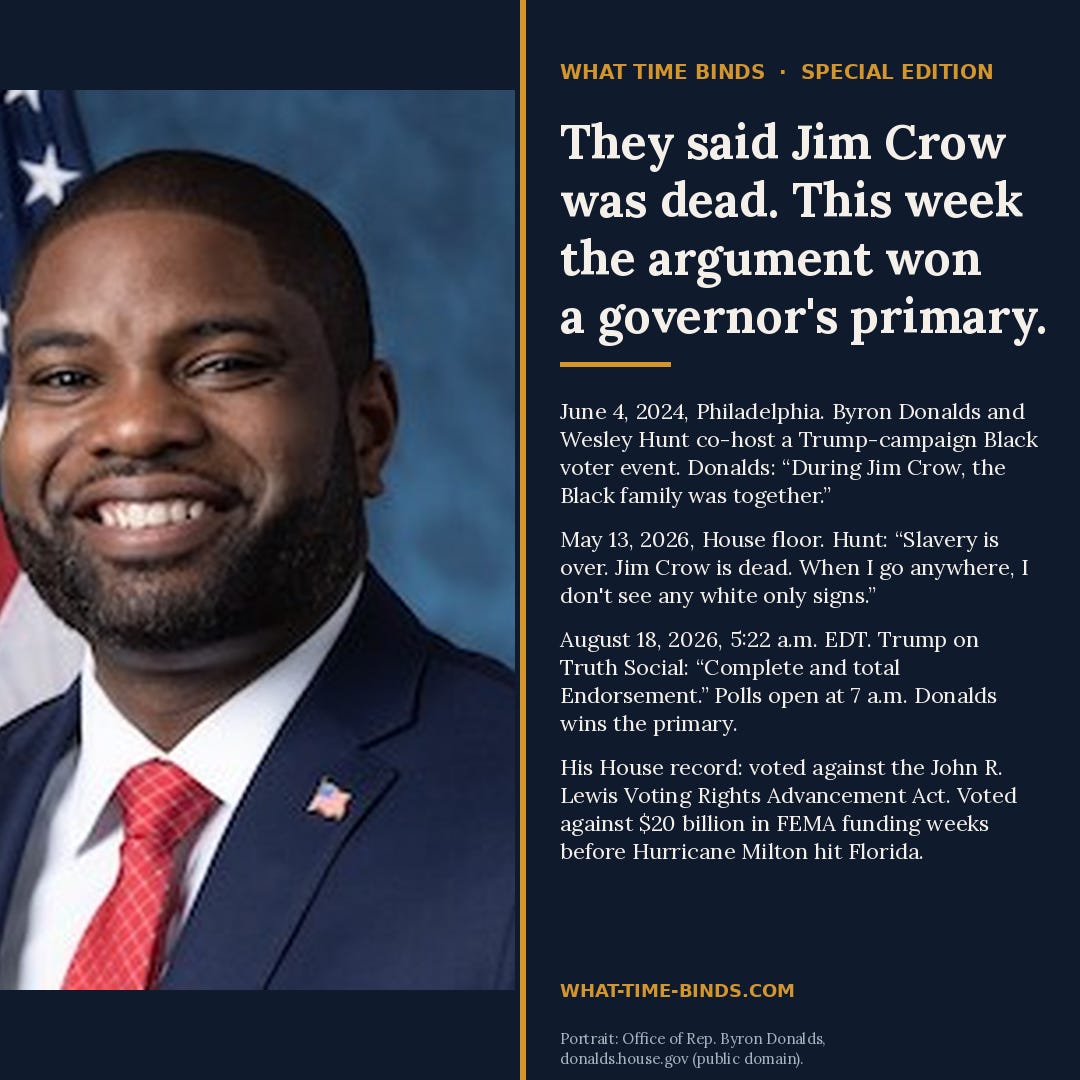
On June 4, 2024, Donalds spoke at a Trump campaign event in Philadelphia called “Congress, Cognac, and Cigars.” The event was pitched as Black voter outreach. He co-hosted it with Representative Wesley Hunt of Texas. The two men are not parallel figures moving in the same tradition. They are partners on the same tour.
The Washington Post transcribed what Donalds said:
“During Jim Crow, the Black family was together. During Jim Crow, more Black people were not just conservative — Black people have always been conservative-minded — but more Black people voted conservatively.”
House Minority Leader Hakeem Jeffries called the statement “factually inaccurate,” “outlandish, outrageous and out-of-pocket.” Donalds spent the following week clarifying that he had not said Black people were better off under Jim Crow. He said his point concerned family structure after the Johnson-era welfare policies. That was his defense.
Read the sentence again. The phrase doing the work is the Black family was together. The frame assigns a moment of relative Black family strength to the era of legally enforced racial subordination. The sentence works only if the reader treats Jim Crow as one variable in a larger sociological picture and treats family cohesion under coercion as a positive rather than a symptom of coercion.
Eleven months later, on May 13, 2026, Hunt stood on the House floor and told the country that slavery was over and Jim Crow was dead. Ninety-seven days after that, Donalds won a Republican gubernatorial primary with the President of the United States posting his complete and total endorsement seven hours before the polls opened.
The two men said the same thing at different volumes at different addresses. Donalds nostalgized the era. Hunt buried it. Both moves do the same job. They let the Black conservative speaker take the argument about racial subordination in America and close it, using his own body as the seal.
What both memes refuse to say
The Republican primary Donalds won did not treat him as a colorblind conservative.
On January 11, 2026, James Fishback, a candidate in the GOP primary later endorsed by Tucker Carlson, quote-tweeted a post mocking Donalds’ name as “By’rone” and added: “By’rone wants to turn Florida into a Section 8 ghetto.” Fishback later called Donalds a “SLAVE who was auctioned off for $31 million” and claimed Donalds had no standing to complain because his mother is Caribbean. Carlson endorsed Fishback anyway and said: “James Fishback is running for governor in Florida. Pretty soon, all winning Republican politicians will talk like this.”
Fishback finished fourth. Donalds won.
Both memes come from the same political side that produced Fishback. Neither meme mentions him. Neither can. The racism-inversion play works only if the reader does not remember that Tucker Carlson endorsed a candidate who called Donalds a slave inside the primary the memes are celebrating. The Mrlucky Ferguson dare and the Anthony Aztek Liptow performance both collapse the moment Fishback enters the room, because both memes rest on the claim that anti-Black racism now belongs to the other side. The actual record is that the racism in the primary Donalds just won came from inside his own party, from a Tucker Carlson-endorsed candidate, and Republican primary voters chose Donalds over him. That is a real thing to say about the primary. It is not a thing either meme can say.
Both memes also have to leave out what Donalds himself said in Philadelphia in June 2024 about Jim Crow. Both memes have to leave out what Hunt said on the House floor in May 2026 about Jim Crow being dead. Both memes have to leave out that Trump endorsed Donalds seven hours before the polls opened. Both memes have to leave out that DeSantis did not endorse him at all. Both memes have to leave out the actual policies a Florida governor decides.
The memes are engineered to make the reader stop before any of that reaches the argument.
Same play, bigger board
Hunt was one seat. He represented Texas’s 38th Congressional District, drawn by the state legislature after the 2020 census to elect a Republican. He stood on the House floor for sixty seconds and dismissed the idea that Jim Crow persists. That was the play at the scale of one representative.
Donalds is a state. Florida has 23 million residents, 4.5 million K-12 students, a property insurance market in extended crisis, a Medicaid program the current administration declined to expand, a state university system in the middle of a legislated dismantling of DEI offices, and thirty electoral votes in every four-year presidential cycle. The Florida governor sits on the state cabinet, appoints agency heads, signs or vetoes the budget, calls out the National Guard, and controls the executive branch of the third-largest state in the country. That is the play at the scale of a governor.
Same accommodationist tradition. Same rhetorical machine. Same use of a Black conservative speaker to close the argument about structural racial politics. One order of magnitude up in governing authority.
The Republican Party is running four Black congressmen out of the U.S. House in a single election cycle. Donalds is leaving for the Florida governor’s race. John James is leaving for Michigan governor. Burgess Owens and Wesley Hunt are leaving for other statewide bids. All four seats leave the House Republican Conference’s Black membership at zero after January 3, 2027. In the same year, the Congressional Black Caucus is on track to lose roughly a third of its members because of the Supreme Court’s Louisiana v. Callais decision and the redistricting it authorized. The party is placing individual Black candidates in high-visibility statewide races while the total number of Black seats in Congress falls.
That is a coordinated deployment, not a coincidence. It is a strategy the two memes cannot describe, because the strategy runs at a level of institutional coordination neither meme sees.
What a governor decides
A U.S. representative casts votes and gives speeches. A governor decides what a state does.
Donalds’ campaign platform sits on his own site under headings like “Insurer Scorecard,” “Zero Tolerance, Zero Dollars,” “Your Doctor, Your Price,” and “Student Success Plans.” His stated positions include modernizing Florida’s property insurance regulatory framework, which he says has not been substantially updated in 25 years and which he claims his approach could cut rates by up to 20 percent. He has led on school choice through Hope Scholarships. He voted against certifying the Arizona and Pennsylvania electoral votes on January 6 and 7, 2021. He voted against the Freedom to Vote: John R. Lewis Act. He voted against the September 25, 2024 continuing resolution containing $20 billion for FEMA, weeks before Hurricane Milton hit Florida. His stated reason: FEMA had become “a pet project for a lot of other different funds.”
Jolly’s platform on the same insurance question is a state catastrophic fund removing hurricane coverage from private insurers, funded at $30 to $40 billion, which he claims could cut private premiums by 60 to 70 percent. His campaign lists reproductive freedom, gun violence prevention, community public schools, campaign finance reform, and gerrymandering reform.
Those are the actual choices facing Florida voters in November. Insurance market restructuring. Medicaid expansion. Voucher expansion or contraction. DEI office elimination or restoration inside the state university system. Redistricting posture. Disaster funding posture. Voting rights posture. Board of Governors appointments. The next Florida Supreme Court seat.
None of that appears in either meme.
The primary question
Here is the strongest version of the objection this piece invites. Byron Donalds is a Black man. He just won a Republican gubernatorial primary in Florida against multiple white opponents, including one (Fishback) who attacked him racially. Republican primary voters had a chance to choose the race-baiter and did not. They chose Donalds. If the party is racist as an institution, doesn’t this outcome disprove it? Isn’t this what the civil rights movement was working toward?
The question is worth taking seriously because most people are not asking it in bad faith. The answer requires two schemas.
A primary offers a slate. Voters pick from the slate. The slate is not what the voters produce. The slate is what the party’s institutional gatekeeping produces. Trump endorsed Donalds in February 2025, the day he announced. Trump’s donor network moved. National Republican organizations backed him. He raised $7.1 million by April 1, more than eleven times what any competitor raised. He entered primary day with double-digit polling leads across the field. The choice a Republican primary voter had on Tuesday was between a heavily-resourced, presidentially-endorsed Black frontrunner and a race-baiting Tucker Carlson-endorsed longshot at 4 percent in July polling. Those are the two candidates the party’s institutional pathway produced. That the voters chose the frontrunner over the longshot tells us about the slate the party built. It does not settle the question the objection was pointing at.
A Black conservative winning a Republican primary is what the accommodationist tradition looks like when it works. The tradition has always required a Black speaker who takes the argument about racial subordination and closes it. That speaker’s Blackness is the thing that lets him do the work. Booker T. Washington did it in 1895. Clarence Thomas has done it from the Court since 1991. Wesley Hunt did it on the House floor three months ago. Donalds is running the speech at the scale of a state right now. In each case, the Black candidate’s success inside the party is part of the argument the party is making, not a refutation of it. The party runs the play because the play requires the candidate.
The precedent from the prior piece holds. The Court replaced Thurgood Marshall with Clarence Thomas, and Thomas has voted to dismantle the legal architecture Marshall built. The party got a Black justice. The policy direction ran the other way. A Republican Florida governor’s mansion held by Donalds performs the same function at a bigger scale. If he governs the way he has voted in the House on FEMA, on the John R. Lewis Act, on the January 6-7 certification, Black Floridians will see less voting protection, less disaster funding, less federal cooperation. His election would function against the Black political voice the movement worked toward.
The objection is real. The answer is that a Black man winning a Republican primary tells us what the party’s slate looked like. It does not tell us what a Black governor of that party would do with power. On the second question, the record is already available. Read it.
The tradition, updated
The prior piece traced two traditions inside Black American political thought. The accommodationist tradition runs from Booker T. Washington’s Atlanta Compromise in 1895 through Clarence Thomas through Ben Carson. The political-rights tradition runs from W.E.B. Du Bois through Thurgood Marshall through Fannie Lou Hamer through Sherrilyn Ifill. That timeline had Wesley Hunt as its most recent Accommodationist entry, dated May 13, 2026.
The updated timeline has Byron Donalds as the next entry, dated August 18, 2026. He earns the entry as the next public deployment of the same play at a bigger board. The tradition has run for 130 years. It is arriving at its logical destination: a candidate whose biography and Blackness serve as the party’s answer to the charge of racial politics, at the scale of a state whose governor writes real policy for real people.
The two memes I woke up to yesterday will not survive that reckoning. They will not survive the Fishback story, which sits inside the primary they are celebrating. They will not survive the Philadelphia quote from June 4, 2024, which is Donalds in his own words. They will not survive the actual Florida governance questions Donalds will face if he is elected. The memes are designed to prevent the reader from arriving at any of those.
What to do
Read the sentence Donalds said in Philadelphia in June 2024. Read the sentence Hunt said on the House floor in May 2026. Read the timing of Trump’s endorsement, 5:22 in the morning on primary day. Read Fishback’s tweet from January. Read Donalds’ vote against the FEMA appropriation before Hurricane Milton. Read Jolly’s actual policy positions, not just his party switch. Read the campaign platforms, not the memes.
Then vote. If you live in Florida, the November 2026 gubernatorial election decides the next four years of state policy on insurance, health, education, and everything a governor actually controls. Register, check your status, and find your polling place at vote411.org.
You refuse to know. The record remembers. I refuse to forget.
Sources
Where I Fit — a note on this piece’s sources.
Primary source records: Trump’s Truth Social endorsement, August 18, 2026; Byron Donalds’ campaign platform, byrondonalds.com; David Jolly’s campaign platform, davidjolly.com; Louisiana v. Callais, U.S. Supreme Court, April 29, 2026.
Primary election coverage: Forbes on the AP call; WLRN on Jolly’s Democratic primary win; News4Jax on Donalds’ primary night statement; Wikipedia on candidate financials and the pre-primary field; Time profile of Donalds.
Trump endorsement history and DeSantis quote: Roll Call, February 25, 2025.
Donalds’ June 4, 2024 Jim Crow remarks: Washington Post; PolitiFact fact-check; CNN.
Wesley Hunt: the WTB piece from May 14, 2026; The Grio on Hunt and the four Black House Republicans leaving Congress, April 30, 2026.
Fishback attacks and Carlson endorsement: Yahoo News; ms.now on the “SLAVE” post and the Caribbean-heritage attack.
Donalds’ Congressional voting record: Ballotpedia; Newsweek on the September 25, 2024 FEMA vote and his statement on Hurricane Milton.
Historic context on Black governors: The Hill.
CBC losses under Callais redistricting: NBC News.
Insurance platform comparison: Insurance Business Magazine.
Byron Donalds’ campaign platform: byrondonalds.com. David Jolly’s campaign platform: davidjolly.com. The prior WTB piece on Wesley Hunt: “Slavery is over. Jim Crow is dead.” — The Week Wesley Hunt Said It (May 14, 2026).
Great essay and review of the situation and election. Lived in Floriduh for way too long and was always dismayed that the people continuously voted against their own best interest. Basically became a total red state for 25 years, leaning into the Confederacy “heritage” (yes lots of rebel flags and hate) , with every issue created by republicans, yet still voting them in. Amazing acts of group cognitive dissonance….