


On Wednesday, May 13, 2026, Representative Wesley Hunt of Texas spoke at a House Judiciary Subcommittee on the Constitution and Limited Government hearing. He spoke as a Black Republican congressman from a white-majority district. He spoke as the great-great-grandson of a man born on a plantation. He spoke to dismiss Representative Steve Cohen of Tennessee, who had told the hearing that “Jim Crow is alive and well” after the redrawing of Tennessee’s congressional map.
That same week, NBC News reported, NBC News published a story reporting that the Congressional Black Caucus is expected to lose roughly a third of its members because of the Supreme Court’s Louisiana v. Callais decision of April 29, 2026, which effectively gutted Section 2 of the Voting Rights Act. Six days earlier, on May 7, Tennessee Republicans dismantled the majority-Black Memphis congressional district. The day before Hunt spoke, Tennessee’s House Republican Speaker stripped Democratic lawmakers of every committee assignment as discipline for protesting the redistricting on the floor.
This is the week Hunt chose to tell the country that Jim Crow is dead.
What he actually said
“I’m seeing a lot of talk from my colleagues on the left, too, as we shift toward this reinvigorated talk about Jim Crow and the past of this country. And as someone who was a direct descendant of a slave, as someone whose great-great-grandfather was born on a plantation, I can assure you, slavery is over. Jim Crow is dead. When I go anywhere, I don’t see any white only signs. I don’t, I promise you. I am a black man that represent a white majority district in Texas. The great, great grandson of a man born in the plantation stands before you today as a proud conservative Republican from Texas. As a believer and follower in Christ, and as a believer in what this country can be if we allow equality for not just Muslim Americans, not just Buddhist Americans, but also Christian Americans like yourself.”
Read it twice. The speech is doing several distinct things at once. Each is worth naming.
The words doing the work
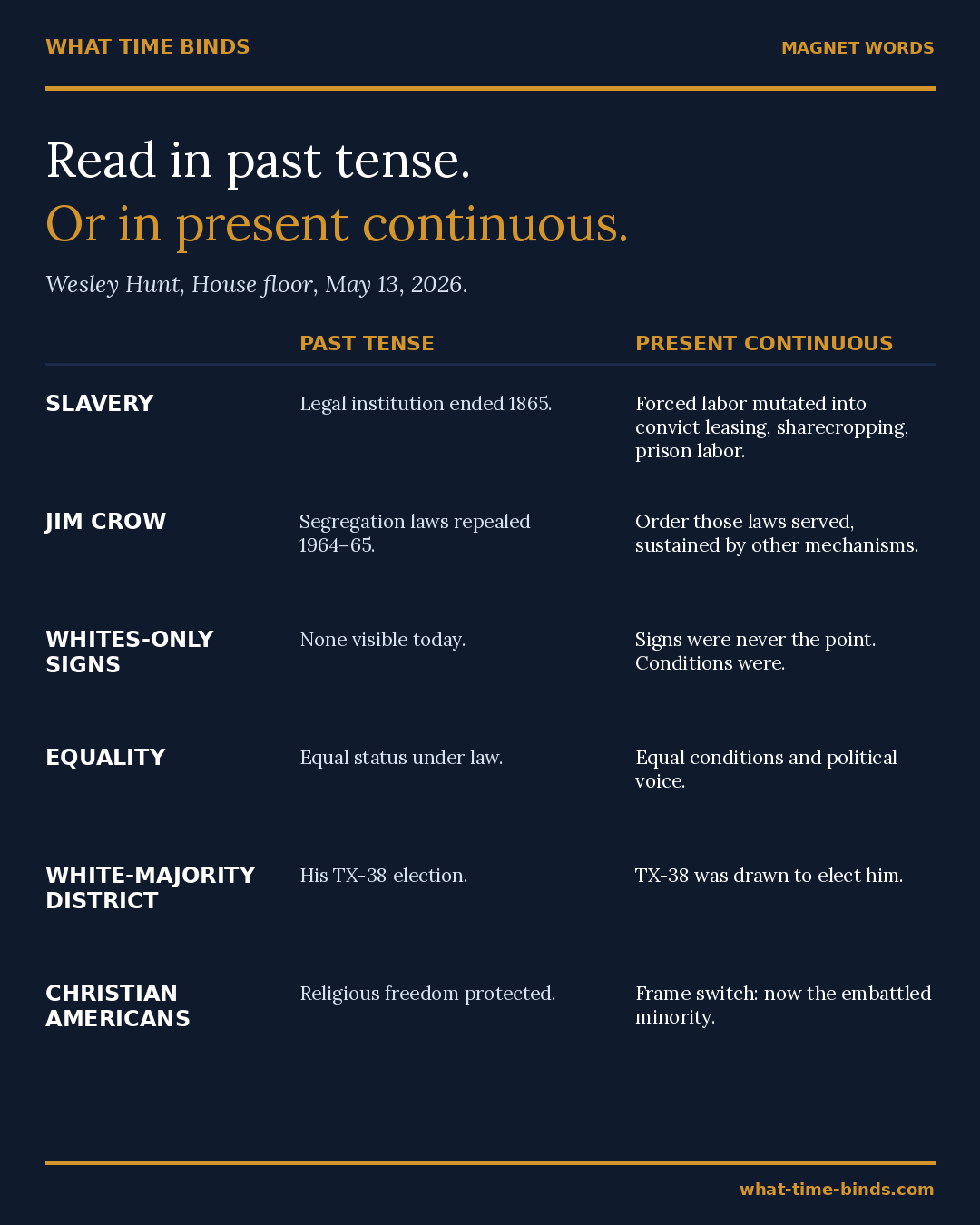
There are at least seven magnet words in those sixty seconds. A magnet word is one that pulls listeners toward different meanings without anyone noticing they have disagreed.
Slavery. The legal institution of chattel bondage ended in 1865. The system of forced and exploited labor it served continued through convict leasing, sharecropping, debt peonage, and prison labor. The word covers both. Hunt’s sentence works only if “slavery” means the legal institution.
Jim Crow. The formal segregation laws were repealed in 1964 and 1965. The political and economic order those laws served can be sustained through other mechanisms: voter ID rules, polling place closures, felony disenfranchisement, residential segregation by mortgage policy, school funding by local property tax. Hunt’s sentence works only if “Jim Crow” means the signs and the statutes, not the system they served.
Whites only signs. This is the measurement test Hunt sets. Visible, named, legal exclusion. By that bar, no jurisdiction in America has Jim Crow. By any other bar (outcome bar, mechanism bar, descendant-disparities bar), the question is open.
Equality. Equal status under law, mostly met. Or equal conditions and political voice, measurably not. Both meanings are available. The speech needs the first.
A white majority district in Texas. Hunt offers his election as evidence the system is fair. The district was created in the post-2020 census redistricting and drawn specifically to elect him. Houston Public Media reported in 2022, citing Texas Southern University political scientist Michael O. Adams: "State Republican lawmakers drew the 38th with Wesley Hunt specifically in mind." The district is 63 percent white. He is a product of the same redistricting machinery now being deployed against other Black members of Congress. He is the first Black Republican to represent the Houston area in Congress since Reconstruction. That fact does not refute structural racial politics. It demonstrates how structural racial politics work.
Christian Americans. The last sentence pivots. Discrimination’s victims are no longer Black Americans, whose claims Hunt has just dismissed. They are Christian Americans, whose claims he is about to advance. The mechanism in both directions is the same: a group is presented as the victim of discrimination most listeners can’t directly see. The difference is which group qualifies.
The past of this country. This is the temporal placement that makes the whole speech work. If slavery and Jim Crow are in the past, the present is a different country. If they are mechanisms still operating through different vehicles, the present is the same country with new uniforms.
The bar he set
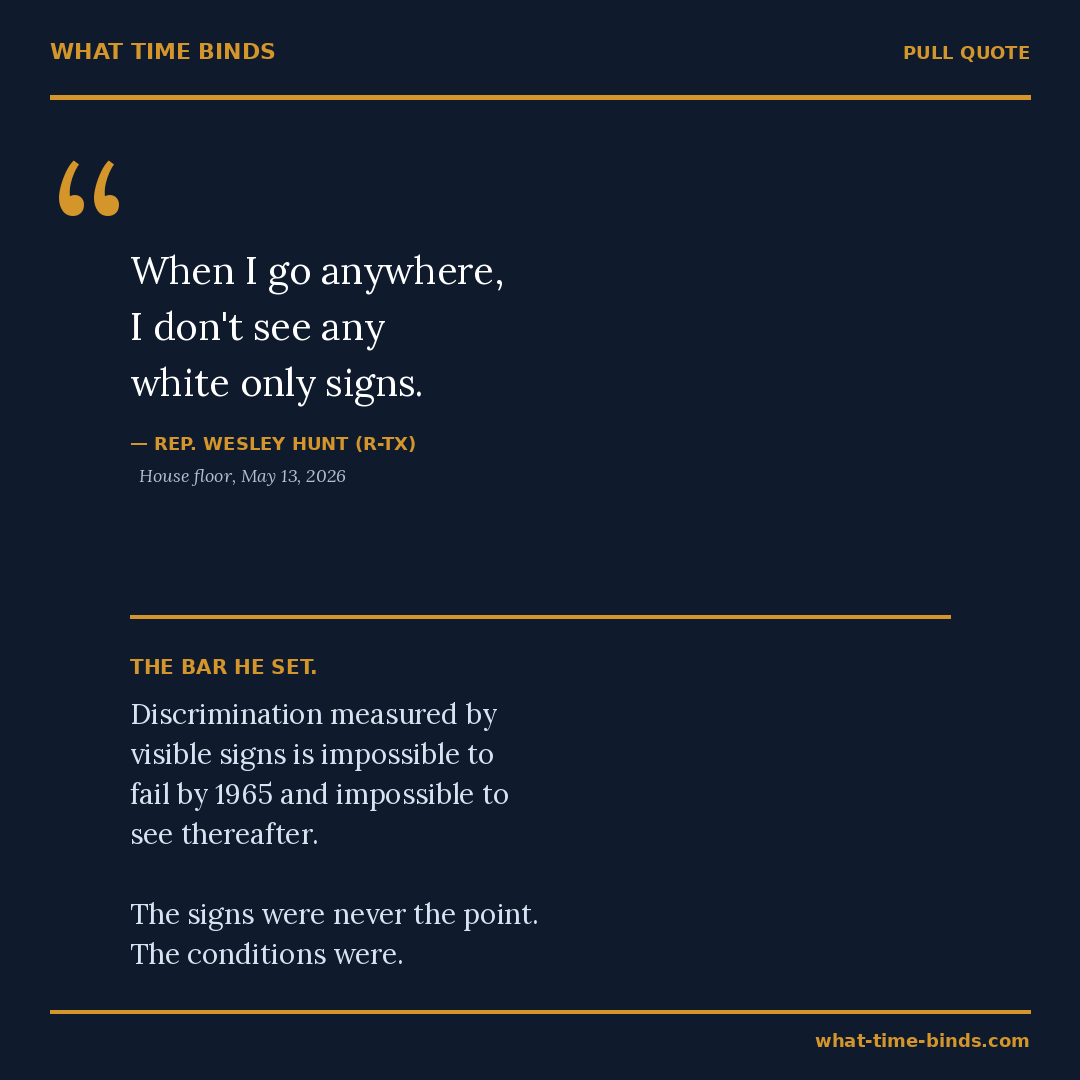
The “whites only signs” line does the heaviest rhetorical lifting in the speech. Hunt sets the bar for discrimination at legal, named, signed exclusion. By that bar, racism has not existed in any American jurisdiction since the Civil Rights Act and the Voting Rights Act.
The bar is impossible to fail because it was designed that way. The 1964 and 1965 acts did not promise to end the conditions that segregation produced. They promised to end the legal regime of segregation itself. They ended the regime. They could not, by their own terms, end the wealth disparities, the housing patterns, the school funding structures, or the political map-drawing that the regime had built up over the previous century.
Setting the bar at signs is a category move. It transfers the question from “what conditions exist” to “what laws are on the books.” Most listeners do not notice the transfer.
The district question
Here is the strongest version of the objection the speech invites: Republicans in Texas drew a white-majority district. White voters elected a Black candidate. The Black candidate now represents them in Congress. Whatever you think of his politics, the outcome is what the civil rights movement was working toward. Doesn’t this end the structural argument?
It does not, and the reason is worth getting right.
A district draws a seat. A candidate fills the seat. The party that draws the district selects the candidate whose biography maximizes its rhetorical position. Hunt’s biography (Black, West Point graduate, Apache pilot, conservative Christian) is useful to the party as a counter to charges of racial bias in party policy. The district is the structural fact. The candidate is the political fact. They are not the same fact.
The question to follow is what the candidate then votes for. On civil rights and voting rights questions, Hunt’s record places him with his party. The party defended the Louisiana maps the Supreme Court struck down in Callais. The party is now drawing maps in Texas, Tennessee, Florida, Missouri, North Carolina, and Ohio designed to eliminate seats currently held by Black members of Congress. Hunt’s vote on those questions runs against the interests of the Black voters in districts being eliminated. One Black representative in a Republican-drawn seat does not offset the elimination of Black representation in many other seats. The math does not balance.
There is a precedent for the move. The Court replaced Thurgood Marshall on the bench with Clarence Thomas. Thomas has voted, repeatedly, to dismantle the legal architecture Marshall built. The party gets to claim a Black justice while the policy direction runs the other way. Hunt’s seat performs a comparable function at the legislative scale.
What the civil rights movement was building was Black political voice. A Black representative whose votes weaken that voice is not building it. The seat by itself does no political work.
Two ways of seeing
The speech sits inside a longer argument about how to read American racial conditions. There are two coherent ways of looking, each with evidence, each with an intellectual tradition.
The first reading: America is a contest with rules. The rules used to be unfair. The rules were fixed in 1964 and 1965. If you do not succeed under the new rules, the explanation is in you. The fact that some Black Americans now succeed proves the rules now work. Wesley Hunt is the proof.
The second reading: America is a system that produces patterns. The pattern-producing mechanisms used to be visible and legal. They became less visible and stayed legal after 1965, then kept producing patterns through different mechanisms. Individual success does not refute the pattern. It sits inside it. Wesley Hunt is the proof.
Both readings have evidence. Both have intellectual lineages inside Black thought. Both produce coherent politics. They answer different questions.
Hunt’s speech runs a specific move. It uses the answer to the first reading’s question (can a Black person succeed in America?) to declare the second reading’s question (do Black Americans as a group experience patterns descended from slavery and Jim Crow?) settled. The two questions are not the same. They are not substitutes. The speech treats them as if they are.
Through the levels
A useful way to see how an individual story scales into a public claim is to walk it up through the levels of setting at which a person lives.
At the level of the immediate setting (family, church, school, workplace), Hunt’s frame is consistent with his experience. His father served in the military. He attended St. John’s School in Houston, then West Point, where he commissioned in 2004. He flew Apache helicopters in Iraq. He earned graduate degrees at Cornell. He attends Champion Forest Baptist Church. Every setting reinforces the same theory: effort and discipline produce outcomes. Nothing in his immediate environment pushes back on the theory.
At the level of connected settings, the same coherence holds. Military, school, family, and church carry one theory of how the world works. The settings reinforce each other.
At the level of settings he does not directly participate in but which shape his life: Fox News carried this speech within hours. The Republican Party promotes Black conservatives because their voices neutralize charges of racial bias against party policy. The Texas Legislature drew the lines of TX-38 specifically to put a Republican in the seat. Hunt is the seat’s first occupant. The institutions that surround him reward exactly the message this speech delivers.
At the level of the broader cultural script: post-racial America. The legal achievement of formal equality. The fusion of conservative-Christian-Republican identity as the pattern of a model citizen. The macro-script tells the same story Hunt’s micro-story tells.
The level that does most of the work is the level of time. Hunt collapses 1865, 1965, and 2026 into one settled question. The actual content of those years (that wealth, housing, school quality, incarceration patterns, and political representation measured today are accumulated effects of 246 years of slavery and 100 years of legalized segregation) disappears from the frame. The chronological compression is the magic trick.

What persists when the flow stops
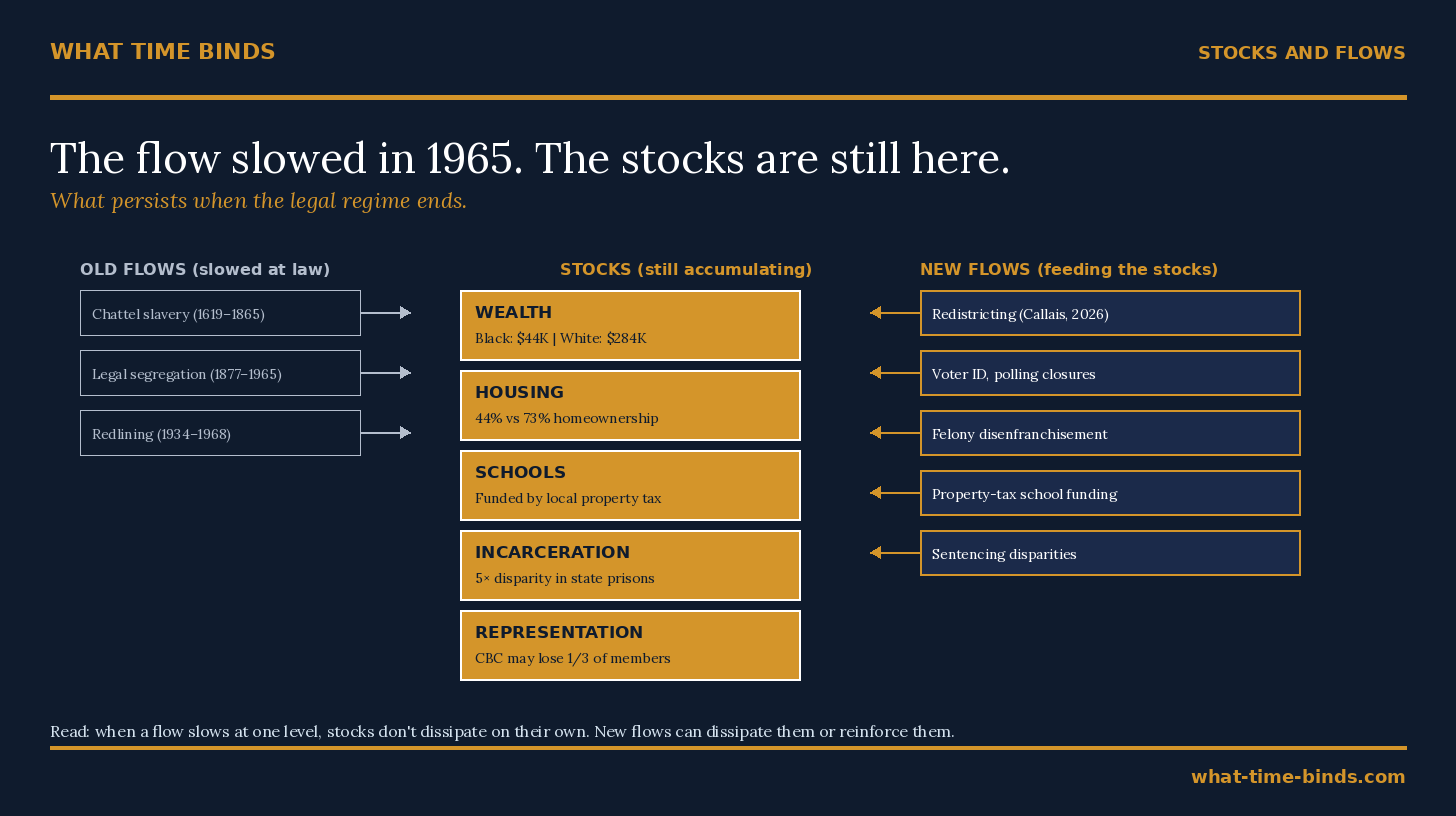
There is a simple systems concept that makes the disagreement concrete. Stocks and flows.
A stock is an accumulation. Wealth is a stock. Residential patterns are a stock. School quality is a stock. Incarceration legacy is a stock. Political representation is a stock.
A flow is a process that fills or drains a stock. Labor markets flow into wealth. Mortgage policy flows into residential patterns. School funding flows into school quality. Sentencing policy flows into incarceration legacy. Map-drawing flows into political representation.
Chattel slavery was a flow into multiple stocks for 246 years. Legal segregation continued that flow for another century. The legal regime ended in 1965. The flow at the legal level slowed.
The stocks did not disappear. Stocks do not disappear when flows stop. They drain at whatever rate their own dynamics permit. Residential segregation reproduces school segregation. School quality reproduces wage gaps. Wage gaps reproduce wealth gaps. Wealth gaps reproduce political access patterns. The stocks reinforce each other.
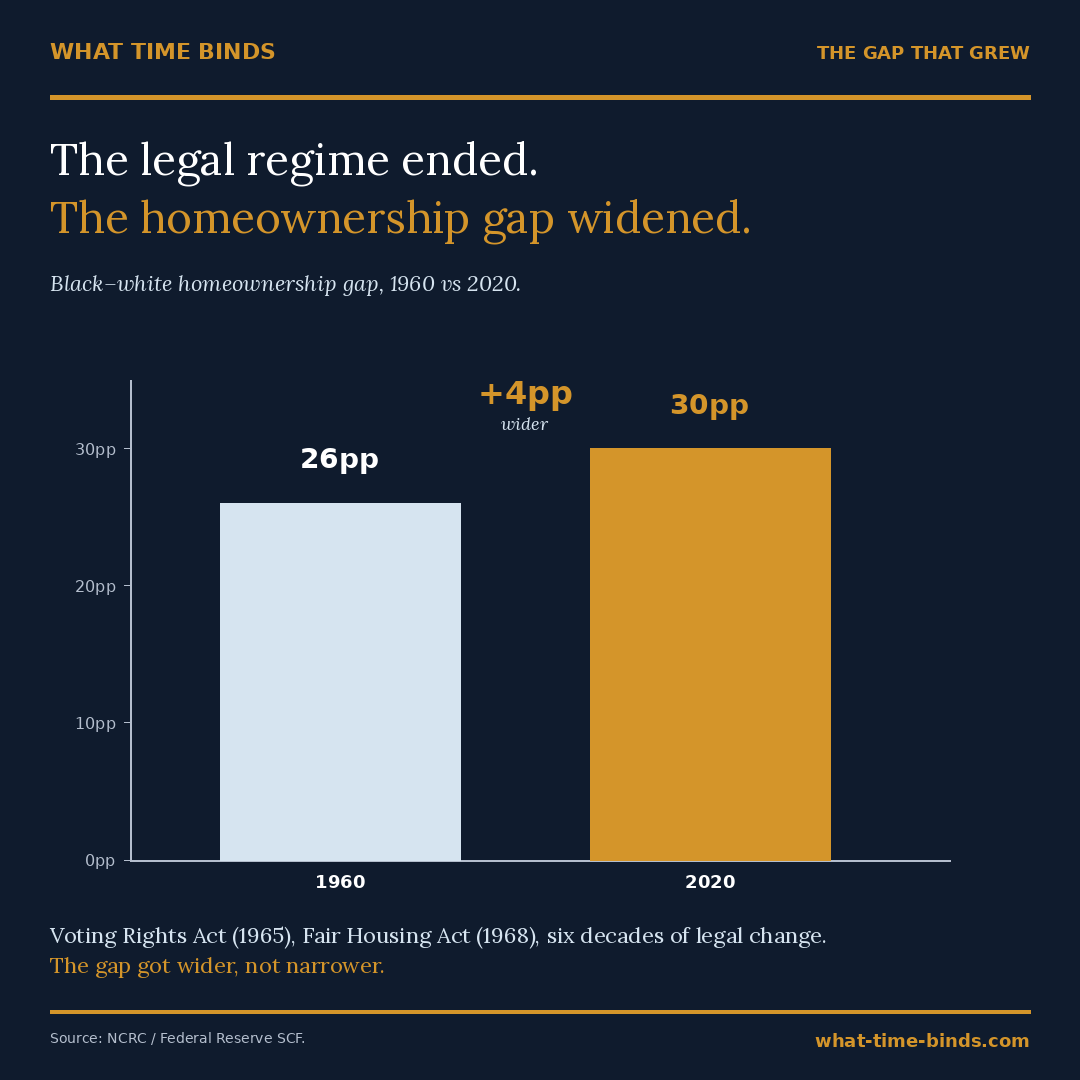
The Federal Reserve’s 2022 Survey of Consumer Finances shows median Black household wealth at $44,100 and median white household wealth at $284,310. Black households hold roughly 15 cents for every dollar of white household wealth. That gap has been virtually unchanged from 1992 to 2022. Black homeownership stands at 44 percent against 73 percent for whites. The homeownership gap actually widened from 26 percentage points in 1960 to 30 percentage points in 2020.
Those numbers are stocks. They are the residue of the flow that Hunt says is over. The flow slowed at the legal level. The stocks are still here.
What is new is a set of additional flows that can either dissipate or reinforce the stocks. Redistricting is a flow. Voter ID rules are a flow. School funding by local property tax is a flow. Felony disenfranchisement is a flow. The Louisiana v. Callais ruling did not end the older flows. It opened space for new flows in a particular direction.
That is what people who say “Jim Crow 2.0” are saying. They are not claiming that whites-only signs are back. They are claiming that the new flows feed the same stocks.
The tradition Hunt is in
Hunt is not an outlier. The accommodationist position has a long lineage inside Black American thought, and it deserves an honest accounting.
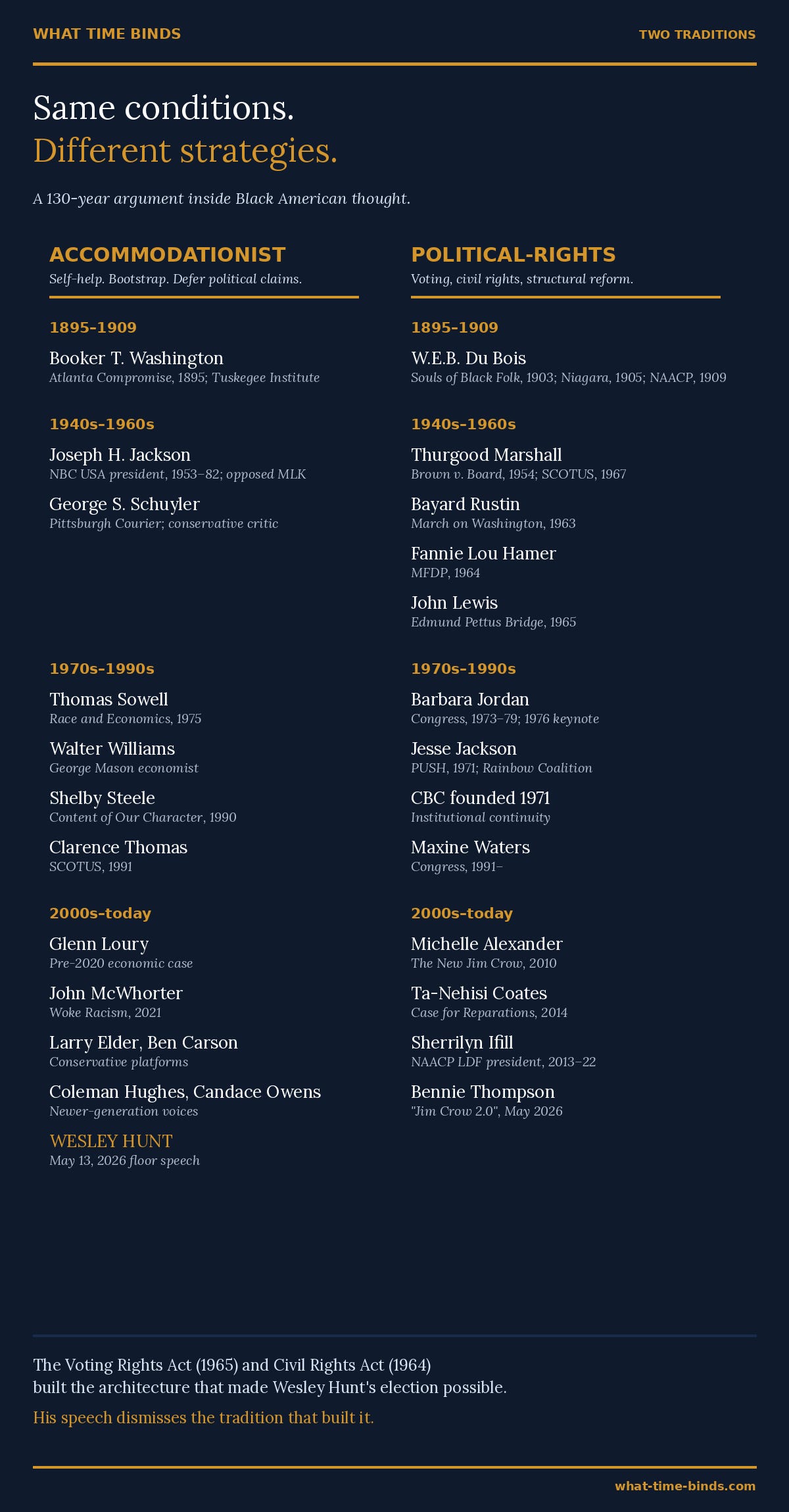
In September 1895, Booker T. Washington delivered what would later be called the Atlanta Compromise speech. He told a southern audience that Black Americans would accept political and social separation in exchange for vocational education and economic opportunity. His program built Tuskegee Institute and shaped a generation of Black educators. He was, in his time, the most powerful Black American in public life.
W.E.B. Du Bois responded in 1903 with The Souls of Black Folk. He argued that Washington’s program traded political rights for industrial training and would leave Black Americans permanently subordinate. He founded the Niagara Movement in 1905 and co-founded the NAACP in 1909. He argued for what he called the Talented Tenth, the educated leadership class that would press for civil and political rights.
The two men were responding to the same conditions. They disagreed about strategy. The disagreement has run continuously inside Black American thought for 130 years.
Through the twentieth century, the political-rights tradition produced the legal architecture that opened American civil society to Black Americans on something closer to equal terms. The NAACP litigated Brown v. Board. Bayard Rustin organized the March on Washington. Fannie Lou Hamer testified at the 1964 Democratic Convention. John Lewis crossed the Edmund Pettus Bridge. Thurgood Marshall took a seat on the Supreme Court. The Voting Rights Act passed.
The accommodationist tradition continued in different forms. Thomas Sowell’s economic writing in the 1970s and 1980s argued that culture, not structural racism, explained Black-white outcome gaps. Walter Williams made similar arguments at George Mason. Glenn Loury, before his later turn, made an economic case against affirmative action. Shelby Steele argued in The Content of Our Character that Black Americans were trapped by their own narratives of victimization. Clarence Thomas, on the Court, has repeatedly voted to dismantle the legal architecture his predecessors built.
The contemporary line runs through John McWhorter, Coleman Hughes, Candace Owens, Larry Elder, Ben Carson, and now Wesley Hunt.
The honest accounting: the accommodationist tradition has produced individual successes. It has produced Black-led institutions. It has produced careers, books, conferences, and political platforms. It has not, by itself, produced wealth parity. It has not produced collective political power. It has not produced protection from new mechanisms of subordination.
The political-rights tradition produced the architecture that made Hunt’s individual success possible. The Voting Rights Act of 1965 created the conditions under which a Black Republican could be elected from a Texas district. The Civil Rights Act of 1964 created the conditions under which he could attend St. John’s School and West Point without legal barriers. Hunt’s life is downstream of work he was not part of, in a tradition his speech dismisses.
What Hunt does that is distinct: he wields the accommodationist tradition as a weapon against the political-rights tradition at the precise moment the political-rights tradition is most needed. He does it the same week the Court has removed protections that tradition built. He does it the same week Black members of Congress are being mapped out of their seats.
The pivot
The last sentence of the speech is the worldview signature.
“As a believer and follower in Christ, and as a believer in what this country can be if we allow equality for not just Muslim Americans, not just Buddhist Americans, but also Christian Americans like yourself.”
In a single sentence, the frame switches. Discrimination’s victims are no longer Black Americans. They are Christian Americans. The same listeners who have just been told that visible signs of discrimination do not exist are now told that an invisible discrimination against Christians does exist. The rhetorical move is identical in both directions. The difference is which group qualifies.
The speech cannot function without this pivot. The pivot makes the dismissal of one set of claims feel coherent with the advancing of another set. Without it, the speech is a denial. With it, the speech is a transfer.
Pinning the words
What would the magnet words need to mean for adults to disagree about them productively?
Slavery, pinned: the legal institution of chattel bondage in the United States from 1619 to 1865. Distinct from “the labor patterns slavery built into the U.S. economy,” which is a separate question.
Jim Crow, pinned: the body of state and local laws enforcing racial segregation in the United States from approximately 1877 to 1965. Distinct from “the political and economic order those laws built and the mechanisms now sustaining it,” which is a separate question.
Discrimination, pinned: differential treatment by race. Distinct from “differential outcomes by race,” which is a separate measure with separate causes.
Equality, pinned: equal status under law. Distinct from “equal conditions,” which is a different measure.
White majority district, pinned: a district where most voters are white. Distinct from “a district drawn to produce a particular electoral outcome,” which describes how lines are drawn, not who lives inside them.
Adults can disagree about whether the second item in each pair has been achieved, is achievable, or should be policy goals. They cannot disagree productively as long as the first item is being used to settle the second.
The day, again
Hunt spoke on May 13. The day before, the Congressional Black Caucus chair told NBC News the caucus could lose a third of its members, and Tennessee Republicans stripped Democratic lawmakers of their committee assignments for protesting the Memphis redistricting. The dismantling of the Memphis district had happened six days earlier. The Callais ruling that authorized all of it had been handed down weeks before, on April 29, 2026. The new Texas maps drawn in mid-decade redistricting were already in litigation.
The speech was not disconnected from any of that. The speech was the response to it.
The question the country has to answer is not whether Hunt’s individual story is real. It is. The question is whether his individual story settles the questions he says it settles. It does not. The questions about wealth, housing, schools, political representation, and the new flows feeding old stocks remain open whether or not Wesley Hunt represents Texas’s 38th congressional district.
The words Hunt used will travel. The week he used them will not travel with them. That’s worth fixing.
Sources
The speech and the week:
Wesley Hunt’s House floor remarks, May 13, 2026: Townhall coverage
Congressional Black Caucus and redistricting: NBC News
Tennessee Democrats stripped of committee seats: CNN
Texas redistricting after Callais: Texas Tribune
The Supreme Court ruling:
Full opinion: Louisiana v. Callais, 608 U.S. ___ (2026)
Case summary: SCOTUSblog
Analysis: Campaign Legal Center, Brennan Center, Constitution Center
Hunt’s biography and district:
Racial wealth and homeownership data:
Federal Reserve Survey of Consumer Finances, 2022, via NCRC: The Racial Wealth Gap 1992 to 2022
Brookings: Black wealth is increasing, but so is the racial wealth gap
Inequality.org: Racial Economic Inequality (cites NCRC 2023 report Still a Dream for homeownership gap 1960–2020)
Historical and intellectual lineage:
Booker T. Washington, Atlanta Compromise speech (1895)
W.E.B. Du Bois, The Souls of Black Folk (1903)
Fannie Lou Hamer, testimony before the Credentials Committee (1964)