

The Friday Binding · October 9, 2026
The question
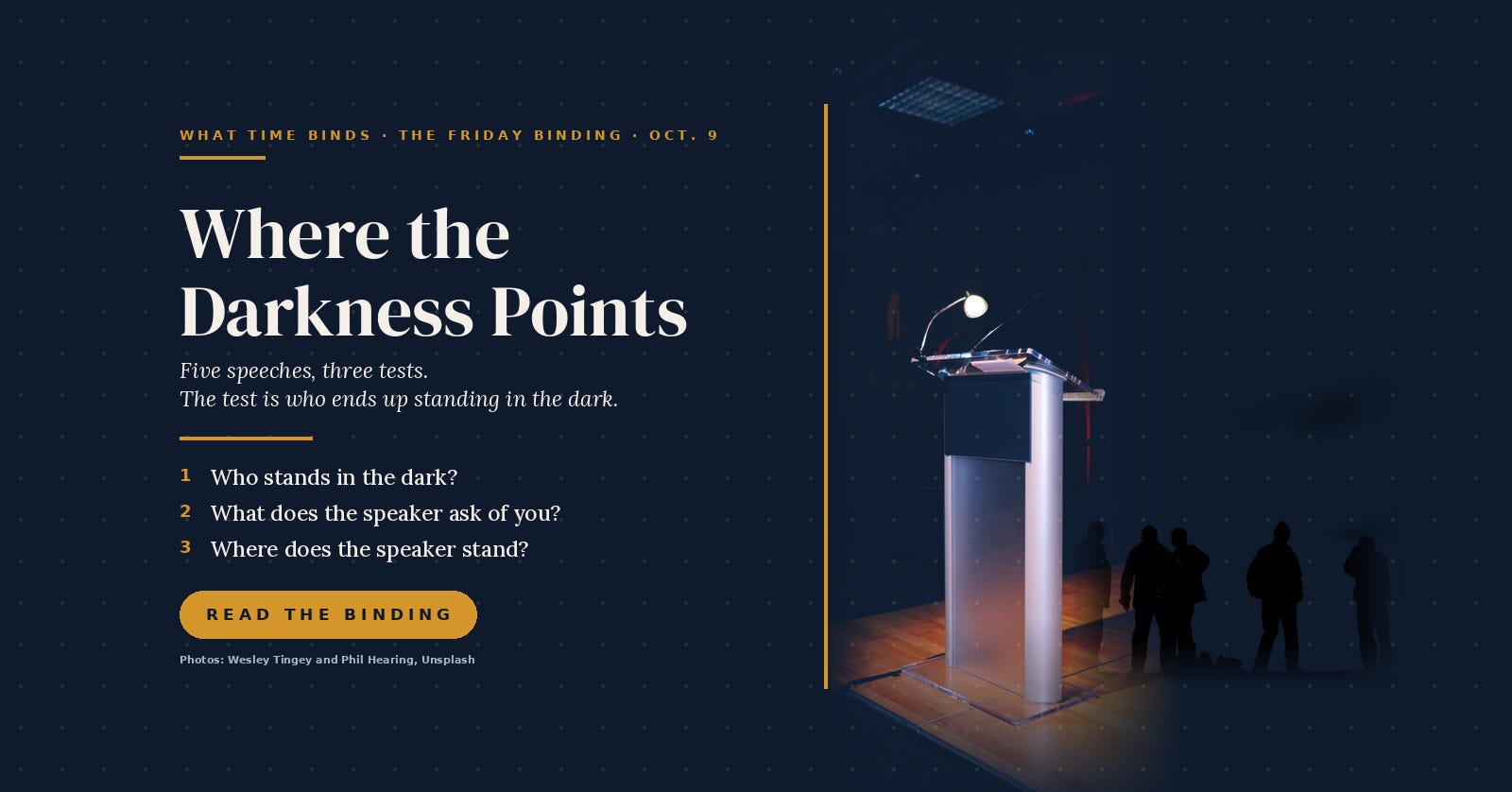
Five speeches, three tests. Every leader on this list paints in light and dark. The test is who ends up standing in the dark.
This week’s question: when a leader draws the line between light and dark, who does he put on the dark side of it?
The answer separates the speeches a country carves into stone from the speeches historians keep as evidence. Defenders of self-government point the dark at a regime, an ideology, a sin the whole nation shares, or the power of their own institutions. Then they ask the listener to carry something. Autocrats point the dark at the neighbors and ask the listener to watch them.
The opening page
June 18, 1940, the House of Commons. The day before, France had asked Germany for terms. Winston Churchill closed his report with the most famous light and dark in modern English:
“If we can stand up to him, all Europe may be free and the life of the world may move forward into broad, sunlit uplands. But if we fail, then the whole world, including the United States, including all that we have known and cared for, will sink into the abyss of a new Dark Age made more sinister, and perhaps more protracted, by the lights of perverted science.”
Look at who stands in the dark. “Him” is Hitler, across the Channel. The dark itself is a future the British people could still refuse. Nobody sitting in that chamber stands in it.
Wednesday night in San Antonio, a president drew his own line, speaking of Democratic-run states: “when the blues get in, everything becomes dirty. The streets are dirty. The doorknobs going into stores are dirty. The sidewalks are filthy, dirty. Everything becomes dirty and has a bad smell.” The people in that dark live in California, New York and Illinois. They are Americans.
This Binding reads five speeches on the same three tests. The tests are the point. You can run them on any speech, from any party, in about a minute.
The defenders
1. Lincoln, March 4, 1865: the dark belongs to everyone
The page: the Second Inaugural Address, carved on the north wall of the Lincoln Memorial.
Lee would surrender at Appomattox five weeks later. By the standards of any war, Lincoln had earned the right to cast the South as the darkness. He did the reverse. “Both read the same Bible and pray to the same God, and each invokes His aid against the other.” He named slavery as the offense and gave the war “to both North and South” as “the woe due to those by whom the offense came.” The dark falls on the whole nation, the winning side included.
Then the ask: “With malice toward none, with charity for all, with firmness in the right as God gives us to see the right, let us strive on to finish the work we are in, to bind up the nation’s wounds, to care for him who shall have borne the battle and for his widow and his orphan.”
The Department of Veterans Affairs built its motto from that sentence. I do my best not to carry malice toward any American. I do, however, recognize behaviors. Finishing that work, to me, means healing each other, working together, supporting each other, and taking care of our veterans.
Where the dark points: at a sin the whole country shares. What he asks: bind wounds, care for the people who fought. Where he stands: under the same judgment as everyone else. “Let us judge not, that we be not judged.”
2. Churchill, June 18, 1940: bad news first, then the light
The page: “Their Finest Hour,” House of Commons.
Before the uplands, Churchill gave the House the defeat himself: “in the first two of those weeks the battle in France has been lost.” And: “What General Weygand called the Battle of France is over. I expect that the Battle of Britain is about to begin.” A defender tells you the bad news in his own voice before he asks anything of you.
The dark points across the Channel, at “him” and at a regime. The ask lands on everyone in the room, the speaker included: “Let us therefore brace ourselves to our duties, and so bear ourselves that, if the British Empire and its Commonwealth last for a thousand years, men will still say, ‘This was their finest hour.’” The glory goes to people he will never meet.
The empire he invoked ruled India without its consent. That belongs on the page too, and it does not change where this speech points the dark.
Where the dark points: a regime abroad. What he asks: duty. Where he stands: inside “us.”
3. Eisenhower, Jan. 17, 1961: the general warns about his own house
The page: the farewell address, reading copy at the Eisenhower Presidential Library.
Eisenhower named the outside dark plainly: “We face a hostile ideology—global in scope, atheistic in character, ruthless in purpose, and insidious in method.” Then the five-star general who led the Normandy invasion turned the warning on the institution that made him: “In the councils of government, we must guard against the acquisition of unwarranted influence, whether sought or unsought, by the military-industrial complex.”
The ask goes to the citizen: “Only an alert and knowledgeable citizenry can compel the proper meshing of the huge industrial and military machinery of defense with our peaceful methods and goals, so that security and liberty may prosper together.”
I spent twenty-three years inside the institution he was warning about, and I believed in what I did. Inside, the map comes with the uniform: duty, country, security. In January I wrote about Smedley Butler, a Marine with two Medals of Honor who served 33 years under those words. After he retired, he said of his service: “I suspected I was just part of a racket at the time. Now I am sure of it.” Eisenhower gave his warning on his way out of office. A warning from inside carries weight because the speaker has been there. The citizen’s job is to tell a map that explains reality from a map that sells it.
Where the dark points: an ideology abroad, and unchecked power at home, his own side’s included. What he asks: stay alert and informed. Where he stands: leaving office, handing the watch to you.
See for yourself: read the last paragraph of each speech. Circle every “I.” Then circle every “we,” “us” and “our.”
The autocrats
4. Hitler, Stalin, Putin: the dark moves inside
The pages: Hitler’s Reichstag speech, Jan. 30, 1939 (U.S. Holocaust Memorial Museum translation). Stalin’s report to the Central Committee plenum, March 3, 1937 (Marxists Internet Archive translation). Putin’s remarks to government ministers, March 16, 2022 (Kremlin English transcript).
All three paint in light and dark too. The difference is where the dark falls.
Hitler, seven months before he invaded Poland: “If the international Finance-Jewry inside and outside of Europe should succeed in plunging the peoples of the earth once again into a world war, the result will be not the Bolshevization of earth, and thus a Jewish victory, but the annihilation of the Jewish race in Europe.” The key word is “inside.” The dark lives among Germans, and the speaker blames his target in advance for what will be done to it.
Stalin, to his own party: the enemy “shield themselves behind the Party membership card and mask themselves as Bolsheviks.” Comrades “failed to recognize the wolves in sheep’s clothing and were unable to tear away their masks.” His ask: “We do not need complacency, but vigilance, real Bolshevik, revolutionary vigilance.” The listener’s job is to watch the person in the next chair. The purges of 1937 and 1938 followed.
Putin, three weeks into his war on Ukraine: the Russian people “will always be able to distinguish true patriots from scum and traitors and will simply spit them out like an insect in their mouth, spit them onto the pavement.” He called it “a natural and necessary self-detoxification of society.”
The three share a pattern. The enemy wears your neighbor’s face. The words come from hygiene and pest control: masks, insects, detoxification, a people to be removed. The ask is vigilance against fellow citizens. The speaker is the one who sees the enemy everyone else missed.
Where the dark points: inside the country. What they ask: watch your neighbors. Where they stand: alone, as the one who sees.
See for yourself: in each passage, circle the word that tells you where the enemy lives. Hitler: “inside.” Stalin: “Party card.” Putin: “society.”
Where Trump’s rhetoric sits
5. Trump, Oct. 5 to 8, 2026: two maps in one speech
The pages: Grand Island, Neb., Oct. 5 (KTLA transcript). San Antonio, Oct. 7 (Roll Call Factba.se transcript). Claremont, N.H., Nov. 11, 2023 (The Washington Post, via the Anchorage Daily News). Fox News, “Sunday Morning Futures,” Oct. 13, 2024 (CNN). Truth Social, Oct. 8, and Executive Order 14434, Sept. 29, 2026.
On Iran, he points the dark where the first three pointed it. “I am ensuring that Iran will never have a nuclear weapon,” he said in San Antonio, and less than two minutes later: “We protect our cities. We protect our country.” The dark is a regime abroad. The ask, from Monday in Nebraska, is a cost at the pump. That day he told News Channel Nebraska that fuel prices are “a relatively small price to pay for keeping nuclear weapons out of the hands of a lunatic nation.”
On Americans, the map turns inward. In the same speech: “when the blues get in, everything becomes dirty.” Protesters are “paid by enemies of our nation.” Texans, he said, will not let “weak, gutless, self-hating, transgender-promoting freak shows destroy everything that we’ve built.” This is a pattern with a record. On Veterans Day 2023 he pledged to “root out the communists, Marxists, fascists and the radical left thugs that live like vermin within the confines of our country.” In October 2024 he named “the enemy from within” and said it could be handled “by National Guard, or if really necessary, by the military.”
The next day, the enemy got a new definition. On Truth Social he wrote: “The White House considers anyone that uses the term, ‘Artificial Intelligence,’ as opposed to the highly accepted new and more accurate term, ‘Super Intelligence,’ THE ENEMY!” Nine days earlier, his executive order said the executive branch “will not acknowledge the usage of ‘Artificial Intelligence’ and ‘AI.’” The dark now holds anyone who says “AI.”
His ask carries two things. The first is a vote: “Get out and vote.” That is a democracy’s ask, and none of the three autocrats ever needed to make it. The second is trust in one man: “the only thing you have to stop that is a guy named Ken Paxton, a Republican that loves you, and a president named Donald J. Trump.” Later: “only I can make this promise to you.”
So here is where his rhetoric sits. On the war, it points the dark abroad, the way Churchill and Eisenhower did. On his own country, it points the dark inside, at a party, its voters and its states, and it uses the autocrats’ vocabulary: dirt, smell, vermin, the enemy within. He still asks for votes, which they never did. That is a reading of direction and vocabulary, the two things a transcript can show. It says nothing about what he intends, and this Binding claims nothing about that.
What the words did. Intent stays out of reach. Outcomes are on the record. In Grand Island, some in the crowd cheered when he named the two cities. The next day the White House had to explain what he meant. San Diego’s mayor, Todd Gloria, answered: “San Diego is not collateral damage. We are not expendable. And we are never a ‘small price to pay.’” A Republican county supervisor there, Jim Desmond, said: “I vehemently disagree with President Trump’s comments.” Two days later, the president said it again.
On Thursday he gave his own account on Truth Social. He wrote that he was “making a comparison between paying a little more, for a short time, for Gasoline, versus the bombing of our Major Cities.” In that version, the two cities are the big price. In the Grand Island transcript, the sentence right after them is “This is a very small price to pay.” The same post put the press on the dark side of the line: the “Fake and Artificial News,” and “these people are Degenerates.”
The strongest defense. This is campaign talk aimed at political opponents, and democrats have named villains at home too. Franklin Roosevelt’s first inaugural, March 4, 1933, put “the money changers” in the dark: “the money changers have fled from their high seats in the temple of our civilization.” That is the best case for the defense. Read Roosevelt’s noun, though: “Practices of the unscrupulous money changers stand indicted in the court of public opinion.” He indicted conduct, asked Congress for laws, and asked the country to be “willing to sacrifice for the good of a common discipline.” San Antonio’s nouns are a party, its voters and its states, and they come with a smell.
See for yourself: open Roll Call’s timecoded transcript of the San Antonio rally. Read 57:32 to 59:23, then 4:03 to 4:54. Write down who stands in the dark in each stretch.
The habit: where does the dark point?
Three questions. Any speech, any party, about a minute.
Who stands in the dark? A regime, an ideology, a practice, or a group of your neighbors?
What does the speaker ask of you? A load to carry, or a watch to keep on the people next door?
Where does the speaker stand? Inside “us,” under the same judgment, or alone as the one who can save you?
A speech can pass on one subject and fail on the next, the way San Antonio did inside a single hour. So run the test sentence by sentence, and run it on your own side’s speeches first.
This week’s question for the comments: pick a speech you remember, from any leader and any party. Find the sentence where the dark falls and paste it here. Then tell me who is standing in it.
You will hear a lot of speeches before Election Day, November 3. Check your registration at vote411.org, then run the three questions on the next one you hear.
Send this to one person who will hear a stump speech before Nov. 3.
Author’s note. Paid subscriptions open at 500 readers, and the paid product is Coded Threads, the codebooks built from these comment sections. A pledge now is a vote for that.
Sources. Every quote above traces to one of these. Status as of Oct. 8.
Lincoln, Second Inaugural, March 4, 1865: National Park Service, Lincoln Memorial. Opened; standard text for full sentences.
Churchill, “Their Finest Hour,” June 18, 1940: International Churchill Society. Opened.
Eisenhower, farewell address, Jan. 17, 1961: National Archives; Eisenhower Library reading copy. Opened.
Butler, on his own service: Federation of American Scientists text. Opened Oct. 8. FAS dates it to a 1933 speech; other sources place the same passage in Common Sense, November 1935.
Roosevelt, first inaugural, March 4, 1933: American Presidency Project. Opened.
Hitler, Reichstag, Jan. 30, 1939: U.S. Holocaust Memorial Museum. Opened.
Stalin, plenum report, March 3, 1937: Marxists Internet Archive. Opened.
Putin, ministers’ meeting, March 16, 2022: Kremlin, English transcript. Opened Oct. 8; quotes match the Kremlin’s English text.
Trump, Grand Island, Oct. 5, 2026: KTLA transcript; Roll Call Factba.se transcript, at 12:21. Verified this week.
Trump, San Antonio, Oct. 7, 2026: Roll Call Factba.se timecoded transcript. Opened Oct. 8; quotes match at 3:09, 4:03 to 4:54, 10:16, 17:27, 24:41, 44:12, 57:32 and 58:48 to 59:23.
Trump, Claremont, N.H., Nov. 11, 2023: The Washington Post, via the Anchorage Daily News. Opened.
Trump, Fox News, Oct. 13, 2024: CNN, Veronica Stracqualursi, via KTVZ. Opened; full sentence checked Oct. 8 against Mediaite’s transcript of the clip.
Executive Order 14434, Sept. 29, 2026: White House, “Inaugurating the Era of Super Intelligence”. Opened Oct. 8; quote from Sec. 1.
Trump, Truth Social, Oct. 8, 2026, 12:14 PM ET: Truth Social post. Opened Oct. 8; text matches.
Trump, Truth Social, Oct. 8, 2026, 2:59 PM ET: Truth Social post. Opened Oct. 8 (archive copy at Trump’s Truth); matches the MS NOW broadcast.
What the words did: the crowd’s cheer from FactCheck.org, Oct. 6, 2026 and the KTLA transcript; Gloria and Desmond from Newsweek, Khaleda Rahman, Oct. 6, 2026. Opened Oct. 7.
Oct. 5 interview: Roll Call Factba.se transcript, Michael Shively, News Channel Nebraska, at 1:02. Opened Oct. 7; the quoted words match.
This piece was written with AI assistance under the disclosure framework at what-time-binds.com. The analytical frame, the sources, and every position taken are mine and verified.
Jerry W. Washington, Ed.D., is a Marine Corps veteran of twenty-three years, a combat engineer by trade, an instructor at UC Irvine’s Division of Continuing Education, and the writer of What Time Binds, a record of how institutions bend words and how the page holds them to account.
I advise school districts, community colleges, and workforce teams on AI readiness: what the words mean before the tools arrive. Hit reply if you would like to talk.