


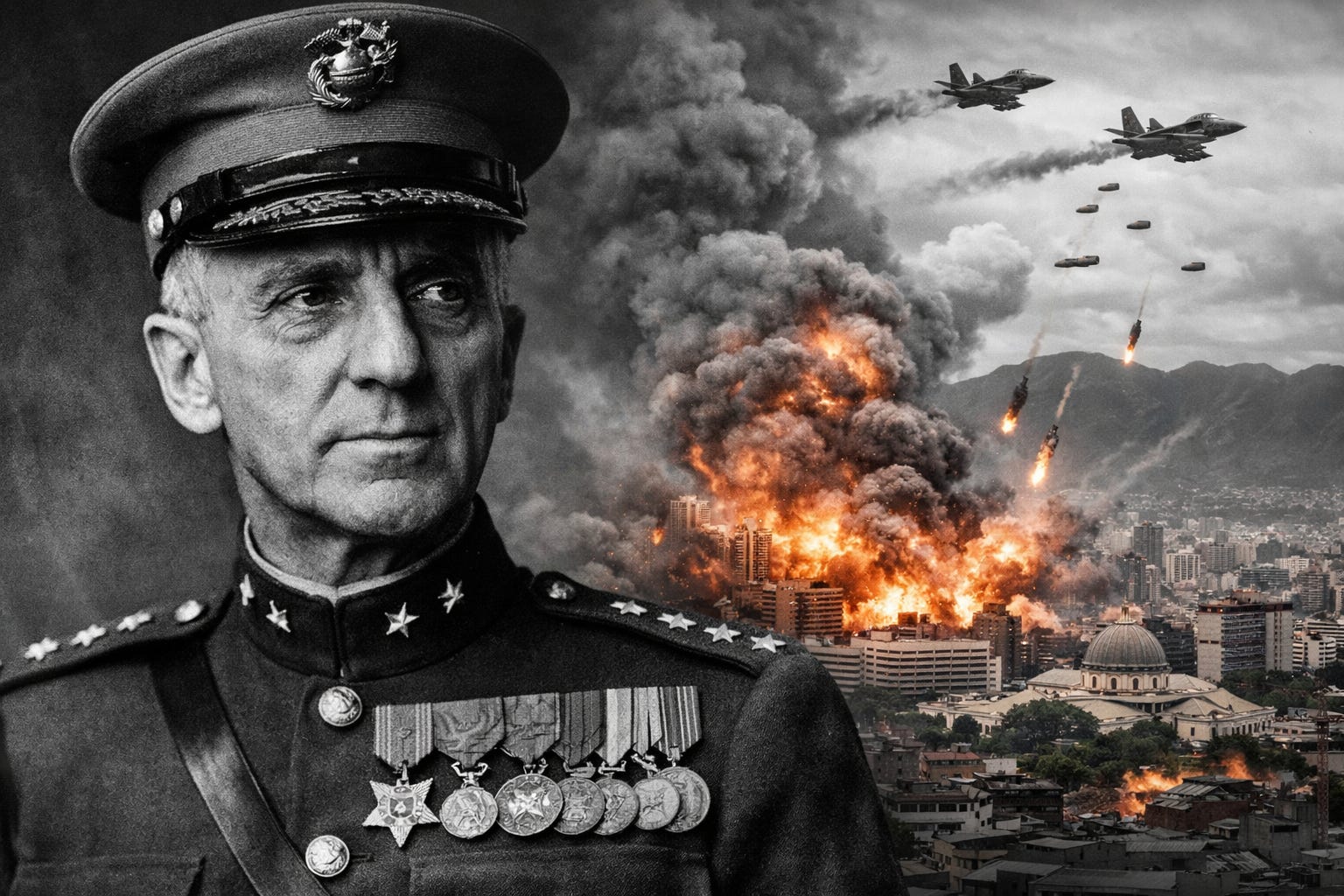
On February 28, 2025, I posed a question on social media about how we read war narratives – a thought experiment back then. Now, it’s real life.
In January 2026, a U.S. strike in Venezuela ousted its president amid “good versus evil” rhetoric and global controversy. Suddenly, my year-old question feels urgent.
How do we tell if an intervention is really about noble ideals or something else?
For insight, consider Major General Smedley D. Butler. Butler was one of America’s most decorated Marines, a two-time Medal of Honor recipient and celebrated hero, who did something almost unheard of: he publicly changed his map of war.
After 33 years of fighting for duty, country, and security, Butler came to see those very words as smoke screens. His journey from revered warfighter to author of War Is a Racket offers a rare case of an insider redrawing the boundaries of his reality – and a template for how we might update our own maps when confronted with today’s intervention narratives.
The Decorated Map-Holder
Smedley Butler entered the U.S. Marine Corps in 1898 as a teenage officer and went on to fight in virtually every American conflict of his era. He saw action in the Philippine-American War, the Boxer Rebellion in China, the “Banana Wars” across Central America and the Caribbean, and World War I.
By the time he hung up his uniform in 1931, he had risen to major general and was the most decorated Marine in U.S. history. Butler amassed 16 medals (five for heroism), including two Medals of Honor for separate acts of outstanding bravery – one at Vera Cruz in 1914 and another at a fortress in Haiti in 1915.
In other words, he embodied the institutional story of American military might. His exploits – leading assaults, pacifying restive areas, “stabilizing” countries – were held up as examples of duty and honor. This earned him immense credibility.
When a man nicknamed “Old Gimlet Eye” and trusted as a protector of civilization spoke, people listened. His map of the world was drawn by the institutions he served: a map where U.S. interventions were largely righteous missions bringing order, security, or civilization. And his accolades reinforced that map’s legitimacy. If even a figure like this could later question the mission, it would make folks stop in their tracks. Butler’s credibility was a form of epistemic trust – he had been there, done that, so if he said something was amiss, it mattered.
The Crack in the Map
But what happens when the map you’ve lived by no longer matches the terrain? For Butler, cracks formed slowly. Decades of fighting “small wars” on three continents exposed him to a pattern: where American forces went, American business interests followed.
As he later confessed, “I helped make Mexico ... safe for American oil interests in 1914. I helped make Haiti and Cuba a decent place for the National City Bank boys to collect revenues.”
In a famous passage, Butler tallied intervention after intervention – Nicaragua, Dominican Republic, Honduras, China – and admitted that in each he’d been “a racketeer, a gangster for capitalism,” operating on continents Al Capone could only dream of. This realization didn’t strike in the heat of battle but in the cool reckoning after retirement. Only as a civilian, Butler wrote, could he truly think for himself and see what had been hiding in plain sight.
The spell broke further when he reflected on World War I. Butler described how a post-1917 propaganda apparatus sold that war to the public. “So vicious was this war propaganda that even God was brought into it,” he wrote, noting that “with few exceptions our clergymen joined in the clamor to kill, kill, kill… to please the same God.”
Moral language – patriotism, religion, democracy – had been weaponized to herd young men into combat. And Butler saw that behind the stirring slogans lay a more banal incentive: profit. “War is a racket. It always has been,” he declared bluntly. “It is possibly the oldest, easily the most profitable… It is the only one in which the profits are reckoned in dollars and the losses in lives.”
War, he argued, isn’t what it appears to the majority. It’s a deceptive map: “only a small ‘inside’ group knows what it is about. It is conducted for the benefit of the very few at the expense of the very many.” This was the “racket” he had finally discerned. Butler even noted how patriotism had been used to camouflage skyrocketing wartime earnings. “Of course, it isn’t put that crudely in wartime,” he explained. “It is dressed into speeches about patriotism, love of country… but the profits jump and leap and skyrocket – and are safely pocketed.”
In short, Butler came to see that the moral and patriotic map he’d lived by was engineered – a ghostly script designed to make the public war conscious while keeping the true incentives hidden. Admitting this, and shattering the hero’s narrative he once inhabited took immense moral courage. But Butler’s updated map didn’t form in a vacuum; the culture around him was starting to question the old story as well.
The Era That Rewarded His Update
When Butler published War Is a Racket in 1935, he found an America primed to hear him out. The mid-1930s were years of deep skepticism about the previous war.
Congress had convened the Nye Committee in 1934 to investigate the munitions industry – hearings so sensational that the press dubbed them the “Merchants of Death” investigation.
Senators hauled in arms manufacturers and bankers to ask whether war profits had greased the skids for U.S. entry into WWI, where more than 53,000 Americans died, even as industrialists “reaped enormous profits.” The committee’s chairman, Senator Gerald Nye, captured the mood: “When the Senate investigation is over, we shall see that war and preparation for war is not a matter of national honor and national defense, but a matter of profit for the few.”
Those words could have come straight from Butler’s own book. And indeed, while the Nye Committee ultimately found no smoking-gun conspiracy, its 93 hearings and reports cemented a popular prejudice against “greedy munitions interests.”The public was receptive to the idea that patriotic rhetoric had masked a money racket.
This climate validated Butler’s message. He became a celebrated speaker on the anti-war circuit, drawing on his insider status to give weight to the outrage. Veterans, pacifists, even church groups packed halls to hear the ex-Marine general who dared say the system was rotten.
Meanwhile, Washington responded with reforms: a series of Neutrality Acts in 1935–37 aimed to prevent the next war profiteering bonanza. In short, Butler’s revised map of war as a racket was legible to Americans in the 1930s because many were sketching similar maps.
The era rewarded his candor. Rather than being dismissed as a crank, he was seen as an honest whistleblower echoing an emerging consensus: the real enemies were not the boys in the trenches but the “insiders” cashing in behind the scenes.
Reading Today as Competing Maps
Fast forward to January 2026. How can Butler’s perspective help us decode the competing narratives around the U.S. intervention in Venezuela?
Consider that episode not as a partisan drama, but as a clash of maps – different models of reality selecting different facts. On one map, the Venezuela operation was simply a law enforcement mission.
U.S. officials emphasized that Venezuela’s president (Nicolás Maduro) had been indicted on drug-trafficking charges, and framed the armed intervention as a justified move to “force him to face U.S. criminal charges.” In this model, the U.S. is acting as a global policeman – arresting a “narco-terrorist” as one would a mafia kingpin.
A second map presented the intervention as a matter of national security and regional stability. By this account, the U.S. had to act to reassert American dominance in its hemisphere and safeguard vital resources.
Indeed, officials bluntly stated that any new Venezuelan government must align with U.S. interests – “keeping Venezuela’s oil industry out of the hands of U.S. adversaries” and curbing the flow of illicit drugs.
Here, the keywords are security, influence, and oil: it’s a strategic chessboard map, where Venezuela is a node to control for America’s own good and for “stability” in the neighborhood.
Then there is the democracy restoration map. This narrative highlights Maduro’s authoritarianism and the promise of liberating the Venezuelan people. President Trump toggled into this frame when he said the goal was “liberty for the people” of Venezuela, painting the U.S. as midwife to a better, freer future.
This map draws on classic ideals – fighting tyranny, spreading democracy – and implies the U.S. intervention is a noble act of solidarity with suffering Venezuelans. But zoom out, and another map comes into view – one drawn by international law and historical memory.
From this perspective, the January 2026 raid appeared to be a flagrant breach of sovereignty and the rules-based order. U.S. allies in Europe stressed that “the principles of international law and the U.N. Charter must be upheld,” pointedly reminding Washington that might does not make right.
Latin American critics invoked bitter memories of past U.S. coups and invasions; even leaders who despised Maduro warned that bombing a capital and kidnapping a head of state set a dangerous precedent. This legalistic map frames the U.S. not as a hero but as a rogue actor crossing lines etched after World War II.
Finally, threading through all the above is a cynical map of oil and power – essentially what Smedley Butler might recognize as the racket. Observers noted how swiftly the talk turned to Venezuela’s vast petroleum reserves and who would profit. The White House itself hinted at “replacing [Venezuela’s] oil infrastructure” and taking charge of its energy assets.
Some analysts labeled the operation “petro-imperialism,” arguing that despite the democratic packaging, it was fundamentally about oil and geostrategic clout. In this map, lofty ideals are overlays on an old-fashioned grab for resources – a view very much in line with Butler’s decades-old warning.
Each of these maps – law enforcement, national security, democratic rescue, international-law objection, and oil-realpolitik – highlights certain truths and filters out others. They are competing models of the same events. And as models, each carries its own incentives.
The law-enforcement framing urges us to cheer a fugitive finally in cuffs – but it downplays the reality of foreign bombs falling on a sovereign city. The democracy narrative appeals to our values – yet history urges caution when war’s “beautiful ideals” are used to rally support.
The international-law map speaks to global norms – but can gloss over the genuine misery wrought by Maduro’s regime that made some Venezuelans welcome intervention. The oil-and-power map may feel jaded, yet it forces us to ask Cui bono – who profits” – a question too often lost amid flag-waving.
The Civic Task: Inheriting a Revised Map
Smedley Butler updated his war map at great personal cost, and he did so publicly, hoping his hard-won insight would be time-bound into our civic DNA. In our era of dizzying information, that kind of map-inheritance is exactly what we need.
The concept of “time-binding,” as Alfred Korzybski used it, is the ability to pass knowledge forward – to not start each generation from scratch. Butler’s life is a time-binding gift. He handed down a revised map drawn in truth, distinguishing between a map that explains reality and a map that sells it.
Our job is to learn when to revise our own mental maps and how to discern propaganda from principle. This doesn’t mean adopting cynicism as a default; it means, as Binding Time suggests, being willing to compare the promised road on the map with the landscape under our feet.
As citizens, the most important question we can ask when confronted with any grand narrative is: Does the reality match the rhetoric, or are we wandering into a well-marketed mirage?
Butler’s journey from the barracks to the bully pulpit challenges us to do the same hard work he did – to recognize when an outdated or misleading map needs redrawing. Only by inheriting and applying these revised maps can we hope to navigate toward a future where our interventions, if any, align with facts on the ground and the true public interest, rather than the ghostly scripts of profit and power.