


The Friday Binding · November 6, 2026
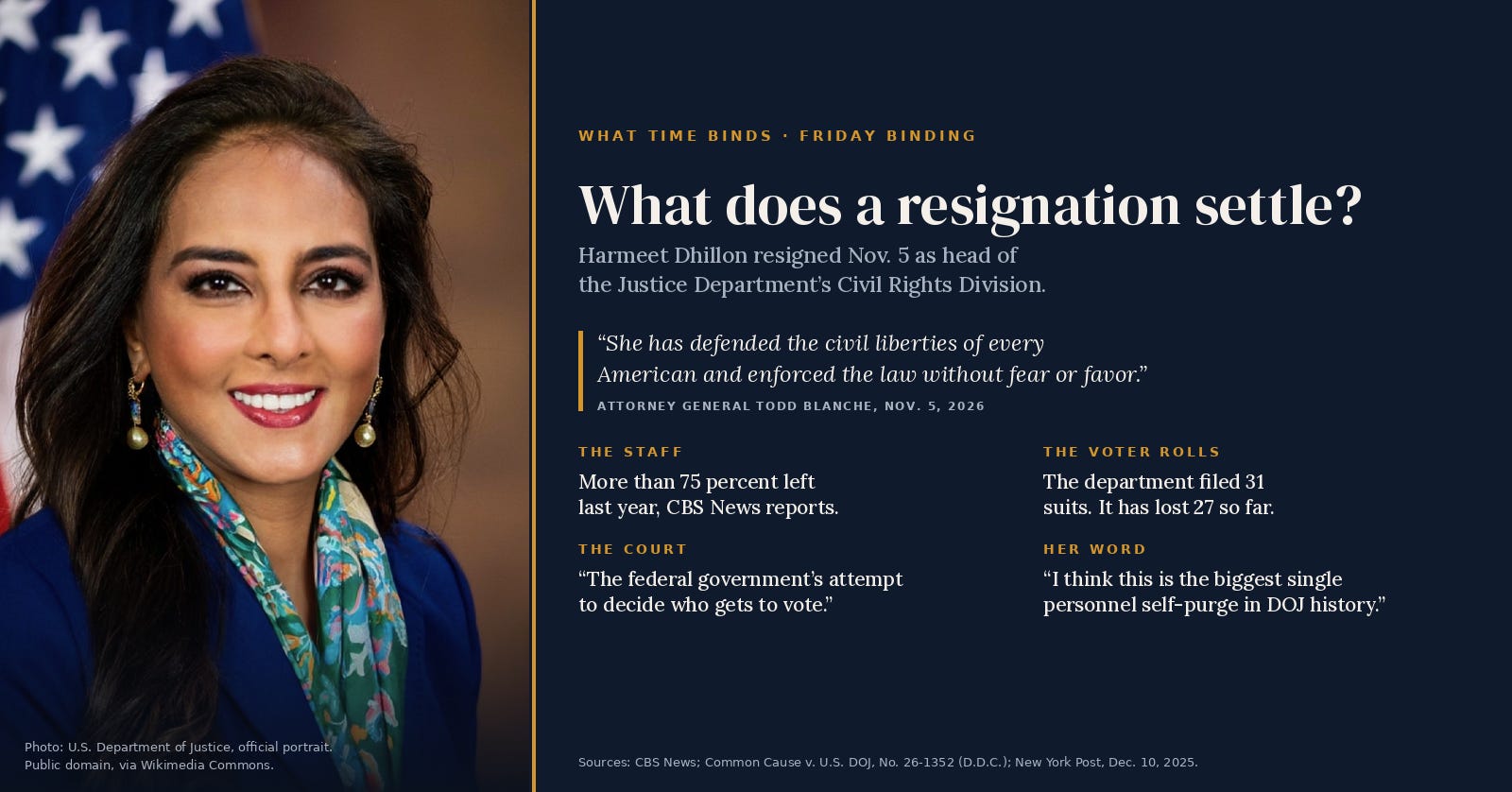
On Thursday, Nov. 5, 2026, Attorney General Todd Blanche announced it on X. “Today, I accepted the resignation of Assistant Attorney General Harmeet Dhillon, who led the Civil Rights Division with conviction the past 18 months,” he wrote. “She has defended the civil liberties of every American and enforced the law without fear or favor.” CBS News ran the post above its own account of what the Division did in those months.
I saw the news on MS NOW. By evening the feeds had a reading. MeidasTouch posted on Facebook: “BREAKING: TRUMP DOJ OFFICIAL FLEEING AFTER DEMOCRATIC MIDTERM SWEEP!” That post ties her exit to Tuesday’s results.
Bloomberg Law adds a detail the feeds left out. She “has told allies that she would be leaving the department after the midterm elections, according to four people familiar.” The report doesn’t say when she told them.
Houston’s KPRC 2 posted a card Thursday over an Associated Press photo: “The woman who dismantled the DOJ’s Civil Rights Division just resigned.” Its caption quoted her own word for the departures, “biggest single personnel self-purge in DOJ history.” She said it on the New York Post’s Pod Force One in December 2025, and the Post reports her account that the staff left voluntarily. The card’s word puts the departures on her. Her word puts them on the people who left.
The statement and the feeds both skip a question. What does a resignation settle? This week the Binding sets aside its outside reads. This page has kept a record on the Division since July 13, and the five picks below are mine, read in the order they ran.
A name comes off the door on Thursday, and the record stays here. Every Friday I bind five reads to one question and show the page under each. Subscribe and the next one is in your inbox, free.
This week’s picks
1. The Locus of Repair (July 13)
This is where the record starts. Two days earlier I had posted a photograph Dhillon shared herself. She labeled the group her “civil rights warriors.” The essay set that photograph beside the numbers already on the record. In the months after her arrival, “roughly 300 of the division’s 400 attorneys left.” The Division “dropped or withdrew from nearly 30 cases, including voting rights actions and hiring-discrimination cases.” New section mission statements read “Keeping Men Out of Women’s Sports” and “Eradicating Anti-Christian Bias.”
The passage closed on a reading this page has used ever since: “The Civil Rights Division was created in 1957 to enforce federal civil rights law. The phrase ‘civil rights’ had not changed. What it protected had.”
Read Thursday’s statement after this piece. It says she “led the Civil Rights Division,” and it names no case. The Division’s name, from 1957, carries the whole statement.
2. How Exactly? (July 30)
This piece put her own words on the record. “Assistant Attorney General Harmeet Dhillon described her goal as turning ‘the train around and driving it in the opposite direction.’” It set the count under the words. The Division “lost roughly 250 attorneys between January and the end of May 2025, about 70 percent of its lawyers.” It listed the new work too: “protecting children from chemical and surgical mutilation, keeping men out of women’s sports, and eradicating anti-Christian bias.”
My July pieces counted attorneys. CBS counts “more than 75% of its staff” departing last year. The measures differ, and they point the same way.
I’d hand this piece to anyone who reads Blanche’s “with conviction” as praise, and to anyone who reads it as a jab. She told the public where the train was going. CBS now reports the Division was “reoriented” toward “protecting gun owners’ rights, curbing the use of equity, diversity and inclusion policies at universities, and adopting legal positions that oppose civil rights protections for transgender people.” Her word and theirs describe the same trip.
3. WDYM by “Monitoring” (Aug. 19)
This Field Guide pinned a word the department still uses. The pin: “Monitoring is watching a documented standard with the authority to act when it is violated.” The essay followed the Voting Section from 1965 forward. In 2025, it found, the section “was cut from roughly thirty career attorneys to three,” by a watchdog’s estimate. Its non-example was the Aug. 18 deployment: “Two counties. Six attorneys. Announced the day of the primary.”
On Tuesday, CBS reports, “the Civil Rights Division sent out more than 1,000 monitors to polling sites across the country, a record number.” CBS adds that the number “required the Justice Department to solicit volunteers from unusual parts of the DOJ.” The count went up. The pin asks what a count can’t answer: which of those monitors carried the authority to act, and against what published standard?
That question outlives her tenure. Whoever runs the Division next inherits it with the office.
4. The Grammar of the 2026 Election, the Oct. 9 entry
This essay keeps growing as the record does. On Oct. 9 it took an entry on a federal judge’s opinion. In Common Cause v. U.S. Department of Justice, No. 26-1352, Judge Sparkle Sooknanan set aside the Division’s voter-roll policy. Her opinion opens on the institution, “forged in the Civil Rights Movement in response to massive resistance against racial integration.” Then it turns: “Against that backdrop, this case is anomalous.” In her words, “Behind all the window dressing, the challenged policy represents the federal government’s attempt to decide who gets to vote.” She held that none of the laws the department cited authorize the policy.
Two facts sit beside her opinion in that entry, and they belong here too. Judge Sooknanan served as the Division’s principal deputy assistant attorney general under Kristen Clarke. And on Sept. 25 the Supreme Court stayed her June 22 order on the SAVE citizenship-check program. Her holding rests on the statutes.
The department’s own voter-roll suits kept losing after Oct. 9. CBS reports the Division “filed 31 lawsuits against primarily blue states and the District of Columbia” for unredacted voter rolls, and “So far, the Justice Department has lost 27 of those cases.” The State Democracy Research Initiative at the University of Wisconsin Law School tracks them. Its tracker says no court “at either the district or appellate level has ruled in favor of the Justice Department.”
See for yourself. Open the opinion and read its first two pages. Then read “enforced the law without fear or favor” again.
5. The Election Record (Nov. 3)
This page went live on Election Day as the second WTB Record: a dated, sourced page that changes when the record does. It holds the department’s 2026 election cases through the week she left. Its newest voter-roll entry is a federal judge in Utah on Oct. 23: “The Attorney General’s Complaint is DISMISSED with prejudice.”
The same page keeps the department’s larger push in California. There, three courts said no in five days to holding apart the mail ballots of more than 20,000 people a federal list calls likely noncitizens. The last of the three was the Supreme Court, on Nov. 2, in one sentence.
A Record does what this Binding asks you to do. It dates every line, so you can see what changed and when.
The small install: read the exit against the page
An exit statement is the last thing an institution says about a tenure.
Copy each claim the statement makes. Blanche’s makes two you can test: she “defended the civil liberties of every American,” and she “enforced the law without fear or favor.”
Find the page that tests each claim: a court order, a docket count, a staffing figure. Write down who produced it and when.
Set the page beside the claim. Then decide what the claim is worth, and name the page that decided it for you.
What the five show
The department’s case deserves its own words first. In July a Justice Department spokesperson told Ashleigh Fields of The Hill that the Division enforces the law “evenhandedly for all Americans,” and that “preferential treatment on the basis of race has no place in our society.” In her account, the staff who left chose to go. Read on those terms, the new mission statements are the point. The Division did what its leader said it would do, and Blanche praised her for it. On the voter rolls, CBS reports, the Division’s lawyers “repeatedly argued that they needed the information to ensure states were complying with two federal voting laws that require them to maintain clean voter lists.” Oklahoma settled and agreed to provide its data.
My bottom line is that a resignation settles one thing: who holds the office. The record of what the office did stays where it is. A federal judge called the voter-roll policy an “attempt to decide who gets to vote.” By CBS’s count, the department has lost 27 of its 31 voter-roll suits. More than 75 percent of the Division’s staff left last year, CBS reports. None of that left with her on Thursday.
Her successor inherits this record. So does the Congress seated in January. A House majority can hold hearings and issue subpoenas, and the Senate seated in January may vote on her successor. They will need the pages. Five of them are above.
You refuse to know. The record remembers. I refuse to forget.
A question for the comments
If you could hand her successor one page at the confirmation hearing, which page would it be? Name it and link it.
One more
Fourteen Weeks. One Record. ran Sept. 16. It reads: “Kristen Clarke ran this division through January 2025. Harmeet Dhillon runs it now.” Since Thursday the second sentence is out of date. Today that page carries a dated line: “Update, Nov. 6, 2026: Harmeet Dhillon resigned Nov. 5.” A page that asks institutions to date their changes has to date its own.
Author’s note. I saw the news on MS NOW Thursday. Since we started tracking this Division in July, I have had a very hard time understanding the goal. The data I have read, starting with the National Urban League’s State of Black America, shows the disparity between Black and white Americans. I get that from the administration’s position there had to be a shift. But really, that far?
The comments are the appendix: tell me where the record is wrong and I will show the page or fix the line. Paid subscriptions open at 500 readers, and the paid product is Coded Threads, the codebooks built from these comment sections. A pledge now is a vote for that.
Voters, if your state elected a senator on Nov. 3, that senator may vote on her successor. Read your next ballot the way you read this piece, every race and every proposition, at vote411.org.
I write What Time Binds with Claude. Every claim carries its page, and I approve every line. How I work: How the bread gets made.
Jerry W. Washington, Ed.D., is a Marine Corps veteran of twenty-three years, a combat engineer by trade, an instructor at UC Irvine’s Division of Continuing Education, and the writer of What Time Binds, a record of how institutions bend words and how the page holds them to account.
I advise school districts, community colleges, workforce boards, and veteran-service organizations when the words move faster than the coordination. AI adoption is the most common case. See the five ways to work together at jerrywwashington.com, or hit reply if you would like to talk.