


A chapter draft of the book in progress.
Jenkins’ Court
Reserving a lecture hall was too cumbersome, so our classes happened in Jenkins’ Court. We were also the Marines who built it.
If you served with 1st Combat Engineer Battalion at Camp San Mateo, Camp Pendleton, in the mid-1990s, you remember it. Sunbaked concrete, barracks on two sides, battalion headquarters and the parade deck off in the distance, and the smell of dust, sweat and CLP. We staged there for working parties, smoked between formations and chased the thin strip of shade as it moved across the day. Every so often an NCO called a hip-pocket class. There was no projector and no PowerPoint. A squad or a platoon stood in a loose formation or sat along the low CMU block walls that passed for benches, and a corporal or a sergeant used fifteen stolen minutes to teach something the schedule never seemed to have enough time for.
That afternoon the topic was My Lai. We knew the basics. In 1968, American soldiers massacred hundreds of Vietnamese civilians: men, women, children, even infants. We had seen the grainy photos. We knew the term “war crime,” and we could say “I was just following orders” with the proper disgust. This class aimed the history straight at us. The sergeant walked us through the scenario, then shifted from story to interrogation.
“So here’s the question,” he said. “If you’re on patrol and an officer tells you to fire on unarmed civilians, what do you do?”
Someone answered fast, almost by reflex. “Refuse. It’s an unlawful order. End of story.”
A few heads nodded. It was the answer from formal training, the Law of Armed Conflict slides, a line we had heard so many times it sat there like a sentence in a manual. The sergeant didn’t let it rest.
“Okay, devil. You refuse. You’re twenty years old, rounds might be flying, your squad leader is screaming, the lieutenant is in your face, your buddies are already firing. You still refuse? And if you do, what happens to you?”
Silence. He pressed on. “Don’t give me the textbook answer. Give me the real one. Right here in Jenkins’ Court. Would you pull that trigger or not?”
One Marine, usually quiet, finally spoke up. “I want to say I’d refuse,” he said. “But we spent months getting trained to obey. Boot camp, MCT, everything here in the fleet. You don’t get rewarded for arguing. You get rewarded for doing what you’re told. In the moment? With your whole chain of command leaning on you? I don’t know. I might fire and tell myself I’ll fix it later.”
You could feel the temperature change. Most of us graduated high school and had some college, or at least a decent education. We could quote articles of the UCMJ. We had watched the documentaries in boot camp and heard staff NCOs and officers talk about honor and integrity. We thought of ourselves as the kind of Marines who would never become the villains in a war-crimes documentary. Standing there, it got harder to pretend that morality was purely a matter of individual willpower.
The binary
In my own comment threads, the sergeant’s question keeps getting two answers. A commenter put it to me plainly under my Called It post at the end of August: “If you have concerns about the orders you’re being given you have but two choices.” Follow them, or resign: “there is no middle ground.”
This chapter’s mechanism is that binary: two choices offered where the system built more, so a question about the rules becomes a verdict on one person.
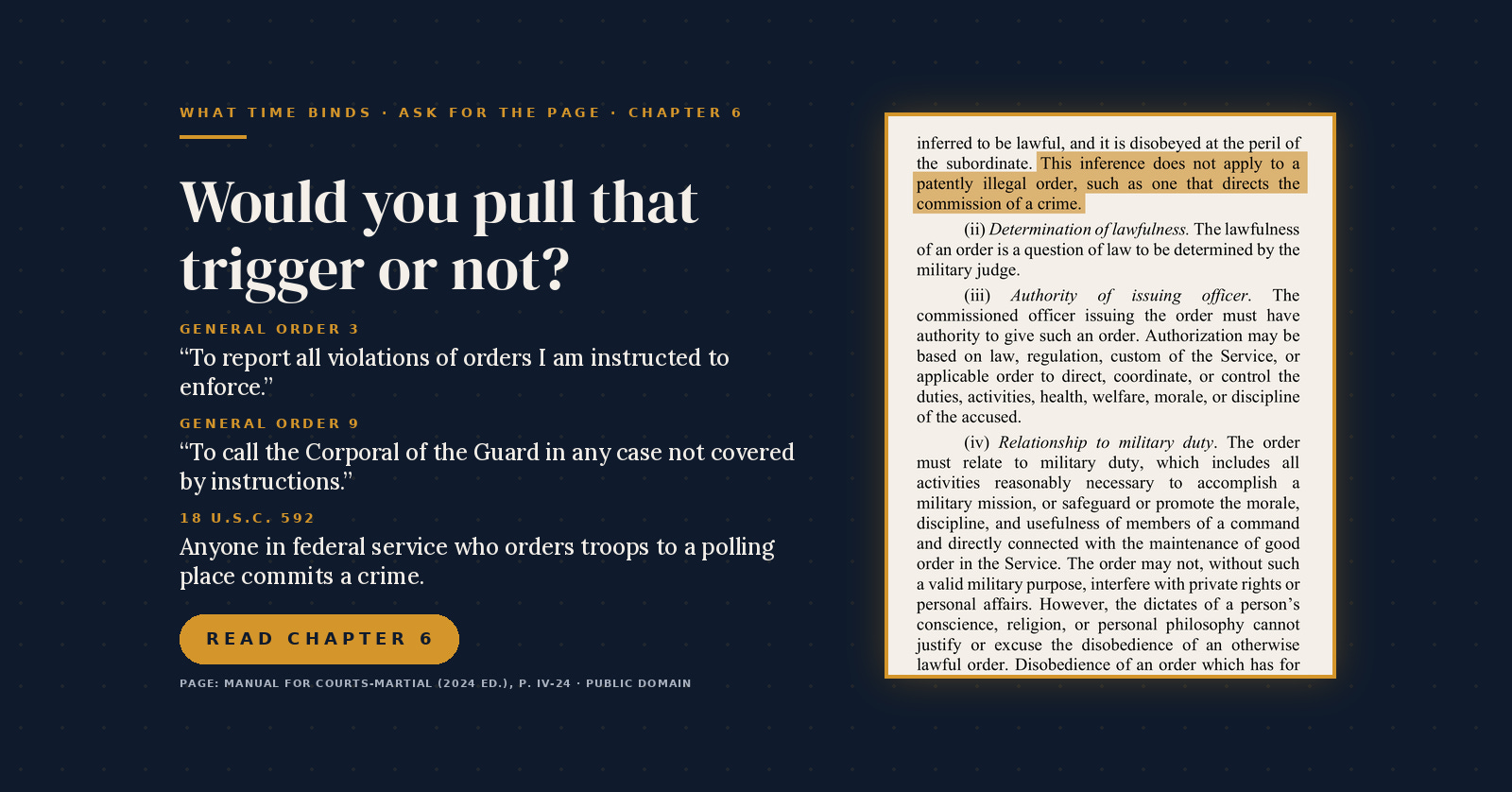
The law builds more. Article 90 of the Uniform Code of Military Justice punishes a service member who “willfully disobeys a lawful command” of a superior commissioned officer. Article 92 punishes failing to obey “any lawful general order or regulation.” The duty runs to lawful orders. The Manual for Courts-Martial sets the presumption. An order “may be inferred to be lawful,” and “it is disobeyed at the peril of the subordinate.” Then the next sentence: “This inference does not apply to a patently illegal order, such as one that directs the commission of a crime.”
I read that paragraph as a division of labor. The Marine on the line refuses the order to commit a crime, the order the sergeant described in Jenkins’ Court. He does not rule on the statute behind a deployment or the reasons for a general’s removal. Those questions go up the chain and out of it, to judge advocates, inspectors general, courts and Congress.
The General Orders put that division in a recruit’s head before he reaches the fleet. General Order 3 was the first thing I memorized in boot camp: “To report all violations of orders I am instructed to enforce.” General Order 9 covers the rest: “To call the Corporal of the Guard in any case not covered by instructions.” A sentry reports what he sees and calls up what he can’t settle.
The quiet Marine described the binary as it feels from the inside: obey, or stand alone against your whole chain of command. The General Orders asked something smaller of him than heroism. They asked him to report.
The binary is also politically useful. When the only choices are comply or resign, a removal reads as turnover and a refusal reads as insubordination. Few ask what happened in between, and the channels built to answer that question go unexamined.
Thirty-two years
On the night of Oct. 28, The Atlantic reported that Army Lt. Gen. Brett Sylvia, the Pentagon’s chief planner, had been ousted as director for strategy, plans and policy on the Joint Staff, the job known inside the military as the J5. “No explanation was given.” Defense officials the magazine did not name said the Secretary had “lost confidence in him.” I posted a card on my Facebook profile at 2 a.m. the next morning: “Thirty-two years. No official reason.”
Later that morning the chief Pentagon spokesman, Sean Parnell, posted that the department has “zero tolerance for the intentional, unauthorized disclosure of classified information.” He said it had taken “necessary personnel action to protect sensitive information” after an Air Force investigation and had referred the matter to the Justice Department. He named no one, and he closed: “We vowed to find you, and we meant it.”
That day President Trump told reporters, “We’re very much looking for leakers, and she’s going to have big problems, long-term problems,” misidentifying Sylvia as a woman. Unnamed officials told reporters Sylvia had failed polygraph tests. Two other Pentagon sources told CBS the firing was tied to the polygraph tests and that the accusations are not true. Axios reported on an internal report that says he admitted leaking. As of Nov. 1, I can find no charge and no public statement from Sylvia. The dated account lives on The Pentagon Record. This chapter is about what readers did with the silence.
The card reached 191,676 views, and 99.6 percent of them came from people who don’t follow me. By Oct. 30 the post held more than a thousand comments. I had every visible comment coded under one written codebook: 987 turns, 954 of them from 677 other people.
Coding means reading each comment and tagging the move it makes with a label from a written codebook. Every label carries a definition, a rule for when it applies and a rule for when it doesn’t, so the counts rest on the comments themselves. I explain the method in The Silence — the workbook and the work, the first issue of Coded Threads, and the note at the end of this chapter says how this thread was coded.
Both halves of the binary showed up in commenters’ own words. One half: “You serve at the pleasure. We don’t need a reason. That is how it works and has always worked.” Forty-eight turns made a version of that argument. One commenter turned it into a rule about who may ask: “you don’t need to know you’re not in the military.” Answering a line like it, another wrote, “A democracy requires an informed public.”
The other half: “Because he said no to an unlawful order.” Fifty-one turns told a version of that story. He refused an order, he kept his oath, he wouldn’t be a yes man. One went all the way back to Jenkins’ Court: “These are the generals that would have stopped the troops from firing on unarmed civilians.”
The sergeant’s question came back, asked about a three-star general, and the thread answered it the way the binary does. He leaked, 192 turns said as settled fact, and 39 called him a traitor. Or he refused, 51 said. Either way, the verdict landed on one man.
The other side of the thread had a story too. Forty-six of those 51 refusal turns came from readers, and the two that drew the most reactions offered motives with no source: “They take their oath to the constitution seriously,” with 46 reactions, and “Because he said no to an unlawful order,” with 35. The two stories stand on unequal ground. The leak account has a spokesman’s statement, a Justice Department referral and the President’s words on the record, though no named official has said what Sylvia did. The refusal story has nothing on the record at all. An unsourced story can still turn out true. Until a page shows up, it stays a story.
What almost nobody argued was the system. Eleven of the 954 turns took up the law, the process, Congress or oversight without taking a side. They asked what evidence a court-martial could hear and who could sit on one for a three-star. I found no respondent who raised the Senate, which confirms every officer at Sylvia’s rank. I raised it three times, and I found no one who picked it up.
In September, The Silence coded 168 turns across two of my Pentagon posts and found none that engaged the five oversight items it named. This thread was almost six times larger. Counted with a broader code, the system still drew about one turn in a hundred.
The account
The other side’s case is strongest on authority, and it goes first. The Secretary may choose his senior officers. A general holds a post at the pleasure of the President. If the leak allegation holds, removal is the least of what should follow, and the law has a path for the rest: an investigation, a charge, a trial.
Eight turns made a third argument: if he talked to reporters, he was warning the country. Nothing on the record ties the alleged disclosures to an unlawful order, and unnamed officials describe the topics as the Iran and Ukraine wars. Even if one did, the law built a door for that warning. A service member may report a violation of law to a Member of Congress or an inspector general, and the statute’s guarantee of open contact with Congress “does not apply to a communication that is unlawful.” Marines have used the congressional door before. In November 1934, Smedley Butler, a retired Marine major general, testified to a House committee about a plot to recruit him to lead a march on Washington.
One commenter put the fair version of that case to me directly. I had documented the departures, the reader wrote, without establishing that they were improper. The allegations against Sylvia “remain unproven, but so does the implication that Sylvia was wrongfully removed.” That is right. The record shows a removal and a spokesman’s statement that names no one. Whether the removal was wrongful, and whether he leaked, are both still open.
The account is where the system comes in. The President nominates officers at Sylvia’s rank, and the Senate confirms them. Last December, Congress added a rule for the services’ top uniformed lawyers. If a Judge Advocate General is removed before the term ends, the Secretary of Defense has five days to notify both Armed Services Committees, with “a statement of the reason.” The defense bills from the House and from the Senate Armed Services Committee would each add a similar five-day notice when a general leaves a key post early. Neither is law.
The law does ask for an account at one later point. To retire in his three-star grade, Sylvia needs the Secretary to certify in writing, to the President and both Armed Services Committees, that he “served on active duty satisfactorily in such grade.” The Secretary may not delegate that certification. It is the next page to watch in this record.
I read this record as authority with half of its architecture missing. The power to remove a general is real. The Secretary named the other half himself. On Sept. 30 at Quantico, after saying the department had fired about 10 percent of its generals and admirals and cut general officer posts by another 10 percent, he said, “The media calls that a purge. I call it accountability, and long overdue, and frankly, the bare minimum.” Accountability needs an account. Congress already requires one within five days when a service’s top lawyer is removed early. Until the same rule covers generals in other key posts, the commenter who wrote “We don’t need a reason” is describing the law on the removal itself, and the word accountability is carrying weight the record doesn’t.
A three-star lost his post with a statement that names no one, and today the law asks for no more. Every Monday I take one word an institution bent and show the page it bent on. Subscribe and the next one is in your inbox, free.
Tuesday
Election Day makes the plainest unlawful order easy to name. Federal law makes it a crime for anyone in the “civil, military, or naval service of the United States” who “orders, brings, keeps, or has under his authority or control any troops or armed men at any place where a general or special election is held.” The one exception is force “necessary to repel armed enemies of the United States.” An order to post federal troops at a polling place on Tuesday would direct the commission of a crime. That is the kind of order the Manual says no one may presume lawful.
On Aug. 31, the Associated Press reported a letter from Gen. Dan Caine, chairman of the Joint Chiefs, to Sen. Elissa Slotkin: “The Joint Force has no plans to send Federal military personnel or Federalized members of the National Guard to polling places during the 2026 elections.” His sentence covers federal troops and federalized Guard members. It leaves out Guard members serving under a governor, and that is where one uniform can answer to different authorities. A newer letter from Assistant Secretary of Defense Mark Ditlevson, released by Slotkin’s office on Oct. 1, draws the same line: the department “has no plan to deploy active-duty troops or Federalized National Guard to polling sites.”
In Washington, D.C., Joint Task Force-DC runs a Guard mission of about 3,000 troops from the District and 18 states and territories. On Oct. 9, the day the city opened its ballot drop boxes, a photo of Guard members standing near the box at 23rd and I Streets NW spread online. The Board of Elections asked the Guard to limit where its members stand near drop boxes and other voting locations. The task force answered: “JTF-DC service members are directed not to monitor or secure polling locations.” Someone posted a photo, an election office asked, and a command put its answer in writing within a day. That is the system working.
In Washington state, seven counties took Gov. Bob Ferguson’s offer of Guard members to watch drop boxes: King, Pierce, Thurston, Clark, Snohomish, Lewis and Island. Election officials say the Guard members will be unarmed, wear plain clothes, and only monitor drop boxes.
On Oct. 28, the reporter Ken Klippenstein wrote, citing military sources he did not name, that the Guard’s election mission “spans all 50 states.” That is reported, and not yet on the record.
In each place the Guard answers to a different authority. The binary looks at troops near a ballot box and sees a threat or a comfort. The habit asks for the order.
The habit
The pin: the binary. Two choices offered where the system built more, so a question about the rules becomes a verdict on one person.
What it includes: Comply or resign. Traitor or hero. “We don’t need a reason” and “he said no to an unlawful order,” each standing where a page should be. Troops near a ballot box, read as a threat or a comfort before anyone asks whose order put them there.
What it cannot be read to say: It cannot be read to say Sylvia did not leak. No charge has been filed as of Nov. 1, and no court has ruled. It cannot be read to say he refused an order. Nothing on the record says so. It cannot be read to say the Secretary lacks the power to remove a general. He has it. It cannot be read to say a service member may refuse any order he dislikes. The presumption of lawfulness is real, and it covers nearly every order a Marine will ever get. And it cannot be read to say every two-sided question is a binary. Some questions have two answers. A binary hides the rest of the system behind them.
The questions: When an argument hands you two choices about a person, ask three questions about the system. What is the rule? Who checks it? What is on the record?
Try them on Sylvia. The rule: the Secretary may remove him, and no law yet requires a reason. Who checks it: the Senate that confirmed him, the Armed Services Committees that would receive any retirement certification, and a court if a charge comes. What is on the record: a spokesman’s statement that names no one, and a referral to the Justice Department. Then try the questions Tuesday on any uniform you see near a polling place. Whose order put it there, and under what authority? If you can’t tell, ask your county election office, and write down the date and the answer.
The reader who challenged me in the thread called it fair to ask for accountability, and “nothing but politics” to be “presenting unanswered questions as an election verdict.” Tuesday’s ballot leaves Sylvia’s case open. It decides who holds the seats that write rules like the five-day notice: every House seat and about a third of the Senate. Election Day is Nov. 3. Read your ballot before you go, every race and every measure, at vote411.org.
The pages
The Pentagon Record, What Time Binds, updated Oct. 30, 2026
The Atlantic, Nancy A. Youssef, “Hegseth Fires a Top General,” Oct. 28, 2026
Associated Press, Konstantin Toropin, via Yahoo, Oct. 28, 2026
Reuters, Phil Stewart, via Defense News, Oct. 29, 2026 (the President’s remark)
CBS News, Oct. 29, 2026 (two Pentagon sources dispute the accusations)
Axios, via Yahoo, Oct. 29, 2026 (an internal report shared with Axios)
Stars and Stripes, Matthew Adams, Sept. 30, 2026 (the Quantico speech)
Mediaite, transcript of the C-SPAN video of the Quantico speech, Sept. 30, 2026
Manual for Courts-Martial, United States (2024 edition), Part IV, para. 16.c.(2)(a)(i), p. IV-24 (the current edition; same words as the 2019 edition)
10 U.S.C. 526 (limits on generals and admirals)
10 U.S.C. 7037(f) and 10 U.S.C. 9037(g), added by Pub. L. 119-60, sec. 506, Dec. 18, 2025
10 U.S.C. 8088(f) (the Navy’s Judge Advocate General), added by the same law
10 U.S.C. 1370(c) (retirement in three- and four-star grades)
18 U.S.C. 592 (troops at polls)
10 U.S.C. 1034 (protected communications to Congress and inspectors general)
The Saturday Evening Post, Ben Railton, Jan. 4, 2023 (Butler’s 1934 testimony)
House Report No. 153, 74th Cong., 1st sess., Feb. 15, 1935, p. 10 (the McCormack committee’s report on Butler’s testimony; copy hosted by fara.us)
Associated Press, Ben Finley, via PBS, Aug. 31, 2026 (Gen. Caine’s letter)
Office of Sen. Elissa Slotkin, Oct. 1, 2026 (the Pentagon letter from Assistant Secretary of Defense Mark Ditlevson)
WJLA, Winston Rogers, Oct. 9, 2026 and Task & Purpose, Nicholas Slayton, Oct. 9, 2026
The Seattle Times, Jim Brunner, via The Spokesman-Review, Oct. 30, 2026 (seven counties)
The Silence, Sept. 7, 2026, and When Order Becomes Oracle, Part Two, Sept. 2, 2026
The Silence — the workbook and the work, Sept. 9, 2026 (Coded Threads №01, the coding method)
The thread numbers come from the codebook built Oct. 30 from the visible comments on my Oct. 29 card: 954 turns from 677 commenters, coded by AI coders under one written codebook, then reconciled and spot-checked in a lead review. A human second coder has not run yet. Hidden comments are not counted. Commenters are quoted as they posted, with names removed. The Jenkins’ Court scene comes from my own memory and my December 2025 manuscript.
This essay is chapter 6 of Ask for the Page, the book What Time Binds is writing in public, one chapter a Monday through December 7. The comments are the appendix: tell me where the record is wrong and I will show the page or fix the line. Paid subscriptions open at 500 readers, and the paid product is Coded Threads, the codebooks built from these comment sections. A pledge now is a vote for that.
Jerry W. Washington, Ed.D., is a Marine Corps veteran of twenty-three years, a combat engineer by trade, an instructor at UC Irvine’s Division of Continuing Education, and the writer of What Time Binds, a record of how institutions bend words and how the page holds them to account.
What Time Binds runs on readers. If this piece told you something you did not already know, forward it to someone who needs to read it. If you want the next one, subscribe below.
P.S. The Pentagon Record has a new dated entry on Lt. Gen. Brett Sylvia: what officials said on the record, and what they said without their names.