

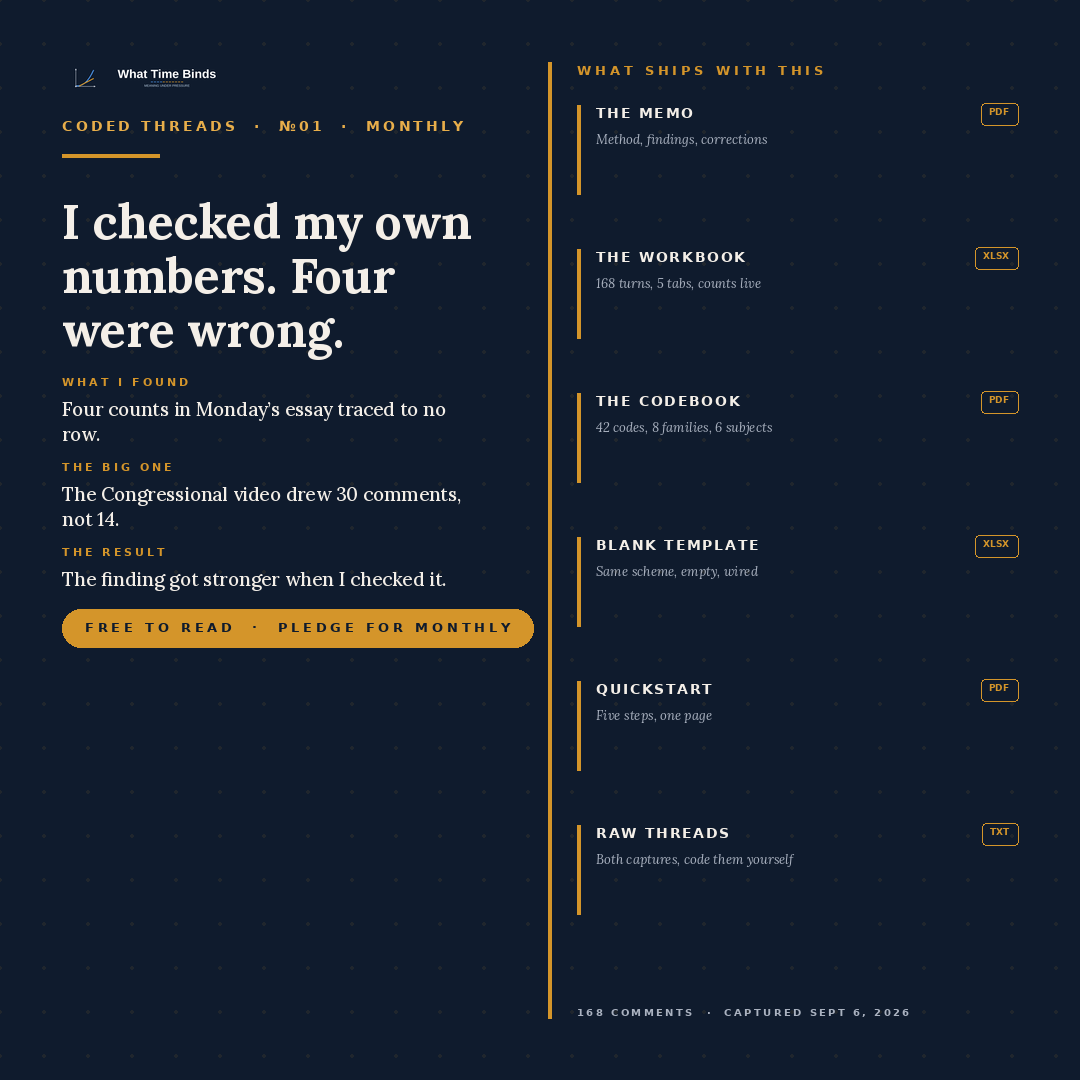
I checked my own numbers. Four of them were wrong.
Monday, I published The Silence. It reported that 167 people commented on two Facebook posts, and that not one of them argued the oversight architecture the essay was about.
Tuesday I sat down to review the workbook that backs it. I opened the file to trace every count in the essay to the row it came from.
Four counts had no row.
The essay said 33 people argued about the Secretary of Defense. Twenty-four about DEI. Fourteen about the video the six members of Congress made. Ten about the Commander in Chief’s authority. I could not find where any of those came from. I made a mistake. Two turned out to be code counts wearing a subject label. The rest, well.
So I read all 168 comments again, coded each one for subject, wrote down the boundary rules I was using, and counted.
The Secretary of Defense: 28. DEI: 16. The Commander in Chief’s authority: 8. Officer promotion mechanics: 20, which the essay never reported at all.
And the video: 30.
That last number is why I am telling you this instead of quietly fixing it. The count I got most wrong runs against me. More than twice as many readers argued the Congressional video as I reported. Part Two drew 40 comments, and 30 of them argued the video, the sedition charge, or whether an illegal order had been given.
Thirty people arguing hard about the military. Still, none of them arguing the four channels.
The finding got stronger when I checked it.
I corrected the essay Tuesday with a dated note. Every count in it now traces to a row you can open. This installment is that row, and the other 167.
Why you are getting this free
Coded Threads is meant to be a monthly paid series. The paid tier at What Time Binds is not open yet. It opens when enough folks support my work.
Publishing installment №01 behind a wall that does not exist yet would hide the only thing that argues for the series. So take the whole thing. Memo, workbook, codebook, a blank template wired to the same scheme, and the raw threads I coded.
If you want this monthly, pledge. Pledges are what tell me it is time to turn the tier on.
Downloads
Six files. Take all of them.
1 · The memo. Everything below, as a PDF. Method, findings, what surprised me, what I would do differently, and the corrections.

2 · The workbook. 168 anonymized turns across five tabs. Every count is a live formula, so recoding a row moves the totals. This is the file that found the four bad numbers.
3 · The codebook. 42 codes across 8 families, plus 6 subject tags. Each code carries a definition, a rule for applying it, a rule for not applying it, an example, and its count.
4 · The blank template. The same scheme, empty. Dropdowns loaded, frequency tabs wired. Paste your own thread in, and it counts itself.
5 · The quickstart. Five steps on one page. Capture, load, first pass, second pass, reconcile.
6 · The raw threads. Both Facebook captures in one workbook, a tab per thread, 194 turns. Commenter names are replaced with the same P-01 through P-92 pseudonyms the coded workbook uses, so you can re-code the material without anyone being named. Paste the verbatim column into the blank template and tell me where we diverge.
Personal use, attribution required, no republishing. Method questions, corrections, divergent codings, and takedown requests: info@what-time-binds.com
Metadata

1. What was coded
Two Facebook posts from What Time Binds published four days apart on my personal page.
The first, Called It, went up Sunday morning, August 31, 2026. It named the five Secretaries of Defense who signed the February 27, 2025 letter warning Congress about the reckless firings of general officers, and it named what happened in the eighteen months since. The post drew 128 reader comments across four days.
The second, When Order Becomes Oracle, Part Two, went up Wednesday, September 3, 2026. It named the six members of Congress (all veterans or intelligence officers) who released a ninety-second video restating what the constitutional meaning of “order” actually is. The post drew 40 comments across three days.
I captured both threads on Saturday, September 6, by screenshotting the full comment section on each and transcribing every reader comment to a text file. What I coded was the reader turns only — my own comments as original poster stayed out of the coding, though they appear in the raw thread capture for reference.
The coding pass ran across the weekend. Two passes, one open and one focused, using a codebook I built for the first pass and refined for the second. Every count in the Monday essay traces to a row you can inspect in the workbook that ships with this installment.
2. The codebook, briefly
The framework is hybrid. It uses grounded-theory-style open coding for the first pass and a deductive-inductive scheme for the second, the same practice I used in my USC Rossier dissertation on media literacy during the COVID misinformation years.
Codes sort into eight families:
A · Service-Anchor Moves — claims anchored to a service record, a family member’s service, a credential, or direct experience of how the institution works
B · Precedent and History — arguments that place the claim in history, deployed as reassurance or as warning
C · Frame Maneuvers — moves that shift the frame rather than answer inside it
D · Loyalty and Civilian Control — the elected branch and the professional military, and the comply-or-resign binary
E · Sedition and Specificity — what counts as sedition, what counts as an illegal order, and how specific a charge must be
F · Fact and Source — sourcing, primary documents, correction, and what happens to a reader who gets corrected
G · Slogan and One-Liner — positions delivered with no argument attached, and the replies they draw
H · Moderation and Delivery — how a turn is delivered, insult wrapped around a real point above all
Forty-two codes sit inside those eight families. Forty-one were applied to this dataset; C4 was defined and never used. The full codebook ships as a separate PDF.
Subject is a second dimension, counted separately. A code names the move a turn makes. A subject names what the turn is about. Six subject tags were derived on September 9, 2026 by reading every respondent turn, with the boundary rules published in the codebook so the counts can be disputed.
Forty-one specific codes sit inside those eight families. The full codebook, with definitions, decision rules, and one example per code, ships as a separate PDF in this installment.
3. Findings
The workbook produced one finding above the others, and the Monday essay is built around it.
The essay was about oversight architecture. Nobody in the thread argued the architecture.
The essay named four channels that stop an unlawful order inside the U.S. military: Judge Advocate General review, Inspector General oversight, chaplaincy, and 10 U.S.C. § 1034, the Military Whistleblower Protection Act. It named what happened to each between January 2025 and September 2026. It named Adm. Alvin Holsey, pushed out of Southern Command two years early after raising legal concerns about the Caribbean boat strikes.
Zero comments across the 168 argued about the JAG-office removals. Zero argued about the seventeen Inspectors General dismissed on the night of Friday, January 24, 2025. Zero argued about chaplaincy replacements or Doug Wilson’s Pentagon invitation. Zero argued about § 1034. Zero named Holsey by name.
What readers argued about instead:
The Congressional video from Part Two (30 comments)
The Secretary of Defense as a person (28 comments)
Officer promotion and selection board mechanics (20 comments)
DEI and affirmative action (16 comments)
The Commander in Chief’s constitutional authority (8 comments)
Obama firing officers a decade ago (7 comments)
One hundred of the 168 turns carry at least one of those six subjects. Sixty-eight carry none: insult with no claim attached, bare agreement, thread housekeeping.
Every one of those is a real subject. None of them is the subject the essay named.

The second finding, which is what most surprised me in the coding, is about delivery.
Thirty of the 168 comments — 18 percent — carried a substantive counter argument delivered inside a personal attack. Not the top argument. Not the top valence. The top delivery mode. Nazi-POS. Hitler-dildo. Snuff-porn. Comments of that shape came from both sides.
More came from the ally side than the opposition side. That is a coalition problem worth naming, and the Monday essay names it. Every time an ally delivers a correct substantive counter with slur and class contempt, the opposition side gets to say “these people are unserious” with evidence to point at.

The third finding is that the two threads split evenly on valence but not on temperature. Roughly half of each thread coded ally, half opposition. Part Two ran proportionally hotter on the ally side: ALLY-H (ally-heated) was 28 percent of Part Two turns versus 12 percent of Called It. Same audience. Same argument. The Part Two piece drew heavier delivery from readers who agreed with it.

4. What surprised me
Three things I want to point out.
First, one exchange did what the essay was hoping someone would do. An opposition-adjacent commenter engaged in three sustained replies across the Called It thread. He delivered real substantive counters: the al-Awlaki 2011 legal framework, Article II and maritime authorities, the tax-loophole analogy for finding executive authority when Congress will not act. Partway through, he noticed the Substack byline listed a doctorate in Organizational Change and Leadership and wrote that he was “in for it.” He closed the exchange with a line about restoring his faith in humanity. One exchange out of 168. That fraction is what tells me the conversation is possible.
Second, even the substantive engagements stayed one register above the essay’s actual subject. The commenter above engaged al-Awlaki, Article II, maritime authorities, Shinseki, and JAG review as an ongoing process. He did not engage the JAG-office removals, the IG dismissals, the chaplaincy replacements, or § 1034 specifically. His argument sat at the culture-change / executive-workaround / majoritarian-mandate register. The essay’s argument sat at the oversight-channel level. The two registers did not meet, even in warmth. That gap is what tells me the frame shift is the hardest ask.
Third, extralegal-punishment proposals showed up on both sides. Some ally-side comments proposed the Secretary of Defense be routed straight to hell, Leavenworth, or Guantanamo. Some opposition-side comments proposed military tribunals for the six members of Congress who released the video. The grounds are not equivalent — impeachment of a Secretary of Defense is a real institutional path; congressional privilege protects the six from a tribunal proposal on its face — but the impulse to route around ordinary process shows up on both sides. I coded the ally-side extralegal proposals under D1 (loyalty-frame) because that was the closest fit. On next pass I will build a distinct code for them.
5. What I would do differently next time
Add a code for extralegal-punishment proposal. Big enough on both sides to deserve its own row rather than being folded into loyalty-frame.
Distinguish first-time commenters from repeat commenters. I did not track this. A first-time commenter’s delivery mode reads differently from a habitual commenter’s, and that distinction would sharpen the ally-side H2 finding.
Track thread velocity. A thread that draws 128 comments in the first six hours codes differently from one that draws 128 comments across four days. The essay’s finding might be sharper if I could show that architecture-silence held constant across both fast and slow coding windows.
Get a second coder. Solo coding is inter-reliably weak by definition. The next installment will run at least one code family past a second reader (Doug Krugman has offered) so the workbook carries a real inter-coder agreement number.
6. The repair
The Monday essay makes one analytical claim. The pattern belongs to the instrument, not to the individuals.
The instrument here is the political discourse machinery that trains readers to argue about persons (the Secretary, the President, the six members of Congress) rather than about mechanisms (the four oversight channels). The commenters, on both sides, did not choose to skip the architecture. The instrument selected against it. The workbook shows the selection at row level.
That is what makes the coded workbook a research artifact rather than a summary. A summary tells you what people argued about. A workbook lets you check whether the summary is right — and lets you take the same instrument to a thread of your own and see whether the pattern replicates.
Every subscriber who does this replicates the essay’s method. Enough replications and the analytical claim strengthens or falls. That is what I want from this series.
7. Notes on method
Anonymization. Every commenter’s name has been replaced with a stable respondent ID (R-001, R-002, etc.). The ID is consistent across the workbook, so exchanges and cross-thread patterns remain readable. Names appearing inside verbatim comment text have been redacted to [respondent]. Public officials named in comments (Hegseth, Mattis, Obama, Wilson, Holsey, Marshall, West) remain named. A private name-mapped master workbook stays on my working system for coding accuracy and audit; no subscriber ever receives the mapping.
Coding process. Two passes. First pass was open coding at the comment level, with codes generated inductively as new patterns appeared. Second pass was focused coding using the refined codebook, with every comment re-coded against the full scheme. Where a comment carried multiple substantive claims, it received multiple codes. Where a comment was pure delivery with no substantive counter (an insult without a claim), it coded H2 alone.
Reliability. Solo-coder installment. Inter-coder agreement is not reported for this installment. The next installment will include at least partial second-coder agreement on one code family.
Reproducibility. The raw thread capture ships with this installment. Any subscriber can re-code the same threads against the codebook and check where their coding matches mine or diverges. Divergences are interesting, not problematic. Send me one that surprises you, and I will publish it in the next installment.
Corrections made before publication. Two, and both are important because they show what the dual-workbook system is for.
First, the v1.0 codebook document described a different scheme than the one applied to the data. It named an M family that does not exist in the workbook and left twelve applied codes undefined. Worse, four shared code IDs carried different meanings in the two documents. Nothing in the Monday essay depended on the bad document, because the essay was written off the workbook. The codebook was regenerated from the workbook’s Code Book tab and shipped as v1.1.
Second, the Monday essay reported five subject counts that traced to no workbook row. Two of the five were code counts relabeled as subject counts; three had no source (me working alone at 1 AM). I coded all 168 turns for subject, published the boundary rules, added a Subject column to the workbook, and corrected the essay in place with a dated note on September 9, 2026. The largest change ran the other way from what a defensive writer would want: the Congressional video drew 30 comments, not the 14 I reported. More readers argued it than I said, and still none argued the architecture.
Neither error would have survived a subscriber opening the workbook. That is the argument for sharing the workbook.
Threats to validity. Selection bias — these threads sit on my page and were seen by my readers first. Timing bias — the September 3 post appeared during a specific news cycle that likely shaped what readers came in ready to argue. Coder bias — I am the author of the essay the workbook was built to support, which is the biggest single threat to the finding. The dual-workbook system, the reproducibility offer, and the second-coder plan for future installments are the mitigations. They are partial mitigations, not solutions.
This is Coded Threads №01, published September 9, 2026, free to read. The series runs monthly once the paid tier opens at five hundred subscribers. If you want it, pledge.
Jerry W. Washington, Ed.D., served 23 years in the Marine Corps. He holds a doctorate in Organizational Change and Leadership from USC Rossier and teaches at UC Irvine Division of Continuing Education. He publishes What Time Binds at what-time-binds.com.
Questions on this installment: info@what-time-binds.com