

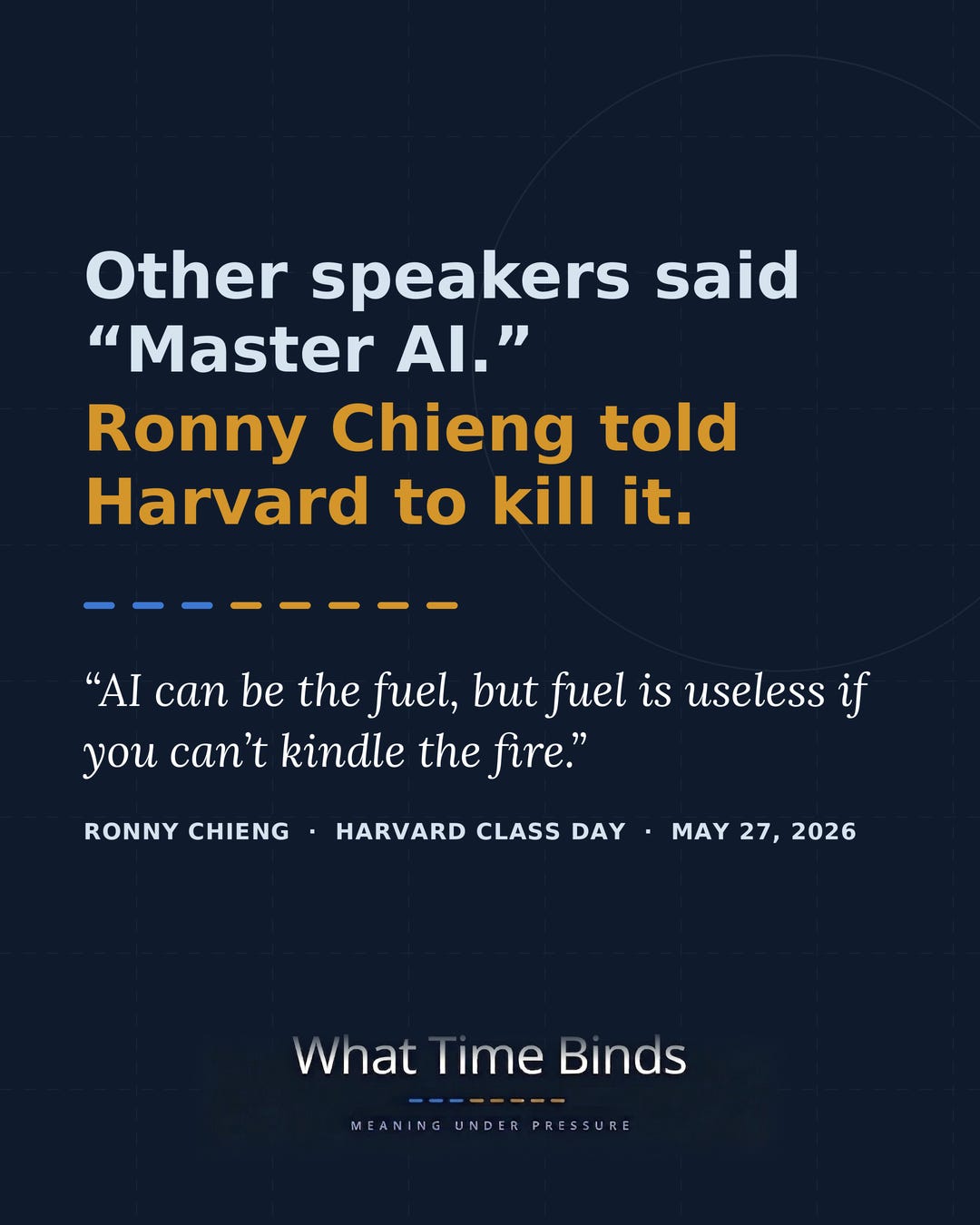
I copied a card off Facebook on Saturday, May 30. Black background, green type, a photo of Ronny Chieng in a red shirt. The white headline read: Other speakers said “Master AI.” Ronny Chieng told Harvard’s Class of 2026 to kill it. Under it, a block of his words about AI making mediocre people dumber.
The card is accurate. Every word on it, Chieng said. It is also one of the smallest readings of his speech a person could publish and stay honest.
That gap is the subject of this piece.
Chieng gave the Class Day keynote at Harvard on Wednesday, May 27, at Tercentenary Theatre. He spoke for about twenty minutes. He opened by swearing at AI three times and got a roar back. The card kept that. What the card could not keep was everything across the other nineteen minutes, including the moment he cut the word “AI” into two different things and judged them in opposite directions. That cut was the most useful thing he did on stage, and it is exactly what a viral crop is built to lose.
The instrument forces a trade
Physics has a name for this kind of loss. Werner Heisenberg’s uncertainty principle says you can fix a particle’s position or its momentum, but not both at full precision. Pin where it is with great accuracy and how fast it’s going goes blurry. Pin its speed and its location smears. The instrument forces a trade. You choose what to see sharply, and you pay for it in what you let go soft.
A speech behaves the same way under a phone camera. Measure Chieng’s talk for shareability, and you get “kill AI” in perfect focus while everything that complicates it goes soft. The card measured for one property. It got that property exactly right and lost the rest.
I read AI arguments through five lenses, drawn from work I published in 2023 on worldviews and technology development. Each lens is an instrument set to measure one property.
The Scientist measures evidence. How would we know it works?
The Meaning-Maker measures interpretation. What is this taken to mean, and by whom?
The Equity Reader measures harm. Who benefits, who is exposed?
The Sovereignty Reader measures control. Whose data, whose decision rights?
The Operator measures results. Does it ship, does it move the number?
You cannot run all five at full resolution at once. In a real meeting, you foreground one, and the rest go soft. The skill is knowing which one you are holding, and what you let blur to hold it.
Read it line by line
Here is the method. Take one line. Ask what it does on its own, and which lens it runs on. Then hold that same lens up to the whole twenty minutes and watch what happens. The reading that fits the fragment almost never fits the speech. That distance is where the meaning lives.
Start with the line on the card. At 5:37, Chieng sets it up: other speakers tell you to “master AI for the future.” At 5:45 comes the line everyone clipped. The mission of your generation is to “destroy AI. Kill it.”
On its own, that is a battle cry. Resistance. It reads through the Equity Reader, the language of fighting a system that does harm. Now run the Equity Reader across the whole talk. Seconds later, at 6:02, Chieng explains the mission: capture an AI, reprogram it, send it back in time, “Terminator 2: Judgment Day.” The battle cry is a movie joke. Hold the harm lens to the full speech, and it finds nothing to grip. He never names who owns these systems, whose labor they replace, or whose data trains them. The resistance reading smears. The card kept the eight seconds and cut the joke that defused them.
That is the whole method in one beat. Keep going.
At 6:12 he heckles the imagined objector in the crowd: “shut up, nerd.” Then at 6:27, the exemption. AI for breakthroughs in medicine and physics, “you’re not the problem.” On its own it plays as a throwaway. Across the talk it is the hinge. Chieng has just cut “AI” into two activities, discovery and shortcut, and assigned them opposite verdicts. That is the Meaning-Maker at work: the meaning of the use decides everything. Same three letters, two different referents, and he names which one he means before he tells you what he thinks of it. The card had no room for the cut. The cut is the part a leader needs.
At 7:11, he runs the Operator’s play. AI can read your email, summarize it, draft a reply, and his answer is “you know who else can do that? Me.” On its own, a punchline. As a measurement, it is a marginal-value test: for someone who already has the skill, the tool’s net gain is small. He is not weighing the system’s harm. He is weighing its value against a competent human, which is the Operator’s only question.
Then, at 8:02, the line an organization should write on the wall: “AI can be the fuel, but fuel is useless if you can’t kindle the fire.” He proves it with a bit about using AI to run a regression analysis, then asks whether he could have done any of it without knowing what a regression analysis is. The answer is no. On its own, a craft maxim. Across the talk, it is the actual thesis, and it runs on the Operator and the Meaning-Maker at once. AI multiplies the competence you bring to it. A multiplier on mastery compounds. A multiplier on zero stays zero.
At 9:50, he lands the Meaning-Maker cleanly. A friend tried to learn Buddhism from a book called Buddhism Made Simple, used AI to summarize it in ten seconds, and “didn’t reach enlightenment.” Speedrunning Buddhism, Chieng says, misses the point. The value lived in the reading. The summary delivered the words and threw away the reason to have them. Same claim as the fuel and the fire, told softer.
By 11:04, he turns it into a forecast: the coming divide is “people with substance versus people with shallow knowledge,” mastery against faking it. Heard alone, an applause line. Heard against everything before it, the steady claim of the entire speech. The work makes the person, and a tool that removes the work removes the formation.
Six lines. Five run on a different lens than the card assigned to the one it kept. The militant surface sells. The argument underneath is built, and it is an argument about competence, not about harm.
The pin
Here is the thing to carry out of this.
“AI” is a magnet word. “Master AI” and “destroy AI” are two camps fighting over a term neither side has defined. The fight dissolves the second someone names the use.
In this room, “AI” means a specific tool, used by specific people, on a specific task. It includes the task, the people, and what they would do without it. It excludes “AI” as one undivided force to be mastered or killed. Revisit the definition every time the use changes.
Position, momentum, and the governance call
This is where the physics earns its place for anyone running an organization.
Enablement and guardrails are your position and your momentum. Push enablement to full resolution: ship fast, roll it out everywhere, let everyone use it, and your read on harm and control goes soft. Clamp control all the way down: lock it, route every use through review, and the win that would have justified the investment goes soft. You cannot max both. The instrument forces the trade.
Most AI governance fails the same way. A decision gets made through one lens and mistaken for the whole picture. The Operator ships the rollout and cannot see the exposure the Equity Reader would have caught. The Equity Reader blocks the pilot and cannot see the result the Operator needed to fund the safety work in the first place. Both readings are precise. Both are partial. The license counts climb and nothing changes, because a tool in someone’s hands changes nothing until it changes how they work.
Chieng gave you the test in eight words: fuel is useless if you cannot kindle the fire. Build where there is a fire to feed, real competence and real judgment the tool can multiply. Guardrail where the tool would burn the reps that build the judgment in the first place. The verdict follows the use, not the three letters.
That tells you how far to push and where to stop. Push where the fire already burns, the complementary risk is low, and you have checked it through the lens you would rather skip. Stop where the tool replaces the thinking the work depends on, or where a lens you were not standing in surfaces a harm your deciding lens cannot see. A blanket ban and a blanket green light are the same error: a single measurement, mistaken for the whole.
A Repair Protocol for the Build-or-Guardrail Call
Before you decide how far to go on any AI use, rotate the instrument:
Name the use, not “AI.” Which task, which people, what they would do without it.
Say which property you are measuring first: speed, cost, risk, capability. Name the lens you are standing in.
Ask the four you are not standing in. Evidence: how would we know it worked? Harm: who is exposed if it does? Control: whose data, whose decision rights? Results: has it moved the number somewhere comparable?
Name the blur. For the property you pinned, write down what went soft while you measured it.
Check for the fire. Is there competence here for the tool to multiply, or are you pouring fuel into an empty pit?
Set the guardrail where the blur is dangerous, not everywhere.
Measure behavior change afterward, not license counts.
Log the decision and the blur, so the next person inherits what you could not see.
Lines for the room
When someone says “we have to master AI” or “we should ban it”: Which use, on which task, for which people? Let’s decide that one, not the whole category.
When the group is optimizing one thing: We’re sharp on speed right now. What did we just let go blurry, the risk or who’s exposed?
When you set a limit: Is there competence here for the tool to multiply, or are we handing it the part that builds the competence? Build the first. Guardrail the second.
Three questions for your own shop
What single property did your last big AI decision measure for, and what went blurry while you measured it?
Where are you running a blanket ban or a blanket green light, when the honest answer is “depends on the use”?
Whose lens never reaches the room before the decision gets made?
I copied that card because it was sharp and because it was true. It was also the smallest version of a twenty-minute speech whose best moment was an act of definition. Chieng cut a word that two camps of very smart people keep refusing to cut, and the cut is what made his position make sense.
Keep arguing “master AI” against “kill AI” and we hand the next class a fight with no referent, a shouting match over a word left blank. Name the use first and we hand them something they can carry: a map of where to build and where to hold the line. A comedian doing a Terminator bit drew more of that map than the speakers who told the same graduates to go master the future.
Wednesday — What Do You Mean? — Use
Chieng gave us the slogan at maximum scale: kill it, from a Harvard stage, to a roar. He left the harder job off the Class Day stage: telling which part of the work is worth keeping. Three things hide inside the word “use”: the rep that builds you, the chore that builds nothing, and the one that quietly takes your judgment while you look away. Wednesday, I’ll sort them and show how the line falls on the email in your drafts, the paragraph you can’t start, and the homework your kid swears they finished.
Sources: Ronny Chieng, Harvard College Class Day keynote, Tercentenary Theatre, May 27, 2026. Full speech video:
(in-text timestamps refer to this recording). Schuyler Velasco, “Ronny Chieng Tells Harvard to ‘Destroy AI’ as Graduates Cheer,” Harvard Magazine, May 27, 2026. “Funny but serious, Chieng issues an AI warning to grads,” Harvard Gazette, May 2026, which identifies the cited research as the 2025 MIT study “Your Brain on ChatGPT,” posted to arXiv, on cognitive debt from overreliance on large language models. The five-lens reading draws on J. Washington, “AI and Philosophy: Worldviews and Technology Development” (SSRN 4656485, 2023).
There's a major historical event in Japan called the Hoko-ji Bell Inscription Incident. The same inscription on a temple bell was read through two completely different lenses — the writers' lens of celebratory intent, and Tokugawa Ieyasu's lens of political attack. The writers were accused of deliberately encoding hostile meaning, and it escalated into a war that destroyed their entire clan, the Toyotomi.
It made me think: when the lens isn't named, the same words can end up fueling completely different fights.
AI is really just a portable dictionary, but once it gets treated like an oracle, we end up following what it says before we even think to question it. There's a sense of omnipotence that comes from AI's power, even though my own abilities haven't actually grown.