

WDYM Field Guide · What Time Binds · October 21, 2026
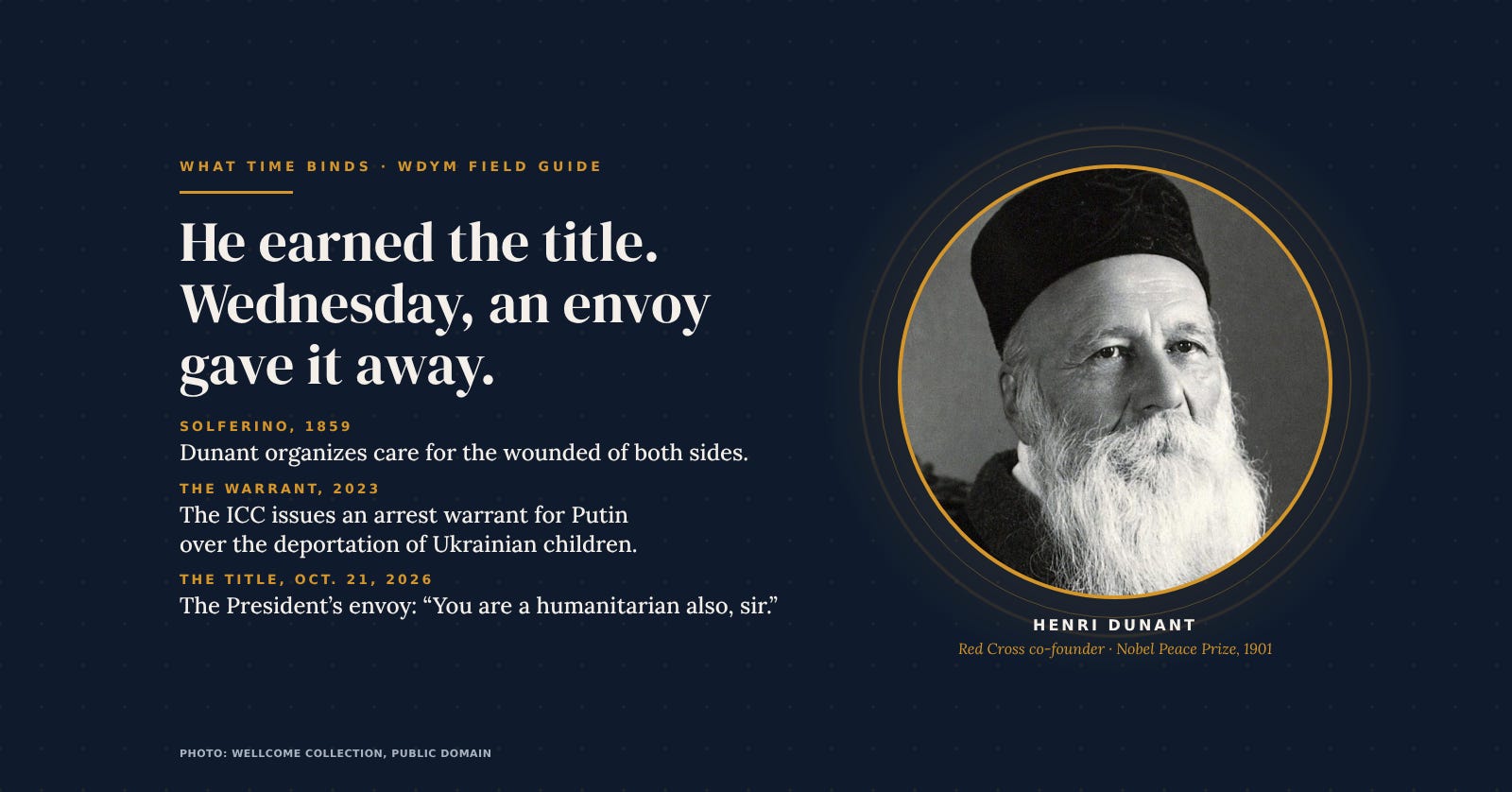
On Wednesday, President Trump’s special envoy, Steve Witkoff, told Vladimir Putin, “You are a humanitarian also, sir.” Here is my argument before the evidence.
The adjective describes an act: a release on “humanitarian grounds,” a humanitarian convoy, a humanitarian pause. One decent act can earn it.
The noun names a person: someone whose conduct prevents suffering and relieves it, for anyone, with no price attached. Only a record can earn it.
The official record lets a few of Putin’s acts earn the adjective. It denies him the noun, because a humanitarian prevents suffering and the record shows his government causing it. Hanging that noun on Putin was reckless. An envoy speaking for “our whole nation” gave the title to a man under an International Criminal Court arrest warrant for the unlawful deportation of Ukrainian children, weeks before talks that have to bring those children home.
Start with the transcript.
The Kremlin’s transcript is stamped 12:25, Wednesday, October 21, in the Constantine Palace outside St. Petersburg. Vladimir Putin speaks first. He thanks President Trump for his attention to Ukraine. “I know that it is a special matter for President Trump,” he says, “primarily for humanitarian reasons.”
Then he adds this sentence: “The civilian population is suffering.”
Steve Witkoff, the President’s special envoy, answers with thanks. Russia had freed an American that morning. “Our whole nation sends their thanks because of Steven Hubbard,” Witkoff says. “Because of you, he is going home to his family.” Putin tells him Hubbard is at Pulkovo Airport. Witkoff hands the word back across the table:
“He is a 75-year-old man. You talk so much about my President, President Trump, being a humanitarian. You are a humanitarian also, sir. I salute that. I commend you, and I thank you again.”
He goes on to Oslo, the peace papers he brought, the First Lady’s “humanitarian projects in the Russian Federation,” and Russia’s decision to lift its export controls on diesel, “a really important act on your part, sir.” (Chapter 4 covers that deal.) When Putin speaks again, he answers the diesel line: “The first tanker, carrying 40,000 tonnes, will depart in two or three days.” In the part the Kremlin published, he never answers the compliment.
Stephen Hubbard is 74, a retired schoolteacher from Michigan. He moved to Ukraine in 2014 and made his home in Izium, in the east. Russian forces captured the town in April 2022 and, by Russia’s own account, detained him that month. Russia says he was manning a checkpoint for Ukraine’s territorial defense. His lawyer, Martin De Luca, says Hubbard told him Russian soldiers “grabbed him from his house.” In October 2024 the Moscow City Court sentenced him to six years and ten months for mercenarism after a closed trial. The State Department designated him wrongfully detained, the only American held in Russia with that status. He spent four and a half years in Russian custody. His freedom is good news on any reading.
My time in uniform taught me to read the word “humanitarian” as law before it is recognized as praise. The Marine Corps order in force today requires law of war training for every new Marine, officer or enlisted, at Officer Candidates School or the recruit depots, with testing. The training doesn’t stop there. Before every combat deployment, Marines go through “build-up” training. You drill the unit skills you will bring to combat, and you are also trained again on the law of war. On many of the deployments I took part in, more training followed as soon as we entered the country, and again during the RIP/TOA, the relief in place and transfer of authority, when one unit hands its area of operations to the next.
Who Said It First
Count the speakers. Putin used the word first, about Trump. Witkoff handed it back, about Putin. Within hours the Kremlin’s spokesman used it a third way. Dmitry Peskov told reporters the President had once again made the decision “out of humanitarian considerations.” In the same answer he said contacts “on exchanges and so on” continue “through the special services.”
Open the Kremlin’s English transcript and count three words: humanitarian, diesel, children. I count five, four and zero.
A word works when the speaker and the listener point at the same thing. Linguists call that thing the referent. On Wednesday one sentence pointed at two different things, on two pages of the same website. In English, Witkoff says, “You are a humanitarian also, sir.” The Kremlin’s Russian text, marked “as translated,” renders the line without the noun, as a man who “graciously considered this matter” (милостиво рассмотрел этот вопрос). Милостиво comes from милость, the Russian word for mercy or favor. Americans heard a humanitarian. Russian readers got a man who granted mercy.
The word is hiding a swap between an act and a title, and the record shows who moved it from one to the other. In the transcript, Putin uses the adjective: “humanitarian reasons,” “humanitarian issues.” Peskov used the adjective with reporters: “humanitarian considerations,” the grounds for one decision. That is ordinary language for a compassionate release, usually for age or illness, and this release may rest on it. Only Witkoff uses the noun. Trump is “a humanitarian.” Putin is “a humanitarian also.” A noun like that is a title, and a title answers to a record.
Stated definition: a person who prevents suffering and relieves it, for anyone, with no price attached.
Operational definition, October 21: a head of state who frees one prisoner his own courts convicted, in a meeting about peace papers and diesel tankers.
The word has a definition, a founding book, and a body of law Russia ratified.
Every Monday I take one word an institution bent and show the page it bent on. Subscribe and the next one is in your inbox, free.
Look It Up
Sen. Thom Tillis, a North Carolina Republican, answered on X the same day: “Look up the definition of ‘humanitarian.’ What an embarrassing and outrageous thing to say. You should go back to Ukraine and ask the families of the children Putin has kidnapped and murdered whether they agree your friend Putin is a ‘humanitarian.’” Sen. John Cornyn of Texas called Putin a “stone cold killer.” Rep. Don Bacon of Nebraska wrote, “Another embarrassment.” All three are Republicans.
So I looked it up. Few words in English carry this much paper.
Collins describes humanitarian behavior in one sentence: people with humanitarian ideas or behaviour “try to avoid making people suffer or they help people who are suffering.” Note the “or.” One act of relief can earn the adjective, and this essay grants it wherever the record allows. The noun asks more. Merriam-Webster defines it as “a person promoting human welfare and social reform,” a description of conduct over time.
Its modern sense started as a sneer. Etymonline dates the sense “philanthropist” to 1842 and notes it “originally was disparaging, with a suggestion of excess.” It earned its standing on a battlefield. On June 24, 1859, a Geneva businessman named Henri Dunant came upon the wounded of the Battle of Solferino and organized their care in the town of Castiglione. In A Memory of Solferino (1862) he wrote that the local women, “seeing that I made no distinction between nationalities, followed my example.” They repeated two words as they worked: “Tutti fratelli.” All are brothers. On August 22, 1864, twelve nations signed the first Geneva Convention. Article 6: “Wounded or sick combatants, to whatever nation they may belong, shall be collected and cared for.”
The principles followed. The Red Cross movement’s first principle, proclaimed in Vienna in 1965, commits it “to prevent and alleviate human suffering wherever it may be found.” The word between the two verbs is “and,” and prevention comes first. Impartiality means relief “guided solely by their needs.” Voluntary service means “not prompted in any manner by desire for gain.” The UN General Assembly wrote humanity, neutrality and impartiality into resolution 46/182 in 1991 and added independence in 2003: “the autonomy of humanitarian objectives from the political, economic, military or other objectives” any actor may hold.
Then came the law. The Soviet Union ratified the 1949 Geneva Conventions in 1954 and Additional Protocol I in 1989. Russia remains a party to both. My own service ran under the same principle. The Pentagon’s Law of War Manual puts it in one sentence: “Humanity may be defined as the principle that forbids the infliction of suffering, injury, or destruction unnecessary to accomplish a legitimate military purpose.”
The word has a referent, and it is written down. That makes a test possible.
Seven Behaviors, One Record
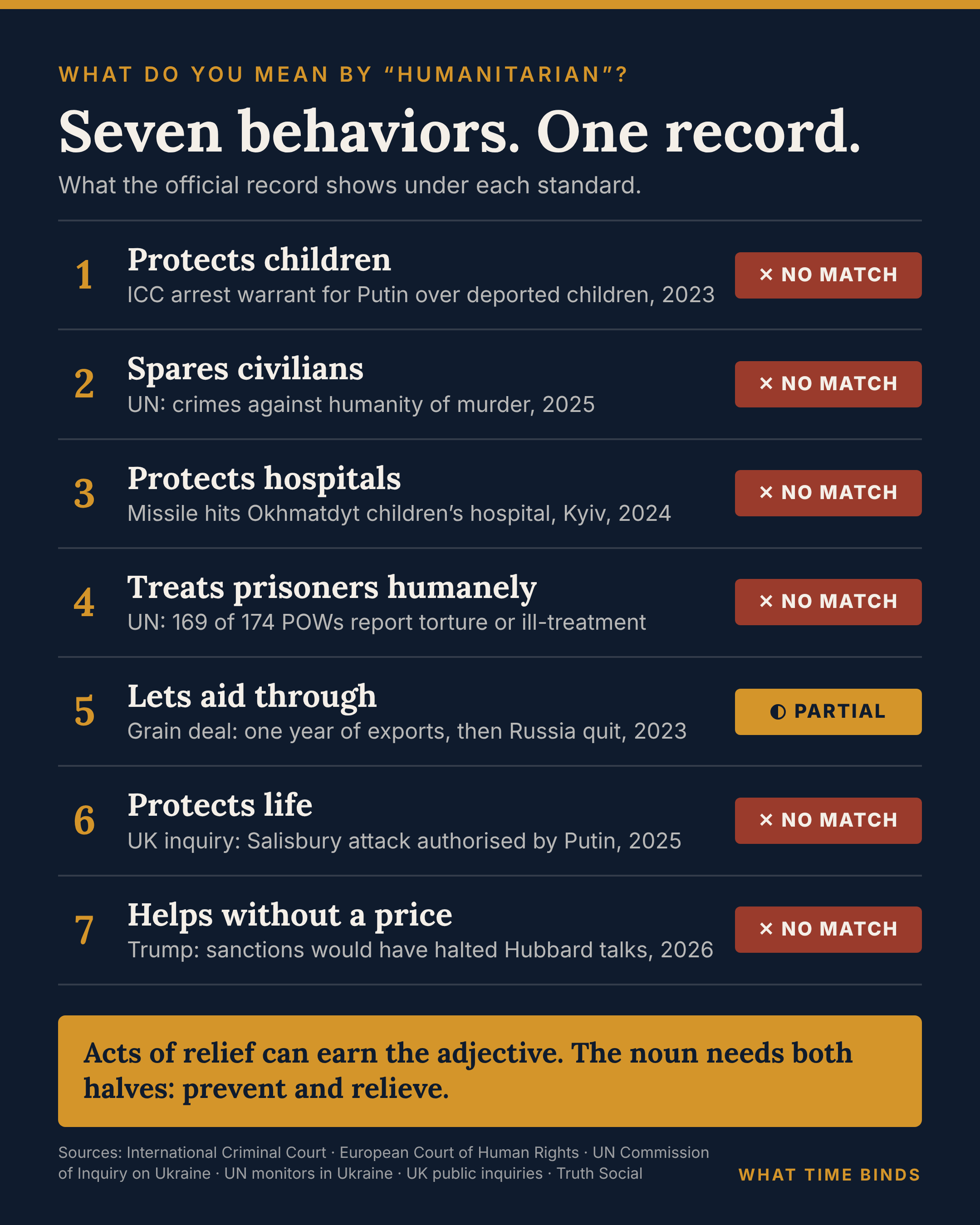
Pull the behaviors out of those pages and you get a list anyone can check. I count seven. Under each one I put the record from courts, UN bodies, public inquiries and governments, and I mark where a fact comes from Amnesty International or Ukraine’s own counts. Where a finding names Putin himself, I say so.
1. A humanitarian protects children.
The standard: children “shall be the object of special respect” (Protocol I, Article 77). An occupier “may not, in any case, change their personal status” (Fourth Geneva Convention, Article 50). Deporting people out of occupied territory is prohibited “regardless of their motive” (Article 49).
The record: On March 17, 2023, the International Criminal Court issued a warrant for Putin himself, finding reasonable grounds to believe he bears responsibility for the unlawful deportation and transfer of Ukrainian children. On July 9, 2025, the European Court of Human Rights, ruling unanimously, described “a systematic programme of long-term, indeed permanent, removal of these children from their legal guardians in Ukraine.” On March 12, 2026, the UN Commission of Inquiry found crimes against humanity, carried out under “a policy conceived and executed at the highest level of the Russian Federation’s leadership.” It added: “The involvement of President Vladimir Putin, and Maria Lvova-Belova, the Presidential Commissioner for Children’s Rights, has been visible from the outset.” Ukraine’s government counts 20,651 children deported or forcibly displaced, and 2,736 returned.
Match: none.
2. A humanitarian spares civilians.
The standard: the parties “shall at all times distinguish between the civilian population and combatants” (Protocol I, Article 48). Civilians “shall not be the object of attack,” and violence meant “to spread terror” is prohibited (Article 51).
The record: The European Court found “overwhelming evidence contradicting Russia’s bare assertions that it had not attacked civilians or civilian objects.” In October 2025 the UN Commission found that Russian drone attacks on civilians across more than 300 kilometers of the Dnipropetrovsk, Kherson and Mykolaiv regions were crimes against humanity of murder. On March 16, 2022, an airstrike hit the Mariupol Drama Theatre, where locals had written “Дети,” children, in giant letters. Amnesty International found Russian aircraft almost certainly carried it out and called it “a clear war crime committed by Russian forces.” The European Court found Russia responsible for the downing of MH17 in 2014, which killed 298 people, and the UN’s civil aviation council found Russia “failed to uphold its obligations under international air law.” UN monitors have verified 17,605 civilians killed in Ukraine since February 24, 2022, on both sides of the front, and say the real number is likely considerably higher. Of the 328 killed in September, 18 were in territory Russia occupies. On Wednesday Putin told the envoy that “the civilian population is suffering.” Five days earlier, the same monitors had reported that “the first two weeks of October were among the deadliest periods for civilians in years.”
Match: none.
3. A humanitarian protects the wounded and the places that treat them.
The standard: the 1864 Convention began here. Civilian hospitals “may in no circumstances be the object of attack” (Fourth Geneva Convention, Article 18).
The record: On July 8, 2024, a missile struck Okhmatdyt children’s hospital in Kyiv. The UN human rights office concluded the strike “was likely due to a direct hit from a missile, and not from falling debris resulting from an air defense interception,” during “a large-scale coordinated attack by the Russian Federation using high-precision missiles.”
Match: none.
4. A humanitarian treats prisoners humanely.
The standard: prisoners of war “must at all times be humanely treated” (Third Geneva Convention, Article 13). “Wilful killing, torture or inhuman treatment” of a prisoner is a grave breach (Article 130).
The record: The UN human rights office reported in October 2024 that 169 of the 174 Ukrainian prisoners of war it had interviewed since March 2023 described torture or ill-treatment. Its June 2026 report found “nearly all” repatriated prisoners it interviewed described the same, and verified the execution of 129 Ukrainian prisoners of war and others hors de combat by Russian forces. In October 2024 the UN Commission found that Russian authorities acted under “a coordinated state policy of torturing Ukrainian civilians and prisoners of war,” a crime against humanity. The same UN reports document abuse on Ukraine’s side too: more than half of the Russian prisoners interviewed reported torture or ill-treatment, mostly during capture and transit. The standard binds both armies. The UN applies it to both. That is what makes it a standard.
Match: none.
5. A humanitarian lets aid through and spares what people need to live.
The standard: “Civilian objects shall not be the object of attack” (Protocol I, Article 52). The parties “shall allow and facilitate rapid and unimpeded passage of all relief consignments” (Article 70).
The record: In July 2022 Russia joined the Black Sea Grain Initiative, and for a year its security guarantees let more than 32 million metric tons of food leave Ukraine’s ports. That year counts. On July 17, 2023, Russia quit the deal and withdrew the guarantees. The UN Secretary-General: “Today’s decision by the Russian Federation will strike a blow to people in need everywhere.” For four straight days, Russian missiles and drones then hit Odesa, Chornomorsk and Mykolaiv, “destroying critical port infrastructure, facilities and grain supplies.” The ICC holds warrants for four senior Russian officials, among them former Defense Minister Sergei Shoigu and Chief of the General Staff Valery Gerasimov, over strikes on Ukraine’s power grid in the winter of 2022–23, including the crime against humanity of inhumane acts. UN monitors counted at least 423 Russian attacks on electricity facilities and 74 on heating plants from October 2025 to March 2026. On October 16 they reported that Russian forces had “resumed systematic attacks on energy infrastructure across Ukraine,” attacks “bound to inflict significant suffering on the civilian population.” The same report logs Ukrainian strikes on power and heat in occupied territory.
Match: partial. One year of grain, under a deal Russia ended.
6. A humanitarian protects life.
The standard: the Red Cross states the purpose plainly, “to protect life and health.” Two of the findings below name Putin personally.
The record: Alexander Litvinenko died of polonium poisoning in London in 2006. A British public inquiry concluded in 2016 that the operation to kill him “was probably approved by Mr Patrushev and also by President Putin.” Dawn Sturgess, a British woman, died on July 8, 2018, after the Novichok brought to Salisbury to kill Sergei Skripal was left behind in a bottle disguised as perfume. On December 4, 2025, a second British inquiry concluded that the operation “must have been authorised at the highest level, by President Putin.” It found “those who sent them, and anyone else giving authorisation” among those “morally responsible for Dawn Sturgess’ death.” Its next sentence: “Deploying a highly toxic nerve agent in a busy city was an astonishingly reckless act.” Alexei Navalny died in a Russian penal colony on February 16, 2024. On February 14, 2026, five European governments said they are “confident that Alexei Navalny was poisoned with a lethal toxin,” and that “Navalny died while held in prison, meaning Russia had the means, the motive and opportunity to administer this poison to him.”
Match: none.
7. A humanitarian helps without taking sides and without a price.
The standard: relief “guided solely by their needs,” “not prompted in any manner by desire for gain,” and independent of “political, economic, military or other objectives.” These principles govern humanitarian action, so they apply to any act that carries the label.
The record: The Kremlin has worn the word as a label for years. In August 2014 Russia sent a “humanitarian convoy” into eastern Ukraine without the Red Cross. The White House said “Russian military vehicles painted to look like civilian trucks forced their way into Ukraine.” In March 2022 Russia announced “humanitarian corridors” that ran from Kyiv into Belarus and from Mariupol and Kharkiv into Russia. Americans held in Russia have come home in trades: Brittney Griner for the arms dealer Viktor Bout in 2022; Evan Gershkovich, Paul Whelan and Alsu Kurmasheva in 2024, in an exchange that sent home Vadim Krasikov, an FSB officer serving a life sentence in Germany for murder; Marc Fogel in 2025, with Alexander Vinnik sent back to Russia. Hubbard came home with no swap, by the President’s account. Minutes later the President posted again: “If sanctions would have been placed, certainly those negotiations would have come to a complete and total halt.” By his own account, sanctions would have ended the talks that freed Hubbard.
Match: none.
Seven behaviors. One partial match, the grain, which Russia ended. None on the rest.
Looking for a Match
A fair test searches the other column too. The record has entries there.
Russia freed Hubbard on Wednesday. In August it freed Robert Gilman, a Marine veteran convicted of assaulting a police officer and later of attacks in custody, after Washington asked for his release on humanitarian grounds. The State Department says nothing was traded. Ukraine’s human rights commissioner counted 9,716 Ukrainians returned from captivity by August 2026. Ukraine’s government counts 2,736 children returned. The First Lady opened her own channel to Putin on the children; in October 2025 she announced that “eight children have been rejoined with their families during the past 24 hours.” In April 2025 Putin declared an Easter truce, “guided by humanitarian considerations.” And for a year, the grain moved.
Each of those is real, and each is better than its absence. Every one meets the second clause of the Collins sentence: help for people who are suffering. Gilman’s release earns the adjective outright, a prisoner in poor health freed with nothing traded. Call it what it was, a humanitarian act.
The Ukrainian entries share a source. The prisoners in those exchanges were captured in a war Russia launched 1,700 days ago. The children came home from the country that took them. The truce was a holiday pause in that same war. The grain needed Russian guarantees because of that war, and it stopped when Russia withdrew them. The First Lady’s “humanitarian projects in the Russian Federation,” in Witkoff’s phrase, exist because the children are there.
Hubbard’s own case makes the point sharper. Russia convicted him as a mercenary. The definition of “mercenary” in Protocol I, Article 47 has six conditions, and a person must meet all six. Condition (d) excludes anyone who is “a resident of territory controlled by a Party to the conflict.” Hubbard had lived in Ukraine since 2014. Russia’s own version makes the case stronger. If he joined Ukraine’s territorial defense, as Russia says, he was a member of Ukraine’s armed forces, which condition (e) also excludes, and a captured member of the armed forces is a prisoner of war, who cannot be tried simply for taking part in the fighting. On his lawyer’s version, soldiers took a civilian from his house. Under either account, the treaty Russia ratified says the word does not fit him. The release ended a conviction the treaty’s own definition never supported.
The Red Cross puts prevention first: “to prevent and alleviate.” On prevention, I searched the official record for a match and found none. Acts of relief can earn the adjective. The noun needs both halves.
The Strongest Defense
Here is the best case for Witkoff’s sentence. Envoys flatter to bring Americans home, and this administration’s channel to Moscow has brought home Marc Fogel, Robert Gilman and now Stephen Hubbard. A family has its father back. Witkoff said Hubbard’s son, a priest, “talked quite a bit about you.” If a compliment buys an American’s freedom, most of us would pay it and call the price cheap.
Most of that is right. The channel produced results, and the son owes no one an explanation for his gratitude.
The sentence still fails on its own terms. Witkoff had already said thank you: “The first thing I want to tell you is thank you.” Thanks closes a transaction. The title opened a new one. He also named who was speaking: “Our whole nation sends their thanks.” A son speaks for his family. An envoy who says “our whole nation” speaks for every American reading this page, and the Kremlin published his line in English and Russian the same day.
Three more objections deserve an answer. The first says Russia rejects the ICC, and the United States does not belong to it either. The record rests on more than one court: the European Court of Human Rights, which Russia belonged to until September 2022, a UN commission, two British public inquiries, five European governments, the UN’s own monitors and the Kremlin’s own transcript.
The second says Russia moved the children for their safety. The law saw that defense coming. Article 49 allows an evacuation for safety inside the occupied territory, unless “for material reasons it is impossible to avoid” leaving it, and sends evacuees home “as soon as hostilities in the area in question have ceased.” For children, Protocol I, Article 78 is stricter. Another country’s children may go abroad only temporarily, for “compelling reasons” of health or medical treatment, and safety is a valid reason everywhere “except in occupied territory.” Parents must consent in writing where they can be found. Each child gets a card, sent to the Red Cross tracing agency, “with a view to facilitating the return to their families.” The UN Commission found that Russia gave the children Russian citizenship and put their profiles on adoption databases. Article 50 says an occupier “may not, in any case, change their personal status.” The Commission’s own summary: “evacuations can only be temporary.”
The third says those regions belong to Russia now. Article 47 of the Fourth Convention answers it: people in occupied territory keep the Convention’s protection despite “any annexation by the latter of the whole or part of the occupied territory.”
Open the ICC’s page for Vladimir Putin and read the two charges. Then read the first paragraph of Article 49, ratified by the Soviet Union in 1954. It ends with four words: “regardless of their motive.”
The Record, Dated
June 24, 1859: The Battle of Solferino. In the days after, Henri Dunant and the women of Castiglione care for the wounded of both armies.
August 22, 1864: Twelve nations sign the first Geneva Convention.
May 10, 1954: The Soviet Union ratifies the 1949 Geneva Conventions.
March 16, 2022: An airstrike hits the Mariupol Drama Theatre, where locals had written “Дети,” children, in giant letters.
March 17, 2023: The International Criminal Court issues an arrest warrant for Vladimir Putin over the deportation of Ukrainian children.
July 17, 2023: Russia quits the Black Sea Grain Initiative.
July 8, 2024: A missile strikes Okhmatdyt children’s hospital in Kyiv.
October 7, 2024: A Moscow court sentences Stephen Hubbard to six years and ten months.
July 9, 2025: The European Court of Human Rights, unanimous: transferring Ukrainian children to Russia “had become a systematic practice in 2022.”
December 4, 2025: A British inquiry finds the Salisbury Novichok operation “must have been authorised at the highest level, by President Putin.”
February 14, 2026: Five European governments: Alexei Navalny “was poisoned with a lethal toxin.”
March 12, 2026: The UN Commission of Inquiry: the deportation of Ukrainian children is a crime against humanity.
October 16, 2026: UN monitors: Russian forces “resumed systematic attacks on energy infrastructure across Ukraine.”
October 21, 2026: “You are a humanitarian also, sir.”
One hundred sixty-seven years from Solferino to the Constantine Palace. The word made the whole trip.
You refuse to know. The record remembers. I refuse to forget.
What the Next Table Inherits
After the meeting, Putin’s aide Yury Ushakov said Moscow is ready in principle to resume three-way talks with Ukraine and the United States, with Abu Dhabi and the middle of November in view. Any settlement has to settle the children. The UN Commission says four of every five children in its documented cases have not come home.
Words set terms at a table like that one. An envoy who has already called Putin a humanitarian has spent the word the children’s chapter will need. That is why I call the sentence reckless.
The nearer date belongs to you. Election Day is Tuesday, November 3, thirteen days from today. Every House seat and a third of the Senate are on the ballot, and the people you elect write the sanctions a president can waive. Read the ballot the way you read the record. vote411.org
The Pin
Humanitarian, the noun, as this field guide pins it: a person whose conduct prevents human suffering and relieves it, for anyone, with no price attached. The pin joins the Red Cross’s “prevent and alleviate” to Merriam-Webster’s “a person promoting human welfare.” The Geneva Conventions turn the prevention half into law for every state at war.
What it includes: an act of relief, a freed prisoner, a returned child, an aid convoy the receiving side agreed to. The adjective fits acts like those, and a release can rest on humanitarian grounds.
What it cannot be read to say: that relieving a share of the suffering you caused earns the noun; that a release negotiated while sanctions were held back counts as impartial aid; that the title belongs to whoever opened the last door.
The habit, in three steps.
When “humanitarian” lands on a person, mark it as a title.
Find the suffering the act relieved, and ask who caused it.
Ask what the act cost the giver, and what it bought him.
The question to carry: Who caused the suffering this act relieved?
The script. When someone tells you Putin is a humanitarian, say this:
“Name the act and the date. I’ll set it next to March 17, 2023, the day the ICC issued his warrant, and we can read both pages together.”
Fifteen seconds, one page asked for. Anyone arguing in good faith can bring one.
The Free Bed
Henri Dunant shared the first Nobel Peace Prize in 1901, “for his humanitarian efforts to help wounded soldiers and create international understanding.” According to his Nobel biography, he never spent the prize money. He died in Heiden, Switzerland, on October 30, 1910. His will left legacies to the people who had cared for him in the village hospital. It endowed a free bed there, kept for the sick among the poorest people in the village. The rest went to philanthropic work in Norway and Switzerland.
That is what the word pointed at when it entered the record: a bed kept open for anyone, paid for by a man who could have kept the money.
Friday, October 30, marks 116 years since Dunant died. When someone hands you the word, ask to see the bed.
How the links work. Every link sits on its source: the court, the inquiry, the transcript, the date. When you pass one of these facts along, pass the link with it.
Decision / Definition Log
Term pinned: Humanitarian (noun).
Pinned definition: A person who prevents human suffering and relieves it, for anyone, with no price attached. Built from the Red Cross Fundamental Principles (Vienna, 1965), Merriam-Webster, Collins COBUILD, and UN General Assembly resolutions 46/182 (1991) and 58/114 (2003).
Operational definition, as used October 21, 2026: A head of state who frees one prisoner his own courts convicted, in a meeting about peace papers and diesel tankers.
Not the same as: “Humanitarian grounds,” the basis for a single act of release.
Test before using the noun on anyone: Name the suffering the person relieved, and who caused it. If both answers carry the same name, the noun does not fit.
Paid subscriptions open at 500 readers, and the paid product is Coded Threads, the codebooks built from these comment sections. A pledge now is a vote for that.
Jerry W. Washington, Ed.D., is a Marine Corps veteran of twenty-three years, a combat engineer by trade, an instructor at UC Irvine’s Division of Continuing Education, and the writer of What Time Binds, a record of how institutions bend words and how the page holds them to account.