

The page I read
On Oct. 7, the Army set the date for Nidal Hasan’s execution in a release that named its rule: “Army Regulation 190-55 governs the procedures for military executions.” That sentence sat in my notes when Chapter 3 of Ask for the Page went out Monday at 5:30 p.m. Pacific. I had not read the regulation it names.
The chapter stood on two older pages. The War Department’s 1944 pamphlet on executions, issued over George C. Marshall’s name, barred “photographs nor motion pictures” of the execution “except for official purposes.” The Justice Department’s 1993 rule for federal executions bars recording to this day. I wrote that the two departments, 49 years apart, “set the same conditions: witnesses present, cameras barred.”
That sentence is true of 1944 and of 1993. It says nothing about 2026, and I left it where a reader would take it for today’s rule. The Facebook card went further. It set “Fifteen paces. No cameras.” over the Defense Secretary’s Oct. 7 words: “We’ll make sure that people are able to watch it.” Read at scrolling speed, the card says the Army bars cameras and the Pentagon plans to break its own rule.
Monday evening a reader asked whether I had read the most recent regulation. I hadn’t. The rule in force is the 2019 revision of AR 190-55, certified current on Oct. 30, 2023. Paragraph 2-5 lists who is “authorized to be present,” including at least two news media representatives, and bars anyone under 18. It has no word on photographs, cameras, video or broadcast. Neither did the 2006 edition sitting in my own source list. The Army reissued Marshall’s camera sentence word for word in 1947. By 2006 its execution regulation carried no such sentence. I quoted the 1944 page by its date and never asked when it stopped being the rule.
The 2006 edition is posted free by the Federation of American Scientists. Search it for “photograph.” You will come up empty, as I would have before Monday, if I had looked.
The drill for this sits in the same 1953 address Chapter 3 quotes. Hayakawa told his St. Louis audience to date their words, so they would catch what changes with time: “Supreme Court (1950) is not Supreme Court (1952) is not Supreme Court (1954).” Army execution rule (1944) is not Army execution rule (2023). I had his page. I did not run it on mine.
I fixed it that night, in public and with dates. At about 6:30 p.m. the web version took an “Update, Oct. 12” note, and the regulation joined the list of pages at the bottom. At about 6:45 it went into the first comment under the card. The email had gone out at 5:30. Every subscriber who opened it read the version without the regulation, and the card still says “No cameras.” The fix has reached fewer people than the miss.
My checklist had a line on that regulation marked done, with a note that the current edition had not been opened. The chapter shipped on that note. Now an open or half-finished source line stops the schedule until I have seen the page myself.
What the new page changed
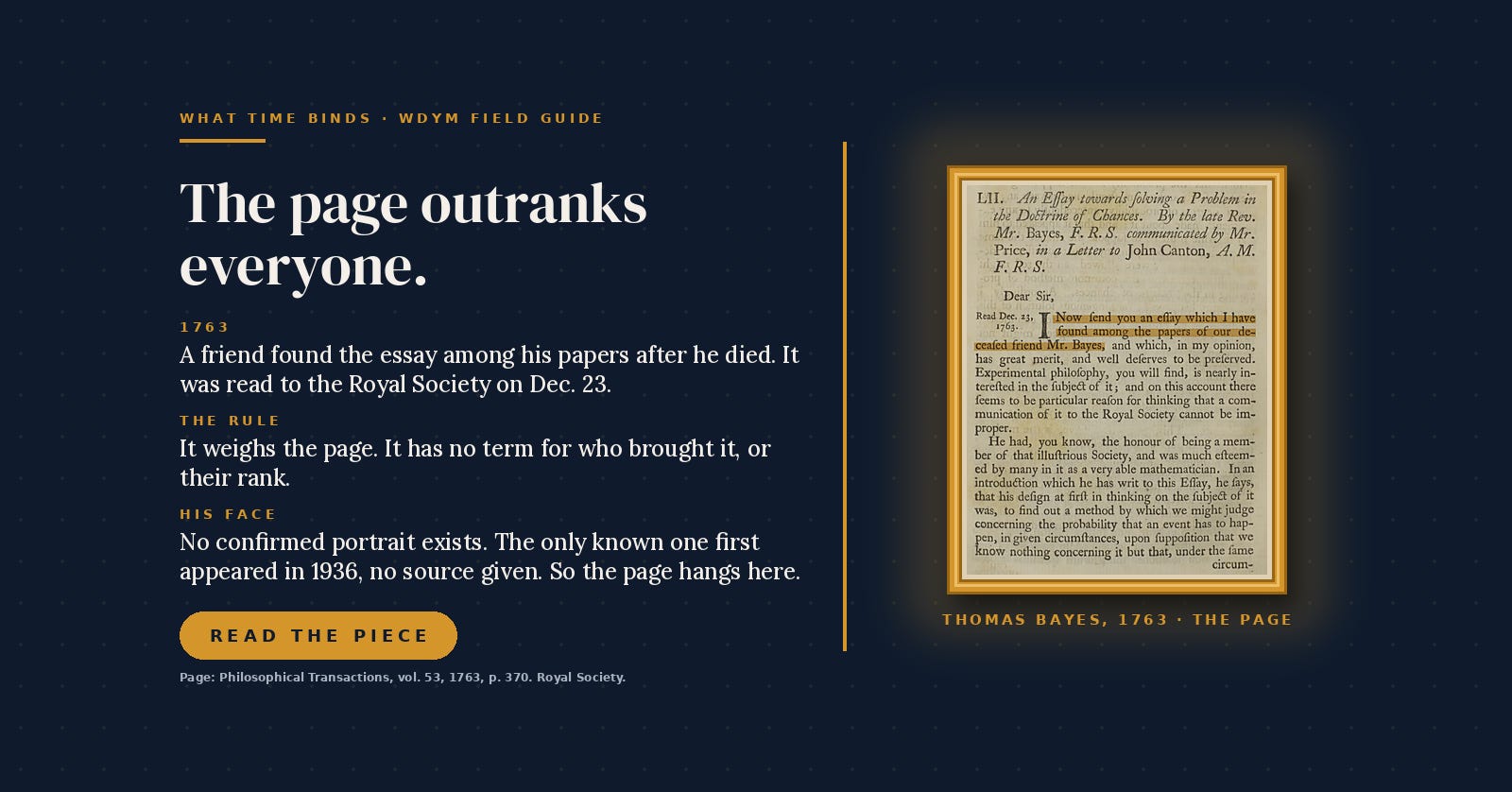
There is arithmetic for how far a page like that should move you. It carries the name of Thomas Bayes, an English minister whose essay on the problem was published in 1763, two years after his death. Without the symbols, it runs like this. Start with how sure you were; statisticians call that the prior. Ask how much more likely the new page is if you were right than if you were wrong. That ratio sets how far you move, and which way.
When you can open the page and read it yourself, the arithmetic has no term for who brought it, where it was posted, or what rank anyone held. The page is the evidence.
Run it on two claims a reader could take from Chapter 3.
The first: the Army’s execution rule bars cameras. If that were true, a current execution regulation with no word on cameras would be close to impossible. That is the regulation in force. The claim falls to nearly zero, and my card invited readers to hold it.
The second: no page authorizes the stream, and an interview set the terms. If an Army page did authorize a broadcast, the regulation that governs executions is the likeliest place to find it. It isn’t there. That raises the second claim, modestly. One silent regulation cannot rule out a memo I have not seen. On Monday, Axios reported that the President has privately expressed doubts about the stream and has not decided. So far the stream still has no page.
So the correction cut a premise and nudged a conclusion up. That is also exactly what a writer saving face would say. Don’t take it from me. Open Army Regulation 190-55, read paragraph 2-5, and look for the word “camera.”
The arithmetic closes two easy exits. The writer who moves nothing treats the page as an insult. The reader who throws out the whole piece treats one fallen premise as a knockout. Both skip the step that matters: a page moves each claim as far as it bears on that claim, and no farther.
What I heard first
Here is the part I would rather leave out.
The question came on the reader’s own post, in front of his readers. I read the post before I read the regulation, and what I heard was rank: somebody senior checking whether a junior man had done his homework. The question itself was courteous. I can’t see his intent from here. I know what I heard, and I heard it before I knew whether he was right. He was.
Some of what I heard was in the setting. A question raised on your own page plays to your readers first and reaches the writer second, if it reaches him at all. Some of it was mine. Twenty-three years in the Marine Corps trained my ear for rank, and I came to that post carrying history of my own. In the terms of the last section, I brought a prior about the man and charged it to the page. The page didn’t care. It said what it said.
The sociologist Erving Goffman had a name for what I was guarding. In his 1955 essay “On Face-Work,” he called it face: “the positive social value a person effectively claims for himself” in a given encounter. A public correction puts face on the line for the person corrected, and sometimes for the person correcting. That is why corrections get heard as power. Face belongs to the people in the thread. The page belongs to the record.
After the fix was up, a second reader posted the same regulation under the card, politely: “For your review.” My first thought was that he hadn’t read past the image. My second thought was better: the image was mine. The card still said “No cameras,” and he answered what I had put in front of him.
The strongest defense
My first reaction deserves its strongest case, because corrections do get used as power.
A correction can be staged for an audience: the corrector’s own page, his own readers, the writer tagged in to answer in front of them. It can come as a question built to work as a test. “Did you even read it?” invites everyone watching to wonder what else the writer skipped. It can land on one premise and let the audience assume the conclusion fell with it. It can arrive after the fix as a second blow. It can be selective, aimed at people the corrector would like to see smaller, while errors on his own side pass without a word. Anyone who has worked inside a hierarchy has watched all five.
Grant every word of that, then run the arithmetic again. A power move can carry a true page, and the motive changes nothing in paragraph 2-5. Had I waved off the question over where it was posted, I would have left a dated premise in front of my readers to protect my face. That trade spends the readers’ trust to buy the writer’s comfort.
The test for a power move runs after the page lands. A reader who wants the record right is done once the record is fixed. A reader who wants the win keeps going after the fix is up. You learn which one you have the only way available: fix the record in public, with the date, and watch what comes next.
The pin
The pin: a correction. A dated page that changes how sure you should be about a claim, by as much as the page bears on that claim.
What it includes: A reader’s question with a link. A newer edition of a regulation. A newspaper’s correction box. A fragmentary order that changes Monday’s plan on Wednesday. The “Update” note at the bottom of Monday’s chapter. Your own second look at your own notes.
What else it touches: Face. A public correction moves someone’s standing along with the claim, and a thread will argue about the standing long after the claim is settled.
What it cannot be read to say: It cannot be read to say the person who brought the page outranks the person who got it. It cannot be read to say the corrected writer was wrong about everything. It cannot be read to say a fix is finished when the web page changes, since the email, the card and the screenshots keep the original. And it cannot be read to say every correction comes in good faith. Some come to win. The page still counts.
The page outranks everyone in the thread, the writer included. Every Monday I take one word an institution bent and show the page it bent on. Subscribe and the next one is in your inbox, free.
The habit
Every correction has three seats: the person who brings the page, the person who gets it, and everyone watching. Each seat has a script.
If you bring the page: Post it where the claim lives, in the writer’s own comments when you can. Give the page and its date. Say what it changes, and what it leaves standing if you can see that too. Before you post, check whether a fix is already up.
If you get the page: Say thank you before you know whether it was kind. Open the page. Then say in public what changes and what stands, with the date, and carry the fix everywhere the original went: the post, the comments, the card, the inbox. I have done two of those four. The words fit in one breath: “Thank you. Show me the page. Here’s what changes, and here’s what stands.”
If you are watching: Ask the thread one question, what did the page change, and leave the scoreboard alone. Who won is the least useful thing a correction can teach you.
The question: The last time someone corrected you in public, what did you hear first, the page or the person?
Twenty days to Election Day. Check the date on anything that tells you what’s on your ballot, then read the ballot itself, every race and every measure, at vote411.org.
The pages
U.S. Army, “Army Sets Execution Date for Convicted Murderer Nidal Hasan,” Oct. 7, 2026
Army Regulation 190-55, Procedures for Military Executions, certified current Oct. 30, 2023 (Army Publishing Directorate)
Army Regulation 190-55, Jan. 17, 2006 (Federation of American Scientists copy)
War Department Pamphlet No. 27-4, Procedure for Military Executions, June 12, 1944 (HyperWar transcription)
Department of the Army Pamphlet 27-4, Procedure for Military Executions, Dec. 9, 1947 (Library of Congress)
Chapter 3: The Room Written Before You Enter, Oct. 12, 2026, with its Oct. 12 update
Axios, “Trump privately expresses doubts about livestreaming execution,” Oct. 12, 2026
Thomas Bayes, “An Essay towards solving a Problem in the Doctrine of Chances,” Philosophical Transactions of the Royal Society of London 53 (1763): 370–418
Erving Goffman, “On Face-Work: An Analysis of Ritual Elements in Social Interaction,” Psychiatry 18, no. 3 (1955): 213–231
S. I. Hayakawa, “The Semantics of Being Negro,” ETC. 10, no. 3 (Spring 1953), p. 174
The comments are the appendix: tell me where the record is wrong and I will show the page or fix the line. Paid subscriptions open at 500 readers, and the paid product is Coded Threads, the codebooks built from these comment sections. A pledge now is a vote for that.
Jerry W. Washington, Ed.D., is a Marine Corps veteran of twenty-three years, a combat engineer by trade, an instructor at UC Irvine’s Division of Continuing Education, and the writer of What Time Binds, a record of how institutions bend words and how the page holds them to account.