


Wednesday drop — July 15, 2026. Field Guide entry. Companion to today's WTB special, Name the Mechanism.
The word
DEI. Three letters that used to be a shorthand for a portfolio of workplace practices and civil-rights obligations. Now the letters are a battleground.
Why it’s a magnet
Many definitions travel under those three letters. Each carries the weight of the others. Each speaker acts as if their definition is the only one on the table.
Below are examples I dealt with this week.
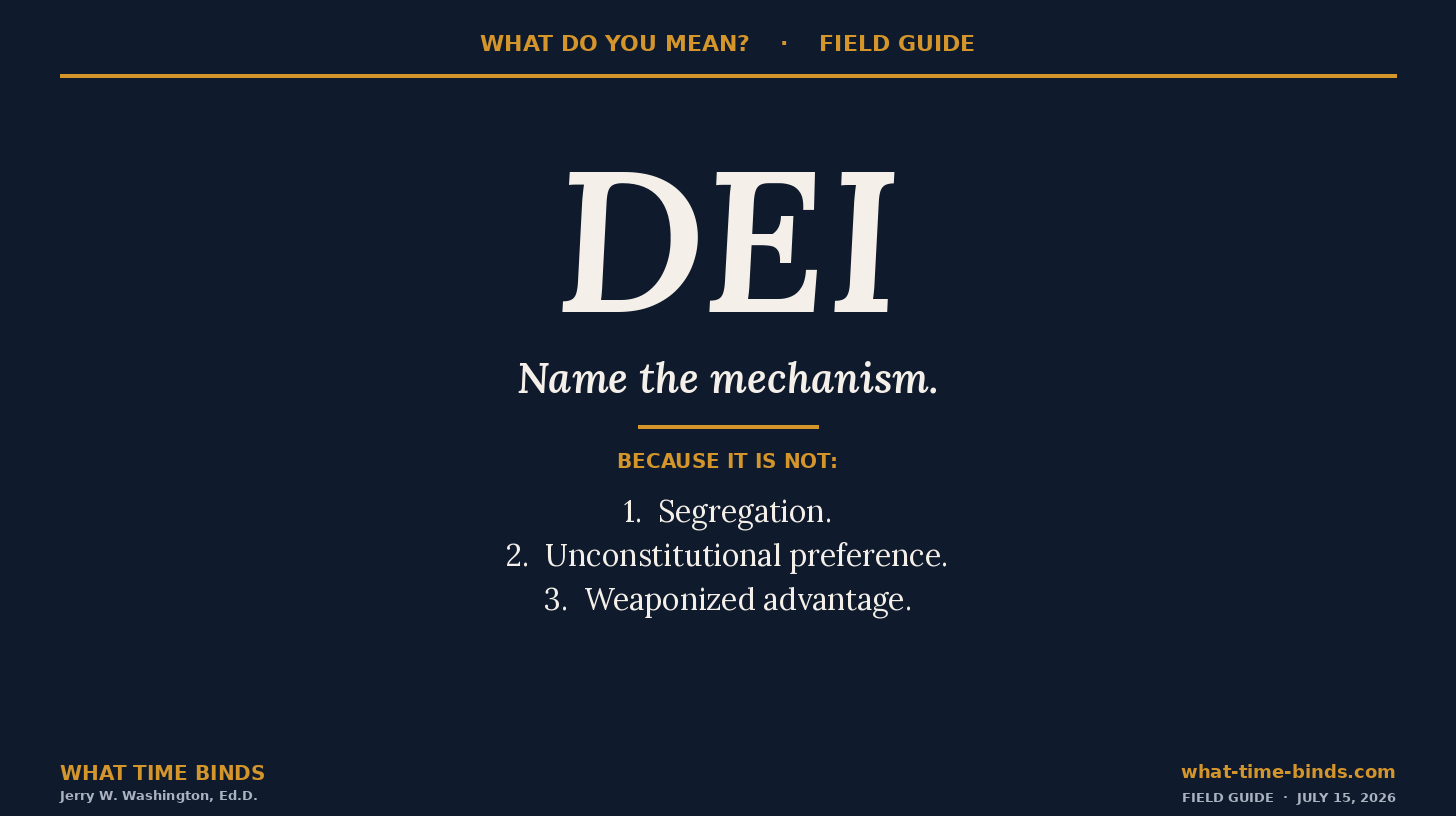
Definition 1: DEI as segregation. Racial exclusion enforced by law or organizational fiat. This is Thomas Guastavino’s opening move on a Facebook thread I posted this weekend: “Does the author know DEI is a form of segregation?” Definition 1 requires collapsing Jim Crow (state-mandated racial exclusion) with Title VII (voluntary access-widening under statute). The distance between the two is the entire civil-rights record of the last sixty years.
Definition 2: DEI as unconstitutional preference. Race-conscious action that violates the 14th Amendment. This is Tom Kelly’s opening move: “Dei violates the 14th amendment.” Definition 2 requires treating cases about specific doctrinal areas (university admissions in SFFA v. Harvard, 2023; government set-asides in Croson 1989 and Adarand 1995) as if they had ruled on DEI as a whole practice. None of them did.
Definition 3: DEI as weaponized advantage. A mechanism by which someone who did not earn the job forces the employer to hire them. This is Ryan McCoy’s move: “Sadly some people that got an interview but didn’t make the cut used DEI to force them to get hired...” Definition 3 requires an unnamed anecdote to stand in for a documented case.
Sitting under all three, the actual referent: DEI as a portfolio of statutory obligations and institutional practices. Title VII (1964). ADA (1990). VEVRAA (1974). Section 503 of the Rehabilitation Act (1973). PWFA (2023). EEOC barrier analysis under 29 CFR 1608 and 41 CFR 60. On top of the statutes: outreach, mentorship, employee resource groups, bias training, standardized rubrics.
The failure mode
Many definitions in one word means every debate about DEI is at least a few debates layered on top of each other, with participants speaking past each other while agreeing the word matters. The Facebook thread I ran this weekend and the House Oversight hearing on Tuesday morning were the same failure mode at different scales. Each speaker used DEI to attack a version nobody defended and defend a version nobody attacked.
The failure resolves in one direction. Whoever is asked to define what they mean, and refuses, gets to keep the ambiguity as an argument.
The pin
DEI, as it exists in current law and institutional practice, is a portfolio of statutory obligations covering race, sex, disability, veteran status, religion, and pregnancy, plus voluntary practices that expand recruitment, reduce evaluator bias, and support retention. Race-decisive decisions and hard quotas are the illegal edge case, not the portfolio.
That definition is testable. It survives contact with the statute. It survives contact with EEOC guidance. It survives contact with the case record.
Boundary test
Includes:
Barrier analysis under EEOC MD-715
Disparate-impact enforcement under Griggs v. Duke Power (1971)
ADA accommodations for qualified applicants with disabilities
VEVRAA and Section 503 outreach to veterans and people with disabilities
Mentorship, sponsorship, and employee resource groups
Standardized evaluation rubrics
Pregnancy accommodations under PWFA
Excludes:
Hard numerical quotas (illegal in employment since United Steelworkers v. Weber, 1979; illegal in admissions since SFFA v. Harvard, 2023)
Race, sex, or another protected class as a decisive factor in a specific hiring decision (illegal under Title VII disparate-treatment doctrine since 1964)
Race-conscious plus-factors in university admissions (illegal since SFFA v. Harvard, 2023)
Example. A federal contractor conducting a barrier analysis under 41 CFR 60 to identify neutral policies that produce disparate outcomes. That is DEI.
Non-example. An employer refusing to hire white applicants. That is a Title VII violation. Title VII has said so for sixty-two years.
One-minute script
When someone tells you DEI is discrimination, or DEI violates the 14th Amendment, or DEI is a form of segregation, ask three questions. Take about a minute total.
“Which DEI practice specifically? Barrier analysis? ADA accommodations? Veteran outreach under VEVRAA? Employee resource groups?”
“Which employer ran the practice, and which mechanism in it produced the harm you’re describing?”
“Which statute, regulation, or court ruling defines that practice as unlawful?”
If the answer arrives, engage the answer on its merits. If the answer does not arrive, the silence is the argument. File the silence next to the claim.
Log prompt
Before you use DEI as a target or as a shield, log two things.
Which of the three definitions am I using: segregation, unconstitutional preference, or weaponized advantage?
Which specific DEI practice am I pointing at?
If you cannot answer the second question, you are arguing about a category. Categories don’t hire. Categories don’t accommodate. Categories don’t approve or deny a home loan. Programs do those things. Name the program.
This is a Field Guide entry. Companion to today’s special essay, Name the Mechanism, which traces the same pattern through three Facebook commenters and the House Oversight hearing on Tuesday, July 14. Both pieces are the record built on one Facebook photograph and one CSPAN clip.
Related WDYM entries: What Do You Mean, “Allegiance”? — where “DEI Justice” showed up as a smear-magnet. When “Award” Stops Meaning Award — same repair pattern applied to a different magnet word.
Sources
Statutes: Title VII of the Civil Rights Act of 1964; Rehabilitation Act of 1973 §503; VEVRAA of 1974; ADA of 1990; Civil Rights Act of 1991; PWFA of 2023.
Regulations: 29 CFR 1608 (EEOC affirmative-action guidelines), 41 CFR 60 (OFCCP contractor obligations), EEOC MD-715 (federal employer barrier analysis).
Cases: Griggs v. Duke Power (1971), Regents of the University of California v. Bakke (1978), United Steelworkers v. Weber (1979), City of Richmond v. J.A. Croson (1989), Adarand Constructors v. Peña (1995), Grutter v. Bollinger (2003), Students for Fair Admissions v. Harvard (2023).
Facebook thread source material:
WTB Essays/Hayakawa Series/_Source Materials/2026-07-12_Dhillon-Thread-Case-Study.md.House Committee on Oversight and Government Reform, Task Force on Defending Constitutional Rights and Exposing Institutional Abuses, Combating DEI in American Institutions, Tuesday, July 14, 2026, 10 a.m. ET. Chair: Brandon Gill. Witnesses: Mike Gonzalez (Heritage Foundation), Inez Feltscher Stepman (Independent Women), Michael Shires (America First Policy Institute).
The refusal to define does two jobs, I think. The first is the talking-past you describe — each side attacking a version nobody defended. The second shows up mid-conversation: the definition switch. Someone argues from the anecdote version, gets pressed, and slides to "no no, I'm talking about the institutional side here." Each definition doubles as an emergency exit from the others. Kept undefined, the word isn't just ambiguous — it's mobile. Your script pins that down too: once someone names which practice they mean, the exits close.
Thank you for this excellent review and dialogue about DEI and its purpose. I find it interesting that opponents of DEI think that 40 or 50 years of leveling the field is enough to overcome 10,000 years of Patriarchal misogyny, 400 years of slavery, Jim Crow laws enforcing segregation and institutionalized repression of equality, opportunity and access. It does not.