

Legal said. The research shows. The CEO's position is. Thirty seconds that save your week.
A week of claims with other people’s names on them
This week, I watched the same pattern show up in four conversations in a row.
Someone drops a claim. “Legal said…” “The research shows…” “The CEO’s position is…” “Anthropic announced…” The room nods. The work starts building on it.
And nobody asks the one question that would save the week: did you read the actual source, or did you read someone quoting it?
A meme landed with a quote attributed to a public figure. A headline about an AI announcement got reframed by five different newsrooms, each telling a different story about the same two words. A policy memo got summarized in Slack, then the summary got summarized in a meeting, then the meeting summary became the basis for a decision. A citation in an OECD paper turned out to be stretching the original argument in a direction the source never made.
Four separate conversations. One quiet pattern. The same magnet word underneath all of them.
That’s what SOURCED? is for. The crew took it on this week.
“Sourced” is a magnet word. It sounds like verification. It’s actually a confidence wrapper that hides how the claim traveled. Four people can say it and mean four different things:
I read the primary document.
I read a quote of the document.
Someone I trust said it.
I saw it in a Slack thread this morning.
All four get offered with the same weight. Only one holds up when you push on it.
The fix: source-pin the claim before you build on it. Three questions. Thirty seconds. You’ll know whether the thing you’re treating as load-bearing is actually load-bearing.
Move: Source-Pin — run three questions before treating any claim as load-bearing. Why it matters: A claim that has traveled three rooms has usually dropped a condition along the way. Thirty seconds up front prevents a week of building on a summary of a summary.
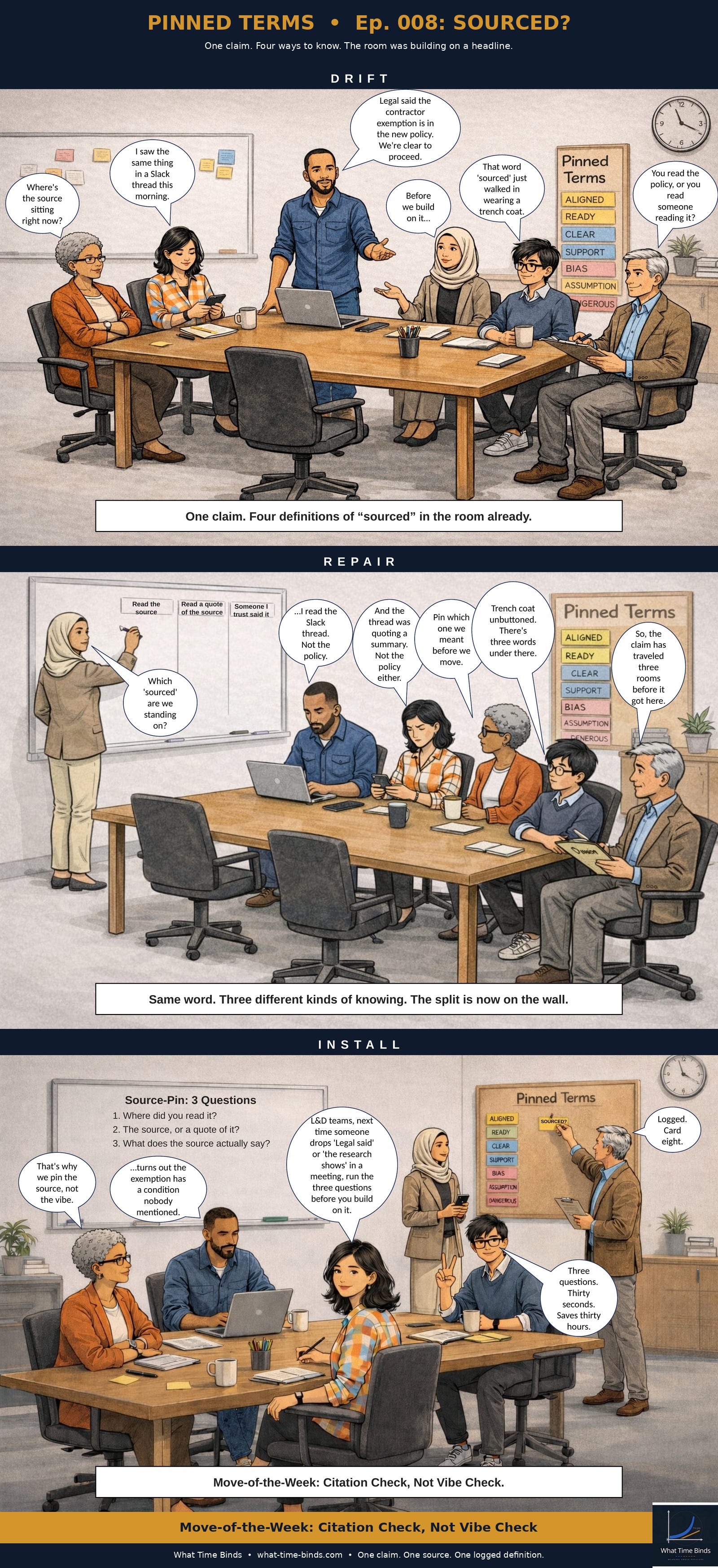
Panel 1 — DRIFT
Malik: “Legal said the contractor exemption is in the new policy. We’re clear to proceed.”
Lila: “Where’s the source sitting right now?”
Rosa: “I saw the same thing in a Slack thread this morning.”
Amina: “Before we build on it…”
Juno: “That word ‘sourced’ just walked in wearing a trench coat.”
Hart: “You read the policy, or you read someone reading it?”
Caption: “One claim. Four definitions of ‘sourced’ in the room already.”
Panel 2 — REPAIR
Amina writes three column headers on the whiteboard: Read the source / Read a quote of the source / Someone I trust said it.
Amina: “Which ‘sourced’ are we standing on?”
Malik: “…I read the Slack thread. Not the policy.”
Rosa: “And the thread was quoting a summary. Not the policy either.”
Lila: “Pin which one we meant before we move.”
Juno: “Trench coat unbuttoned. There’s three words under there.”
Hart: “So, the claim has traveled three rooms before it got here.”
Pinned Terms board visible: ALIGNED, READY, CLEAR, SUPPORT, BIAS, ASSUMPTION, DANGEROUS.
Caption: “Same word. Three different kinds of knowing. The split is now on the wall.”
Panel 3 — INSTALL
Whiteboard updated: Source-Pin: 3 Questions — (1) Where did you read it? (2) The source, or a quote of it? (3) What does the source actually say?
Lila: “That’s why we pin the source, not the vibe.”
Malik: “…turns out the exemption has a condition nobody mentioned.”
Rosa (to the reader): “L&D teams — next time someone drops ‘Legal said’ or ‘the research shows’ in a meeting, run the three questions before you build on it.”
Juno (two fingers up): “Three questions. Thirty seconds. Saves thirty hours.”
Amina: “The move: before we treat a claim as load-bearing, we source-pin it.”
Hart: “Logged. Card eight.” (pins the new amber SOURCED? card on the corkboard)
Caption: “Move-of-the-Week: Citation Check, Not Vibe Check.”
Where does “sourced” cost you the most — in meetings, memos, news cycles, or the research you’re citing in your own work?
Drop it in the comments. I’ll be reading.
How to use it this week
Next time someone drops a claim with a name attached — “Legal said,” “HR said,” “the research shows,” “the CEO’s position is” — don’t argue with the claim yet. Ask the three questions.
If the person can’t answer question two, the claim is a quote of a quote. Treat it as a lead, not a fact.
Log what the source actually says somewhere future-us can find it.
Thirty seconds. One card on the wall.
📌 Pinned Terms publishes Saturdays. Same reset. Fresh word each week.
Pinned Terms is a weekly Meaning Repair comic from What Time Binds. If this helped, share the link and tell me which word you want pinned next.
Catch up on the series:
Ep. 001: ALIGNED — Pin the term before it pins you.
Ep. 002: READY? — Scope check: includes what, excludes what?
Ep. 003: CLEAR — Grounding verification beats consensus without content.
Ep. 004: SUPPORT — Role Map: one sentence each on what “support” actually looks like.
Ep. 005: BIAS — Definition Split: write the meanings as separate lines.
Ep. 006: ASSUMPTION? — The word that hides inside every other word.
Ep. 007: DANGEROUS — One word, five newsrooms, five different stories.
Ep. 008: SOURCED? ← you are here
Shared reality doesn’t maintain itself. We maintain it — one pinned term at a time.