

“Dangerous” is a magnet word. This week, an AI company called its own model “too dangerous” to release. Five newsrooms printed the same two words and told five incompatible stories. One said a real capability line just got crossed. Another said it was a brand-positioning moment before an IPO. A third said the clock just started for every competitor. A fourth said it was a geopolitical argument dressed as a safety notice. A fifth said we’ve seen this press strategy before.
Every reading had evidence behind it. Every reading pointed in a different direction. The word “dangerous” sat in the middle holding everyone’s attention and nobody’s actual meaning.
The same thing happens in smaller rooms every day. A leader sends an AI headline into Slack and says “we need to talk about this.” One person hears job security. Another hears opportunity. A third hears compliance risk. Everyone nods. Everyone walks out with a different plan.
The fix: word audit — before the team reacts to a headline or announcement, audit the word carrying the weight. Find the word. Read three sources. Check if it’s doing more than one job. Write what it means for your decision. Name what would change your mind.
Move: Word audit. Why it matters: A word doing five jobs at once will produce five reactions that look like disagreement but are actually five people responding to five different meanings. Two minutes of audit prevents a week of misaligned work.
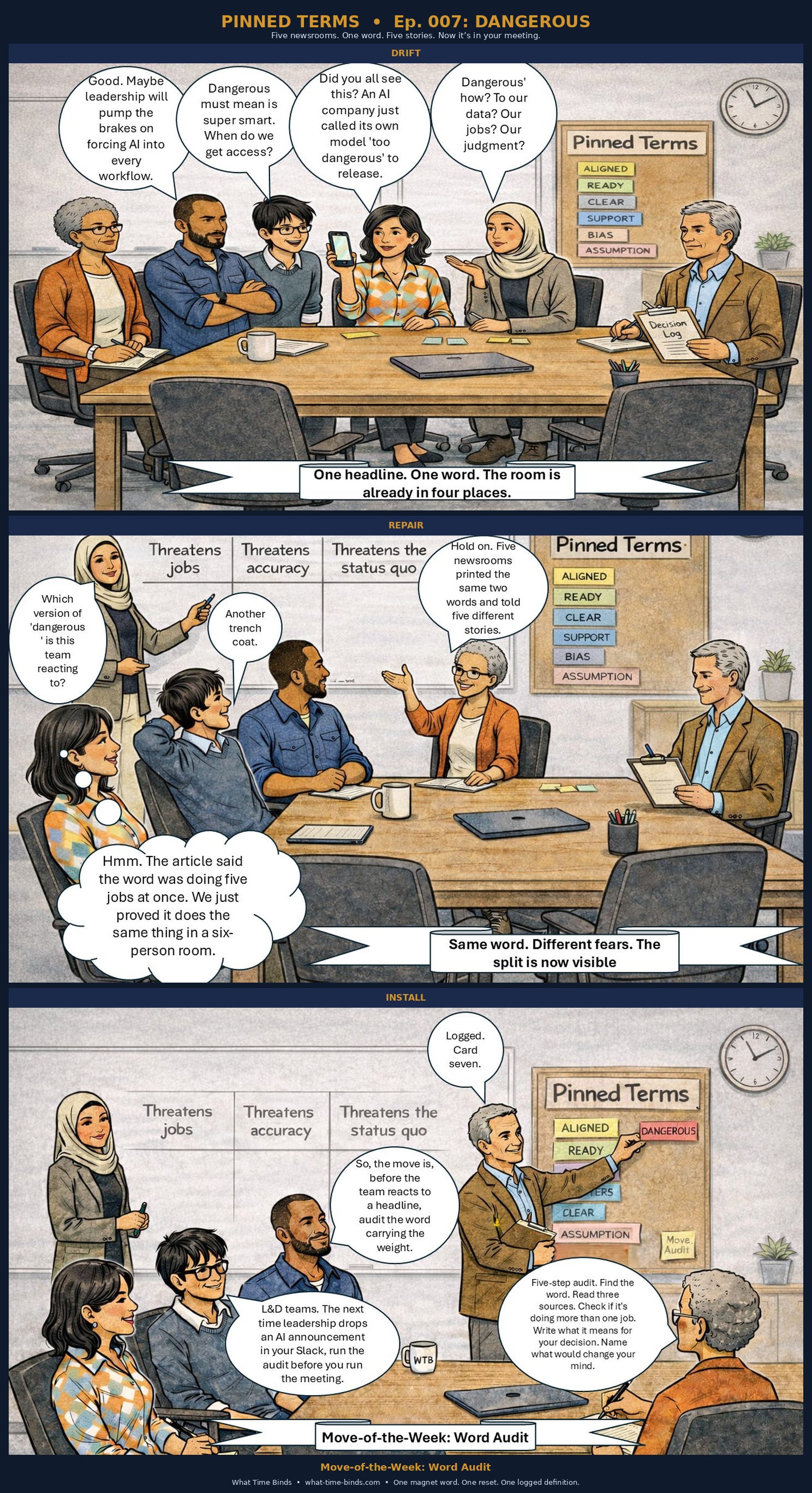
Panel 1 — DRIFT
Rosa holds up her phone: “Did you all see this? An AI company just called its own model ‘too dangerous’ to release.”
Malik: “Good. Maybe leadership will pump the brakes on forcing AI into every workflow.”
Juno: “Dangerous must mean is super smart. When do we get access?”
Amina: “’Dangerous’ how? To our data? Our jobs? Our judgment?”
Caption: “One headline. One word. The room is already in four places.”
Panel 2 — REPAIR
Lila: “Hold on. Five newsrooms printed the same two words and told five different stories.”
Amina runs a Definition Split on the whiteboard: Threatens jobs / Threatens accuracy / Threatens the status quo
Rosa (turned toward the reader): “The article said the word was doing five jobs at once. We just proved it does the same thing in a six-person room.”
Juno: “Another trench coat.”
Caption: “Same word. Different fears. The split is now visible.”
Panel 3 — INSTALL
Hart pins the seventh card — DANGEROUS — to the Pinned Terms wall: “Logged. Card seven.”
Malik: “So, the move is, before the team reacts to a headline, audit the word carrying the weight.”
Lila delivers the five-step protocol: “Five-step audit. Find the word. Read three sources. Check if it’s doing more than one job. Write what it means for your decision. Name what would change your mind.”
Juno (looking at the reader): “L&D teams. The next time leadership drops an AI announcement in your Slack, run the audit before you run the meeting.”
Post-it on the board: “Move: Word Audit”
Footer: “Move-of-the-Week: Word Audit.”
What word landed in your team’s Slack this week that meant something different to every person who read it?
This episode extends Friday’s essay, “Anthropic Said Its New AI Is ‘Too Dangerous.’ Five Newsrooms Heard Five Different Warnings.” The essay is the evidence. The strip is the install. If you haven’t read it yet, start there, then come back and steal the move.
Pinned Terms is a weekly Meaning Repair comic from What Time Binds. If this helped, share the link and tell me which word you want pinned next.
Catch up on the series: Start Here: Pinned Terms | Ep. 001: ALIGNED — Pin the term before it pins you. | Ep. 002: READY? — Scope check: includes what, excludes what? | Ep. 003: CLEAR — The word that ends conversations before they start. | Ep. 006: ASSUMPTION? — The word that hides inside every other word.