


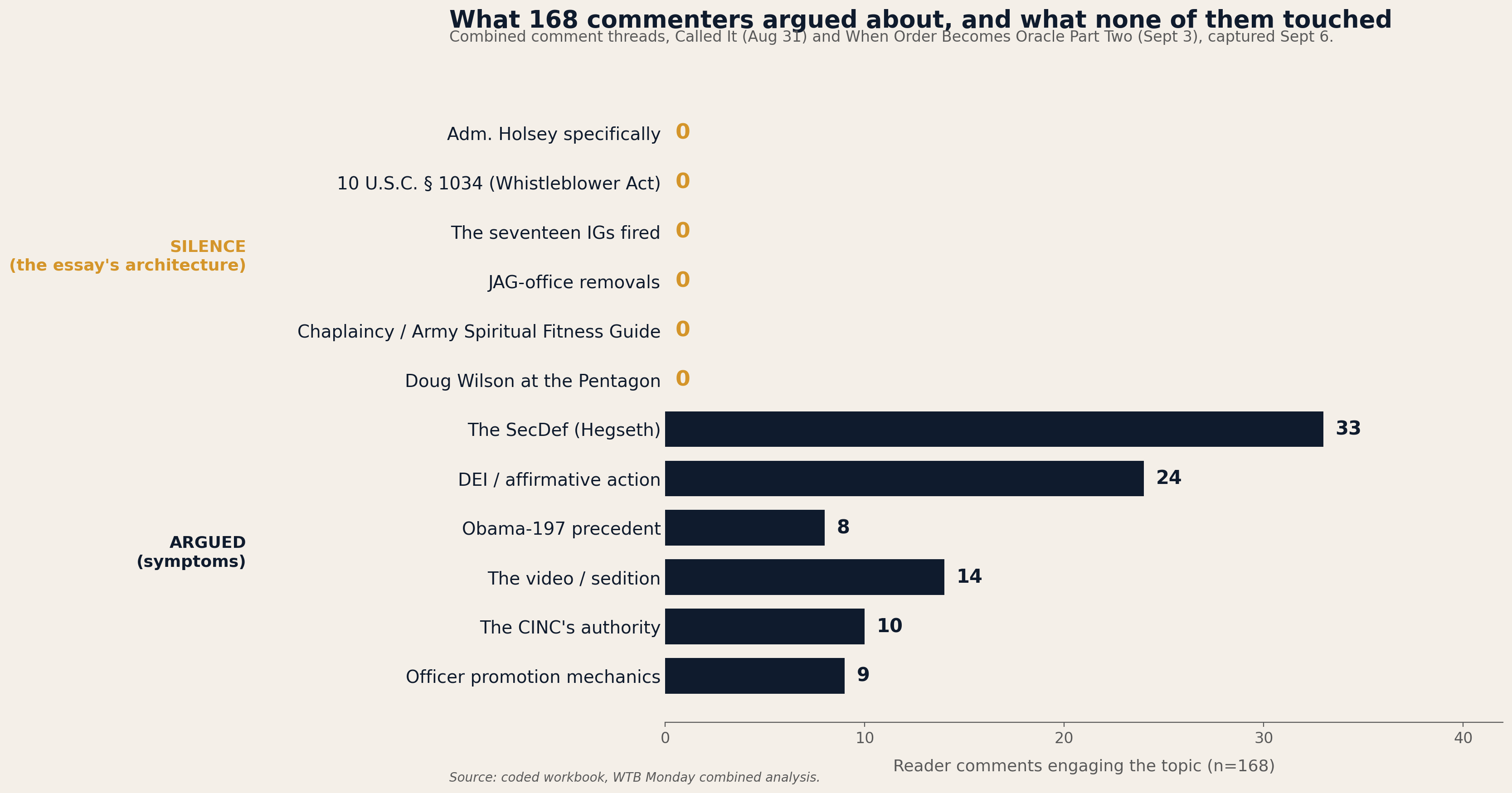
One hundred and sixty-eight comments across two Facebook posts.
Zero mentions of chaplaincy.
Zero substantive engagement with 10 U.S.C. § 1034, the Military Whistleblower Protection Act.
Zero engagement with the seventeen Inspectors General dismissed in a single evening in January 2025.
Zero engagement with the Judge Advocate General offices worked over between February and September: the Air Force JAG relieved in February, the Navy JAG replaced, the Army JAG under sustained pressure.
Zero engagement with Doug Wilson’s invitation to preach at the Pentagon. Zero engagement with the Army Spiritual Fitness Guide, eliminated by the Secretary’s office.
I posted Called It on August 31 and When Order Becomes Oracle Part Two on September 3. Between the two threads, one hundred and sixty-eight people wrote comments on my page. They argued, agreed, disputed, insulted, taught, testified. I read the claim in every comment. Then I did what I was trained to do at USC Rossier: I sorted the claims into patterns, tracked which patterns showed up most often, and noted the ones that told me something new. Researchers call this coding. Marines run the same practice in an after-action review: read every account, sort what happened by category, see which patterns keep coming back. What it produces is a workbook that holds each comment, the claim inside it, and where it sits in the argument.
The workbook holds one finding above the others.
The essay I wrote was about the architecture that stops unlawful orders inside the U.S. military. Four channels. Judge Advocate General review. Inspector General oversight. Chaplaincy. The whistleblower protections at 10 U.S.C. § 1034.
Nobody in one hundred and sixty-eight comments argued about the architecture.
They argued about the Secretary of Defense (28 comments). They argued about the video the six members of Congress made (30 comments). They argued about officer promotion mechanics (20 comments). They argued about DEI (16 comments). They argued about the Commander in Chief's authority (8 comments). They argued about Obama firing officers a decade ago (7 comments).
What they argued about were the symptoms.
The architecture was already worked over. That is what the essay said. That is what the record shows. Nobody argued the record.
This is not a complaint about my readers. My readers gave me what any writer would ask for: engagement, disagreement, testimony, and their own recall of institutional history. They did not engage the specific institutional structure the essay named. Nobody on either side did.
That silence is a finding.
What they did argue about
The Called It thread produced 128 reader comments. Part Two produced 40 more. The claims sorted into eight broad families and forty-one specific patterns. The method is the same one I used in my dissertation on media literacy during the COVID misinformation years: start with a working set of categories, then let the data expand or revise them as new patterns surface.
The most-frequent pattern across both threads was insult-as-delivery. Thirty comments carried substantive counters buried under personal attack. Nazi-POS. Hitler-dildo. Snuff-porn. Comments of that shape came from both sides. More came from the ally side. That is a coalition problem worth naming, and I will name it below.
The second-most-frequent pattern was fact-quality duel. Twenty-one comments turned on source discipline, primary sources, or the debunking of a specific claim. One long exchange traced the “Obama fired 197 officers” claim from a 2013 Breitbart Facebook post through a 2013 Investor’s Business Daily editorial to Secretary Hegseth’s sworn testimony at the House Armed Services Committee on April 29, 2026. I traced the same claim in Friday’s Binding.
For readers who want the full trace of the “Obama fired 197 officers” claim from a 2013 Breitbart post through Hegseth’s sworn testimony, see The Name They Keep Reaching For, published Friday, September 4. That piece includes the repair protocol for when the meme lands in your comments.
The third pattern was the loyalty-frame. Ten comments treated any criticism of the sitting Commander in Chief as loyalty failure. One commenter named James Mattis as untrustworthy, calling him “mad dawg.” Mattis was Trump’s own first Secretary of Defense. If the loyalty test does not spare Mattis, no institutional pedigree spares anyone. That bounds where the essay can meet the opposition reader. It also names, in one sentence from one comment, the ceiling on the entire oversight-channel argument.
The fourth pattern was precedent-as-defense. Same structural claim, four vehicles. Obama-197 was the dominant reference. The 1993 Clinton administration promotion-board litigation (Togo West, the Christian II v. United States line of cases) supplied a second. Lincoln’s Civil War officer removals supplied a third. An inverted-Marshall reading, citing the World War II plucking board as pro-purge authority, supplied a fourth. The pattern is: not new, therefore not alarming. The pattern collapses on inspection every time. Marshall’s board was internal, merit-based, and combat-readiness-driven. The current removals are external, loyalty-framed, and demographically skewed. The 1996 board instructions the courts struck down operated on the promotion process. The current removals hit the officer roster directly. The categorical label matches. The substance does not.
The architecture that got no engagement
This is what none of the one hundred and sixty-eight comments argued about.
Judge Advocate General offices. The Air Force JAG was relieved in February 2025. The Navy JAG was replaced. The Army JAG has been under sustained pressure through the summer. JAG review is what stops an unlawful order at the level where it matters: before the fire mission, before the strike, before the deployment. Replacing the JAG modifies the oversight channel itself.
On the one partial exception. One commenter did name JAG review in the Called It thread. Writing as a former battalion executive officer, he pushed back on the “boat, shoot” caricature of the Caribbean strikes: “Anyone who has been in a room prior to a strike like that knows it goes through some serious scrutiny (including JAG review) before the commander gives the order to fire.” That is a real engagement with an oversight function, and it deserves acknowledgment. It also stays one step away from the specific pattern the essay was tracking. He engaged JAG review as an ongoing process. He did not engage the fact that the Air Force JAG was relieved in February, that the Navy JAG was replaced, or that the Army JAG has been under sustained pressure. Even here, in the substantive engagement, the architecture stayed on the shelf. My reply named the distinction: JAG review happens. The question is what JAG review can carry when the underlying authorization is in dispute. That question is what the whistleblower paragraph below is about.
Inspector General oversight. Seventeen federal Inspectors General were dismissed on the night of Friday, January 24, 2025. That number includes the DoD IG. The IG office is the statutory landing pad for a service member who raises a concern up the chain. If the office is decapitated, the landing pad is gone.
Chaplaincy. Doug Wilson, the pastor of Christ Church Moscow, was invited to preach at the Pentagon in 2025. That is a specific person with a specific theological position. The Army Spiritual Fitness Guide was eliminated in the same window. When chaplaincy is the fourth channel, chaplaincy replacements are not decoration.
Whistleblower protections. 10 U.S.C. § 1034 makes it unlawful to retaliate against a service member who reports a concern to Congress, an Inspector General, or the chain of command. Adm. Alvin Holsey, a four-star, was pushed out of Southern Command two years early after raising legal concerns about the Caribbean boat strikes. That is what retaliation looks like at the flag-officer level.
Four channels. Part One of When Order Becomes Oracle named them on March 4, 2026. Part Two named what had happened to each in September. The record on each runs back to early 2025.
The essay was about that sequence. The commenters, on both sides, did not argue that sequence. They argued the symptoms. The instrument the Friday Binding named works on symptoms. That is its function: keeping the reader looking at symptoms while the architecture goes unattended.
The mirror the commenters showed
My time in the Marine Corps taught me that precise distinctions matter. A verbal counseling is not an Article 15. An Article 15 is not a court-martial. The corps ran on those distinctions because the alternative was giving the wrong order to the wrong person. That training is why I owe my own coalition an honest observation.
Some ally-side comments proposed extralegal punishment for the Secretary of Defense. “Straight to hell.” Leavenworth. Guantanamo. The line was delivered as escalating humor. It was also a proposal to route the Secretary around ordinary process. The opposition side proposed the same shape in a different register: “military tribunals” for the six members of Congress, “jeopardize the safety of America” as identity charge.
The grounds are not equivalent. Impeachment of a Secretary of Defense is a real institutional path. Congressional privilege protects the six from the tribunal proposal on its face. The opposition side’s proposals attack the guardrails themselves. The ally side’s proposals attack a Cabinet officer who is a legitimate subject of removal debate.
The impulse to route around process still shows up on both sides. Calling that out here is the price of my analytical position.
Same for the delivery. Insult-as-delivery is the most common pattern in the dataset. Some ally-side comments carrying correct substantive counters delivered them with slur and class contempt (”go mow or cut down a tree,” directed at a commenter who had asked a real question). Every opposition comment that says “these people are unserious” has evidence to point at. That is a coalition problem.
The instrument is equivalence. The repair is precision.
One reader named a list of procurement and doctrinal failures. DDG 1000. LCS. F-35 developmental problems. Walrus HULA. McNamara's Vietnam decisions. Foolish rules of engagement. He asked whether the current purge fixes any of them. It does not. Every failure on that list was corrected by internal process reform: Holloway Commission, JSOC, Goldwater-Nichols, USSOCOM. External loyalty screening does not touch any of them. A longer treatment of the specifics is on the writing bench for later this month.
One exchange did what the essay wants
One opposition-adjacent commenter engaged in three sustained replies across the Called It thread. The exchange ran for an afternoon. The commenter delivered real substantive counters: the al-Awlaki 2011 legal framework, Article II and maritime authorities, the tax-loophole analogy for finding executive authority when Congress will not act. I answered each. Partway through, he noticed the Substack byline listed a doctorate in organizational change and wrote that he was “in for it.” He closed the exchange with a line about restoring his faith in humanity.
That is one exchange out of one hundred and sixty-eight comments. A small fraction. That fraction is what tells me the real conversations are possible.
The exchange also shows what even the good-faith version does not produce on its own. He engaged al-Awlaki, Article II, maritime authorities, Shinseki, and JAG review. He framed the officer removals as culture change and as the executive branch finding a “tax loophole” to work around a worthless Congress. He did not engage the JAG-office removals, the IG dismissals, the chaplaincy replacements, or 10 U.S.C. § 1034. His argument sat one register above the essay’s: culture change, executive workaround, majoritarian mandate. The essay’s argument sat at the oversight-channel level. The two registers did not meet. That gap is real even when the exchange is warm, and the credentials get acknowledged in mid-thread.
The conversations my essays want are possible. It requires both parties to name what they are actually arguing about. It requires the ally side to hold delivery to a higher standard than the opposition side is holding itself to. It requires the opposition side to answer the question rather than shift the frame. It also requires the good-faith reader to shift from the culture-change frame to the architecture frame. That last shift is the hardest of the four. Nobody in one hundred and sixty-eight comments made it.
The record is longer than any thread. The architecture is what holds the record together. The instrument wants the reader to look at symptoms only. The commenters obliged, on both sides, without noticing that they were.
New to What Time Binds? Start with the frame that shapes all of it: Start Here. Read what I wrote in March about the four channels: Part One of When Order Becomes Oracle. Read what landed last week about what happened to the six members who tried to restate the constitutional meaning of “order” from outside the chain: Part Two. Read Friday’s Binding on the “197” meme and how it works: The Name They Keep Reaching For.
Read the ballot the way you would read the record. Every race. Every proposition. Every judge. Check. vote411.org.
You refuse to know. The record remembers. I refuse to forget.
— JWW
Correction — September 9, 2026. This essay originally reported five subject counts. Four of them had no source I could trace to a workbook row. I went back and coded all 168 turns for subject, using boundary rules I have now published. The corrected counts appear above.
The largest change is the video the six members of Congress made. It drew 30 comments, not 14. That correction strengthens the finding. More readers argued the video than I first reported, and none of them argued the oversight architecture.
Officer promotion mechanics drew 20 comments, which the original essay did not report at all.
I also corrected the date of the Inspector General dismissals. Seventeen were dismissed on the night of Friday, January 24, 2025. The essay said February.
The subject column, the boundary rules, and the row-level data ship in The Silence — the workbook, the first Coded Threads installment. Every count in this essay now traces to a row you can inspect.
Author’s note. I wrote this essay after coding every comment on Called It and When Order Becomes Oracle Part Two — reading the claim in each one, sorting the claims into patterns, and tracking which patterns recurred. Every count in the essay traces to that workbook. Commenter names are held out of the essay by choice. The analytical claim is about the pattern, not the person.
A separate methods piece publishes midweek, free to read. It shows the codebook, describes the method, and names the patterns as they show up in a live comment section. When the paid tier opens at What Time Binds, subscribers get Coded Threads — one WTB post per month, coded workbook and analytical memo included. If that is a series you want, pledge. Enough pledges is what tells me it is time to turn paid on.
This piece was written with AI assistance under my [disclosure framework] at what-time-binds.com. The analytical frame, the coding, the sources, and every position taken are mine and verified.
Jerry W. Washington, Ed.D., served 23 years in the Marine Corps. He holds a doctorate in Organizational Change and Leadership from USC Rossier and teaches at UC Irvine Division of Continuing Education. He writes What Time Binds, an independent newsletter on language, institutions, and democratic accountability.
Great work and essay. But one partial conversation out of 168. Those numbers say everything about the democracy of information the internet has produced. Everyone seems to have their own opinion and we know what that means. Facts are rarely involved. Thanks again