

A friend posted a meme on Facebook:
Obama didn’t have time to rename lakes, he was busy working to get Americans healthcare.
Six words showed up in the first comment.
He had time to rename a mountain tho.
That comment has one job. Occupy the space where fact-checking would sit, long enough for a scroller to see a “debate.”
Here is the record on the mountain. Alaska petitioned to rename McKinley in 1975. Ohio blocked the petition for forty years. In 2015, Interior Secretary Sally Jewell moved it under 43 U.S.C. § 364, on federal land, at the state’s request, through the same Board on Geographic Names statute that resolves this kind of naming dispute every year. One rename in eight years. At a state’s request. Through statute.
Since January 2025: Denali reversed by executive order. Gulf of Mexico renamed. Seven Army bases renamed back to their Confederate namings. The Defense Department renamed to the Department of War. Lake Ontario renamed Lake America. The president has floated an ocean too.
One rename at request through statute is not the shape of a serial pattern by assertion. The comparison the six-word comment invites collapses on the second click. It was not built to survive the second click. It was built to sit there.
Before I get to my own thread
Here is what I felt when I saw the comment.
Recognition. I have watched this shape work on people I love for years. Marines I served with. Family members. Students. None of them are gullible. The instrument is built to reach past the parts of us that check. Our bias.
You see the six words go by and you know the friend who commented is not going to Google Denali. You know the friend who posted the meme is going to read the comment and feel the ground shift a little. Facts are heavy. Comparisons are light. The comment is designed to be lighter than the thing it wants to displace.
That is the feeling. Recognition, and the quiet knowledge of what comes next. In the Corps, when the same shape keeps working, you give it a name, a rule of thumb. You teach the next Marine to see it. You write it down.
The same shape, one thread over
Two days later, a comment landed on my own Facebook post. Different subject, same shape:
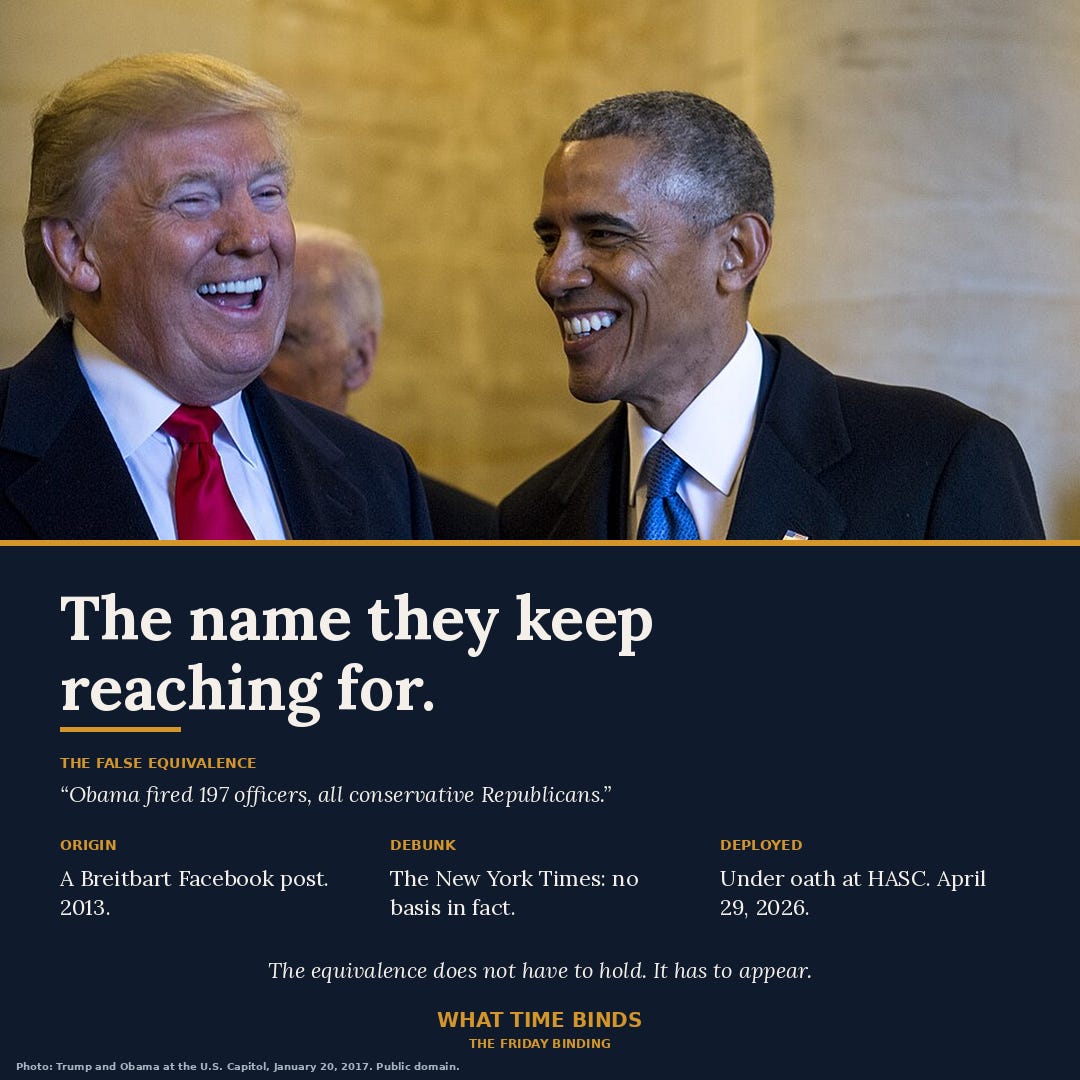
Obama FIRED 197 officers, all the way down to O-4s, same pattern, all male, all conservative, all non-woke, all republicans.
I asked for a source. What came back was “There’s this thing called Google...” I chuckled. A different commenter jumped in: “are you too stupid to refute it yourself with intelligence.” I chuckled again. A third: “every president removes commanders.” I laughed out loud…not like this!
Three variants of one motive. None defended the specific claim. All did the same work as the mountain comment. Occupy the space where the current record would go.
Where 197 comes from
The number traces to a 2013 Breitbart Facebook post. Retired Major General Paul Vallely — a birther who told a Tea Party group in January 2014 that if given 250,000 Marines he would “surround the White House” — reposted the list on his Stand Up America site. An unsigned Investor’s Business Daily editorial published it on October 29, 2013, and updated the same file on December 21, 2018.
Every case IBD names as evidence of a purge is an individual misconduct dismissal. General Carter Ham retired through routine command succession; Chairman Dempsey called Benghazi speculation about that departure “absolutely false” and DoD called the rumors “categorically false”. Vice Admiral Tim Giardina was removed for gambling with counterfeit poker chips. Major General Michael Carey for public drunkenness on a trip to Moscow. Rear Admiral Chuck Gaouette for “inappropriate leadership judgment.” Not one is a policy firing. Jim LaPorta, the national security journalist who covers this beat, put it plainly: the 197 list combines years, includes field-grade officers, and covers “sexual misconduct, DUIs, leadership issues” — matters no president would weigh in on.
The New York Times called the 197 number “no basis in fact”. Pentagon spokesman Sean Parnell used it in a November 2025 statement to the Times; press secretary Kingsley Wilson then asked the Times not to publish that language and sent a replacement statement that omitted the number entirely. Six months later, Secretary of Defense Pete Hegseth said it under oath at the House Armed Services Committee on April 29, 2026.
That is not a mistake repeated. That is a piece of coordination tested for thirteen years, deployed at the moment it was needed.
One commenter’s stronger version
A different commenter on my thread offered a sharper argument. He pointed to Christian II v. United States (Federal Circuit, 2003) and Judge Royce Lamberth’s 2015 Saunders ruling. Both are real cases. Both found that Army selection board instructions from the 1990s created race and gender preferences the courts held unconstitutional. He gets the direction right. Federal courts did strike down specific Clinton-era mechanisms.
Two things his framing misses. The rulings targeted board instructions on how to weigh officers’ records where past discrimination appeared. They did not describe “aggressive affirmative action metrics” driving dismissals. And the Saunders ruling came down in January 2015, under President Obama, six years into the term the meme now calls a purge.
Even in his fullest reading, the equivalence collapses. A ruling that board instructions were unconstitutional in 1996 is not the same shape of event as a Secretary of Defense removing roughly eighty senior officers in eighteen months, with nearly sixty percent of them female or Black, for stated reasons that read as “loss of confidence” or nothing at all. The categorical label matches. The substance does not.
For readers who want the mechanics — how flag-officer selection and reduction are meant to work, from Gates' 2010 Efficiency Initiatives through the FY2017 NDAA — I laid that out in Star Wars or Star Creep? The Battle Over America's Generals in May 2025.
Where the record is being kept
I've been in this pattern before. In an earlier Friday Binding, I traced how a Cabinet secretary struck seven officers a Navy promotion board had picked, and how the FITREP language filter did the sorting one stage earlier. This piece extends that argument.
Other writers on this platform are keeping the record. This piece does not compete with theirs. It sits alongside them, naming what shows up in their comment sections too. Five writers whose work I want you to read.
Heather Cox Richardson. In her August 31 letter, Richardson documents the ongoing pattern at the Defense Department: three Stars and Stripes staffers fired, including the editor-in-chief, for covering negative military conditions, with the fired employees suing for First Amendment violations. Pentagon-hired right-wing social-media influencers running paid propaganda from inside the department. A Navy that can deploy only a quarter of its destroyer fleet. Richardson names the frame directly, quoting Charlotte Clymer: “an ongoing, blatant campaign of intimidation.” That naming is what breaks the equivalence spell.

Charlotte Clymer. In “Our Generals Have No Confidence in Hegseth,” Clymer walks through the Washington Post story on four top commanders’ non-concurs on Iran operations and calls the historical scale unprecedented. She names the officers fired for contradicting Hegseth: Lt. Gen. Kruse, Admiral Holsey, Gen. Randy George. She cites the polling on public support for the Iran handling at 31%. She specifies the operational cost: closed shipping lanes, depleted weapons, troop hardships. Her contribution is scale-naming. When the equivalence-meme needs the reader to see a familiar shape, Clymer puts a number on the shape that has never been seen before.

alimcforever. “The U.S. Military Purge” runs the operational-security and readiness numbers. Signal messages carrying classified strike timings sent to civilians one day after the Pentagon warned the app was compromised. Discharge inquiries up from a handful weekly to three-to-four daily by April 2026. Only 25% of F-35s fully mission-capable. More than 150 unimplemented GAO readiness recommendations. Documentary register, GAO and IG citations throughout. Her contribution is quantified anti-equivalence: this shape has consequences, and here they are in specific numbers with named sources.

narativ. “Hegseth Purges Seven More Officers Who Could Say No” carries the September 2 firing of seven officers struck from an eighteen-person Army promotion list. Roughly 80 generals and admirals fired or promotion-blocked total, per the reporting. The smallest share of women nominated to general and admiral rank in at least 25 years. Dan Driscoll, the Army Secretary, resigning after warning the White House. The title itself refuses the “personnel decisions” frame. The contribution is a running count, updated as the pattern extends.

Michael D. Sellers. In “As Army Secretary Driscoll Resigns, Just How Bad Is Hegseth’s Gutting of U.S. Military Leadership?”, Sellers does the work of comparison, which is the work equivalence cannot survive. Five of eight inherited Joint Chiefs members departed in Hegseth’s first nineteen months. Zero left during Trump’s first term over the equivalent period. One left under Biden. The Army today has roughly half as many four-star generals as it had when Hegseth arrived, from ten down to five, the fewest in decades. Of twenty-nine Army colonels selected for promotion in 2026, four were removed. Of thirty-one Navy captains selected, nine were removed. Sellers is careful with counter-cases too, separating organizational restructuring from personnel removals. His contribution is the denominator, which is what anti-equivalence needs to hold.

Every one of those essays exists because the writer knew that without the record, the equivalence would erase what happened. The record is the anti-equivalence. The instrument is trying to make you not see the record.
The instrument
The instrument is equivalence. Act-for-act comparison, whether the acts share the same mechanism or only the same category label.
Twenty-three years in the Marine Corps taught me one thing about categorical language. A verbal counseling is not an Article 15. An Article 15 is not a court-martial. A DUI is not a mission failure. Two events with the same category word attached are not the same event. The corps ran on precise distinctions because the alternative was giving the wrong order to the wrong person.
Here is the boundary test. Includes: comparisons where the acts share the same mechanism, scale, procedure, and record. Excludes: comparisons where the acts share only the category label.
One rename at a state’s request through statute equals dozens by executive assertion. One misconduct dismissal equals a demographic pattern. One 1996 board instruction equals officer removals for a fifteen-year-old academic paper. The comparison does not have to hold. It has to appear.
Repair protocol: when the meme shows up in your comments
Ask for the source once. Do not ask twice. The first ask is a good-faith invitation; the second is a fight.
If the source is “Google it,” the argument is over. Do not chase it. The instrument is designed to make you spend time on a claim the speaker will not defend.
If the source is a real case, read it. Then ask whether the fact, even in full, would license the current pattern.
Name the shape. If a comparison shares only the word, say so. “This comparison shares the label but not the mechanism” is a sentence non-specialists will understand.
Point the reader to the record. The writers keeping it are named above. Do this so the reader who came in scrolling has somewhere to go that is not a fight.
Then let it go. One sourced reply, then silence. You are not writing for the commenter you are answering. You are writing for the reader watching you answer.
Close
Chad’s friend posted a meme about a president who was working on healthcare instead of renaming lakes. The comment about the mountain was not about the mountain. It was about whether the reader would accept that any rename equals any other rename.
That acceptance is what the instrument needs. Refusing it is what the record needs.
The Board on Geographic Names still processes name-change requests through 43 U.S.C. § 364. Alaska waited forty years. Ohio blocked the petition for most of that time. In 2015, an interior secretary named Sally Jewell finally moved it, at Alaska’s request, on federal land, under the same statute the board uses every year for names most Americans have never heard.
That is what a rename looks like when it is a rename.
Next time you scroll past a comparison, ask one question. Does this share only the word, or also the shape?
Read the ballot the way you would read the record. Every race. Every proposition. Every judge. The equivalence works because most readers do not check. Check. vote411.org
You refuse to know. The record remembers. I refuse to forget. — JWW
Sources: Wikipedia · Renaming of Denali/Mount McKinley; MSNBC / Maddow Blog on Hegseth’s Obama claim; GV Wire · Hegseth Cites Falsehood; Jim LaPorta on X; CBS News · Hegseth firings tracker; Wichita Liberty · Hegseth Military Promotion List fact-check; Christian II v. United States (Federal Circuit, 2003); Fox News · Judge Knocks Down Army Promotion Process (Saunders/Lamberth); Truth or Fiction · Carter Ham stand-down claim rated fiction; Militarist Monitor · Paul Vallely profile.
Author’s note. I wrote this Binding for the reader who shares an essay documenting the current pattern and then watches the “197” meme drop into their comments. That reader is me, this year, on Facebook, more times than I can count. — JWW
This piece was written with AI assistance under the disclosure framework at what-time-binds.com. The analytical frame, the sources, and every position taken are mine and verified.
Jerry W. Washington, Ed.D., served 23 years in the Marine Corps. He holds a doctorate in Organizational Change and Leadership from USC Rossier and teaches at UC Irvine Division of Continuing Education. He writes What Time Binds, an independent newsletter on language, institutions, and democratic accountability.