

I am writing this while my dog Sammie pants through the last of the neighborhood fireworks. She cannot settle. She circles, leans against my leg, startles at every sound. I know the drill from the inside. For years after I came home, I handled the Fourth the way she is handling it now. The sound was the problem, especially in the middle of the night, when a late boom would catch me drifting in and out of sleep, and I would have to remind myself where I was in time and space.
The United States turned 250 this weekend. The Marine Corps trains a particular relationship to that birthday. You stand for the colors. You know names of people who did not come home. You hold the promise and the ledger at the same time.
This is the second of three essays. Last Monday’s piece named an inversion: in 1953, the country’s words about equality ran behind its facts. In 2026, the words run ahead of the facts, and the gap is widening. Today’s essay takes apart the mechanism that lets the gap widen — a mechanism S.I. Hayakawa described with precision in 1953, and one condition he could not predict. Next Monday: where the work of repair belongs.
The place to start is a wreath stand that stayed empty on June 10.
Written Before They Arrived
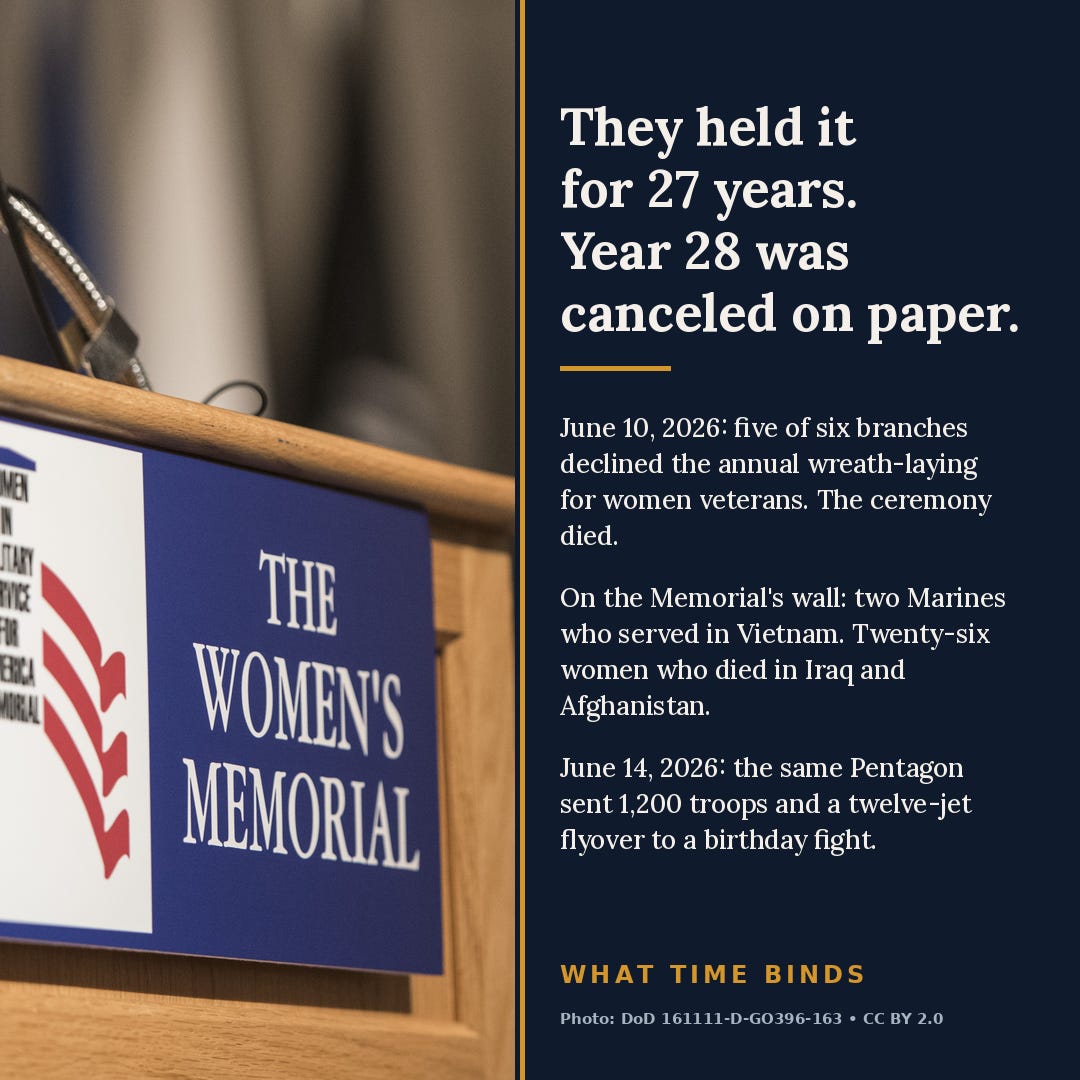
The Women in Military Service for America Memorial stands at the ceremonial entrance to Arlington National Cemetery. Every June for 27 years, the Bipartisan Women’s Caucus laid a wreath there ahead of Women Veterans Recognition Day. The ceremony is short. The Caucus invites all six service branches. The branches send representatives. The wreath gets laid, the photographs get taken, and veterans and family members travel from across the country to stand in the June heat for half an hour.
Consider what the people who would have arrived for the 28th year carried with them.
They carried a track record: 27 ceremonies without incident. They carried institutional standing: a bipartisan congressional caucus, about as legitimate as an organization gets in Washington. They carried a date with legal weight: Women Veterans Recognition Day, June 12. They carried the names on the wall: two Marines who served in Vietnam, 26 women who died in Iraq and Afghanistan. And they carried an expectation. The 28th year would look like the 27 before it, because nothing about the service being honored had changed.
The ceremony did not happen.
The Air Force, Navy, and Space Force declined to send representatives, citing Executive Order 14185 and the Pentagon memorandum titled “Identity Months Dead at DoD.” The Army cited a scheduling conflict with its own 250th birthday celebration. A defense official told Task & Purpose the Marines had planned to attend. Five of six branches out. The ceremony requires service representation. No representation, no wreath.
Here’s the point I want people to understand. Nobody in that sequence met the veterans. Nobody looked at the two Marines’ names on the wall and decided their wreath violated policy. The officials who wrote the memorandum were not at the Memorial on June 10. The officials who read its prohibition broadly and its encouragement narrowly were not at the Memorial on June 10. The plaza where the ceremony would have happened stayed open to the sky. The decision that emptied it was signed weeks earlier, on paper, in an office no veteran ever entered.
Four days later, the same Pentagon sent the Marine Band, a twelve-jet flyover, and roughly 1,200 active-duty troops to the White House South Lawn for UFC Freedom 250 — the semiquincentennial, celebrated with an octagon. The musicians, pilots, and wreaths existed that week. The decision about the June 10 wreath had been made.
Hold that scene. Everything the veterans brought was real. The track record, the standing, the purpose, the expectation. In 1953, one of the sharpest observers of American race relations built a model that said what they brought should have been enough to set the atmosphere they walked into.
His model deserves a fair statement before this essay names the condition he could not predict.
The First Audit
Hayakawa was the second great auditor of the gap between the country’s words and its facts. The first stood at Corinthian Hall in Rochester, New York, on July 5, 1852, and asked the Ladies’ Anti-Slavery Society the question the country’s 76th birthday could not answer: “What, to the American slave, is your 4th of July?”
Frederick Douglass praised the document. He told his audience the Declaration’s principles could save the country and urged them to cling to what it declared. His charge aimed at the distance between the declaration and the practice. The words said all men are created equal. The facts, 76 years in, held millions in bondage. Douglass read the two levels apart in public, in the week of the nation’s birthday, and made the distance itself the subject.
That is the tradition this series works in. Douglass audited the gap at 76. Hayakawa audited it at 177. This essay audits it at 250. Douglass named the distance. Hayakawa, a century later, proposed a mechanism inside it: expectation.
The Symmetric Prophecy
On Lincoln’s birthday, February 12, 1953, Hayakawa stood at the Urban League of St. Louis dinner and handed his audience that mechanism: the self-fulfilling prophecy. A prophecy fulfills itself when the person who believes it behaves in ways that produce the predicted outcome. A rumor that a bank will fail sends depositors running, and the run breaks the bank. A town that refuses to hire a man fresh out of jail predicts he will offend again, and the prediction, by closing every honest door, delivers him back to crime.
Then he turned the mechanism toward race relations, and he turned it in both directions. The white homeowner who says integration will bring trouble is announcing that he intends to help make the trouble. The Black professional who walks into mixed company braced for insult telegraphs the bracing, and the company stiffens around it. Expectation leaks into posture, word choice, timing. The encounter reads the leak and answers it.
Hayakawa went one claim further, and this is the claim Part 2 exists to examine. Segregation was breaking down. White Americans, unsure of the new rules, were watching their Black counterparts for cues about how the encounter should go. That uncertainty, he argued, put unprecedented power into Black hands: “the power to determine the atmosphere of the meeting lies with him.” The person carrying the fair expectation held the controls, whether he knew it or not.
The operational advice followed. Expect the best. Walk into the meeting as a biochemist among biochemists, a parent among parents at the P.T.A., and the encounter will, nine times out of ten, arrange itself around that expectation. Stop spending emotional energy on what white people said. Spend it on the life the lunch counters were quietly making possible.
Honor the advice in its context, because in its context it worked. The encounters Hayakawa described were individual, local, and reversible. Two people at a lunch counter. A teacher and a parent. A salesman and a customer. Both parties stood in the same place at the same time, each one readable by the other, each one reachable by the other. When an encounter is built that way, expectation has a live surface to land on. He granted freely that the advice would sometimes fail. His counter-challenge (how do you know you acted naturally?) kept the power where his model put it, with the person present.
And he closed the speech by scaling the mechanism all the way up. The Declaration of Independence, he told the Urban League, was the largest self-fulfilling prophecy on the continent: a 177-year-old prediction that Americans, by treating one another as created equal, would make one another so. The prophecy of democracy fulfills itself slowly, he said, as people accept its assumptions and act on them.
Douglass would have recognized the size of that claim. He had cross-examined the same document on its 76th birthday, while the facts beneath it ran toward disunion. Hayakawa examined it while the lunch counters integrated. A prophecy is easier to believe on a rising trend.
The model asks one thing of the world in exchange for everything it offers. The party carrying the expectation has to stand where the atmosphere gets made.
Where the Model Breaks
Now walk the model back to the Memorial.
Run Hayakawa’s checklist against the Bipartisan Women’s Caucus. Fair expectation: they planned the 28th ceremony as if it would go the way of the 27 before it. Track record: no incident, ever. Standing: a bipartisan congressional caucus, all six branches invited the way they had been invited for a generation. Purpose: a federal recognition day, two days out. By every term of the 1953 model, the atmosphere of June 10 belonged to them. They expected fairness, and they carried that expectation exactly the way Hayakawa prescribed, as people with every reason to take the outcome for granted.
The model failed because its one requirement went unmet. Nobody stood at the Memorial for the expectation to land on.
Hayakawa’s white counterpart of 1953 was present, uncertain, and watching. That person could be reached. A steady manner reached them. A fair expectation, leaking into posture and word choice, gave them their cues, and nine times out of ten they took them. The officials of 2026 were absent, certain, and finished. The memorandum had been signed weeks before anyone traveled to Arlington. The services had already made their readings, prohibition broad, encouragement narrow. A directive cannot read a veteran’s bearing. A directive cannot notice a track record. A directive cannot relax.
Hayakawa had an explanation, in the same 1953 speech, for why a record like the Caucus’s carries so little weight until it breaks. He pointed at Fourth of July weekend traffic: 9,999 cars come home safely, and the one crash makes the paper. He meant it as the reason integration’s quiet progress stayed invisible. The figure cuts in a second direction he did not pursue. Twenty-seven uneventful ceremonies produced no coverage, no constituency, no file in the offices where the directive was drafted. A wordless success has no advocate at the table where its ending gets decided. The safe arrivals never make the news. Then one year the road is closed, and the people who drove it for 27 years learn that their record lived only in their own memory.
So name the veterans’ situation precisely. They carried a fair expectation into a space whose conditions had been set by parties they could not reach. The expectation kept doing what expectation does. It shaped their planning, their travel, their patience, their certainty that showing up would matter, because showing up had mattered 27 times. It could not shape the outcome. The outcome had been authored elsewhere. Carry a fair expectation into a space you have no power to affect, and the expectation stops working as prophecy. It starts working as exposure.
None of this makes Hayakawa wrong. It makes his model conditional. He wrote practical guidance for encounters where both parties were present and reachable, and for 1953 that description held. What the model needs, 73 years later, is a question you ask before you apply it.
The Operator
The question sounds like this: who sets the atmosphere of this encounter, and are they in the room?
A symmetric room holds both parties. Each one can read the other. Each one can be reached by the other. The lunch counter of 1953 was a symmetric room. So is most of daily life in 2026: the teacher conference, the sales call, the new neighbor at the fence, the first meeting with a new team. In a symmetric room, Hayakawa’s advice remains the best instrument anyone has built. Expect the best. Give the cues. The atmosphere will, most of the time, arrange itself around the party who brings the steadier expectation. Seventy-three years have not improved on that guidance, and this series does not intend to retire it.
An asymmetric room was written before you entered it. The atmosphere arrives pre-authored, by a directive, a policy, a rule engine, an algorithm, a memorandum signed weeks earlier by people who will never see your face. You are present. The author is absent. The author’s structural authority outweighs anything you can carry through the door. The Memorial on June 10 was an asymmetric room. So is the job application screened by software before a human reads it. So is the claim denied by a decision rule, the book pulled by a list, the promotion slow-walked by a policy reading no one in your chain of command produced. In an asymmetric room, you receive the atmosphere the way you receive weather.
The operator changes where the energy goes. In a symmetric room, spend it the way Hayakawa said: on bearing, on steadiness, on the fair expectation that hands the other party its cues. In an asymmetric room, that same expenditure lands on nothing. The energy belongs on authorship instead: finding the document, dating the signature, naming the reading that closed the door, and keeping the kind of record that outlasts the author.
One word needs pinning here, because the whole confusion lives inside it. The word is expectation.
“Expectation” pulls two meanings that sound identical. In Hayakawa’s mouth it is an instrument: a stance that shapes an outcome because a present counterpart can read it. In everyday use it is also a forecast: a bet on what conditions beyond your reach will deliver. The failure mode arrives when the meanings collide. When an asymmetric room produces a bad outcome, observers reach for the instrument meaning and grade the person who showed up. Maybe they came in with the wrong attitude. Maybe a different approach would have kept the ceremony. The grading is false. No attitude opens a door that was locked from an office.
So pin it. Expectation, in this essay, means the stance you bring to an encounter, and it counts as an instrument only when someone present can read it. Includes: the interview where a human sits across the table. Excludes: the ceremony canceled by memorandum weeks in advance. Run the test before you spend anything: can the party who sets this atmosphere see me at all? If yes, spend your energy Hayakawa’s way. If no, the stance will not decide the outcome, and what you need is a record.
Two Rooms, One Pattern
A friend and thought partner, writing from the other side of the Pacific, has been tracking the same pattern at a smaller scale. His finding: when a word carries a noble cause (equality, safety, merit), the person who questions how the word is being used pays a toll the word’s users never pay. Push back on a noble word, and you appear to push against the noble cause itself. The toll was set before the conversation started. Every official who used the word as cover wore it out a little, and the honest asker inherits the suspicion the instrumental users built. He watches this run in Japanese; I watch it run in English. The language changes. The cost structure does not.
Set his finding beside the Memorial and the shape repeats at two scales. In the conversation, the price of questioning was written by absent users of the word. At Arlington, the atmosphere of the ceremony was written by absent authors of a directive. Both times, the party present pays for conduct authored elsewhere. One pattern, two rooms, an ocean apart.
The Twenty-Eighth Year
The veterans deserved a wreath, six uniforms, and half an hour of June heat. They deserved to have the 28th year look like the 27 before it, because the service on that wall did not change between ceremonies. What they got instead has now entered the record: the year the absence itself was documented, dated, sourced, and witnessed.
The country turned 250 this weekend with its words in the best shape of their long life. Douglass cross-examined the promise at 76, while millions were held in bondage. Hayakawa vouched for it at 177, while the lunch counters integrated ahead of the speeches. At 250, the promise reads flawlessly, and the wreath stand stood empty. Hayakawa taught us the terms for what the Declaration is: a prophecy that fulfills itself through the people who act on it. The question the 250th year puts to us follows from his own model. Who can act on a prophecy when the rooms that test it are written in advance?
That is Part 3’s question, and it has an answer. Next Monday: where the work of repair belongs, and what a record is for.
The fireworks ended late on Saturday. Sammie found her way back to sleep before I did. Somewhere past midnight a last boom went off, and I did what I have learned to do. I reminded myself where I was in time and space. A country can need the same discipline. Startled by its own noise, drifting between what it says and what it does, it has one reliable way to locate itself again.
You refuse to know. The record remembers. I refuse to forget.
Jerry W. Washington, Ed.D., is a Marine combat engineer veteran, independent researcher, and instructor at UCI Division of Continuing Education. He writes What Time Binds on Substack.
If this essay gave you the mechanism, share it with one person who needs it before Part 3 lands next Monday.
Sources
Hayakawa, S.I. (1953). The Semantics of Being Negro. Address to the Urban League of St. Louis, February 12, 1953. ETC.: A Review of General Semantics, Vol. X, No. 3 (Spring 1953), 163–175.
Douglass, F. (1852). “What to the Slave Is the Fourth of July?” Address at Corinthian Hall, Rochester, New York, July 5, 1852.
Bipartisan Women’s Caucus (2026). Open letter regarding the cancellation of the 2026 Women Veterans Recognition Day wreath-laying ceremony.
Task & Purpose (June 2026). Reporting on the cancellation of the Women Veterans Recognition Day wreath-laying ceremony.
Executive Order 14185.
Department of Defense (2025). “Identity Months Dead at DoD” memorandum.
Washington, J.W. (June 29, 2026). At the Level of Words, At the Level of Facts. What Time Binds.
Washington, J.W. (June 22, 2026). Every Tuesday at 2 PM. What Time Binds.
Symmetric and asymmetric rooms — when the purpose of the room differs, what gets evaluated, where the eyes actually land, differs too. The asymmetric one isn't really person-to-person; it's more like facing a system, or something in that shape. I do see the logic too — allow one exception and that exception starts to pass as the rule. Still, the ones on the receiving end are human beings, so wanting a proper reason explained rather than a single notice — that's just how a human heart works, I think. Putting it out on paper is easy. But having that one piece of paper make it as if all the accumulation up to now never existed — that's a sad thing.