

Sunday night, Keith Hammond replied to the Rogers Quiet Rewrite thread from his own memory. Another Marine. He recalled the President’s House removal from the year before — replaced after uproar, then quietly revised to strip the enslaved of their identities. He named the pattern before I linked it publicly. His line:
“The same people who were fine with putting skin color on water fountains and bathrooms, now have issues with putting it on depictions of courage, heroism, and honor.”
This Binding runs the comparison Keith drew. Semper Fi, Keith. Save the receipts.
— Jerry
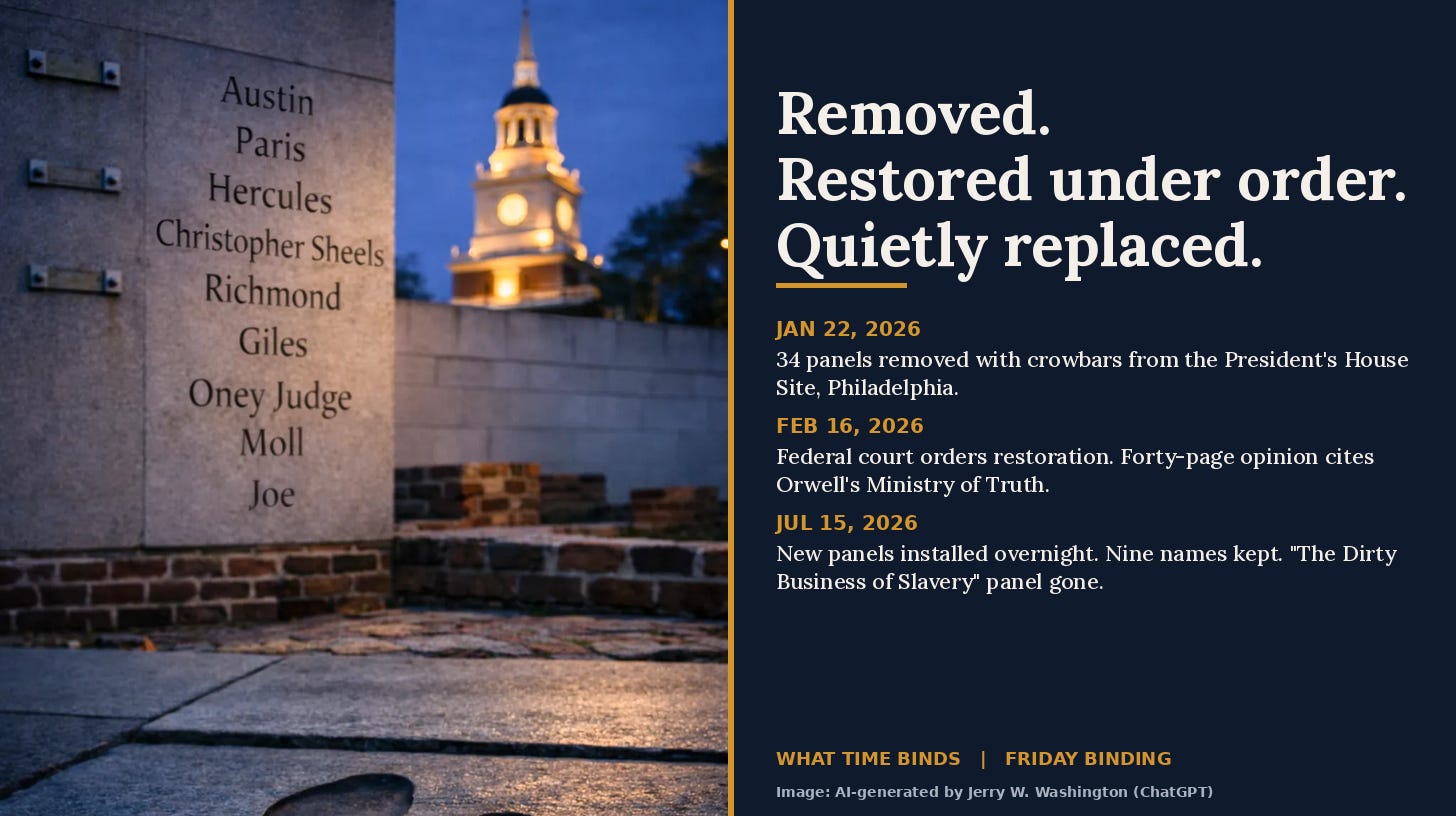
Presidents’ Day, February 16, 2026. Judge Cynthia M. Rufe ordered the National Park Service to put the panels back at Sixth and Market. The judge wrote forty pages. The administration’s argument, she wrote, was “dangerous” and “horrifying.” She invoked the Ministry of Truth in Orwell’s 1984. The next morning, I published an essay “Version Control for Democracy in a Ghost-Map Age.” I found Michele Norris’s Substack post the same day titled “Say Their Names.” It is crazy to think that two writers on the same platform on the same day, using the same word to explain what was going on: restore.
Wednesday night, July 15, 2026, a work crew was dispatched to the site with a different set of panels for Sixth and Market. The panels had been “manufactured,” an Assistant U.S. Attorney told the Third Circuit on July 2. The court cleared its mandate on July 3. The installation finished before sunrise on July 15. It was done “under cover of darkness,” according to Mayor Cherelle Parker’s office.
All nine names are still there; however, the story around them was rewritten.
This week’s picks
1. Alexis Coe, “Trump’s George Washington is a Civic-Minded Enslaver,” Alexis Coe on Substack, July 21, 2026.
Coe wrote You Never Forget Your First: A Biography of George Washington (Viking, 2020). She has read Washington’s correspondence about the enslaved workers he rotated between Philadelphia and Mount Vernon to evade Pennsylvania’s 1780 Gradual Abolition Act. The new panel at the President’s House calls Washington “caught between his private doubts about slavery and his public responsibilities as president.” Coe’s answer, published six days after the panel swap, is one sentence: “Legal evasion is not civic mindfulness.” Read this pick first. It is the historian’s annotation to the July 15 text.
Read it:

2. Michele Norris, “THE REWIND: Say Their Names,” The Race Card Project on Substack, February 17, 2026.
Norris founded The Race Card Project in 2010 to collect six-word stories about race from ordinary people. Her Substack post landed the day after Judge Rufe’s Presidents’ Day injunction. Her argument: naming enslaved people in public history is what keeps them from being enslaved a second time by omission. She wrote it in February about the removal. The Third Circuit’s June 18 opinion vacated the injunction that made her sentence true. Read Norris against the July 15 panels. Note what she asked for. Note what got kept — the nine names in cement — and what got moved into a smaller panel that emphasizes Washington’s trust in “his enslaved house staff” and buying them theater tickets.
Read it:

3. Heather Cox Richardson, “March 28, 2026,” Letters from an American.
Richardson maps the executive order the President’s House case runs on: “Restoring Truth and Sanity to American History,” signed March 27, 2025. She names the three-person review team, the museums flagged, and the phrase that governs every decision downstream — “improper ideology.” Sixteen months of setup landed at Sixth and Market on January 22 this year, at the National Museum of African American History and Culture in the July 4 DPC report, and on the war.gov Charles Rogers page between March 20 and April 5 of last year. One order. Three arenas. This is the origin document.
Read it:
4. Mika Douglas and Robert Anderson, “The White-Out Pen of American History,” The Firing Line on Substack, July 14, 2026.
Published one day before the panels came down. The essay’s spine sentence: “Nothing false has been added. Something true has been taken away.” That is the whole mechanism in one line. Douglas and Anderson count more than thirty historic sites under exhibit review since the March 2025 order. Read this piece before you read Coe. Douglas and Anderson give you the pattern. Coe gives you the case.
Read it:

5. Erica Armstrong Dunbar, Never Caught: The Washingtons’ Relentless Pursuit of Their Runaway Slave, Ona Judge. Atria Books, 2017.
Ona Judge escaped from the President’s House on May 21, 1796. She lived free in New Hampshire for the next fifty-two years and refused the manumission Washington’s estate later offered, because acceptance would have recognized his family’s ownership of her. Her footsteps are cast in the pavement at the site. Dunbar’s book is why. Dunbar is the Charles and Mary Beard Professor of History at Rutgers and a MacArthur Fellow. Read the book this weekend. If you can, walk over to Sixth and Market on Sunday and stand on the print. That is the fact panels cannot replace.
https://ericaarmstrongdunbar.com/nevercaught-ericaarmstrongdunbar
The small install: a three-step audit
When an institution you track announces a restoration, log three things the same day.
The announcement date.
A capture of the original including the date: Wayback Machine, archive.today, a photograph you took, a screenshot with a visible timestamp.
Set a reminder thirty days out to compare again.
The quiet change depends on nobody coming back. The Rogers page went unnoticed for fifteen months because we did not come back to check. The President’s House panels are the same mechanism playing out live. We need to keep the watch.
Landing
The court order was the legal command to restore. The Third Circuit called it invalid on June 18. The overnight installation on July 15 was the final commit. Version control for democracy describes what a citizen does when the institutional substrate becomes editable in the middle of the night.
Read the ballot the way you read this Binding. Every race, every proposition. vote411.org.
A question for the comments
Can you name one restored building, exhibit, park sign, or federal page? Make sure you check yourself against a dated capture this week. Post what you find. If the current version matches the archived original, say so. If it doesn’t, call it out.
One thing I wrote
Presidents’ Day this year, I published “Version Control for Democracy in a Ghost-Map Age.” I called Judge Rufe’s order a restore command and left one question open: whether public memory answers to evidence or to power. The July 15 replacement is the answer.
Read it:
Version Control for Democracy in a Ghost-Map Age

At Sixth and Market Streets in Philadelphia, a set of brick foundations sits exposed in the ground. The house they supported was demolished in 1832. The interpretive exhibit built over them — “The President’s House: Freedom and Slavery in the Making of a New Nation” — came down faster, in roughly seventy-five minutes, on a Wednesday afternoon in January…
Also this week on WTB
Wednesday’s What Do You Mean? entry pinned the word restored against the Rogers page. Read them in order — Wednesday’s pin, Friday’s Binding — and you have the tool and the receipts.
Author’s note
I have been tracking the executive order behind this case since it landed on March 27, 2025. My February 17 essay ran the day after Judge Rufe’s injunction. Michele Norris’s “Say Their Names” ran the same day. Two Substacks pinned the same meaning on the same date. This week we found out what the third act looks like.
Twenty-three years in the Marine Corps taught me to read the audit log before the announcement. Save the receipts.
— Jerry
What Time Binds is my way of keeping receipts. Every claim in the Friday Binding is checked against a primary source before publication, and every essay carries a decision log a reader can request from me directly. Subscribers get an essay when a moment calls for one and five verified reads every Friday morning at 6:00 a.m. PT. Subscribe for free while free is the offer.
The Friday Binding is the weekly curation ritual of What Time Binds. Five reads, one spine question, every Friday.
Thank you for the kind words! I'm still reeling from it