


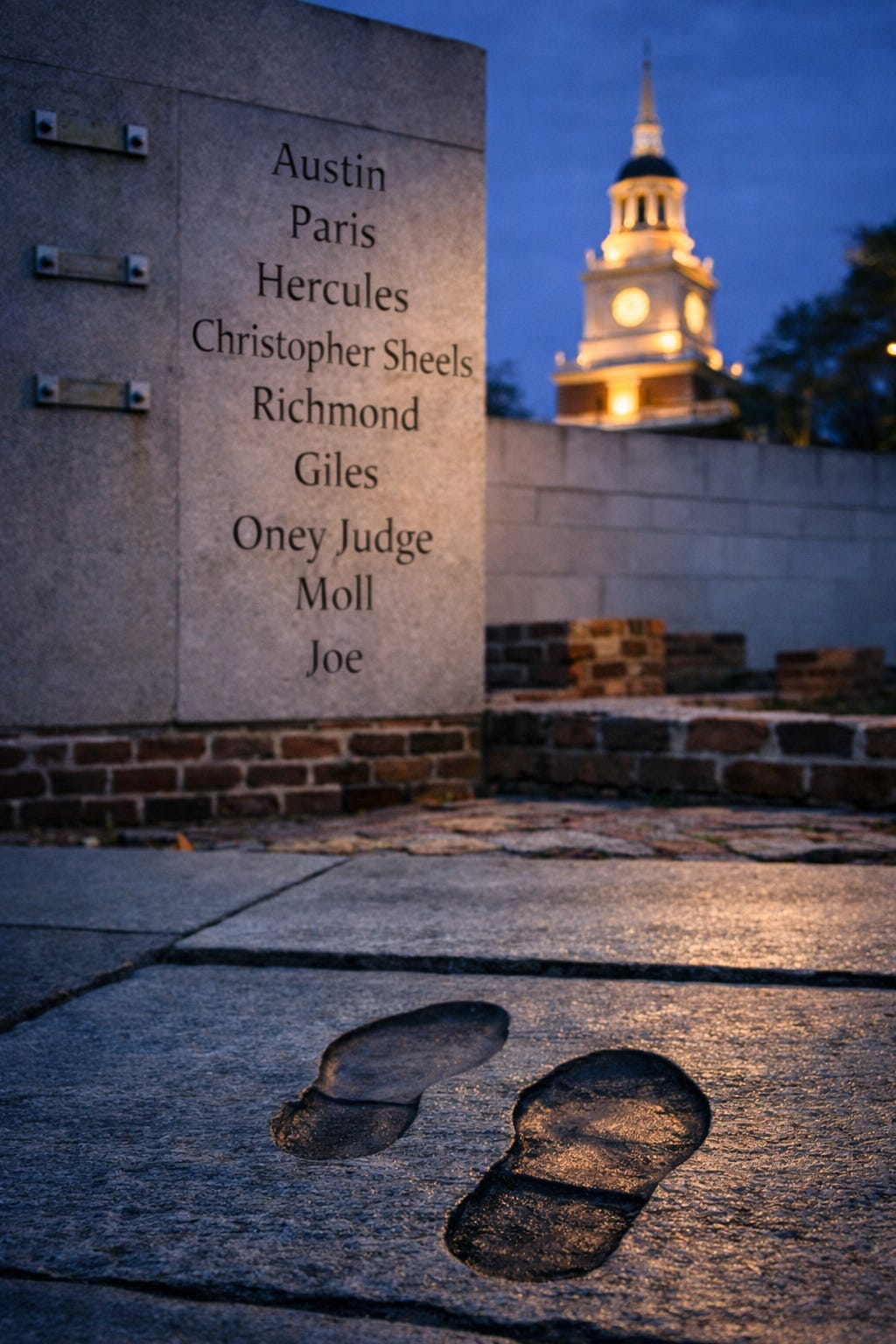
At Sixth and Market Streets in Philadelphia, a set of brick foundations sits exposed in the ground. The house they supported was demolished in 1832. The interpretive exhibit built over them — “The President’s House: Freedom and Slavery in the Making of a New Nation” — came down faster, in roughly seventy-five minutes, on a Wednesday afternoon in January 2026.
What remains is specific. The archaeological footprint. A cement wall engraved with nine names: Austin, Christopher Sheels, Giles, Hercules, Joe Richardson, Moll, Oney Judge, Paris, Richmond. A woman’s footsteps embedded in the pavement, tracing the path Ona Judge took when she left George Washington’s dinner table and walked into freedom in 1796. And thirty-four rectangular ghosts, clean outlines on walls where glass and metal panels once hung, bolts still visible, four video monitors dark.
The absence has hardware. Brackets. Bolt holes. Faded rectangles where sunlight struck unevenly for fifteen years. A visitor on January 23 could read the names and learn nothing about who those people were, what they endured, or why their stories occupied the same ground where “all men are created equal” was adopted one block south.
On February 16 — Presidents’ Day — U.S. District Judge Cynthia M. Rufe ordered the National Park Service to put it all back.
Her forty-page opinion opens with George Orwell and closes with a principle that sounds technical but carries the weight of self-governance: public history is a shared repository, and forcing changes without process does structural damage. The legal question was narrow: did a cooperative agreement between Philadelphia and the federal government require consultation before the exhibit panels came down? The civic question it exposes is vast: Does public memory have version control, or does it answer only to power?
What happened at the President’s House
On January 22, 2026, shortly after 3 p.m., NPS employees arrived at the President’s House Site with crowbars. They pried thirty-four interpretive panels (glass and metal) from their mountings, unbolted signs from poles, and deactivated four video monitors that had played on continuous loop, three narrating the lives of enslaved individuals. By 4:30, a park service truck carried everything away. Philadelphia received no advance notice.
Among the panels: “The Dirty Business of Slavery,” visible in news footage as workers levered it free. Thirteen of the thirty-four told the stories of nine enslaved people in Washington’s household. The Equal Justice Initiative reported that workers used “crowbars to pull down plaques that described Philadelphia’s role in the Transatlantic Slave Trade and included biographical details about the nine people enslaved by the Washingtons.”
The city filed suit in federal court that same day. Its core claims: the removal was arbitrary and capricious under the Administrative Procedure Act and breached a 2006 cooperative agreement requiring mutual consultation before changes to the exhibit. The Avenging the Ancestors Coalition, the NAACP Legal Defense Fund, and Pennsylvania Governor Josh Shapiro joined the case.
Nine days later, Judge Rufe heard oral argument. When a federal attorney stated that “ultimately, the government gets to choose the message it wants to convey,” she called the claim “dangerous” and “horrifying.” She told the courtroom: “You can’t erase history once you’ve learned it.”
On February 2, Rufe visited the site in snow, then spent half an hour in a secured storage space adjacent to the National Constitution Center, inspecting the thirty-four panels. Her report: panels were not destroyed, but some “exhibited damage.” She ordered the government to prevent further deterioration.
On Presidents’ Day, she issued the preliminary injunction. Its language is exacting: defendants must “restore the President’s House Site to its physical status as of January 21, 2026.” They must safeguard all removed items. They cannot install “replacement materials” without the city’s agreement. They must maintain the site — grounds, video monitors, recordings, exhibits — “in a clean and accessible manner.” The injunction holds for the duration of litigation.
Nine names and what stands behind them
The President’s House Site sits steps from the Liberty Bell Center — whose bell reads “Proclaim liberty throughout the land unto all the inhabitants thereof” — and one block from Independence Hall, where two documents declared universal rights without extending them universally. The NPS built the exhibit to hold that contradiction in open air. Its own framing: the site “examine[s] the paradox between slavery and freedom” through “the voices of those who lived there, including Washington’s enslaved servants.”
The nine names are not abstractions. Hercules, Washington’s chief cook, was known on Philadelphia streets for evening promenades in a blue coat with a velvet collar, silk stockings, and a gold-headed cane. He escaped Mount Vernon in February 1797 and was never recaptured. Ona Judge, Martha Washington’s seamstress, walked out during dinner on May 21, 1796. Her words, published in 1845: “I was packing to go, I didn’t know where; for I knew that if I went back to Virginia, I should never get my liberty.” Washington pursued her for years. She died free in New Hampshire in 1848, never legally emancipated. Austin, Ona’s half-brother, died in 1794 after falling from a horse, leaving a wife and five children still in bondage.
The exhibit made these biographies physical. Panels at shoulder height on the actual footprint of the house. Video monitors narrating enslaved perspectives. Footsteps in the pavement tracing Ona Judge’s escape. Stripping the panels left names without context — a memorial wall that memorialized nothing a visitor could learn.
Rufe: “Each person who visits the President’s House and does not learn of the realities of founding-era slavery receives a false account of this country’s history.”
When ghost maps become the operating system
Alfred Korzybski coined the term “time-binding” a century ago to describe a basic human capacity: storing knowledge outside our skulls. Archives, curricula, museums, stone inscriptions, interpretive panels bolted to walls at historic sites. Each generation inherits the accumulated record and builds on it. The mechanism is so ordinary we forget it has moving parts — parts that can be unbolted in seventy-five minutes.
Ghost maps are inherited narratives that keep steering decisions after conditions change. They feel like bedrock because they arrived before we did. One powerful ghost map holds that the founding was a story of liberty, full stop. The document signed at Independence Hall proclaimed equality; the household staffed by enslaved people one block north is a footnote, a complication. This ghost map requires no fabrication — only subtraction. Lower the resolution of the public record, and the simplified narrative fills the gap on its own.
Executive Order 14253, signed March 27, 2025, provides institutional machinery for that subtraction. It directs the Department of the Interior to ensure that federal sites “do not contain descriptions, depictions, or other content that inappropriately disparage Americans past or living” and “instead focus on the greatness of the achievements and progress of the American people.” The word “inappropriately” goes undefined. The Organization of American Historians named the result: “This is not a return to sanity. Rather, it sanitizes to destroy truth.”
Think of public history as a shared code repository. The cooperative agreement between Philadelphia and NPS was a governance protocol: both parties had to approve changes. The lawsuit, the court filings, the inspection report, the forty-page opinion — audit logs. Rufe’s order is a restore command, reverting the repository to its last verified state.
When public memory becomes editable by power without process, ghost maps get promoted to operating system. The simplified story stops coexisting with the complex record and replaces it. The replacement looks like the ground state because the evidence that would reveal the gaps has been hauled away in a park service truck.
The government’s strongest argument, and where it breaks
The federal position merits a fair hearing. The National Park Service manages interpretive content at over four hundred sites, and curation involves choices. Every museum makes editorial decisions. Federal lawyers argued the cooperative agreement expired in 2010, ownership transferred to NPS in 2015, and any harm was remediable — replacement panels would cost roughly $20,000.
Rufe drew the line at process. She found a survival clause in the cooperative agreement keeping consultation provisions in force past the agreement’s stated term. Philadelphia had invested $3.5 million. The agreement gave both parties equal approval rights, with five of six jointly agreed themes centered on enslaved persons. Removing panels without consultation was arbitrary and capricious under the APA.
On irreparable harm, she rejected the dollar figure. “If the President’s House is left dismembered throughout this dispute,” she wrote, “so too is the history it recounts, and the City’s relationship to that history.” Removing materials about Oney Judge “conceals crucial information” linking the site to the National Underground Railroad Network to Freedom, designated in 2022.
She then addressed the broadest claim — that the government “alone has the power to erase, alter, remove and hide historical accounts on taxpayer and local government-funded monuments within its control.” She invoked Orwell’s Ministry of Truth, its motto “Ignorance is Strength,” and wrote that such power “echo[es] Big Brother’s domain in Orwell’s 1984.” Her conclusion: “It does not.”
The boundary is procedural. The government can participate in curation decisions about jointly funded sites. It cannot make those decisions unilaterally, without notice, on a Wednesday afternoon.
The full record, visible
Back at Sixth and Market. The foundations remain in the ground. The name wall is legible. The bolt holes mark where panels hung. If the injunction holds, those panels return — along with the videos, the monitors, the documented lives of Hercules, Ona Judge, and seven others whose labor shaped the house where executive power first took residence in the United States.
Keeping both the founding words and the basement story visible is an adult civic practice. A curated brightness with the contradictions stripped away is a ghost map dressed as history — coherent-seeming, decision-shaping, impossible to correct once the evidence revealing its gaps has been removed.
Five ways to maintain version control on public memory:
Photograph and document interpretive materials at historic sites you visit. Timestamped images are primary sources.
Archive public records before they change. Download NPS pages, government reports, FOIA responses. Personal copies add redundancy beyond the Wayback Machine.
Show up where editorial decisions are made — public comment periods and board meetings for museums, parks, and school curricula.
Fund local journalism that covers public institutions, files records requests, and notices when panels come down.
File your own FOIA requests when interpretive materials change at public sites. The paper trail is the audit log. Without it, there is no restore point.
The court order is a restore command. The underlying question, whether public memory answers to evidence or to power, is still being compiled.