

On Monday morning, June 29, the Supreme Court erased a rule that had held since 1935. Before the day ended, it gave one word two meanings and moved the boundary of another. On Tuesday, it held a third word in place and refused to settle a fourth. Then the justices left for the summer.
Wednesday’s essay traced one of those rulings, the birthright citizenship decision, and ended on three words: the pin held. Today’s Binding sits with the harder fact underneath them. The pin held because six people chose to hold it. Three of those same people pulled a 91-year pin the day before. The stability of a pinned word depends on who holds the hammer.
That is the spine question for this issue. Who decides which pins hold?
The book on the desk
S. I. Hayakawa, Language in Thought and Action.
If you read Monday’s essay, this book is already open on your desk. Hayakawa built the abstraction ladder: the tool for noticing when a conversation has climbed from a specific cow named Bessie to “livestock” to “farm assets” to “wealth,” with every rung feeling like the same subject. The Court spent its final 48 hours arguing about which rung four words live on. “Independent.” “Election Day.” “Citizen.” “Sex.” Read Hayakawa first and the week reads like a field demonstration.
Monday: the pull
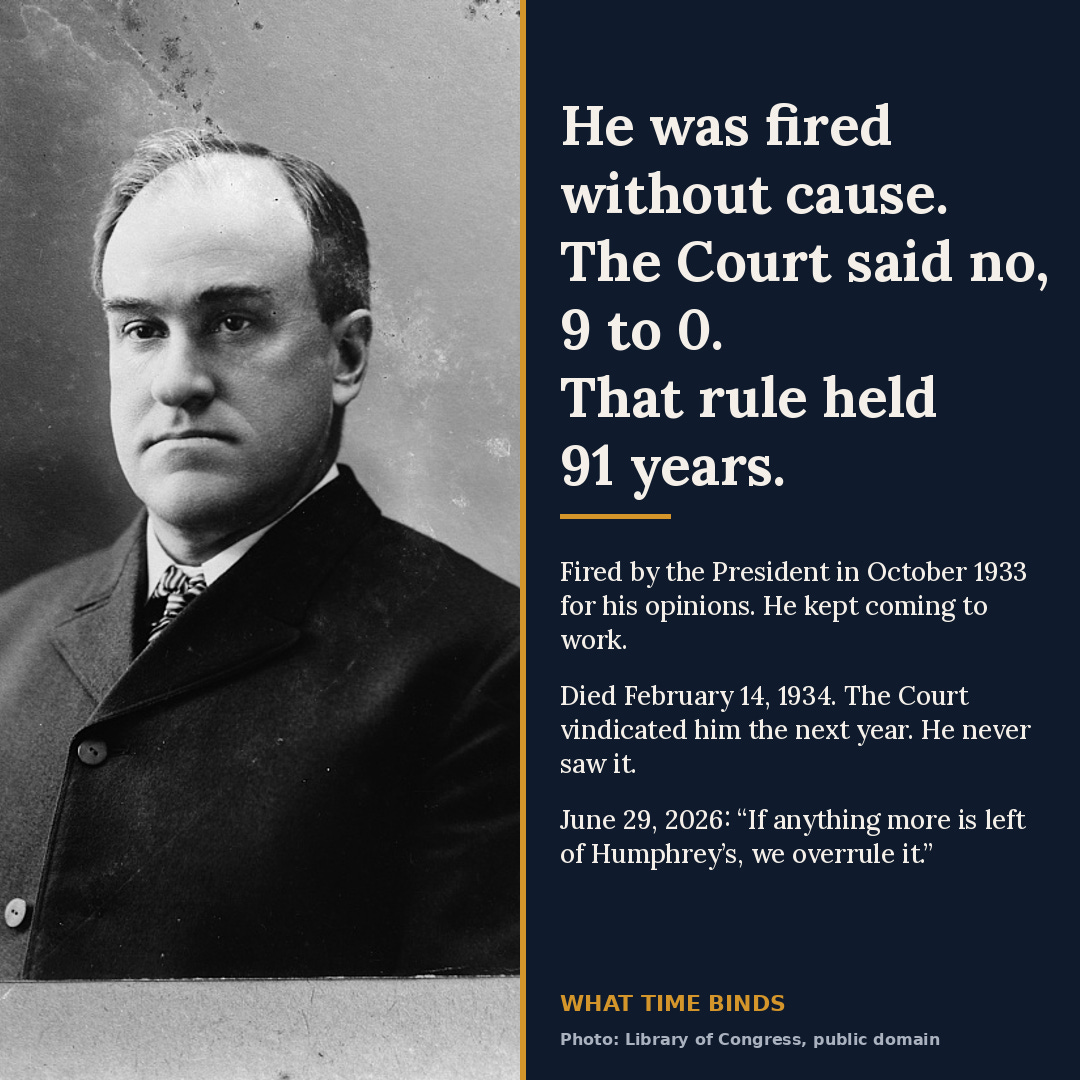
The Court opened its final week by overruling Humphrey’s Executor, the unanimous 1935 decision that let Congress protect independent agency commissioners from firing without cause. The vote in Trump v. Slaughter was 6 to 3. Chief Justice Roberts wrote, “If anything more is left of Humphrey’s, we overrule it,” and called the old case “a result in search of a rationale.” Justice Sotomayor read her dissent from the bench and warned the decision invites “only chaos.”
Pick 1: Harry Litman, “Yes, the Supreme Court Rebuked Trump on Birthright Citizenship. That’s Not the Real Story,” Talking Feds.

Litman, a former deputy assistant attorney general, argues the week’s real event was Monday, and he traces the mechanics with dates. Roberts wrote the groundwork in 2010, took the first cut in Seila Law in 2020, and swung the hammer this week. Litman quotes Justice Kagan’s 2020 warning that the Court’s exceptions to the old rule were “made up for the occasion.” Six years later there is no rule left for the exceptions to modify. Litman calls Slaughter the load-bearing wall under the modern administrative state, and he shows the demolition order was signed one case at a time. Read it for the timeline. A pin does not get pulled in one motion. It gets loosened for decades while everyone insists it still holds.
Monday: the split
The same morning, in Trump v. Cook, the Court ruled 5 to 4 that Federal Reserve Governor Lisa Cook keeps her seat while her case proceeds. Roberts grounded the carve-out in the “distinct historical tradition” of an independent central bank. So by Monday afternoon, “independent” carried two meanings issued by the same nine people: removable at will at the FTC, protected at the Fed. Rebecca Slaughter, the fired commissioner, pinned the new boundary in one sentence at her press conference: “Somehow Wall Street is special and gets special treatment, but other than that, the agencies that look out for everyday Americans do not.”
Pick 2: Don Moynihan, “Welcome to the era of Slaughter,” Can We Still Govern?
Moynihan studies public administration, which makes him the right reader for this pair of rulings. Lawyers ask whether the reasoning is sound. Moynihan asks what the government now does on Tuesday morning. His sharpest observation lands on the split itself: the majority “makes all kinds of absolutist claims without even trying to persuade readers that the simultaneous carve-out for the Federal Reserve adopted in Cook is somehow consistent with that absolutism.” An absolute rule with one unexplained exception is a definition that answers to power rather than to logic. Moynihan has been writing toward this moment since 2025, and the piece links his earlier work so you can watch the forecast and the record side by side.
Monday: the move
Monday’s third act was Watson v. Republican National Committee. Mississippi counts mail ballots postmarked by Election Day if they arrive within five days. The challengers argued that federal law makes Election Day a receipt deadline: a ballot that arrives Wednesday was not cast on Tuesday. The Court disagreed, 5 to 4, in an opinion by Justice Barrett. The election-day statutes, she wrote, “do not set a deadline for ballot receipt.” And on the deeper question of who owns the definition, she was plain: a discretionary power over elections had to be lodged somewhere, and “that power was not lodged in this Court.”
Pick 3: Marc Elias, “The RNC tried to throw out your ballot. I fought back and won,” Democracy Docket. https://www.democracydocket.com/opinion/the-rnc-tried-to-throw-out-your-ballot/
Elias intervened in the case, so read this as a participant’s record with the bias that implies. Its value is the framing he takes from oral argument. The whole dispute reduces to four words: when does someone vote? When the ballot leaves your hand, or when it reaches an official’s desk? Fourteen states and the ballots of overseas service members rode on the answer. One more artifact from this fight belongs in the record. Before the ruling, a senior Justice Department official posted, “Election Day means Election DAY!” That is a definition defended by capitalization. The Court answered with a definition defended by statutory text. Watch which one traveled further.
From Wednesday’s essay. The fourth Monday-and-Tuesday word was “allegiance.” The full anatomy of that fight, written in April and held for the ruling, ran Wednesday: What Do You Mean, “Allegiance”?
What Do You Mean, "Allegiance"?
·At 11:19 a.m. on April 1, 2026, Donald Trump stood up from the front row of the Supreme Court gallery, motioned to those around him, and walked silently through the south vestibule. His motorcade departed shortly after.

Tuesday: the hold
On Tuesday the Court struck down Executive Order 14,160 and upheld birthright citizenship, 6 to 3. Wednesday’s essay covered the mechanism. Today’s addition is the alignment, because it carries the issue’s spine question in miniature. The majority was Roberts, Sotomayor, Kagan, Barrett, and Jackson, with Kavanaugh concurring on separate grounds. That is a coalition, and coalitions dissolve. The pin on “citizen” held because five justices read the 1868 text as written and a sixth found his own path to the same result.
Pick 4: Howard W. Gordon, “A Welcome Decision on Birthright Citizenship,” Substack.

Gordon catches the detail I flagged Wednesday and takes it further. Justice Gorsuch, who exposed the hole in the government’s theory at oral argument, joined the dissent and wrote separately to distinguish children of temporary visitors from children of undocumented parents who have made permanent homes here. Gordon calls the distinction “closer to invented than discovered,” and he flags Gorsuch’s concurrence in Slaughter the day before as part of the same pattern. A decision-maker can name a boundary failure in the question and choose it in the vote. I am writing a full piece on that pattern. Gordon’s essay is the evidence file.
Tuesday: the refusal
The last word of the week was “sex.” In West Virginia v. B.P.J. and Little v. Hecox, the Court ruled 6 to 3 that states may reserve girls’ and women’s school sports for what Justice Kavanaugh’s majority called “biological females.” The majority held that the laws classify by biological sex rather than by transgender status. The dissenters and the challengers hold that the two cannot be separated.
I want to be precise about what kind of dispute this is, because the framework I use has a boundary and this case sits on it. Most of the week’s fights were drift: a shared meaning knocked loose, recoverable by pinning. This one is different. In 2020, the Court read “sex” in one federal statute to cover gender identity. This week it read “sex” in another federal statute to mean biology alone. Ask both sides “what do you mean by sex?” and each answers instantly, completely, and incompatibly. The definition is the disagreement. My four-word question surfaces that kind of dispute. It does not settle it. Pretending otherwise would oversell the tool, and you did not subscribe for that.
Pick 5: National Center for LGBTQ Rights, “What the Supreme Court Did Not Decide in West Virginia v. B.P.J.” https://www.nclrights.org/what-the-supreme-court-did-not-decide-in-west-virginia-v-b-p-j/
I chose this read for its method. Whatever your position on the ruling, this document does the exact work I teach: it draws the boundary of what was decided. The Court permitted exclusion; it did not require it. It called the question of whether schools may include transgender athletes a “distinct question,” undecided. It declined to settle the scientific dispute and declined to set the standard of scrutiny for future cases. That is an includes-and-excludes log, written under pressure, by people who lost. When the stakes are highest, the discipline of writing down exactly what a ruling covers is how you keep the next fight honest.
The return
Four words entered the week carrying settled meanings. “Independent” left with two. “Election Day” left with a wider boundary. “Citizen” left intact, held by a coalition of six. “Sex” left as it arrived, meaning two things to two Americas, now with a ruling attached.
No Supreme Court sits over the words in your conference room. The hammer there is held by whoever bothers to pick it up. This week showed what the job involves: pins get pulled by people who loosened them patiently for years, and pins hold because specific people choose, on a specific day, to hold them.
This week’s question for the comments: Name one word in your workplace or your family that got quietly redefined this year, with no announcement and no vote. Who held the hammer?
The Friday Binding is the weekly curation ritual of What Time Binds. Five reads, one spine question, every Friday.
I like the your use of drift. Conservatives have use small, tiny increments of drift for 50 years now. They have gamed the judiciary system at all levels. McConnell technically was legal holding Obama’s pick for 10 months, then technically correct pushing though unqualified AmyBarrett in three weeks. But this was an afront to norms and guardrails of the precedents of previous 240 years. Trump 1st put the nail in the coffin for Norms and Guardrails, Trump 2nd is now they are finishing off the Rule of Law and independence between the branches. The question is simple, can we make to the mid terms and if so, is there any way we can overcome the cheating that is in already be installed? Thanks for a great article