


The Friday Binding · October 23, 2026
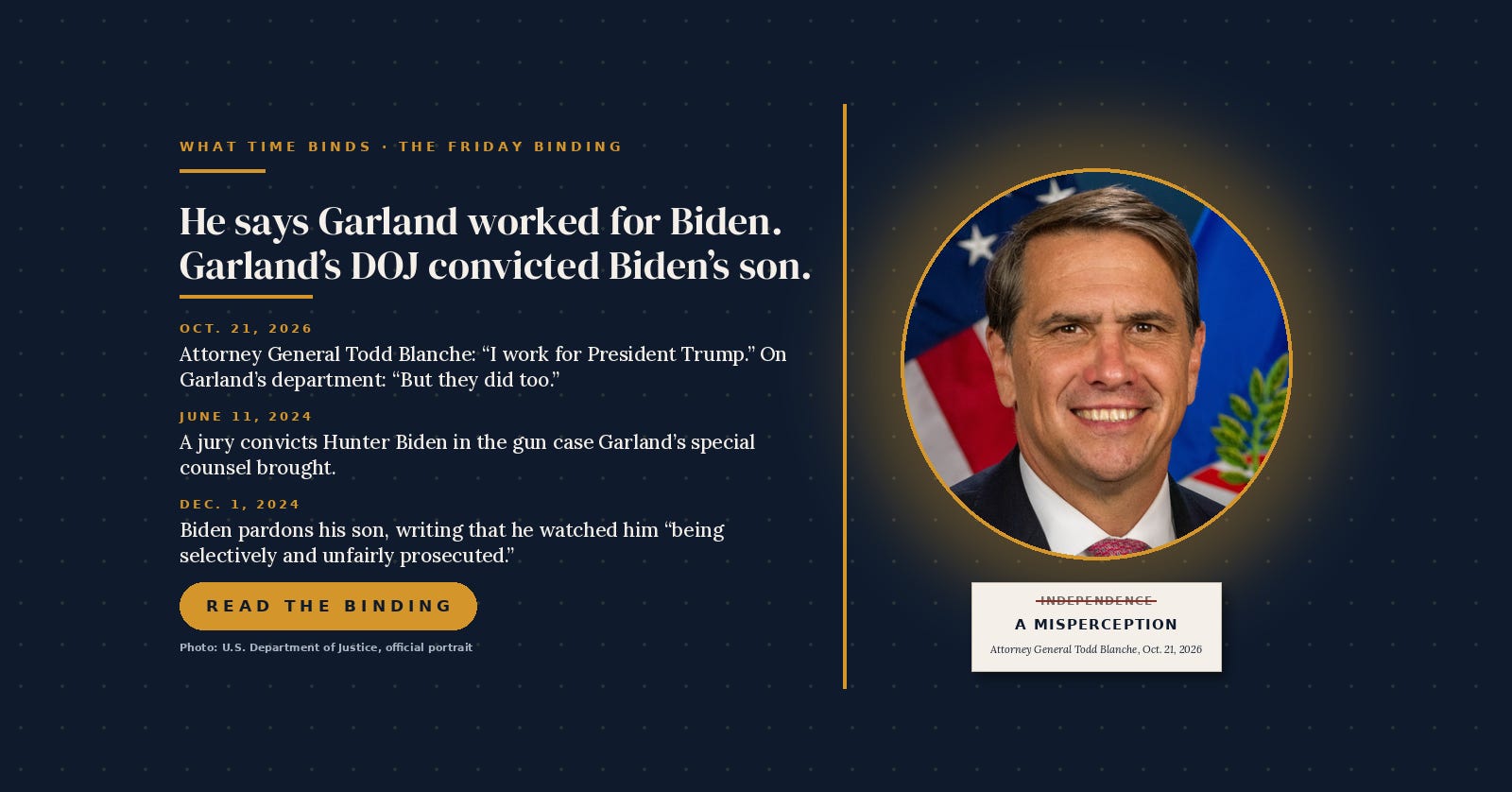
On Wednesday, Oct. 21, Attorney General Todd Blanche sat down with Miranda Devine on the New York Post’s podcast, Pod Force One. Devine asked how Merrick Garland’s Justice Department decided to charge the Jan. 6 cases. Blanche said it was Garland and his deputies, “but I also think it was the White House.” Then he widened the claim.
“So there was this misperception that there’s this separation and independence between the Department of Justice and the White House,” he said. His critics, he said, “accuse me of not suffering from independence. I don’t. I work for President Trump.” Then, about Garland: “But they did too. They did too.”
He made two claims. The first is about Blanche, and he gets the last word on it. The second is about the record, and the record is public. Five writers tested it before I did, some of them months ago. This week’s Binding reads each of them against the documents. Here is the question the five picks below share: did the Justice Department ever stand apart from the White House, or was that always a story?
I come to this as a Marine. In 1993 I raised my right hand and swore an oath that names the President. It names the Constitution first, and it binds my obedience “according to regulations and the Uniform Code of Military Justice.” The oath Blanche took on Aug. 10 has no obedience clause. It does not mention the President at all.
Independence at the Justice Department was a written rule, and the record shows who kept it. Every Monday I take one word an institution bent and show the page it bent on. Subscribe and the next one is in your inbox, free.
This week’s picks
1. Mark Schmitt, “The End of the Post-Watergate Settlement,” The Middle Distance, April 3, 2025

Schmitt gives the arrangement a name, the post-Watergate settlement, and a short history. After Nixon’s first two attorneys general faced criminal charges, Edward Levi “formalized the hands-off relationship in a series of memos and speeches.” Schmitt adds that those were “respected almost to a fault by President Biden and Attorney General Merrick Garland.”
The settlement had an anniversary this week. On Oct. 20, 1973, Richard Nixon ordered Attorney General Elliot Richardson to fire the Watergate special prosecutor, Archibald Cox. Richardson had promised the Senate the prosecutor’s independence. His resignation letter that night was plain: “I could not in the light of these firm and repeated commitments carry out your direction that this be done.” His deputy, William Ruckelshaus, resigned too. Robert Bork, the solicitor general, became acting attorney general and fired Cox.
Levi took the oath in February 1975 and said “our law is not an instrument of partisan purpose.” On Sept. 6, 1978, Griffin Bell, Jimmy Carter’s attorney general, told department lawyers the department “must be recognized by all citizens as a neutral zone, in which neither favor nor pressure nor politics is permitted to influence the administration of the law.”
Bell said something Blanche’s side should hear, too. The attorney general answers to the President, he said, so “true institutional independence is therefore impossible.” In the same sentence he said the President “is best served if the Attorney General and the lawyers who assist him are free to exercise their professional judgments.” The settlement kept the department inside the executive branch and drew a line there. The President sets policy. Nobody at the White House steers a particular case. Bell called it improper for “any member of the White House staff” to try to influence “a particular litigation decision, except by legal argument or the provision of relevant facts.”
That line is still in print. See for yourself: open the Justice Manual, section 1-8.600, and read item A.1. The department “will not advise the White House concerning pending or contemplated criminal or civil law enforcement investigations or cases,” with a narrow exception for the President’s duties. Blanche runs the department that publishes it. The department’s Office of Professional Responsibility still says it “was established in 1975 in response to professional misconduct associated with the Watergate scandal,” a page I read closely in Chapter 2.
2. Mona Charen, “Todd Blanche’s One Promise: Dishonesty,” The Bulwark, Aug. 19, 2026

Charen wrote this after Blanche’s Aug. 16 interview on NBC’s Meet the Press. Asked to pledge that the department would always act independently of the White House, he said, “No, I’m not going to pledge that.” Then: “And no attorney general should ever pledge that.”
Charen goes straight at the Garland comparison. Garland “was actually extremely reluctant to pursue federal charges against Trump,” she writes. “Nor is it the case that President Biden’s administration used the Justice Department to settle political scores.”
The record backs her, and it runs through the cases closest to Biden himself. On Jan. 12, 2023, Garland appointed Robert Hur as special counsel to investigate the sitting President’s handling of classified documents. Hur’s report, released Feb. 8, 2024, said Biden would likely present himself to a jury “as a sympathetic, well-meaning, elderly man with a poor memory.” Biden went before the cameras that night: “My memory is fine.” Garland released the report “without any further additions, redactions, or other modifications.”
On Aug. 11, 2023, Garland made David Weiss special counsel in the Hunter Biden case. Weiss had been the Delaware U.S. attorney since February 2018, appointed in Trump’s first term. A Delaware jury convicted Hunter Biden of three gun felonies on June 11, 2024. He pleaded guilty to nine tax counts that September.
On Dec. 1, 2024, the President pardoned his son. His statement: “I said I would not interfere with the Justice Department’s decisionmaking, and I kept my word even as I have watched my son being selectively and unfairly prosecuted.”
Hold that sentence next to Blanche’s claim about Garland: “the White House wanted him to do exactly what he was doing and he did it.” The President, in writing, said his own Justice Department prosecuted his son unfairly. The same department convicted Sen. Bob Menendez, D-N.J., in July 2024, charged Rep. Henry Cuellar, D-Texas, that May, and indicted New York Mayor Eric Adams, a Democrat, that September.
Blanche’s side has evidence too. Jack Goldsmith wrote at Lawfare in February 2024 that “Biden and his aides have, more broadly, contributed to the perceived politicization of the Justice Department,” pointing to Biden urging prosecution of Jan. 6 subpoena holdouts in October 2021. On Oct. 5 of this year, Blanche’s department released a report saying Garland’s October 2021 memo on threats against school officials “was the product of pressure exerted by the White House.” Take that report at its word, and it describes a memo about threats against school officials. The cases with the Biden name on them went the other way.
3. Jonathan V. Last, “Merrick Garland and the Logic of Failure,” The Bulwark, Jan. 15, 2025
Last makes the case Garland’s own party made for years: he was too careful. As the world looked in 2021, he writes, “Garland’s decision was risky, but reasonable.” Then the results came in. “Garland was just plain wrong.”
The record of the delay is long. In June 2023, Washington Post reporter Carol Leonnig told NPR that the department and the FBI “waited 15 months to launch a formal investigation into that matter,” meaning Trump’s role in Jan. 6. In the spring of 2022, Rep. Elaine Luria, D-Va., a member of the Jan. 6 committee, said it out loud: “Attorney General Garland, do your job so we can do ours.”
In April 2022, The New York Times reported that Biden had told his inner circle Trump should be prosecuted, and that he wanted Garland to “act less like a ponderous judge and more like a prosecutor.” The same report said “the president has never communicated his frustrations directly to Mr. Garland.”
Garland named Jack Smith special counsel on Nov. 18, 2022, three days after Trump announced his campaign. By January 2025, Rep. Jerry Nadler was telling HuffPost, “Merrick Garland wasted a year.”
Too slow is a fair charge, and Last makes it well. It also cuts against Blanche. A President who wanted speed did not get it.
4. Joyce Vance, “The Washington Post Is Wrong About Todd Blanche And Presidential Power,” Civil Discourse, Aug. 19, 2026

Vance, a former U.S. attorney, takes on the strongest case for Blanche: the President runs the executive branch, the Justice Department sits inside it, so the President steers it. Her answer fits in one line. “But presidents don’t direct individual criminal cases or civil suits.” Policy is the President’s, and voters grade it at the next election. Cases belong to professional prosecutors.
The inconvenient fact goes up front. On July 1, 2024, in Trump v. United States, the Supreme Court wrote that “The President may discuss potential investigations and prosecutions with his Attorney General and other Justice Department officials to carry out his constitutional duty to ‘take Care that the Laws be faithfully executed.’” It held Trump “absolutely immune from prosecution” for those discussions. The Court protected the President’s side of that conversation. The attorney general still decides what to do with it.
Blanche has told us. April 7, as acting attorney general, on the President’s role in investigations: “That is his right and indeed it is his duty to do that, meaning to lead this country.” Aug. 16: no pledge. Oct. 21: “I work for President Trump.” On Thursday, reporters in Virginia asked whether the department might try to stop a state from certifying its election results. “Is there any scenario? Yes,” he said. He said it is “never our intention” to “improperly interfere with our elections,” and then: “But to say that there’s no circumstances that we would ever do that, of course I’m not gonna say that.”
Vance’s line between policy and cases is the line Bell drew in 1978 and Garland wrote down in 2021. Blanche is erasing it one interview at a time.
5. Bob Bauer and Jack Goldsmith, “The Comey Indictment,” Executive Functions, Sept. 29, 2025

Bauer was Barack Obama’s White House counsel. Goldsmith ran the Office of Legal Counsel under George W. Bush. This conversation is the clearest picture I know of what “I work for President Trump” looks like inside a case file.
On Sept. 20, 2025, the President posted a message to his attorney general, Pam Bondi. A federal judge later reprinted it in a court opinion. “What about Comey, Adam ‘Shifty’ Schiff, Leticia??? They’re all guilty as hell, but nothing is going to be done.” Then: “We can’t delay any longer, it’s killing our reputation and credibility.” And: “JUSTICE MUST BE SERVED, NOW!!!”
Goldsmith: “Here you have a real-time directive to the attorney general of the United States.” Bauer said Bondi and Blanche, then deputy attorney general, had sided with the U.S. attorney “in thinking the prosecution shouldn’t be brought, and it was overruled by the president.”
The dates move fast. Sept. 19: Erik Siebert, the U.S. attorney in the Eastern District of Virginia, told colleagues he was resigning. The next day’s post said, “No, I fired him.” Sept. 22: Lindsey Halligan was named interim U.S. attorney. Sept. 25: Comey indicted. Oct. 9: New York Attorney General Letitia James indicted.
Then the system pushed back. On Nov. 24, 2025, Judge Cameron McGowan Currie dismissed both indictments, ruling that Halligan’s appointment “violated 28 U.S.C. § 546 and the Appointments Clause of the U.S. Constitution.” Grand juries declined to indict James again that December. On Feb. 10 of this year, a grand jury in Washington declined to indict the six Democratic lawmakers whose “illegal orders” video I wrote about in When Order Becomes Oracle: Part Two. The checks that held were judges and citizens on grand juries. The department was supposed to be one of them.
The habit: follow the closest case
It takes one sheet of paper.
Pick the case closest to the President: his family, his rival, his own conduct.
Write down what the President said he wanted, with the date.
Write down what the department did, with the date.
Run it on Biden. He told his inner circle Trump should be prosecuted. His department took 15 months to open a formal investigation of Trump’s role in Jan. 6. He watched his son convicted and called the prosecution unfair, in writing. Run it on the Sept. 20 post. The President demanded charges, and the indictment came five days later.
Landing
Here is where I come down. Blanche is wrong on the history, and he is wrong on Garland.
On the history: the line between the White House and particular cases was written down after Watergate by people who paid for it. Richardson gave up his office over it. Levi and Bell put it in memos and speeches. Garland put it in the department’s manual, where it still sits.
On Garland: the cases closest to Biden went against Biden. His son was convicted. He was investigated, and the report wounded him. His private complaint about Garland was speed, and he never got it.
The stakes run past one man. The Supreme Court already shields the President’s conversations with his attorney general. The attorney general now says he works for the President. That leaves judges, grand jurors, career prosecutors willing to resign, and voters. In February 2025, Danielle Sassoon, then the interim U.S. attorney in Manhattan, wrote, “I cannot agree to seek a dismissal driven by improper considerations,” and resigned. Steve Vladeck at One First called what happened that Thursday “the October 1973 ‘Saturday Night Massacre’ on steroids.”
The Senate confirmed Blanche 50 to 49 at 4:17 a.m. on Aug. 8. Every House seat and a third of the Senate are on the ballot Nov. 3. Read the ballot the way you read this record: every race, every proposition. vote411.org
A question for the comments
If you swore an oath to the Constitution, in uniform or in a federal job, who did you understand yourself to work for?
One more
Before you settle on this reading, hold a claim that pushes against it.

Scott Ingram writes Justice Briefs, a weekly newsletter on federal criminal prosecution, and wrote a book on the first federal prosecutors. On Aug. 24 he read Blanche’s first two statements as attorney general, the Aug. 13 address to the department and the Aug. 16 Meet the Press interview, more kindly than I do. He sees “black-and-white rhetoric to obscure the inherently gray world of federal prosecutorial discretion,” a man “using formalist messaging to protect his agency.” He wrote that the statements “do not reveal that Blanche is merely the President’s stooge.”
Independence, Ingram argues, runs along a continuum. “Complete independence leaves prosecutors unaccountable. Complete dependence leaves prosecutors at the mercy of political whims.” He left his verdict open: Blanche “has set a high, although gray, bar for himself. Whether he clears it remains to be seen.”
I am not sure Ingram is right. He wrote in August, two months before the podcast. Messaging built to protect an agency would keep the rule the agency inherited. On Oct. 21, Blanche called the separation itself a misperception.
I include the piece because his continuum is the right frame. Bell drew the same line in 1978, and the question was always where it sits. I will keep reading.
Send this to one person who swore an oath.
Author’s note. I wanted other writers in this one. Five of them had built most of the case before I got there. My job was to bind their reads to the documents and the dates. “I work for President Trump” tells you which order a man will follow. My oath told me which one comes first.
The comments are the appendix: tell me where the record is wrong and I will show the page or fix the line. Paid subscriptions open at 500 readers, and the paid product is Coded Threads, the codebooks built from these comment sections. A pledge now is a vote for that.
Sources. Every quote above traces to one of these. Status as of Oct. 23.
Blanche on Pod Force One, Oct. 21, 2026: Mediaite, Alex Griffing. Opened; the quotes match the clip’s captions.
The two oaths: 10 U.S.C. 502 and 5 U.S.C. 3331, Cornell Legal Information Institute. Opened.
Schmitt, “The End of the Post-Watergate Settlement,” April 3, 2025: The Middle Distance. Opened.
Oct. 20, 1973: National Archives chronology; Richardson’s letter, American Presidency Project. Opened.
Levi’s swearing-in, Feb. 7, 1975: Ford Library release. Opened.
Bell to department lawyers, Sept. 6, 1978: Justice Department text. Opened.
The White House contacts rule: Justice Manual 1-8.600, item A.1, citing the July 21, 2021 memo. Opened.
The Office of Professional Responsibility’s founding line: opened through Chapter 2.
Charen, “Todd Blanche’s One Promise: Dishonesty,” Aug. 19, 2026: The Bulwark. Opened.
Hur: appointment, Jan. 12, 2023; the report’s line, Semafor; “My memory is fine,” News4Jax (AP); Garland’s letter, Feb. 8, 2024. Opened.
Weiss: appointment, Aug. 11, 2023; the gun verdict, June 11, 2024. Opened.
The pardon, Dec. 1, 2024: statement, govinfo. Opened.
Menendez, Cuellar and Adams: Justice Department releases on Menendez, Cuellar and Adams. Opened.
Goldsmith, Feb. 12, 2024: Lawfare. Opened.
Weaponization Working Group report, Oct. 5, 2026: Justice Department release. Opened.
Last, “Merrick Garland and the Logic of Failure,” Jan. 15, 2025: The Bulwark. Opened.
Leonnig, June 19, 2023: KUNC (NPR). Luria, spring 2022: PBS (AP). Opened.
The New York Times, April 2022: both quotes confirmed in The Spectator and Fox News reports of April 5, 2022. Nadler: his HuffPost interview, quoted by Fox News on Jan. 6, 2025.
Smith’s appointment, Nov. 18, 2022: Justice Department. Opened.
Vance, “The Washington Post Is Wrong About Todd Blanche And Presidential Power,” Aug. 19, 2026: Civil Discourse. Opened.
Trump v. United States, July 1, 2024: the Supreme Court’s opinion. Opened.
Blanche, April 7, 2026: GV Wire (Reuters). Blanche in Virginia, Oct. 22, 2026: The New Republic, Malcolm Ferguson. Opened.
Bauer and Goldsmith, “The Comey Indictment,” Sept. 29, 2025: Executive Functions. Opened.
The Sept. 20, 2025 post, the timeline and the dismissal: Judge Currie’s opinion, Nov. 24, 2025. The James grand juries: ABC7NY. The six lawmakers: CBS News. Opened.
Sassoon, Feb. 12, 2025: her letter. Vladeck, Feb. 14, 2025: One First. Opened.
The confirmation vote, Aug. 8, 2026: Senate roll call 230. Opened.
Ingram, “Prosecutors and Their Presidents,” Aug. 24, 2026: Justice Briefs. Opened Oct. 23.
This piece was written with AI assistance under the disclosure framework at what-time-binds.com. The analytical frame, the sources, and every position taken are mine and verified.
Jerry W. Washington, Ed.D., is a Marine Corps veteran of twenty-three years, a combat engineer by trade, an instructor at UC Irvine’s Division of Continuing Education, and the writer of What Time Binds, a record of how institutions bend words and how the page holds them to account.
I advise school districts, community colleges, workforce boards, and veteran-service organizations when the words move faster than the coordination. AI adoption is the most common case. See the five ways to work together at jerrywwashington.com, or hit reply if you would like to talk.