

On Monday, a research institute in Gothenburg, Sweden, changed a classification in a database. By Tuesday morning, the headline was everywhere: America is no longer a liberal democracy.
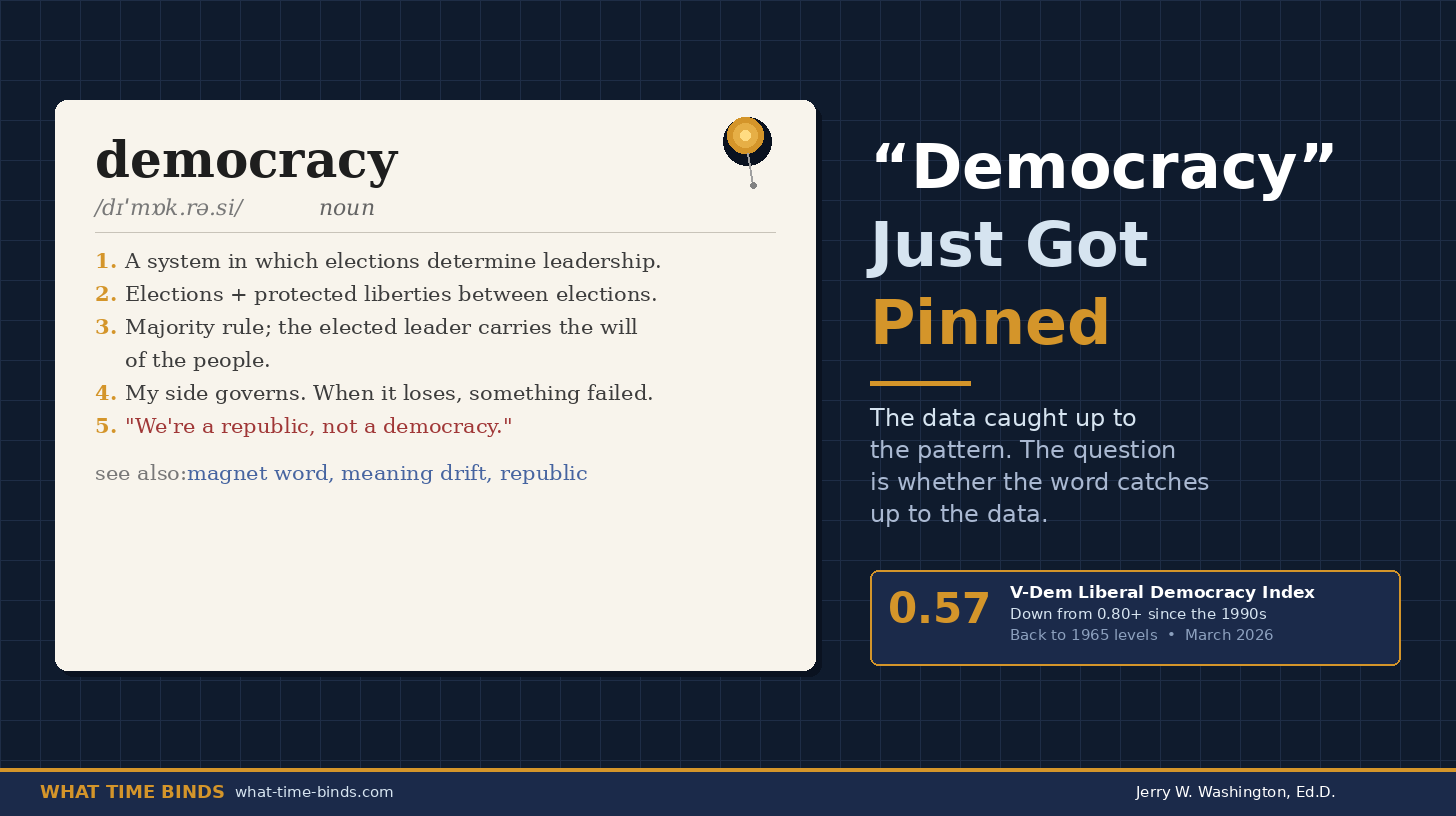
The Varieties of Democracy Institute — V-Dem, the largest quantitative democracy dataset in the world — released its 2026 Democracy Report and moved the United States from “liberal democracy” to “electoral democracy.” The U.S. score on V-Dem’s liberal democracy index dropped to 0.57, down from a consistent 0.8 or above since the 1990s. That puts American democracy, by their measurement, at the same level as 1965 — the year the Voting Rights Act was passed, and the year most scholars consider the country to have become a full democracy in the first place.
The report’s title is “Unraveling the Democratic Era?” Its cover is a tattered American flag with “S.O.S.” spray-painted across the stripes.
Within hours, millions of people reacted. Almost none of them were responding to the same claim.
The magnet word
“Democracy” is one of the most powerful magnet words in public life. A magnet word is a term that pulls everyone toward agreement while meaning something different to each person. Almost everyone says they support democracy. Everyone means something different by it.
In public conversation, “democracy” pulls toward at least four competing definitions:
Procedural: Elections happen. Winners take office. Losers concede. If the voting machinery works, democracy works.
Liberal: Elections happen, and individual rights are protected between elections — press freedom, judicial independence, civil liberties, constraints on executive power. The checks are the democracy, as much as the votes are.
Populist: The majority rules. If the elected leader carries out the will of the people, democratic legitimacy is intact — regardless of what courts, agencies, or media say about constraints.
Tribal: My side is in charge. When my coalition wins, the system works. When it loses, something went wrong.
Dismissive: “We’re not a democracy. We’re a republic.” This one deserves its own line because it does something the other four definitions do not: it rejects the word entirely and treats the conversation as already settled. I’ve been tracking this script for years — in mess tents in the Marines, in graduate seminars, in comment sections, in family group chats. Every time a democracy index makes the news, the reply arrives on cue. I wrote about it twice on Medium: first testing the viral Aaron Russo clip against the Federalist Papers and founding texts, then taking the “we’re a republic” claim completely at face value and asking what duties that actually imposes on leaders and citizens. The short version: “democracy” and “republic” are partners in American usage, not opposites. Madison described a republic as government by representation, bounded by higher law — a structure through which democratic self-governance operates. The false dichotomy lets people wave away any evidence of institutional erosion by insisting the word itself was always wrong. That is meaning drift weaponized as a conversation-ender.
V-Dem is precise about which definition they use. Their downgrade says: elections still happen, but the liberal protections around them have degraded below threshold. The checks and balances, the press freedom, the judicial independence, the constraints on executive overreach — those specific components fell far enough, fast enough, that the classification changed.
Most people reading the headline will not make this distinction. They will hear “America isn’t a democracy,” “some European academics hate Trump,” or “we were never a democracy in the first place” — three reactions that each respond to a different ghost definition of the word. The debate that follows will generate enormous heat and almost zero shared understanding, because the participants are arguing about different things using the same term.
This is exactly what meaning drift looks like at civilizational scale.
The pattern was already visible
I wrote a detailed analysis of this trajectory earlier this year: The State of Democracy: A Factual and Analytical Review of Global Trends and Tipping Points. That paper used V-Dem’s 2024 data — along with Freedom House and the Economist Intelligence Unit — to map the specific mechanisms driving democratic erosion in the United States and five other countries.
The mechanisms I documented are the same ones the 2026 report now cites as reasons for the downgrade:
Press intimidation with concrete consequences. The AP ban, tied explicitly to editorial compliance with a government naming directive. The Paramount settlement of a presidential lawsuit while the company had an $8.4 billion merger pending before a Trump-appointed FCC chairman. ABC News settling a defamation suit for $15 million. These are the receipts behind the V-Dem finding — reported widely this week — that U.S. freedom of expression is at its lowest level since the end of World War II.
Judicial constraint-stripping. The Supreme Court’s June 2025 ruling limiting nationwide injunctions. The administration’s lawsuit against all 15 sitting federal judges in Maryland. The executive order to dismantle the Department of Education. Each action reduces the structural distance between executive intent and executive outcome.
Administrative capture through DOGE. The Department of Government Efficiency, tasked with restructuring the federal bureaucracy, cutting agencies, and eliminating positions — framed as efficiency, functioning as executive consolidation. The $783 million in NIH grants cancelled. The Social Security field offices closed.
Immigration enforcement as dissent suppression. The invocation of the Alien Enemies Act of 1798 — a wartime statute — to deport alleged gang members without due process. The detention of student activists and lawful permanent residents. The explicit presidential statement that one arrest would be the first “of many to come.”
My paper called this a “whole-of-government approach to consolidating executive authority.” The 2026 V-Dem report, working from newer data, arrives at the same conclusion — and adds a striking comparison: the speed of autocratization under the current administration outpaces the trajectories of Putin, Erdogan, and Orbán over the past 25 years.
The data confirmed a pattern that was already operating in the open.
What the V-Dem debate will miss
Here is what concerns me about the next 72 hours of public argument.
The conversation will split along predictable lines. Supporters of the current administration will attack V-Dem’s methodology, its funding sources (the Open Society Foundation is one of many funders), and the premise that any foreign research institute should judge American democracy. Critics of the administration will treat the downgrade as vindication — proof that the alarm they’ve been sounding was correct all along.
Both responses avoid the harder question: What do we mean by “democracy,” and are we willing to pin it?
V-Dem did something specific and useful. They defined their terms. Their liberal democracy index measures five high-level principles across more than 470 indicators, coded by thousands of country experts, aggregated through a statistical model. You can disagree with the methodology. You can argue about the threshold. You can question the weighting. But you cannot pretend the word means whatever is convenient in the moment, because V-Dem forced a definition into the open.
That act — pinning a contested term with specific, operationalized criteria — is the move I study and teach. In Meaning Repair as Cognitive Infrastructure, I call it Phase 3: Repair Activation. Someone speaks the first sentence. Someone says: “This word means this, measured this way, and by that standard, this is what we see.”
The question is always what happens next.
If the repair takes — if the public conversation sharpens around specific, measurable criteria for democratic health — the classification becomes a tool for action. Citizens can look at the specific indicators V-Dem flagged (press freedom, judicial constraints, legislative oversight) and assess whether those conditions are improving or degrading. The word “democracy” stops floating and starts pointing at something concrete.
If the repair is suppressed — if the response is tribal dismissal, source-attacking, or retreat into competing ghost definitions — then the classification becomes another piece of wreckage in a discourse that has already lost its capacity for shared reference points. The word keeps drifting. The positions harden. The argument generates heat forever because the participants never agreed on what the word meant in the first place.
That suppression dynamic is the least-addressed failure mode in how groups process contested information. I wrote about it in “What Do You Mean?” as Cognitive Infrastructure and again in the Feynman piece: clarity is the price of admission for “why.” If you skip the “what do you mean” step, everything that follows is people talking past each other with confidence.
The fair objection, answered clean
The strongest objection to the V-Dem downgrade deserves a serious response: V-Dem is one index with one methodology, and reasonable people can disagree about where classification lines should be drawn.
That objection is accurate and incomplete.
My paper compared all three major democracy indices — V-Dem, Freedom House, and the Economist Intelligence Unit — and found they converge on the direction of travel even when they disagree on the threshold. Freedom House documented its 18th consecutive year of global freedom decline in 2024. The EIU’s Democracy Index registered its lowest global average in a decade. V-Dem’s 2024 report identified 45 countries as autocratizing, up from 12 two decades earlier.
Three different organizations, three different methodologies, three different funding structures, three different countries of origin — and the same finding: the trend line points one direction.
The debate about where to draw the line between “liberal democracy” and “electoral democracy” is a real methodological conversation worth having. It is also a conversation that people in good faith can use as a reason to look more carefully at the underlying data — or as an excuse to look away entirely. Which response you choose says more about your relationship to the word “democracy” than about V-Dem’s methodology.
I explored how this works in Version Control for Democracy — the principle that public memory and public meaning require audit logs. When the terms change, you need to see the diff. V-Dem just showed the diff. The question is whether we read it or close the file.
What this means for your team, your family, your next meeting
You might be thinking: this is macro-level politics. What does it have to do with me?
Everything. The same mechanism runs at every scale.
“Democracy” drifts at the national level because no one pins it. “Aligned” drifts in your Monday standup for the same reason. “Ready” means three different things to three different people on your project team, and the moment you discover the gap is the moment the deadline passes. “Support” means something different to every member of your family, and the version mismatch surfaces during the crisis, when the stakes are highest and the time for clarification has already run out.
The Meaning Repair for High-Stakes Teams course teaches the mechanics of catching and repairing this kind of drift before it compounds. The four-phase model — Drift, Suppression, Repair Activation, Outcome — applies whether you’re talking about a word in a boardroom or a word in the body politic.
The V-Dem report is a Repair Activation event. A research institute spoke the first sentence. They said: by our measurement, using these criteria, this word no longer means what most Americans assume it means when they use it.
Whether that repair leads to restored shared meaning or reinforced suppression depends on what 330 million people do with the information.
It depends, in other words, on whether we treat “democracy” as a magnet word that everyone can claim without defining — or as a term precise enough to act on.
Pin it
The word: Democracy
Why it’s a magnet: It pulls toward at least five meanings — procedural, liberal, populist, tribal, and dismissive (”we’re a republic, not a democracy”) — and almost every public argument about democratic health involves people using different definitions without surfacing the difference.
V-Dem’s pin (2026): The United States retains electoral democracy (elections happen, winners take office). It has lost liberal democracy (checks on executive power, press freedom, judicial independence, civil liberties protections have fallen below the threshold that separates liberal democracies from electoral ones). The score: 0.57 out of 1.0, down from 0.8+ for three decades.
The boundary test: If your definition of democracy is “elections happen,” the U.S. still qualifies. If your definition includes “the structures between elections that prevent the concentration of unchecked power,” V-Dem says we no longer do. If your response is “we were never a democracy,” you’ve exited the conversation by rejecting the term — which is itself a meaning move worth naming. Which definition you hold determines whether the headline is alarming, irrelevant, or inadmissible — and that difference is worth surfacing before the argument starts.
One-minute script: “When you say ‘democracy,’ do you mean elections happen, or do you mean elections happen and power is constrained between elections? And if you mean ‘we’re a republic,’ are you saying representation plus rule of law — because that’s what the V-Dem report is actually measuring? Let’s agree on the definition before we argue about the score.”
Log it. Write down which definition you’re using. Notice when someone switches definitions mid-argument. That switch is the drift. Naming it is the repair.
The full evidence base for the patterns described here is in The State of Democracy: A Factual and Analytical Review of Global Trends and Tipping Points, published on SSRN. The interactive version of the team-level framework is at the-definition-gap.netlify.app. Module 1 of Meaning Repair for High-Stakes Teams is completely free — no paywall, no credit card.
Previously on What Time Binds:
Version Control for Democracy — What happens when public memory becomes editable by power without process
Rally Around the Flag — How crisis dynamics suppress the meaning repair a democracy needs most
Feynman’s Real Question — Why “What do you mean?” is the most important sentence in any room
“What Do You Mean?” as Cognitive Infrastructure — The research behind the question
The Taxonomy: What Kind of Clarity? — Six types of meaning failure and how to spot them
Related (Medium):
“Democracy” vs “Republic” — Testing the Aaron Russo clip against the Federalist Papers and founding texts
“We’re a Republic” — Taking the claim at face value and asking what duties it actually imposes
Thank you for a great post! Continued Sad times in the USA…I hope information like this reaches enough people to create real, sustainable and effective resistance to this administration.