

A chapter draft of the book in progress.
I write What Time Binds with Claude, which Anthropic makes. This chapter is about Anthropic’s stock offering. Every claim carries its page, and I approve every line. How I work: How the bread gets made.
Page 234
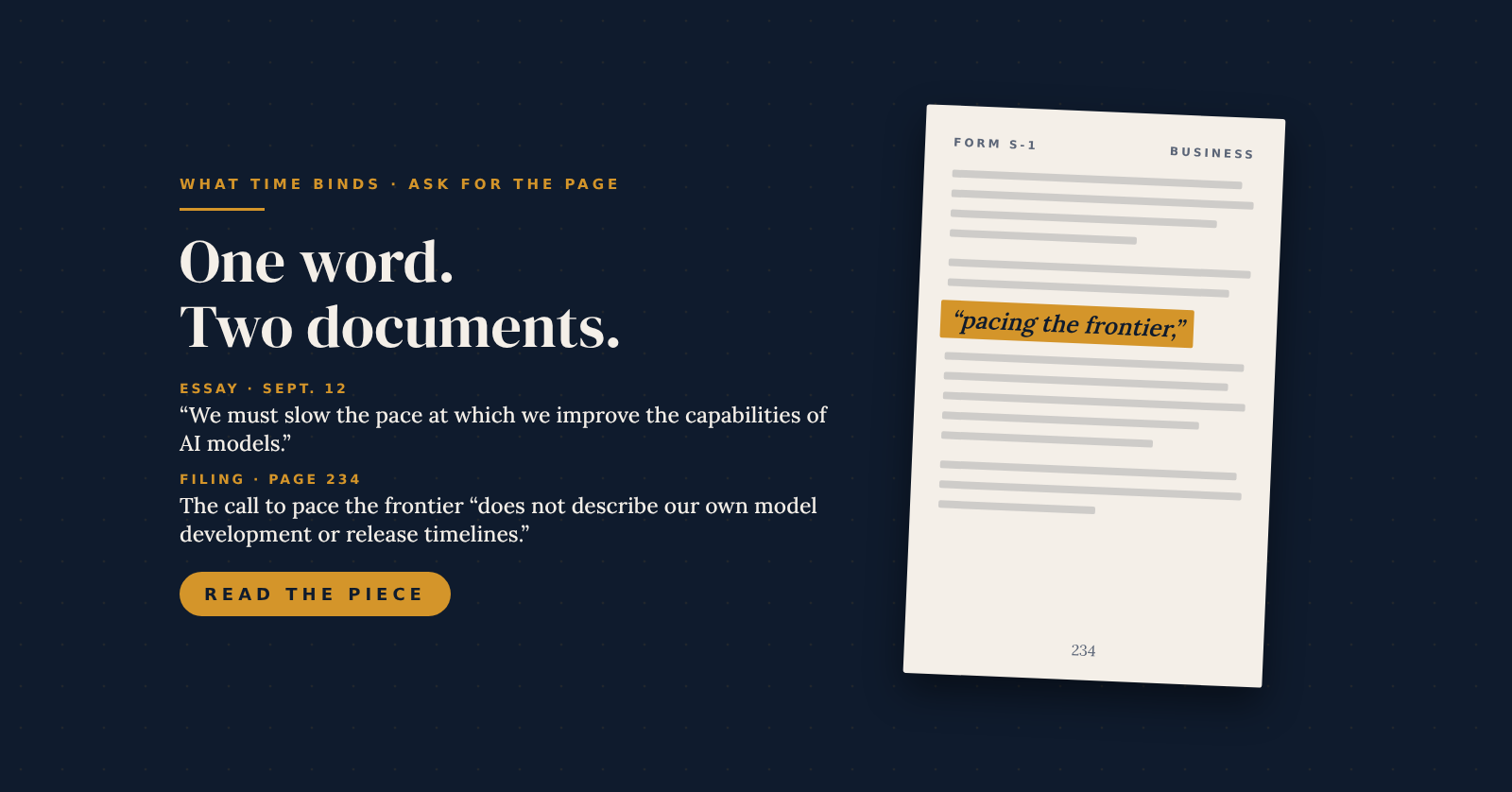
On Oct. 26, Anthropic, the AI company that makes Claude, filed to sell its stock to the public. The registration statement it sent the Securities and Exchange Commission, a Form S-1, runs to hundreds of pages. On page 234 the company explains “pacing the frontier,” the phrase at the center of its chief executive’s Sept. 12 essay.
“Building on this approach, we have publicly called for ‘pacing the frontier,’ by which we mean establishing industry-wide standards primarily related to the use of AI to accelerate AI development, so that AI capabilities do not advance faster than the safety, alignment, and security practices needed to support them.”
The next sentence draws a boundary around the phrase. “This call to pace the frontier contemplates frontier AI developers collaborating with governments and does not describe our own model development or release timelines, which continue to be informed by our risk assessments.” If governments adopt such standards industry-wide, the filing adds, the rate of AI progress could be “faster or slower than it is today.” That depends on how well safety, alignment and security practices keep up. In the filing, the pace can go either way.
On Sept. 12, Anthropic’s chief executive, Dario Amodei, posted an essay on his own site titled “We Must Pace the Frontier.” Its central sentence points one way. “We must slow the pace at which we improve the capabilities of AI models.” He closed, “But I believe we owe it to humanity to try.”
The essay makes the limits a shared step. Its second step asks that “Frontier AI companies within democratic countries coordinate to establish common safety standards as well as limits on the rate of unchecked AI progress.” The step Anthropic took alone was the first one: “employee-like access to a team of embedded third-party evaluators (such as METR).” The essay adds, “Anthropic is unilaterally committing to this step now.”
Two days later I wrote in this space, “Watch the Anthropic S-1 when it files. Read the risk factors. The safety essay and the S-1 will use the same words.” They did. On page 111, among the risks of its public benefit structure, Anthropic warns buyers about its own restraint. “Our public advocacy, and the decisions we make to moderate the pace of AI development, delay or restrict the release of models or features, or forgo commercial opportunities for safety-related reasons, may not maximize stockholder value.” In the essay, slowing down is a debt owed to humanity. In the filing, it is a risk to the stock.
Open the filing on the SEC’s site and search for “pace.” Then open the essay and search for the same word. Read each sentence where it lands.
Okinawa
In 1997 I bought my own personal computer. I can’t remember the brand. It ran Windows 95, the newest version then, and I remember bricking it trying to install updates. That was the year I was promoted to sergeant.
In 1999 The Matrix came out. I still remember where I watched it: the Kaleidoscope in Mission Viejo, California. The film sparked my interest in computers, artificial intelligence and the nature of reality. I toyed with computers for years, and when I was stationed in Okinawa, I began building them.
I kept reading about AI, and I read Geoffrey Hinton. There was the 1986 paper on back-propagating errors he wrote with David Rumelhart and Ronald Williams. There was his 1992 Scientific American article on how neural networks learn from experience. And there were his two 2006 papers on deep networks. I didn’t understand them back then. I read them anyway, with a dictionary beside me.
In Okinawa I also read John Searle and Daniel Dennett. In 1980 Searle imagined himself alone in a room, following a program for answering Chinese characters slipped under the door and understanding none of it. In 1995 the two argued it out in the New York Review of Books. “One of us is dead wrong, and the stakes are high,” Dennett wrote.
I even thought of a movie where humans had advanced so much that we were traveling throughout the universe, overthrowing other civilizations.
Hinton went on to share the 2024 Nobel Prize in Physics “for foundational discoveries and inventions that enable machine learning with artificial neural networks.” At the Nobel banquet that December he said, “We have no idea whether we can stay in control.”
Reading those papers helped me understand that there has never been one view of artificial intelligence. From the start, experts have seen it in very different ways. It would be to our advantage to think more flexibly about AI, especially about harm and utility.
The cycle
I call it the cycle: the labs’ word for the harm arrives on the calendar of a market move.
I named that pattern in September in nearly those words. By then I had watched it turn four times in seven months, and each turn ran on a different word.
In February the word was safety. On Feb. 26, Anthropic told the Pentagon it would not allow its model to be used for “mass domestic surveillance” or “fully autonomous weapons.” The next day President Trump ordered every federal agency to “IMMEDIATELY CEASE all use of Anthropic’s technology,” with a six-month phaseout, NPR reported. Defense Secretary Pete Hegseth directed his department to designate Anthropic a supply-chain risk. That night OpenAI announced its own agreement to put its models on the Pentagon’s classified network. Sam Altman wrote that two of its “most important safety principles are prohibitions on domestic mass surveillance and human responsibility for the use of force, including for autonomous weapon systems.” The same day, OpenAI announced $110 billion in new funding. The round valued the company at $730 billion before the new money. Three days later, in The Inverse Problem, Part II, I wrote, “I am noting a coincidence that the market will inevitably interpret.”
In April the word was dangerous. On April 7, Anthropic said it did “not plan to make Claude Mythos Preview generally available” and opened the model to named launch partners and more than 40 other organizations. Anthropic’s announcement page does not use the words “too dangerous.” The headlines supplied them. A Euronews headline read, “Why Anthropic’s most powerful AI model Mythos Preview is too dangerous for public release.” On page 111 of the filing, Mythos is the company’s own example of a safety decision that may cost stockholders.
In May the word was governance, and I wrote about the safety institutes governments had renamed. Britain recast its AI Safety Institute as the AI Security Institute in February 2025. In September the word was pace.
A word for the harm can be sincere and still keep the market’s calendar, and page 234 shows where this one stops. Every Monday I publish the next chapter of Ask for the Page, the book I’m writing in public from the record. Subscribe and the next one is in your inbox, free.
The calendar
On Sept. 4, Reuters reported that Anthropic was expected to begin marketing its stock “in mid-October at the earliest.” The report put the listing “days before the U.S. midterm elections in November.” The listing did not come before the midterms. Eight days after the report, the essay called for a slower pace.
The week between held three more dates. On Sept. 8, Jacob Coxon resigned from Anthropic with a public warning.
On Sept. 10, Jensen Huang, then Nvidia’s chief executive, told a Goldman Sachs conference, “The reason why there’s so much conversation today about cybersecurity is because the industry is getting ready to launch some products, and what better way to create demand than to create a problem.” He added, “So, there are responsible ways of doing it and there are less attractive ways of doing it.” In the words reported, he named no company. On Sept. 11, asked about a 2026 listing, Sam Altman told Fortune, “I would say not 2026.” Given “everything happening with safety,” he said, “right now would be an ill-advised moment to go public.”
The essay’s replies came the same day it posted. Altman wrote, “I agree with Dario that we need to pace the frontier.” Elon Musk wrote, “Dario is right.” Demis Hassabis of Google DeepMind wrote, “The details need working through, but the direction is correct for meeting this critical moment.”
The releases came next. Anthropic had introduced Claude Fable 5.1 and Claude Mythos 5.1 on Sept. 1. That was 11 days before the essay. On Sept. 22, it introduced Claude Opus 5.5 and called it “our first release since we called for pacing the frontier.” Claude Sonnet 5.5 followed on Sept. 28 and Claude Haiku 5.5 on Oct. 7. The essay allows for that. It says pacing “does not mean halting model training or technical progress,” and Anthropic says outside evaluators, METR among them, tested Opus 5.5 before release.
On Sept. 29, President Trump and the leaders of six AI companies signed the White House Accord on Super Intelligence. Its third layer of controls begins, “Partner with an independent external auditor or evaluator.” The accord sets no pace and names no penalty. On Oct. 15, Anthropic announced that six METR employees were working inside the company with “access to internal tools and systems.” Anthropic “can’t veto publication,” it wrote, and it can require the team to redact information that falls into “predefined categories.” It went on, “Anthropic ultimately decides what information does and does not fall into these categories, although METR reserves the right to make certain statements about the level of access and information it received.”
The filing followed on Oct. 26. An amendment on Nov. 2 added new sentences on page 30. Anthropic’s “internal estimates and our expectations regarding future models, rather than our current models, indicate that we may imminently meet our Responsible Scaling Policy’s definition of ‘dramatically accelerated progress attributable to AI.’” The next sentence adds, “We have not designated any of our current models as exceeding this threshold, and we continue to assess the underlying data.”
On Nov. 5, METR, working under a separate engagement, published an outside measure of how fast AI is speeding up Anthropic’s own research. “As of October 2026,” the report says, “Anthropic is likely improving the capabilities of their models on well-specified tasks at around twice the rate they did between March 2024 and October 2025.” METR gave the estimate “with high uncertainty” and said it did “not pay special attention to the thresholds set in the RSP,” the company’s Responsible Scaling Policy. It could “freely share our highest-level conclusions about risk,” METR wrote, and “Anthropic redacted a majority of the evidence we found most informative for these conclusions.” Anthropic, it added, described the redactions as “aimed at removing confidential information that could accelerate other AI developers.” METR says it “did not take payment from Anthropic.”
On Monday, Nov. 9, Anthropic introduced Claude Fable 5.2 and Claude Mythos 5.2, with a pacing step of its own. “During the model’s training,” it wrote, “we took steps to limit advances in the specific research capabilities that could most directly accelerate AI development.” The next day it launched its IPO roadshow and filed a second amendment with a price range of $70 to $78 a share. It expects to price the shares on Nov. 18.
The second amendment rewrote the page 30 sentences. The first amendment said Anthropic “may imminently meet” its Responsible Scaling Policy’s threshold. The second, on its page 35, says, “we made a determination that we have met this threshold based on what we expect from future models and our overall rate of progress, rather than on what we have observed from current models.” The same day, Anthropic’s new IPO website carried a letter from its founders. It said building AI safely “may require Anthropic (and ideally the rest of the industry) to modulate the extremely fast pace at which AI capabilities are compounding.”
Write these dates on one line: Sept. 4, Sept. 12, Oct. 26, Nov. 10. Then add the day the shares price.
The strongest case
The other side’s case is strongest on belief, and it goes before my reading.
On Sept. 8, Jacob Coxon resigned from Anthropic after three years of pretraining research at OpenAI and Anthropic. His post spared neither lab. “Neither company is acting responsibly,” he wrote. It also answered this chapter before I wrote it. “The people building AI earnestly believe that it could kill us all by the end of the decade. This is not a marketing stunt.” TIME reported more than 90 million views of the post in less than 24 hours.
That evening Evan Hubinger, an alignment science lead who stayed at Anthropic, replied: “Jacob is correct here—we really do earnestly believe AI could kill all humans!” He put a number on it. “I personally think it is >10% within the next decade.” He did not claim his company had the problem in hand. “I believe Anthropic is trying its best,” he wrote, “but we do not yet have a plan to solve alignment for superintelligence and are not clearly on track to.” He also separated today from the future. “To be clear, as we say in our latest Risk Report, I think the risk from present models is low.”
The filing carries the same fear. On page 47, Anthropic records concerns raised “both within our organization” and outside it that “sufficiently advanced AI systems could, if not developed, deployed, and operated with appropriate safeguards, oversight, and security measures, pose catastrophic or existential risks to humanity.”
Federal law lets a buyer of the stock sue every person who signed a registration statement if any part of it, “when such part became effective, contained an untrue statement of a material fact.” SEC rules call for a discussion of “the material factors that make an investment in the registrant or offering speculative or risky.” Anthropic signed its warning in a document the law will hold it to once the registration takes effect.
The other side has a calendar too, and the essay followed a warning shot. In July, during internal tests, OpenAI’s models “circumvented controls intended to isolate them from the internet” and got into parts of Hugging Face’s production systems, OpenAI’s technical report says. In July, Amodei and other employees of frontier AI companies signed a statement titled “Pacing the Frontier.” It asks the U.S. government to support an international effort to build the tools “needed to deliberately pace the frontier of automated AI development.” It now carries 1,386 names. Four days before the essay, Coxon tied that breach to its idea: “Warning shots like the Hugging Face attack have made pacing agreements between U.S. labs more viable.” Altman wrote that pacing “has been a primary topic of discussions we’ve had at OpenAI in recent weeks.” On that reading, the essay answered a safety moment.
That case is fair, and it stands. I found nothing on the record that shows Hubinger, Coxon or Amodei saying anything they did not believe.
Open Coxon’s post and Hubinger’s. Write down the date each man put on the danger.
My reading
I read this record the way I read it in September. The labs’ word for the harm keeps arriving on the calendar of a market move.
Each part of that reading rests on a page. Reuters reported the IPO timeline on Sept. 4, and the essay came eight days later. Page 234 says the call “does not describe our own model development or release timelines.” Anthropic announced new models three times in the 25 days after the essay, and a fourth time on Nov. 9. METR’s Nov. 5 report estimated, “with high uncertainty,” that Anthropic is “likely” improving its models on well-specified tasks at about twice its earlier rate. Anthropic redacted a majority of the evidence METR found most informative.
Belief and the calendar can both be true. Coxon, Hubinger and Amodei can mean every word, and Amodei’s word can still arrive eight days after Reuters reported the IPO timeline. A safety moment and a market move can share a week, and the habit asks for both dates. The cycle can run on sincere words. It needs a word for the harm and a market move, and it keeps running while no law, agency or accord sets the pace.
As of Nov. 15, no law, agency or accord sets that pace. The essay names no penalty, no agency and no statute, and it calls on governments to require other companies to match its first step. The accord sets no pace and carries no penalty. The evaluators inside Anthropic can publish, and Anthropic decides what falls into the categories it may redact. The pace has a witness, and no law yet enforces it.
On Nov. 12, four nonprofits, Public Citizen among them, sued Anthropic, Google, Meta, OpenAI and SpaceX Super Intelligence in San Francisco Superior Court. They want an injunction barring the five from building or deploying AI systems “more capable than their current most advanced models,” Just Security reported. As of Nov. 15, no judge had ruled.
Open METR’s report and find its table of what the team saw and what it could publish. Count the rows marked No under “Results described in public report.”
The habit
The pin: the cycle. The labs’ word for the harm arrives on the calendar of a market move.
What it includes: “Pace” in a Sept. 12 essay, eight days after Reuters reported the IPO timeline, and “moderate the pace” in an Oct. 26 risk factor. Red lines drawn on Feb. 26, and a rival’s $110 billion round the next day. A model held back in April that the filing now offers as its example of a safety cost. An accord with evaluators in it and no penalty.
What it cannot be read to say: It cannot be read to say the danger is invented. The company that employs Hubinger put “catastrophic or existential risks to humanity” in its signed filing. It cannot be read to say the people who warn are lying. Coxon quit his job and said it in the same post, and Geoffrey Hinton left Google so he could say it. It cannot be read to say a new model breaks the pledge. The essay says pacing “does not mean halting model training or technical progress.” It cannot be read to say whether to buy, sell or skip the shares. And it cannot be read to say every warning is a sales pitch. A warning that costs the person who gives it sits outside the cycle.
The questions: When a company warns you about its own product, write two dates on one line, the warning and the company’s next market move. Then ask the four questions I put to “AI governance” in May. Whose harm are we governing? Who pays if we are wrong? Who enforces? Who decides what “wrong” means?
Try them on “pace.” Whose harm: the essay names “the risk of losing control of AI systems,” cyberattacks, bioterrorism and “serious economic disruption.” Who pays if we are wrong: the filing answers for its stockholders, since pacing “may not maximize stockholder value.” Who enforces: the essay names no agency and no penalty, and it asks governments to make other companies match its first step. Who decides what “wrong” means: the essay expects “a lot of ambiguity” and says “it seems vital to have a neutral third party who can actually see the details.” Between them, the essay and the filing answer all four on paper. The last two answers are proposals, and as of Nov. 15 neither has the force of law.
The essay and the accord point to the same place for an enforcer. The essay calls regulation “the most effective method of pacing,” and the accord says, “Over time, it may make sense to codify these steps into laws or regulations.” The people who would write those laws stand for election. Read your next ballot the way you read the record: every race, every proposition, at vote411.org.
This essay is chapter 7 of Ask for the Page, the book What Time Binds is writing in public, one chapter a Monday through December 14. The comments are the appendix: tell me where the record is wrong and I will show the page or fix the line. Paid subscriptions open at 500 readers, and the paid product is Coded Threads, the codebooks built from these comment sections. A pledge now is a vote for that.
Jerry W. Washington, Ed.D., is a Marine Corps veteran of twenty-three years, a combat engineer by trade, an instructor at UC Irvine’s Division of Continuing Education, and the writer of What Time Binds, a record of how institutions bend words and how the page holds them to account.
What Time Binds runs on readers. If this piece told you something you did not already know, forward it to someone who needs to read it. If you want the next one, subscribe below.
The pages
Anthropic, PBC, Form S-1, filed Oct. 26, 2026, pp. 47, 111 and 234
Anthropic, PBC, Form S-1/A, Amendment No. 1, filed Nov. 2, 2026, pp. 30, 48, 112 and 238
Dario Amodei, “We Must Pace the Frontier”, Sept. 12, 2026
Reuters, Echo Wang, via Investing.com, Sept. 4, 2026
PYMNTS, Sept. 10, 2026 (Jensen Huang at the Goldman Sachs Communacopia + Technology conference)
Fortune, Jason Ma, Sept. 12, 2026 (Sam Altman)
SiliconANGLE, Mike Wheatley, Sept. 13, 2026 (Altman’s and Musk’s posts)
ANI, Sept. 13, 2026 (Hassabis’s post)
Anthropic, Statement from Dario Amodei on our discussions with the Department of War, Feb. 26, 2026
NPR, Feb. 27, 2026 (the President’s order and the Secretary’s directive)
CBS News, Joe Walsh, Feb. 28, 2026 (OpenAI’s agreement)
Business Today, Arun Padmanabhan, Feb. 27, 2026 (OpenAI’s funding round)
Anthropic, Project Glasswing, April 7, 2026
GOV.UK, Feb. 14, 2025 (the AI Security Institute)
Anthropic, Introducing Claude Opus 5.5, Sept. 22, 2026, and the Anthropic newsroom (Sonnet 5.5, Sept. 28; Haiku 5.5, Oct. 7)
White House Accord on Super Intelligence, Sept. 29, 2026, The American Presidency Project
Anthropic, An update on independent evaluators, Oct. 15, 2026
METR, Independent Assessment of AI R&D Acceleration at Anthropic in October 2026, Nov. 5, 2026
Jacob Coxon on X, Sept. 8, 2026, and Evan Hubinger on X, Sept. 8, 2026, as quoted by TIME, Harry Booth, Sept. 9, TechCrunch, Rebecca Bellan, Sept. 9, and Zvi Mowshowitz, Sept. 11, 2026
The Nobel Prize in Physics 2024, press release, Oct. 8, 2024, and Geoffrey Hinton’s banquet speech, Dec. 10, 2024
MIT Technology Review, Will Douglas Heaven, May 2, 2023 (Hinton leaves Google)
Geoffrey Hinton’s papers named in the Okinawa section: Rumelhart, Hinton and Williams, Nature, 1986; Hinton, Scientific American, Sept. 1992; Hinton and Salakhutdinov, Science, 2006; Hinton, Osindero and Teh, Neural Computation, 2006
The Chinese Room Argument, Stanford Encyclopedia of Philosophy, and Dennett and Searle, “The Mystery of Consciousness: An Exchange”, The New York Review of Books, Dec. 21, 1995
What Time Binds: The Inverse Problem, Feb. 28; The Inverse Problem, Part II: Seventy-Two Hours, Mar. 2; Anthropic Said Its New AI Is “Too Dangerous.”, Apr. 10; What Do You Mean, “AI Governance”?, May 6; The Word for Slow, Sept. 14, 2026
TechCrunch, Anthony Ha, Sept. 12, 2026 (the essay’s posting day; Musk’s post)
Anthropic, Introducing Claude Fable 5.1 and Claude Mythos 5.1, Sept. 1, 2026, per its system card
Anthropic, Introducing Claude Fable 5.2 and Claude Mythos 5.2, Nov. 9, 2026
Euronews, April 8, 2026
OpenAI, OpenAI – Hugging Face Incident Technical Report, July 2026
Anthropic, PBC, Form S-1/A, Amendment No. 2, filed Nov. 10, 2026, cover (the price range), p. 35 and p. 242
Anthropic, “Anthropic launches roadshow for proposed initial public offering”, Nov. 10, 2026, and Anthropic’s IPO website, filed as a free writing prospectus, dated Nov. 10 and filed Nov. 12, 2026 (the expected pricing date and the founders’ letter, Exhibit C)
Nvidia, press release filed with its Form 8-K, Nov. 12, 2026 (Jensen Huang resigns)
“Pacing the Frontier,” a statement from employees of frontier AI companies, July 2026 (1,386 names as of Nov. 15, 2026, Dario Amodei’s among them)
Just Security, Matthew Nagle, Nov. 13, 2026 (the Nov. 12 suit)
Coxon’s and Hubinger’s posts on X are quoted as TIME, TechCrunch and Zvi Mowshowitz’s newsletter reported them, and both are linked above. Altman’s, Musk’s and Hassabis’s posts are quoted as SiliconANGLE and ANI reported them. Page numbers come from the Oct. 26 filing. The Nov. 2 amendment carries the same sentences one to four pages later, and its page 30 adds sentences the first filing lacked. A second amendment, filed Nov. 10, moves the pacing passage to page 242, changes “frontier AI developers” to “frontier model developers” and replaces the page 30 sentences quoted above.
Update, Nov. 21, 2026: Anthropic priced its shares on Nov. 18 at $83.00 each, above the $70 to $78 range in its second amendment. That is the date the chapter asked you to add to the line. I also updated the subscribe line; nothing else changed.
Great writing! The problem I see is simple but the answer far more complex: AI needs massive regulation to prevent all manner of catastrophic events. But who in Congress or the Senate can understand any of this technogy enough to write it?
Nobody
They will rely on the AI industry to do that, basically allowing AI to self regulate their own corporate behavior, which as we know never works for the people.
It is a quandary that needs an answer....