


Sometime in the mid-1970s, a sergeant in the 82nd Airborne Division got word that a general was coming to see him. Not his unit. Him.
The sergeant was Bruce Watts. He had a secret he guarded carefully: his father was a general officer, and Bruce wanted to be judged on his own merit, so he told no one. The visiting general had eaten dinner at his parents’ table a few days earlier and promised to look in on their son. So Maj. Gen. Charles Calvin Rogers appeared in front of a terrified young NCO, shook his hand, chatted with his troopers until his handlers pulled him away to see the division commander, and left a chain of command spending the rest of the day asking who Bruce’s father was.
Years later, Bruce read the Medal of Honor citation. Fire Support Base Rita, Vietnam, November 1968. A lieutenant colonel wounded three times who kept directing fire, kept leading, and kept his firebase from being overrun. Bruce wrote something about that citation over the weekend that has stayed with me since. Heroism like that, he said, “must be published and displayed in conspicuous places” to inspire the young soldiers coming up.
Conspicuous. Hold that word. The citation’s own phrase is “conspicuous gallantry.” Conspicuous is the standard the record was written to meet.
Now the word this Field Guide pins.
Sixteen months ago, the Defense Department’s tribute page for General Rogers vanished from the Pentagon’s website. The replacement URL contained three letters: dei. The removal drew cameras, then backlash. Three days later the page was back, and the story everyone remembers ends there: restored. Case closed.
“Restored” is the word that ended the attention. Here is what the datestamps say happened while the word did its work.
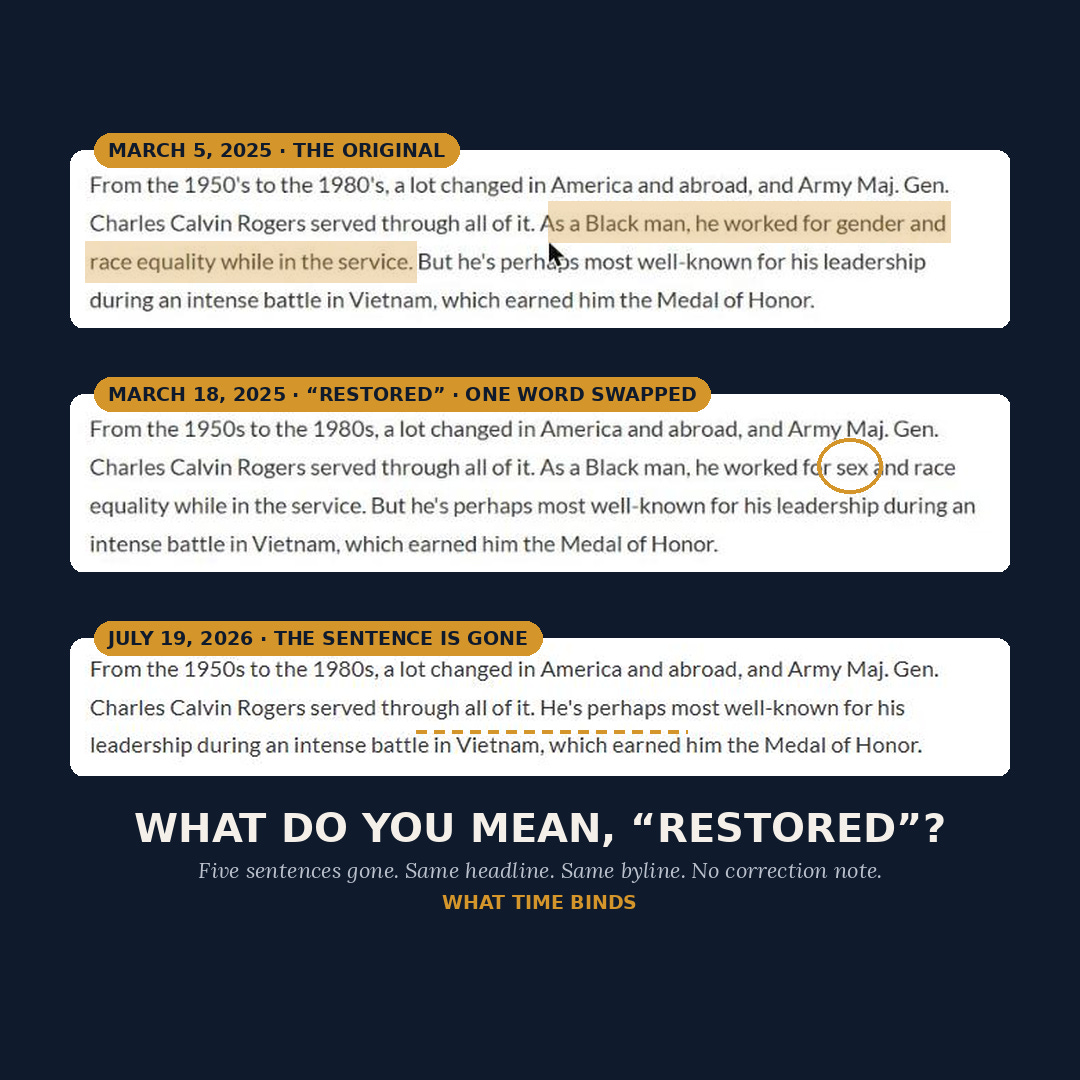
March 15, 2025: an independent archive catches the page mid-removal, returning a 404 error. March 17: the page comes back. March 18: a capture of the returned page shows an edit already inside it. “Gender and race equality” now reads “sex and race equality.” Processes don’t copyedit. The page everyone celebrated as restored had been changed before the celebration finished.
March 21: the Pentagon issues a policy statement. Removed content is under review “to determine if it was mistakenly removed or, in other cases, if it can be edited to make it eligible for reposting.”
Read that twice. Wayne Coy, whose guest essay ran here Monday, read it once and named it: “The standard was not accuracy. It was eligibility.” Edit the record until it clears the filter, post it back, call it restored.
By the April 5 capture, the editing was done. Same headline. Same byline. Same 2021 dateline. No correction note. Five sentences gone:
“As a Black man, he worked for gender and race equality while in the service.”
“Rogers, who attended the all-Black Dubois High School during the segregation era, excelled as a student.”
“His first few years as a soldier were spent serving in artillery commands while the service was being desegregated.”
“To this day, he is the highest-ranking Black Medal of Honor recipient.”
“Rogers has been remembered not just as being a Medal of Honor recipient, but for championing gender and race equality during his long tenure in the Army.”
The Defense Department published every one of those sentences in 2021, under its own byline. They stood for three and a half years. Then they left without a note, from a page wearing a dateline that swears nothing happened.
So, what do you mean, “restored”?
The dictionary means returned to its former state. The page returned to visibility. The record never returned at all. What came back is a document that looks like the original, carries the original’s date, and says less than the original said. The word covered the difference. That is the whole function the word performed: it told the country the story was over while the story kept going.
I posted the receipts on Facebook on Saturday night. As of this morning, the thread holds 264 comments, and what happened inside it is the reason this entry exists.
The Pentagon removed five sentences. The thread produced five witnesses.
Bruce told the handshake story. A soldier wrote that he recovered beside Rogers in a hospital in Japan, both of them wounded, playing hours of cribbage. An officer remembered Rogers speaking at his Ranger School graduation in 1977, before he knew what the man had done at Rita. Another reader served under him as a young lieutenant in the mid-70s and walked the thread through the direct-fire decision at the firebase, gun by gun. An artilleryman wrote that Rogers is the reason he chose the branch, and pointed to the howitzer that stood with him at Rita, a rocket hole in its side, displayed outside Snow Hall at Fort Sill.
Five men, five different decades of contact, surfacing on one post inside a day. One reader named the tradition at work: the griot, the keeper who carries a community’s stories when institutions won’t. Another described her practice at Arlington, laying an extra bouquet on the grave of someone being erased. Her word for it: un-erase.
This is what I mean when I write about time binding. A civilization passes its knowledge forward through substrate: pages, plaques, databases, citations. Whoever edits the substrate edits the inheritance. The Rogers page proves the substrate can be rewritten in the dark. The thread proves the inheritance has a backup system, and the backup system is people.
One more thing happened in that comment section. Several readers asked, some sincerely and some with folded arms, why the man’s race should matter at all. Why not honor the officer and skip the Black officer?
The five deleted sentences are the answer. A segregation-era high school. Artillery commands during desegregation. The highest-ranking Black recipient in the medal’s history. Each sentence records a fact about what this country asked one soldier to overcome while he served it. The question and the edit want the same thing, and the edit already acted on it. Whoever cut those sentences answered “why does race matter” with a delete key and left no name on the work.
And here is where the story stops being finished. In the thread, one reader asked whether the plaque is still on that howitzer at Fort Sill.
Nobody knew.
That is the condition the quiet rewrite leaves us in. Every marker now has to be checked. The page, the plaque, the archive, the database. Friday’s essay returns to this pattern at a memorial in Philadelphia, where a court ordered a restoration and got one, briefly. The pattern runs in three steps: removed, restored under pressure, quietly replaced. Once you can read the steps, you will see them running elsewhere.
Until then, one habit and one assignment.
The habit: when an institution tells you something was restored, ask to see what came back next to what was there before. The datestamped captures for this story are linked below. Repair needs blueprints, and blueprints are what archives are for.
The assignment: an edit history is a public record. So is your voter registration, and the people who hold the pen over both get chosen at the ballot. Check your registration the way you would check that plaque. Read every line. vote411.org.
The record of Charles Calvin Rogers survived because people carried it. Carry it.
Receipts, datestamped:
My March 18, 2025 piece, written while the page was down:
https://medium.com/@jerrywash/trumps-weakness-exposed-4ea0f66687ad
My Facebook Post: https://www.facebook.com/jerrywashington.edd/posts/pfbid0g8Rn3UpVYabBN8GsqLM7rzgrsaT2kigFx4jTAiLhcjgcKL623aYWnKJ3df1dkhrRl
What Time Binds studies how meaning drifts and how we repair it. One field guide like this every week, free.
The word here is "restored." In Japanese it would land as either fukugen or shūfuku, and the two aren't the same. Fukugen means returning a thing to its original form — the endpoint has to match the original. Shūfuku means mending — "fixing the damaged parts so it looks as it did" — so the word itself leaves room for hands to be in it. If the contents were changed on purpose, it's not fukugen anymore; it slides toward shūfuku, then shūsei (revision), and put harshly, kaizan (falsification). But if the announcing side calls it fukugen, I wonder if that's what it becomes.