


You saw the headline. Maybe on your feed. Maybe in a newsletter someone shared. Maybe you shared it yourself.
Wyoming governor decries “aggressive” behavior of federal election monitors. — The Washington Post, Aug 28, 2026.

The story is true. What follows is the process. How you check a live headline before you share it, at the kitchen table, in three minutes.
I spent twenty-three years in an institution that told you to identify your target before you fired. Verification was not a virtue. It was a rule. The Marines call the part before you shoot "reconnaissance". Look before you act. Confirm the picture. Watch for what does not fit.
The Wyoming story is a good field exercise because every decision you need to make on it can be made from your kitchen table in about three minutes. What follows is the exercise, one step at a time. The Repair Protocol at the bottom is the version you can save.
Step 1. What you saw
The headline is a working editor’s summary, written to earn your click. Read it once. Then set it down.
Ask three questions before you scroll further:
Who is quoted?
What action is described?
Where did the action happen?
For this story: a Wyoming Republican governor is quoted, the action is federal election monitors sent to a Wyoming county, and the location is Wyoming’s Aug 18 primary. That is your baseline. Everything below either confirms or complicates that baseline.
Step 2. Leave the article
This is the move that separates a reader from a re-poster. Open a new tab. Do not scroll further into the first article. Do not click the “See more” or the “Related.” Go find someone else who covered the same event.
The Google News screenshot above shows what you find. The Washington Post ran it. ABC News picked it up. NBC News ran it. WyoFile ran it. The Hill ran it. Wyoming Public Media ran it. Cowboy State Daily ran it.
Now ask a follow-up. Are these seven independent accounts, or are six of them rewriting the seventh? Look at the datelines. Look at the bylines. Look at whether the quotes are the same words in the same order.
For the Wyoming story: WyoFile’s Maggie Mullen was in the room at the Wyoming State Canvassing Board on Aug 26, 2026. Cowboy State Daily’s Clair McFarland covered the same room. Wyoming Public Media’s Jordan Uplinger covered it. The national outlets picked up the local reporting the following day.
Three independent local reporters, three independent bylines, three overlapping accounts of the same event. That is what news looks like when it is real. One outlet, six rewrites, is what a game of telephone looks like.
Step 3. Find the primary event
Someone said the aggressive words. Not the reporter. Not the editor. Not the Washington Post’s headline writer. A person, in a room, on a date.
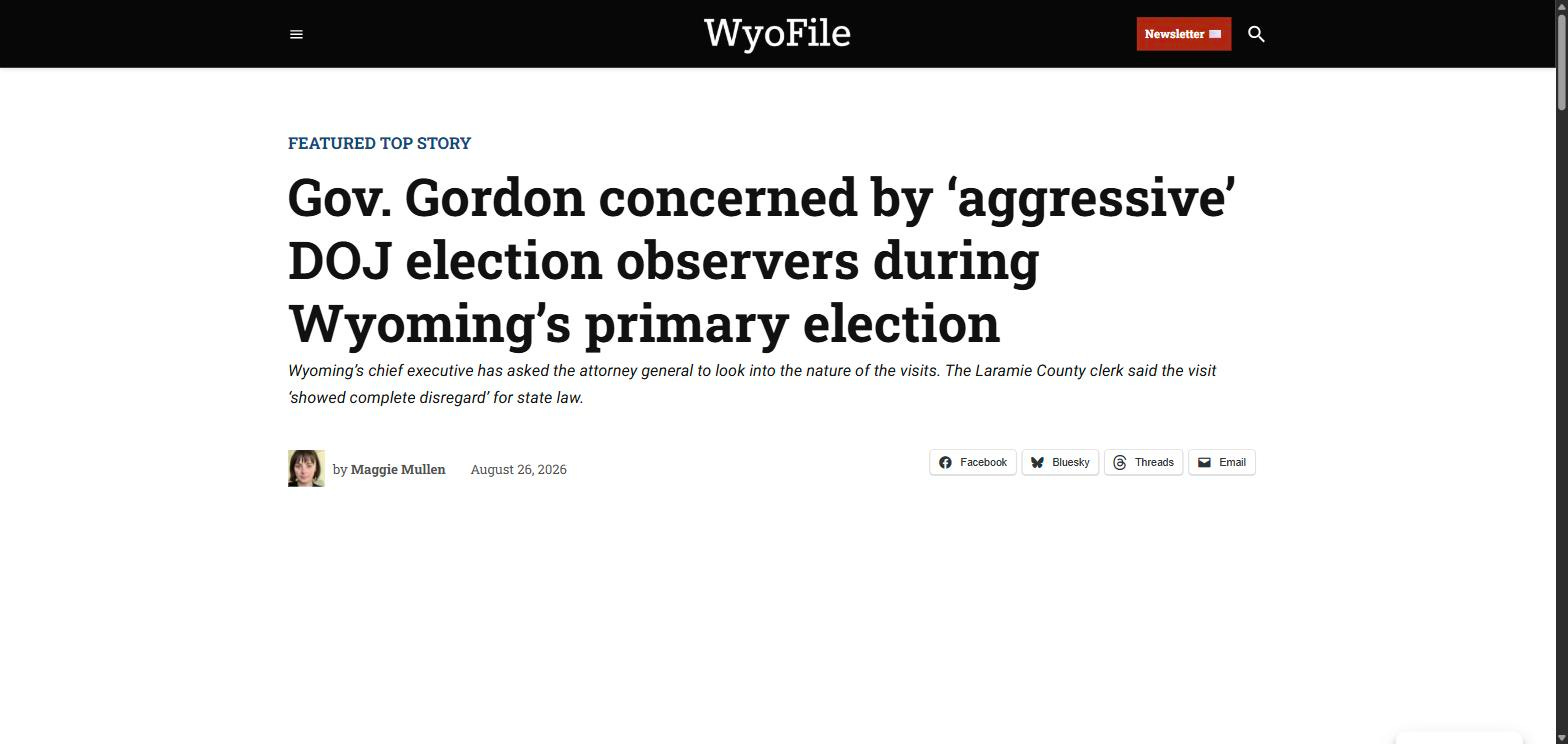
The room was the Wyoming State Canvassing Board. The date was Aug 26, 2026. The person quoted was Governor Mark Gordon, a Republican, appointed and elected in the state that voted more heavily for Donald Trump in 2024 than any other. Trump carried Wyoming 72.3 percent to 26.1 percent.
Log all of that. It matters when you weigh what he said next.
Step 4. Pull the underlying document
Go under the reporter. The reporter is telling you what happened at the canvassing board. The event she is reporting on is a DOJ deployment eight days earlier. Where did that deployment come from?
DOJ press release 26-939, Aug 18, 2026. Two paragraphs and a list of statutes. It lives on justice.gov. Read it yourself before you accept any characterization of it.
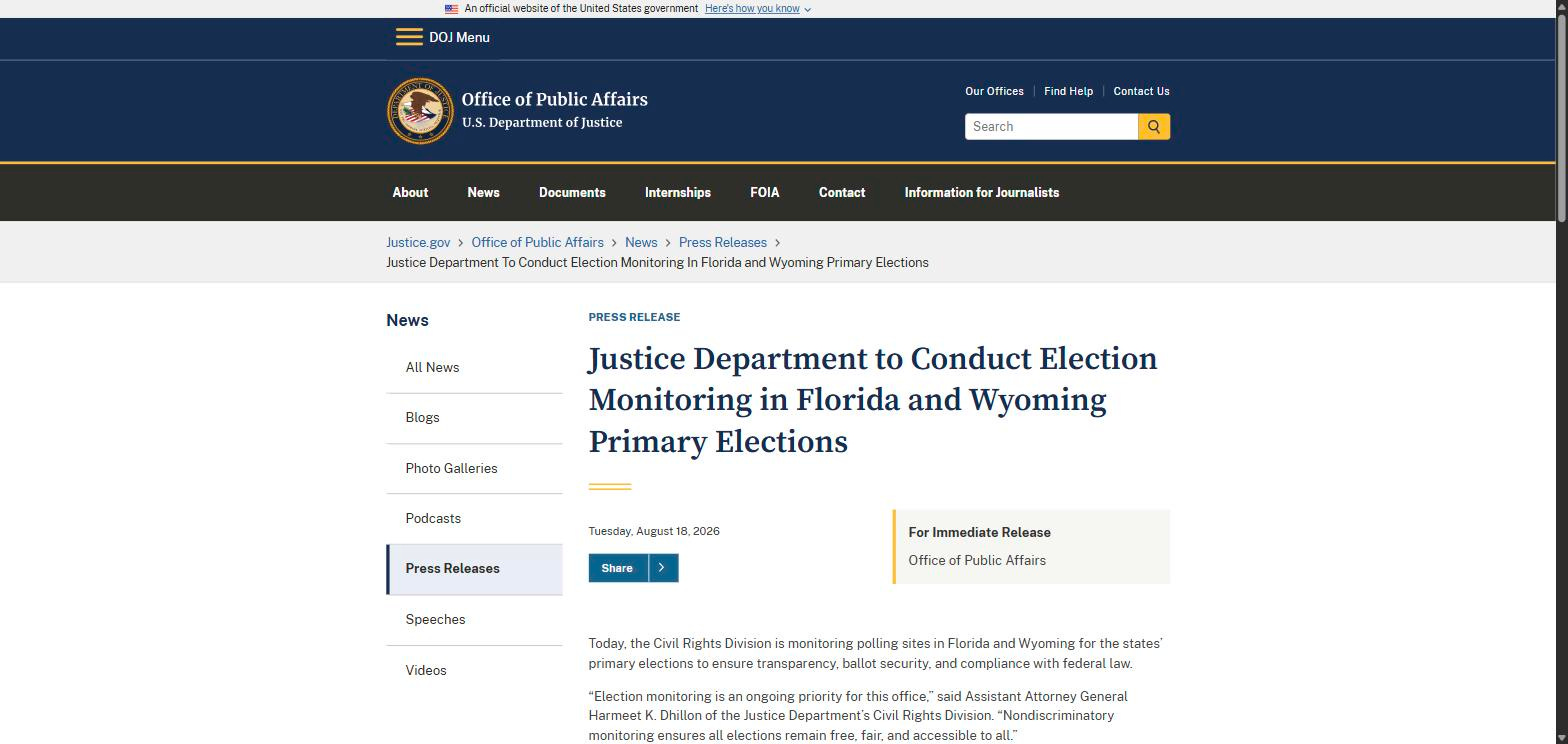
Read the press release. Now read it a second time and pay attention to what it does not say.
It does not name the specific allegation that triggered the deployment.
It does not name the complaint filed by any Wyoming voter.
It does not name the section of the Voting Rights Act being enforced in Laramie County.
It names the Civil Rights Division as the office deploying. It names Assistant Attorney General Harmeet Dhillon. It names the general statutory authorities the Division enforces: the Voting Rights Act, the National Voter Registration Act, HAVA, UOCAVA, ADA, the Civil Rights Acts. It names the counties: Miami-Dade and Laramie.
The press release names the authority to act. It leaves out what is being acted on. A general permission without a specific charge.
Log that gap. Missing specifics are evidence.
Step 5. Read the counter-witness
Every story has a person who thinks the frame is wrong. Find that person before you finish the story.
The Wyoming Republican Secretary of State, Chuck Gray, publicly disputed Governor Gordon at the same canvassing board. Wyoming Public Media covered his response.
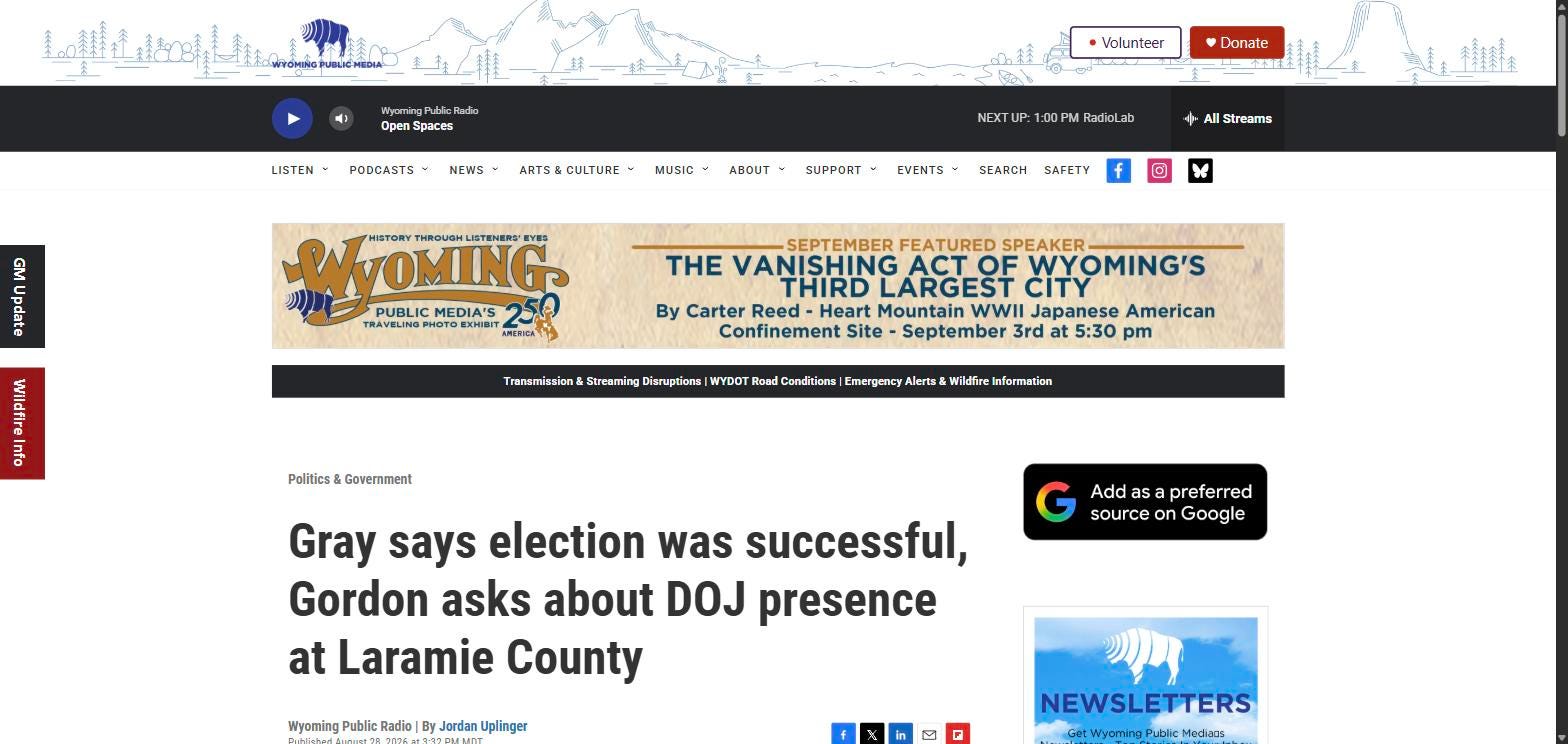
What did Gray actually say? Wyoming Public Media reports the following:
He noted that a news article showed the U.S. Attorney had acknowledged working with election observers.
He said Wyoming law “provides for observation of the election process.”
He said his office had received email notice from federal officials before Election Day.
He said the election overall was “successful.”
Now read what he did not say.
He did not say the monitors’ specific behavior was appropriate.
He did not defend the request to interview voters.
He did not defend the request to examine tabulators.
He did not name a Wyoming statute that permits federal officials to conduct interviews at polling stations.
He said notification happened and the election finished. That is a narrow defense. Log the narrowness.
Step 6. Find the person at the door
At the moment the two federal officials walked into a Laramie County polling station on Aug 18 at approximately 7:00 a.m., one person was standing on the other side of the door.
Debra Lee, Laramie County Clerk. She is the chief election officer of the county that contains the state capital. She had been in that job through two general elections. She had a written statement ready by Wednesday evening. Cowboy State Daily and WyoFile both quoted it in full.
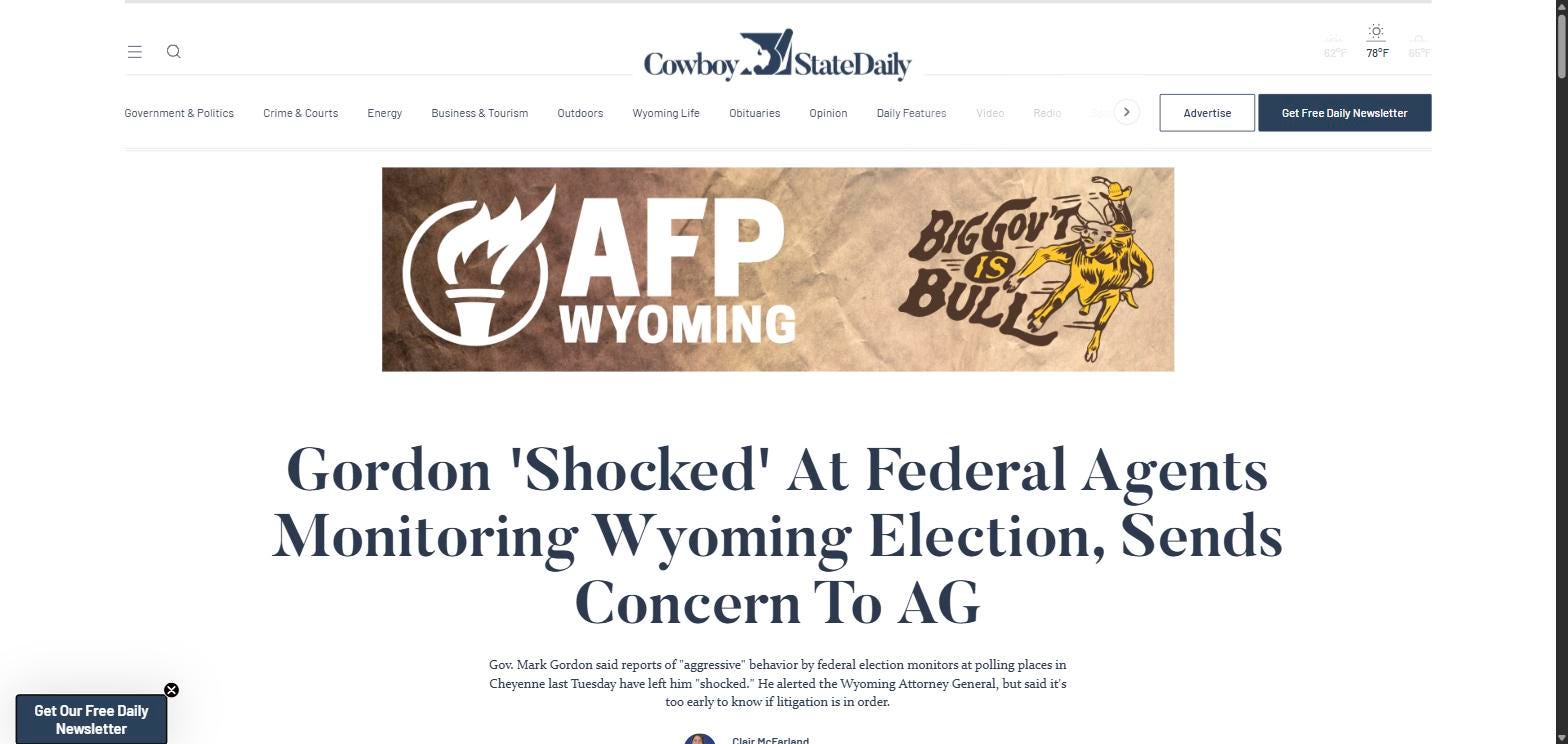
Her statement, verbatim, as reported by both outlets: “Wyoming law has no provision for election monitoring. This was a poorly managed exercise and one that showed complete disregard for our state laws and administration of our elections.”
Her specifics, sourced to the same articles:
The two officials did not offer their credentials until she requested them.
They asked to interview voters at polling stations. Wyoming law does not permit that. She refused.
They asked to examine tabulators. She refused.
They asked for poll-worker training guides and equipment-procurement records.
They visited six of seven Laramie County polling stations over the day.
Now hold two lines side by side.
Chuck Gray said Wyoming law “provides for observation of the election process.”
Debra Lee said Wyoming law “has no provision for election monitoring.”
Same room. Same election. One word doing two jobs.
That semantic slip is the entire story. The Secretary of State chose the softer word. The clerk who was at the door said the softer word does not describe what happened.
Watch words that do more than one job in the same room. They are almost always the mechanism. They drift.
Step 7. Look at what was next to it
The Aug 18 primary produced two events at the same time. Most national coverage reported the first. Some regional coverage reported the second. The two together are the story.
The first event: the DOJ deployed federal monitors to Laramie County under the language of “transparency, ballot security, and compliance with federal law.”
The second event: Wyoming Republican voters, in that same primary, wiped out the state legislative faction that had spent four years pushing local election restrictions.
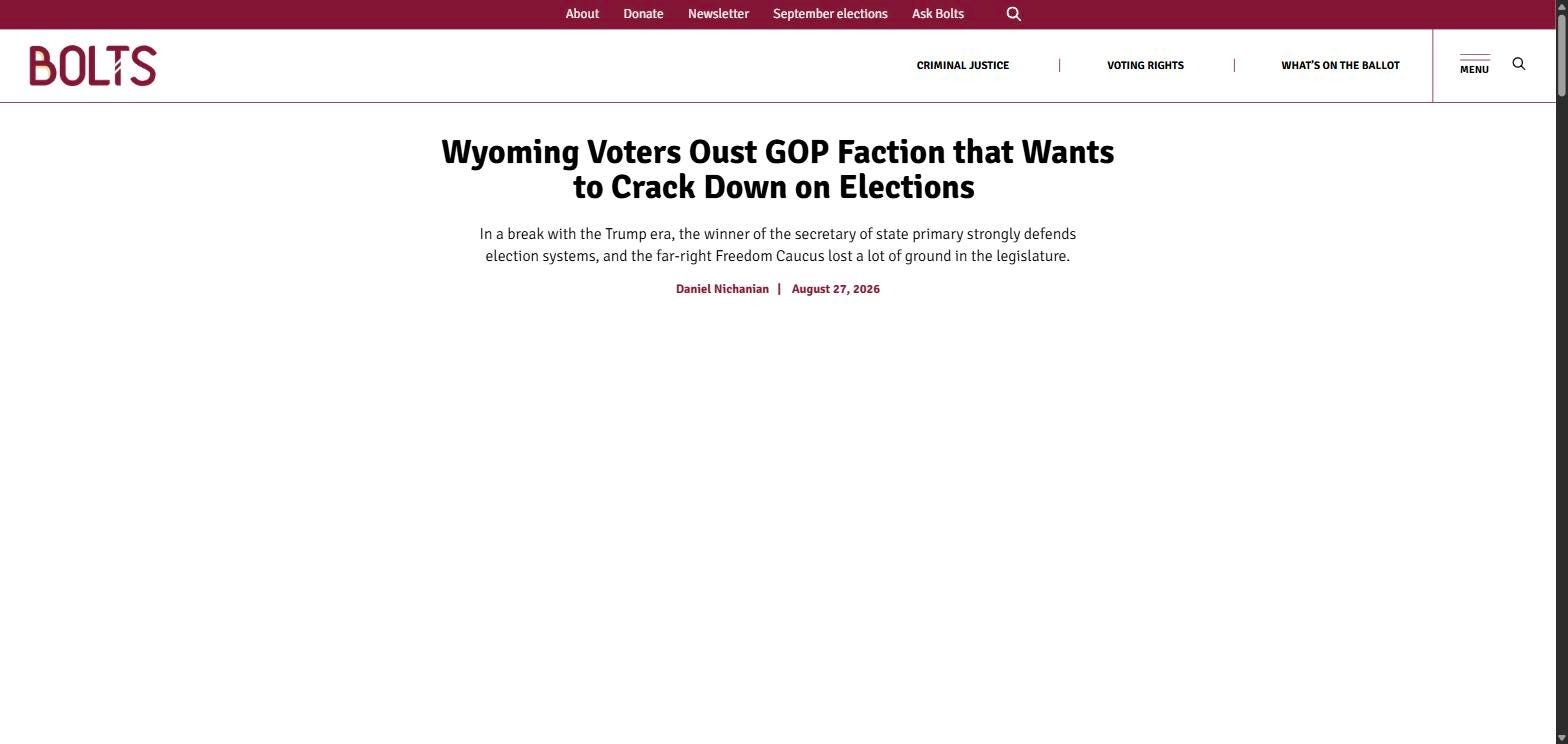
The numbers, from the Bolts reporting and confirmed by WyoFile’s Freedom Caucus recap and the Brownstein Hyatt Farber Schreck primary election recap:
Thirteen or more Wyoming Freedom Caucus House incumbents lost their primaries. Six caucus-aligned Senate candidates lost. The caucus went from House majority control (won in 2024) to roughly ten reliable House votes.
Rachel Rodriguez-Williams, the Freedom Caucus chair, lost the Secretary of State primary to Robert Short by thirteen points. Short’s on-record position: “We should not be making it harder for legitimate citizens to vote.”
Seven of the eight Republicans on the House Corporations, Elections, and Political Subdivisions Committee lost their primaries. That committee wrote Wyoming’s election-restriction legislation for four years.
Trump-endorsed gubernatorial candidate Megan Degenfelder lost the GOP primary to Eric Barlow.
Two verdicts on the same word, in the same election. The federal government said monitoring meant one thing. Wyoming voters, at the state level, said the local version of the same restriction apparatus meant something they had had enough of.
If you read only the Washington Post or NBC headline, you get half the story. Both halves need each other to explain why a Republican governor of the reddest state in the country used the word “aggressive” about a federal deployment from a Republican administration.
Step 8. Check whether the frame is predictable
Nine days before Governor Gordon spoke at the canvassing board, my Field Guide entry named the mechanism.
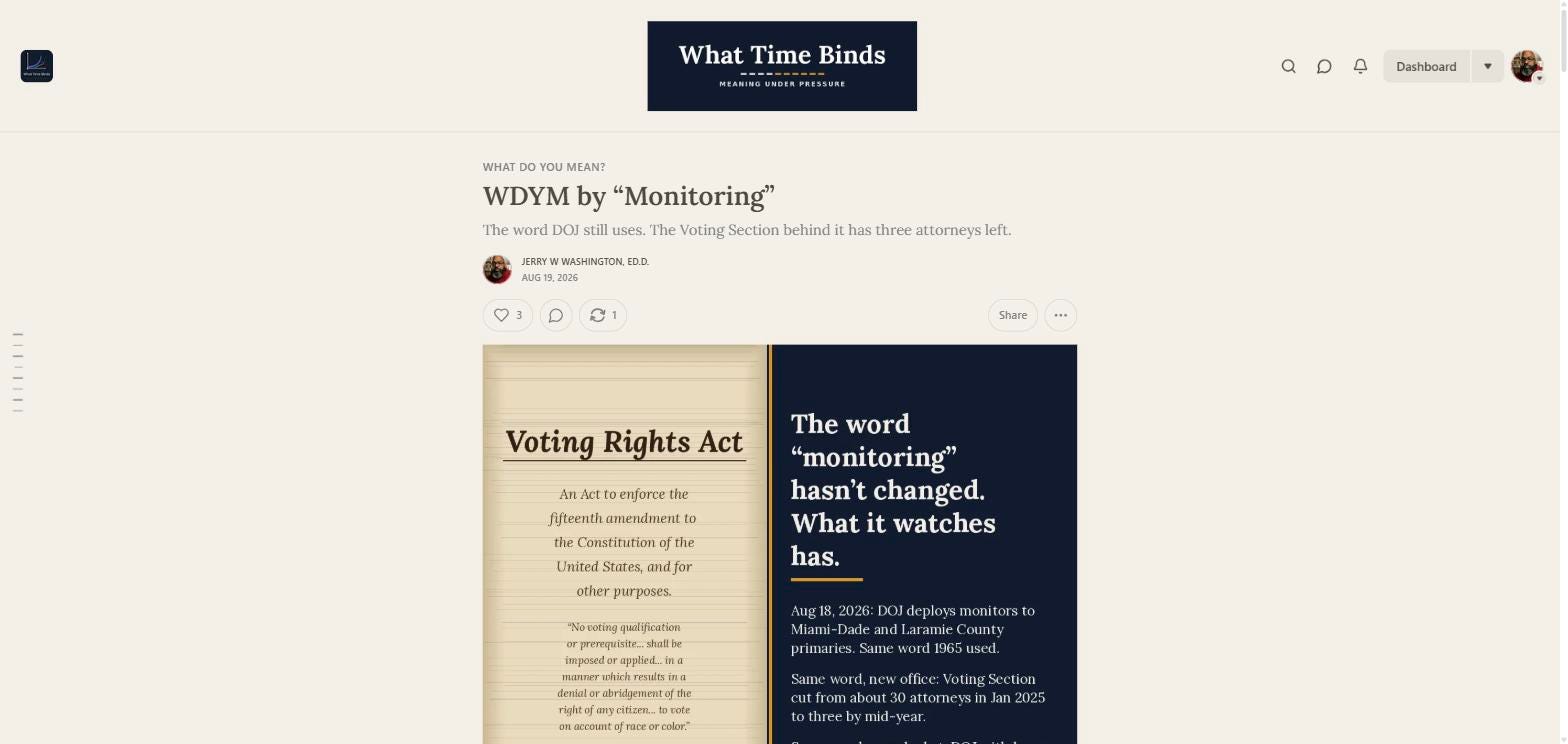
The entry laid out three questions to ask any institution announcing that it is “monitoring” something.
Show me the mission memorandum.
Where is the roster of people trained to it?
What action happens when the standard is violated?
Governor Gordon asked the first question at the canvassing board. He said the monitors’ conduct “exceeded what the authority that Congress had given them was” and asked the Wyoming Attorney General to look into the nature of the visits.
Clerk Debra Lee asked the second question at the door on primary morning. She said the monitors “did not offer their credentials until I requested they do so”.
The third question is the one no one at the DOJ has answered. The press release cited statutory authority. It did not cite a case. The Voting Section that historically brought those cases, as of watchdog estimates published earlier this year, has three attorneys left.
When my frame published on Aug 19 predicts what a Wyoming Governor says on Aug 26 to the letter, one of two things is true. Either the frame is right, or the mechanism is that visible. Both point to the same conclusion. The pattern is real. It has receipts now.
The Repair Protocol
Before you share the next headline, run these steps. Take three minutes. That is the whole cost.
Read the headline once. Do not read the article yet.
Open a new tab. Search the story by keyword. Look at the source list. Three independent local outlets with matching facts is news. One outlet with six rewrites is a game of telephone.
Find the event. Where did this happen? Who was in the room? Name the room and the date.
Find the document. Pull the press release. Pull the docket. Pull the transcript. Read the primary source yourself.
Note what the document does not say. Missing specifics are evidence. A statutory citation without a named allegation is telling you something.
Find the counter-witness. Who disagrees? What exactly do they claim? Log the narrowness or breadth of the defense.
Find the person at the door. Who was on the ground when the event happened? What did they say verbatim?
Watch the word. If the same word appears in two speakers’ mouths meaning two different things, that is the story.
Look at what was next to it. What else happened in the same room, the same day, that changes the meaning of the event you are studying?
Check whether the frame is predictable. Has someone named the pattern before? Does the current event fit? If yes, the pattern is real. Trust it enough to check the next one against it.
A Field Card for the next headline
Cut and save these three prompts. Run them at the kitchen table before you share anything.
What is the room? Name where the event happened, who was in it, and when.
What is the document? Find the primary source under the reporting and read it yourself.
What word is doing more than one job? If a single word appears with two different meanings in the same story, that is the mechanism.
The Governor of Wyoming asked federal officials for their mission. The Clerk of Laramie County asked federal officials for their credentials. Neither of them read a field guide before they spoke. They asked because the moment required it.
The moment is arriving in more counties, on more days, with fewer people trained to ask.
What are you going to check before you share the next post?
Sources
Primary documents:
U.S. Department of Justice, Office of Public Affairs, Press Release 26-939, “Justice Department to Conduct Election Monitoring in Florida and Wyoming Primary Elections,” Aug 18, 2026: https://www.justice.gov/opa/pr/justice-department-conduct-election-monitoring-florida-and-wyoming-primary-elections
Local reporting from the Wyoming State Canvassing Board, Aug 26, 2026:
WyoFile, Maggie Mullen, “Gov. Gordon concerned by ‘aggressive’ DOJ election observers during Wyoming’s primary election”: https://wyofile.com/gov-gordon-concerned-by-aggressive-doj-election-observers-during-wyomings-primary-election/
Cowboy State Daily, Clair McFarland, “Gordon ‘Shocked’ At Federal Agents Monitoring Wyoming Election, Sends Concern To AG”: https://cowboystatedaily.com/2026/08/27/gordon-shocked-at-federal-agents-monitoring-wyoming-election-sends-concern-to-ag/
Wyoming Public Media, Jordan Uplinger, “Gray says election was successful, Gordon asks about DOJ presence at Laramie County”: https://www.wyomingpublicmedia.org/politics-government/2026-08-28/gray-says-election-was-successful-gordon-asks-about-doj-presence-at-laramie-county
National wire coverage, Aug 28, 2026:
Washington Post: https://www.washingtonpost.com/politics/2026/08/28/wyoming-governor-decries-aggressive-behavior-federal-election-monitors/
AP wire via ClickOnDetroit: https://www.clickondetroit.com/news/politics/2026/08/28/wyoming-governor-requests-investigation-into-activity-of-justice-department-monitors-during-primary/
Wyoming primary results and Freedom Caucus context:
Bolts, Daniel Nichanian, “Wyoming Voters Oust GOP Faction that Wants to Crack Down on Elections,” Aug 27, 2026: https://boltsmag.org/wyoming-gop-primary-secretary-of-state-freedom-caucus/
Companion piece:
What Time Binds, “WDYM by ‘Monitoring,’” Aug 19, 2026: https://www.what-time-binds.com/p/wdym-by-monitoring
Author’s Note
Jamelle Bouie’s Aug 29 video reads the administration’s mail-ballot and monitor push as a conspiracy against the Constitution. His phrase for the mechanism: chaos as the point, not the byproduct. The Wyoming episode is a receipt for that reading.
The question I keep coming back to. Why deploy to the reddest state in the country? If the mission were fraud prevention, the deployment goes where fraud allegations are strongest. Wyoming has none. Trump carried it by forty-six points. The county clerks who stood at the door, the Republican Governor who called the visit “aggressive,” the Republican Secretary of State who softened the word to “observation” — these are the administration’s base.
If the point were enforcement, you would pick fights you could win. If the point is chaos, you pick fights everywhere. Even where you already own the room. Especially there. The message the deployment carries is that no polling station is out of reach, no clerk is safe from a visit, no state is too red for a federal officer at the door.
The three-question test in this essay works because chaos survives it badly. When a reader asks for the mission memorandum, the roster, and the last case, the chaos operation has no answer. That is why the questions matter.
Bouie’s video is worth your seven minutes.
This is a Field Guide entry paired with the Aug 19 WDYM by “Monitoring” essay. The frame there names the mechanism. This one shows how to check any headline against the mechanism. Together they are the same argument, told once for the reader who wants the theory and once for the reader who wants the practice.