

Correction, Sept. 28, 2026: Chapter 1 of Ask for the Page retells this story from the record and fixes several facts in this essay. I called the January 2025 guidance a memorandum. It ran as a news release. The accounts of why the branches stayed away differ, and the chapter credits each one to its source. The Army’s birthday that June was its 251st. No source gives a jet count for the flyover. About 1,200 seats were reserved for troops, and no count shows how many came. The women’s memorial has no wall of names, and I have no source for the line about who came there year after year. Read the corrected account: “Chapter 1: Two Levels.”
This is the first of three essays. Last Monday’s piece installed a directional vocabulary in the boardroom around the word “aligned.” Two pulls. Upward in English toward false specificity. Downward in Japanese toward leveling. Same end state, opposite vectors. These three pieces take that vocabulary out of the boardroom and into civic life. Today: how a Pentagon directive ended a 27-year wreath-laying for women veterans while the same Pentagon spent the same week celebrating something else. Next Monday: why the people who showed up year after year could not turn the room around. The Monday after that: where the work of repair actually belongs.
June 10, 2026
The Women in Military Service for America Memorial sits at the entrance to Arlington National Cemetery. For 28 years, the Bipartisan Women’s Caucus held a wreath-laying there ahead of Women Veterans Recognition Day on June 12. The Caucus invites all six service branches. The branches send representatives. The wreath gets laid. Photographs are taken. The ceremony is short. Veterans, family members, and members of Congress travel from across the country to attend.
The 2026 ceremony was canceled.
The Air Force, Navy, and Space Force declined to send representatives, citing Executive Order 14185 and a Pentagon memorandum titled “Identity Months Dead at DoD.” The Army cited a scheduling conflict with its own 250th birthday. A defense official told Task & Purpose that the Marines had planned to attend. Five of six branches out. The ceremony does not happen without service representation. It did not happen.
The “Identity Months Dead at DoD” memorandum bars events related to “cultural awareness months.” The same document instructs the services to “celebrate the valor and success of military heroes of all races, genders, and backgrounds.” A wreath-laying for women veterans is not a cultural awareness month. It is a commemoration of service rendered. Two Marines who served in Vietnam are on the Memorial’s wall. Twenty-six women who died in Iraq and Afghanistan are on the wall. The wreath honored their service. The directive’s own text said the branches should honor that service.
The branches read the prohibition broadly and the encouragement narrowly.
Four days later, on June 14, the same Pentagon sent the Marine Band, a twelve-jet flyover by the Thunderbirds and Blue Angels, and roughly 1,200 active-duty troops to the White House South Lawn for UFC Freedom 250 on the president’s 80th birthday. Medal of Honor recipients escorted fighters to the octagon. The same week.
The Pentagon was not out of musicians. The Pentagon was not out of pilots, troops, or wreaths. The directive’s intent, taken at its word, was honored on June 14. The directive’s intent, taken at its word, was also available on June 10. Two days, two readings, one document.
The gap between what the directive said and what the directive did is the subject of this essay.
What Hayakawa Said in 1953
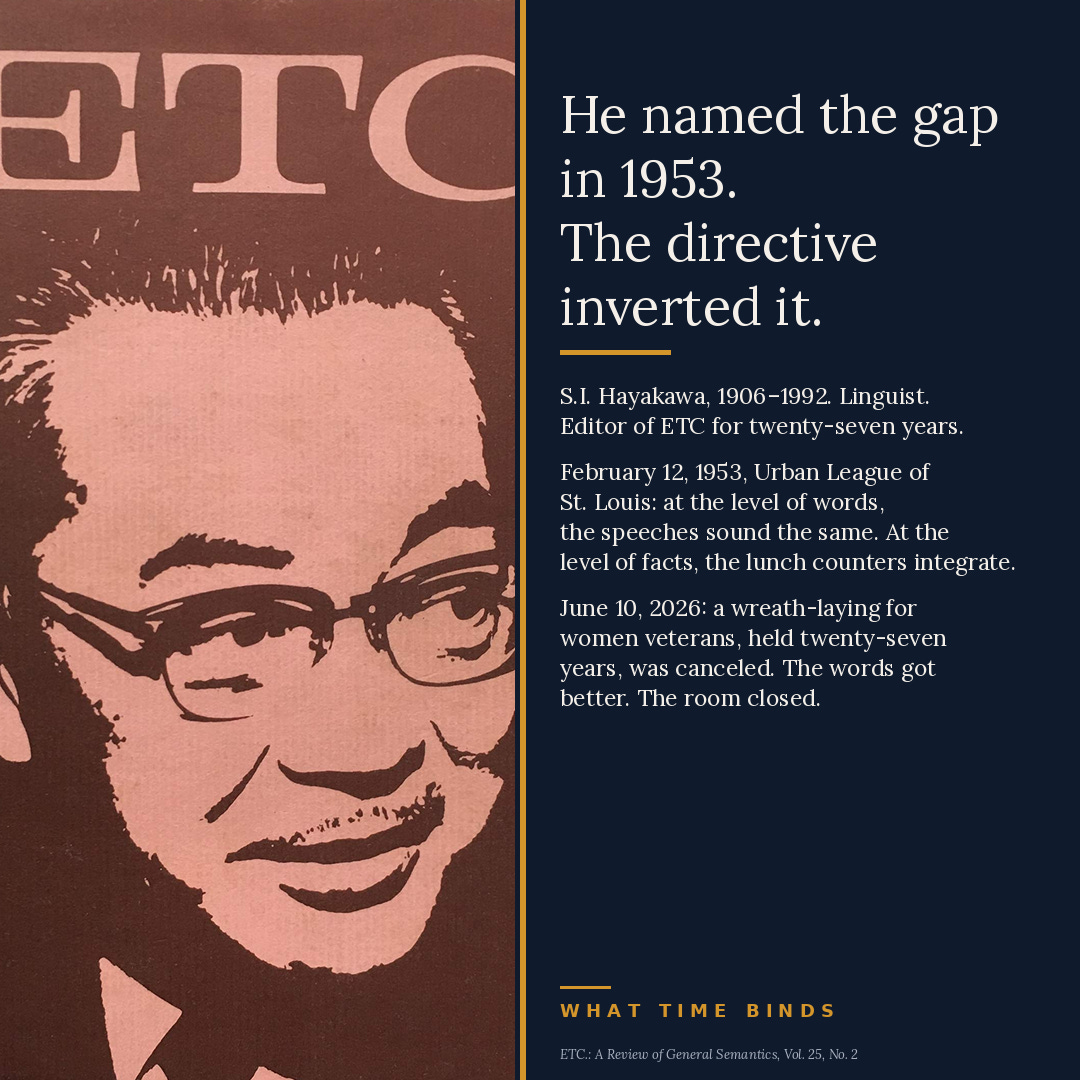
On Lincoln’s birthday, February 12, 1953, S.I. Hayakawa stood at the annual dinner of the Urban League of St. Louis and made a distinction. He said that race relations in the United States had to be read on two registers, and that mixing them produced misdiagnosis.
At the level of words, the speeches in 1953 sounded the way they had sounded for twenty years. Southern reactionaries gave the same speeches defending the practices they wanted preserved. The NAACP gave the same speeches about how much farther there was to go. The press gave the same editorials. Nothing in the verbal register seemed to be changing.
At the level of facts, things were different.
Hayakawa pointed at lunch counters and cafeterias. Twenty years prior, those rooms had been segregated. By 1953, in factories, schools, and along rail lines, integration was happening daily. Ordinary people of both races were eating in the same rooms without incident. None of it made the papers. His point was a journalistic one: the car crash gets covered; the thousands of safe arrivals do not. The integration was real, and the integration was invisible.
This was his thesis. The level of facts was running ahead of the level of words. The integration he saw at the lunch counters was the actual story. The speeches would catch up.
He went further. He argued that the prejudiced white people of 1953 were, on the whole, defensive about their prejudices because the force of official opinion had turned against them. The kind of person who once asserted racial hierarchy with the casual confidence of being on the winning side was getting scarce. The well-meaning white people who said clumsy things, the ones who used phrases like “your people” with no awareness of how the phrase landed, deserved, in Hayakawa’s grading, a “C-minus for effort.” They were, by his diagnosis, ignorant on the subject. But they were trying.
That grade was the operational hinge of his essay. If most white people were either defensive or clumsy-but-trying, then the level of facts could keep running ahead of the level of words, and Black Americans could stop expending emotional energy on what white people said and start preparing for the integrated America the lunch counters were already building.
In 1953, the diagnosis held. In 2026, it runs in the other direction.
The Inversion
Seventy-three years after Hayakawa spoke at the Urban League dinner, the level of words is in better shape than at any point in American history.
The presidential proclamations name all heroes of all races, genders, and backgrounds. The Pentagon memorandum that closed the wreath-laying ended its own text with language affirming the service of those it then declined to honor. Federal contracts include equal opportunity language. Annual reports of every major institution include sections on diversity, inclusion, equity, belonging, fairness, merit, and equal access. Press secretaries, communications officers, and human resource departments speak fluently in the vocabulary of equality. The speeches that Hayakawa called unchanged in 1953 have, at the level of words, changed completely.
The level of facts has changed in the opposite direction.
The wreath-laying did not happen. The Bipartisan Women’s Caucus could not get five of six services to send a representative to a ceremony that had been held without incident for 27 years. The same week, 1,200 troops appeared at a fight. In the months around the cancellation, senior officers’ promotions were being slow-walked. Books were being removed from service academy libraries. Portraits were being taken off Pentagon walls. Title VI enforcement at the Department of Education was being scaled back. Federal agencies were shedding personnel at rates that produced disparate impact at every measurable threshold. None of these things, taken in isolation, made the speeches sound different. Each of them, taken together, produced a wider and steadier erosion of the conditions the speeches claimed.
The speeches pull up, and the conditions pull down. The directional vocabulary from last week’s essay sits underneath this argument. In a boardroom, “aligned” pulls up toward false specificity at the C-suite while the operational consequence pulls down through the org. In civic life, “equality” pulls up at the institutional ceiling while cancellation, removal, and prohibition pull down at the operational floor. Same mechanism. Different place.
The two vectors do not converge because they are not designed to converge. The directive can affirm the value of the service while the agencies that execute the directive read its prohibitions broadly and its affirmations narrowly. The presidential proclamation can name all heroes while the Pentagon declines to send representatives to honor a particular set of them. The annual report can describe an inclusive workplace while the hiring algorithm filters out applicants whose names index toward groups the algorithm has learned to deprioritize. The level of words and the level of facts are not catching up to each other in 2026. They are pulling away from each other. Faster and faster.
Hayakawa’s optimism was anchored in the assumption that the two registers were on the same trajectory and that words lagged facts. In 2026, the words lead the facts. The lag has reversed direction. It has placed us in a post-truth world.
Why the Inversion Sticks
A diagnosis that has reversed direction is not, by itself, a diagnosis that will correct. The wreath-laying did not happen. The wreath-laying probably will not happen next year either. There are five mechanisms keeping the inversion in place.
The first is the false confidence that comes from getting away with the original drift. The five services that declined the wreath-laying in 2026 will face no internal consequence for declining. The directive was read broadly, and the room closed; no one in the agencies that produced that reading paid a professional cost. The 28th year did not happen. The 29th will look at the 28th and conclude that the new reading is the operative one. Drift gets read as policy.
The second is sunk cost. Once the ceremony has been canceled, defending the cancellation costs less than reversing it. Reversal requires officials to say that the prior reading was wrong, which requires them to bear the standing cost of an error that was made under their watch. Defense requires only that they restate the original reading. The math of the institution favors defense.
The third is method-as-identity. The officials who issued the directive and the officials who read it broadly cannot now say it was misapplied without saying that they misread it. Saying that means saying they were the wrong people to make the reading. Most officials, most of the time, prefer to be the right people for the readings they have already made. The reading becomes an identity claim. Reversing the reading becomes an identity threat.
The fourth is social pressure that reads anyone who brings up the cancellation as the problem rather than the symptom. The dominant social phrase here is some version of “I do not need to know.” I have seen that phrase used seven times in one Facebook thread by one commenter explaining why he would not engage with documented facts about the wreath-laying. The phrase functions to relocate the problem from the institution that closed the room to the person who pointed at the closed room. When enough people say “I do not need to know,” the people who know are isolated, and the silence becomes its own form of policy.
The fifth is peer justification. Each agency that declined the wreath-laying could point to the others’ decisions as cover. The Air Force pointed at the memorandum. The Navy pointed at the Air Force. The Space Force pointed at both. The Army cited a scheduling conflict, which is not a reading of the memorandum at all, but which had the same effect. None of the five had to defend the decision alone. The decision was made in parallel, by reference, and the institution distributed responsibility until no agency carried the weight of it.
Five mechanisms, each ordinary, none unusual. Together they harden a single reading of a single document into a precedent that will outlast its authors. The next directive will not have to be as strict, because the first reading taught everyone how to read.
The Category Hayakawa Missed
Hayakawa wrote in 1953 that the prejudiced white people of his moment were mostly defensive holdovers or ignorant-but-trying clumsy people. He gave the second group a C-minus for effort. He did not name a third category.
The third category is the people who use the language of equality to do unequal work.
These are not the holdovers. The holdovers tend to be old, and they tend to know they are out of step. They reach for the older vocabulary, the slurs, and the unalterable traditions, and they sound like 1953 in 2026. They are not who closed the wreath-laying.
These are not the clumsy. The clumsy say the wrong thing because they do not know the right thing. They mean well. They get a C-minus for effort. They are not who closed the wreath-laying either.
The people who closed the wreath-laying speak fluently. They use the vocabulary of equality, merit, neutrality, and consistent enforcement. They read the directive’s prohibition broadly and its encouragement narrowly. They do not call women veterans names. They use the word “all” in their press releases. They cite the rule. They follow the rule. The rule, as they read it, closes the door.
This is the category Hayakawa missed because it could not exist in 1953 in the form it takes in 2026. In 1953, the language of equality had not yet been written into the official documents of the institutions. There was no national language of color-blindness for the holdovers to use as cover. There were only the old slurs and the new claims, and the slurs were losing.
By 2026, the language of equality had been written into the official documents of every major American institution for sixty years. That language is now available as a tool. People who want to close doors can do so while citing the language. The language does the cover work that the slurs used to do.
To be clear about the scale: this is some white people, not all white people. The framing matters. “Some, not all” names a behavior pattern, not an identity. Most white Americans are not in this category. Most white veterans were appalled by the cancellation of the wreath-laying. Most white women in the Bipartisan Women’s Caucus’s mailing list signed the open letters. The category I am naming is small enough to fit in a few agencies and large enough to close a room that 27 years of practice had kept open.
Hayakawa’s C-minus for effort assumed that the white people getting graded were trying. The C-minus is the right grade for someone who is trying. The third category is not trying to honor service while writing in the wrong vocabulary. The third category is using the right vocabulary to decline to honor service. The same grade does not apply to the same effort because the effort is different.
The Grading Scale
Hayakawa’s grading scale was operational, and not only rhetorical. He used it to allocate emotional energy. If most white Americans were defensive holdovers or clumsy-but-trying, then Black Americans could afford to be patient. The work of correction was happening at the level of facts. Words would catch up.
In 2026, the grading scale needs to update.
The defensive holdovers are still around, and they still get a grade that recognizes their resistance is dying. The clumsy-but-trying are still around, and they still get a C-minus for effort. Both categories deserve roughly what Hayakawa gave them.
The third category needs a different grade. The work the third category is doing is not failed reaching for the right vocabulary. It is successful use of the right vocabulary for the wrong purpose. The grade for that work has to recognize the gap between the language used and the result produced. There is no curve for fluency in the wrong direction.
What this changes, operationally, is the question of where the emotional energy goes. Hayakawa told Black Americans to forget being Negro and concentrate on biochemistry, P.T.A. problems, or stamp-collecting. The lunch counters were integrating; the speeches would follow. Forgetting was the right allocation in 1953 because the level of facts was running ahead.
In 2026, the level of facts is running behind. Forgetting allocates emotional energy in the direction the inversion wants. The third category benefits from being forgotten. The third category benefits from the people who notice the closed room being told that the closed room is not the point, that the language is fine, that the directive said all heroes.
The 2026 allocation is the inverse of the 1953 allocation. Hayakawa told his audience to forget. The 2026 essay tells its audience to log it and remember.
What that looks like is the subject of Part 3.
What Part 2 Will Do
Part 1 named the inversion. The level of words has improved. The level of facts has eroded. The two are not catching up to each other because they are not pulling in the same direction.
Part 2 next Monday takes apart the mechanism that makes the inversion run. Hayakawa believed the self-fulfilling prophecy was symmetric. A Black American who expected fairness could, on average, produce fairness in the encounter; a white American who expected trouble could, on average, produce trouble. He believed the power to determine the atmosphere of the meeting lay with the person in the meeting.
The Black women veterans who came to the Memorial year after year for 27 years did everything Hayakawa prescribed. They expected the 28th year to look like the 27 before it. They had a track record. They had institutional standing. The door closed anyway.
Part 2 takes apart why the symmetric prophecy is not symmetric, where the asymmetry runs, and what it means for the question of who is responsible for the atmosphere of an encounter when the encounter is built into a building.
A Word on the Maxim
The thread that closed the wreath-laying produced a phrase, repeated seven times in one Facebook thread by one commenter, that has become part of my vocabulary. The phrase is “I do not need to know.” He used it to refuse the documentation of the cancellation, the testimony of the witnesses, the timeline of the directive, the contents of the memorandum, the photographs of the empty space at the Memorial, and the records of the 27 prior ceremonies.
I wrote a maxim against that refusal. The maxim arranges three claims in a sequence. The order matters.
You refuse to know. The record remembers. I refuse to forget.
The first claim names the refusal that closed the room. The second names the documentation that the refusal cannot reach. The third names the work of the witness. The middle claim is load-bearing because the record carries what neither the refuser nor the witness, on their own, can carry. The record persists across the inversion. The record is where the level of words and the level of facts converge again, at the end.
Part 3 will return to the record.
Jerry W. Washington, Ed.D., is a Marine combat engineer veteran, independent researcher, and instructor at UCI Division of Continuing Education. He writes What Time Binds on Substack.
If this essay gave you the diagnosis, please share it with one person who needs to read the second part next week.
Sources
Hayakawa, S.I. (1953). The Semantics of Being Negro. Address to the Urban League of St. Louis, February 12, 1953. ETC.: A Review of General Semantics, Vol. X, No. 3 (Spring 1953), 163–175.
Bipartisan Women’s Caucus (2026). Open letter regarding the cancellation of the 2026 Women Veterans Recognition Day wreath-laying ceremony.
Task & Purpose (June 2026). Reporting on the cancellation of the Women Veterans Recognition Day wreath-laying ceremony.
Executive Order 14185.
Department of Defense (2025). “Identity Months Dead at DoD” memorandum.
Washington, J.W. (June 22, 2026). Every Tuesday at 2 PM: Why “aligned” splinters on the way down through the org, and the practice that puts it back together. What Time Binds.
Washington, J.W. (June 10, 2026). What Do You Mean? “Aligned”. What Time Binds.
A clean, high-sounding justification is very convenient for the side using it. When a noble cause is attached, it's the person who pushes back who ends up at a disadvantage — they come out looking like they defied a fine-sounding word, so the side using it can press it even harder.
In Japan I've seen a related thing: a word itself gets worn out and dirtied, and then even the character of the person who says it falls under suspicion. Ask someone "are you happy right now?" and you risk being taken for some shady solicitation — because that exact phrasing has been worn out by people pushing things on others. It was a perfectly ordinary question to begin with, but the word wore out.
There's also a phrase here, "it's not discrimination, it's distinction." My sense is this took hold partly because in Japan the word "discrimination" itself carries a lighter weight than it might elsewhere. I find myself wondering, vaguely, whether something like it could eventually surface in places where words are treated with more weight, too.