

Ten of thirteen executives say they are “very clear” or “clear” on what the company will look like after the change. Eight of thirteen say the leadership team is “aligned.” Then the consultants ask each executive to write the specific ways the new company will be different.
Three of the written answers describe three different companies.
One executive writes: the system will be larger and more complex, but operations processes will be very similar to present. Another writes: the change is mostly about standing and competing alone without a parent corporation in charge. A third writes: there will be new assets, new markets, different cost structure, new people, and new leaders.
Same CEO. Same change program. Three companies on paper.
That scene comes from “The False Alignment Trap,” a piece by Julia Dhar, Kristy Ellmer, and Philip Jameson in the July–August 2026 issue of Harvard Business Review. The reporting is sharp. The word doing the damage is aligned.
Background on the Piece
Dhar leads BCG’s People and Organization Practice in North America. Ellmer leads BCG Transform. Jameson is an associate director at the firm. The article previews a forthcoming book, How Change Really Works, from HBR Press in 2026. The central claim is that most organizational change efforts fail. Historically, 50 to 70 percent of them have, and that figure has not improved in three decades. The failures often trace to executive teams behaving as if they agree on the change when they do not.
I have been holding this piece since it ran in May. Sent it to my co-researcher, Jovanny Suriel, Ed. D., the same week. Both of us considered its points carefully, came back to it twice, talked it through. It is the kind of HBR article that gets the diagnosis right, and the work behind it is serious. Coordination failure under pressure is a problem more researchers are naming directly now. That is good news for the field. It is also good news for the people inside the meetings where the failure happens. The diagnosis is the easy part.
Stay with this entry through to the end. There is a Monday WTB essay coming on June 15. The close tells you what it will do and why today’s field guide is the setup for it.
Why “Aligned” is a Magnet Word
“Aligned” sounds like a status report. It feels descriptive. It functions as a placeholder.
From the archive: Pinned Terms Ep. 001, “Aligned?” (February 19, 2026)
The three-panel version of today’s field guide. Malik wants to ship the first strip. Juno asks “aligned on what exactly — tone, topic, audience?” Lila names it as a magnet word that pulls five meanings at once. The whiteboard ends with three lines: same goal, same meaning for key words, next step with owner and due date.
Pinned Terms — Ep. 001: "ALIGNED"

“Aligned” is a magnet word. People nod while hearing different contracts: goal, scope, definitions, next step, and permission. The fix is simple: pin the term to one meaning in this room, then log it so future-us inherits the map.
People use the word aligned to end meetings the same way they use it to start change programs. It signals that no further conversation is required. The signal is false more often than it is true.
Dhar and her co-authors put it plainly:
When leaders say “we are aligned,” what they usually mean is “we are not in one another’s way.” Sometimes they mean “we have discussed this topic at least once and generally accept the contours of a plan.” Those meanings sound exactly like a third meaning — “we have agreed on the specifics, the owners, and the timeline” — that very few teams have actually reached.
That is the magnet. The same word pulls four different agreements into the same sentence, and unless you are aware and have the tools to check, the drift happens.
What People Actually Mean When They Say “Aligned”
Here are the meanings the word collects.
1. Out-of-the-way alignment. “We are not blocking each other.” Lowest bar. Often reached just by avoiding open conflict in the room.
2. Discussed-once alignment. “We talked about it. The contours look okay.” No specific commitments. No trade-offs named. No owners assigned.
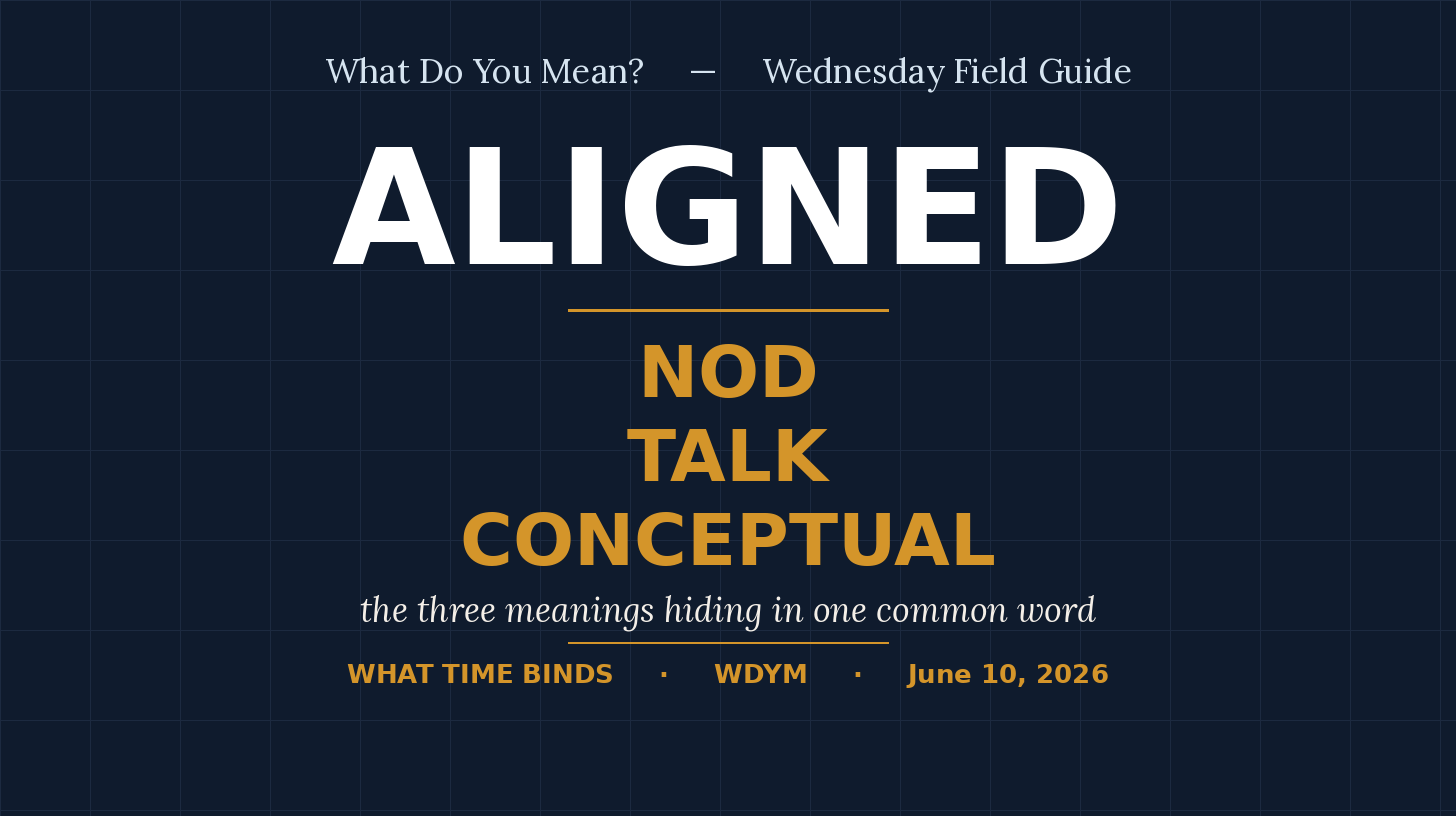
3. Conceptual alignment. This was the COO’s word in the HBR piece. One executive said “I agree with the first proposal but not aligned with the second.” A second said “I am aligned.” A third said “I am partly aligned.” The COO closed the meeting with “I think it is clear that we are conceptually aligned.” Nobody was. Nobody said so.
4. Specific alignment. “We agree on the decision, the trade-offs, the owners, and the timeline. We can each write the same four sentences without checking with each other first.”
The first three meanings sound like the fourth. They are not the fourth.
The Failure Mode
When the four meanings collide, each leader walks back to their team with a different operational version of the same word. The change program splinters by Friday. Each business unit pursues a slightly different version of the same transformation, all under the same banner. More drift.
Dhar and her co-authors describe three downstream patterns: paralysis (lots of talk, no action), hyperactivity (lots of action on the wrong things), and tunnel vision (steady progress on a narrow read of the goal). All three share one upstream cause. The word “aligned” ended a meeting before the agreement had been pinned.
Pin It
In this room, aligned means we have each written down the specific decision, the named owner, and the deadline — and we can each produce the same four sentences without consulting each other. (Think about a more detailed RACI diagram).
Includes:
A specific commitment with a verb and a date.
A named owner for each piece.
A written trade-off (what we are not doing as a consequence of doing this).
A scheduled date to revisit.
Excludes:
“Conceptually aligned.”
“I think we’re speaking the same language.”
“I’m on board with the spirit of this.”
A head-nod followed by silence.
Boundary Test: Pandora
Alexander Lacik, the CEO who led Pandora from 2019 to 2025, ran the test in his first weeks on the job. The management team had forty-six priorities. Lacik took the team off-site for two days and said the group would not leave until twelve priorities remained. The owner of each priority defended it in front of the room. The team voted.
Another executive team in the HBR piece took a different route. Anyone who said the word “aligned” in a meeting paid five dollars. The fines funded a celebration when the team hit a specific goal.
That is what teams do when they have figured out that “aligned” lies until proven otherwise.
One-Minute Script (Use Monday)
Before any meeting closes on “we’re aligned,” ask four questions out loud:
“What specifically did each of us just agree to do?”
“What does done look like, and by when?”
“Who owns each piece?”
“What are we not doing as a consequence?”
Write the four sentences. Get them visible to everyone in the room before the meeting ends. If the sentences cannot be written, the word does not apply.
Log It
Open a definition and decision log. Date it. Write one line:
“In this room, today, ‘aligned’ means a written decision, an owner, a deadline, and a named trade-off. We will revisit on [date].”
Sign it. Send it. The log is what future-us inherits when this week’s meeting becomes next quarter’s blame conversation.
Carry It Into Your Week
One rule: no meeting closes on “aligned” until four sentences are written and visible.
If the team cannot produce the sentences, the team is not aligned. They have discussed the topic. That is a different thing, and it deserves a different word.
On Monday, June 15, the WTB essay picks up where this entry leaves off. The HBR piece names the symptom: leaders behaving as if they agree when they do not. It does not say what happens to meaning below the C-suite after the CEO broadcasts the slogan and the change program moves into the org. That is where the harder work lives.
Monday’s piece treats meaning repair as installed practice across the org. The HBR five-step process happens once, at the top, during a transformation. Installed practice happens every Tuesday afternoon at 2 PM, in every meeting where someone says “we’re aligned” and everyone stops to truly get aligned.
If today’s field guide gives you the practice for the next meeting, Monday’s gives you the architecture for the year. Please share and follow!
Thanks for reading What Time Binds. Subscribe for free to receive new posts.
Jerry W. Washington, Ed.D., is a Marine combat engineer veteran, independent researcher, and instructor at UCI Division of Continuing Education. He writes What Time Binds on Substack.
Great Essay, I saw this repeatedly in several companies I worked for during my career, stunting growth in all of them. Each Department in a company defines these words and meanings differently but nobody knows it until it is too late and the project or the product fails.
Wish I knew this 35 years ago, would have saved me a lot of grief. Thanks for sharing!
I enjoyed this breakdown of "aligned."
In Japanese there's a phrase that gathers several meanings the same way, but I suspect it pulls them in the opposite direction. Your four senses of "aligned," different as they are, all point upward, toward specific agreement. This one — ashinami o soroeru, "to fall into step" — leans the other way, toward leveling down. It carries a pull to hold back whoever is faster or further ahead and bring them to the lower line. The nail that sticks up gets hammered down, as the saying goes. And even when there's no substance behind it, simply seeming to face the same direction is enough to let people say the footsteps are in step.
That said, what I've watched has mostly been the layers below the executive level, so there's little I can say about the C-suite itself.