



Before anyone breaks ground, somebody should walk the site. Somebody should pull the soil data. Somebody should mark the lane with tape and stakes. Like the Marines do to ensure the Marines behind them know where the safe ground ends. When Marines reduced an obstacle, we logged the width, the composition, the time on task, and what we would do differently. That record goes up the chain. It comes back down to other units.
Twenty-three years, MOS 1371. Digging was a documented activity.
That is why this meme has always sat wrong with me.
You have seen it. A cross-section of the earth, two tunnels stacked one above the other. Bottom tunnel: a man walking away, pick over his shoulder, a few feet of rock between him and a wall of diamonds. Top tunnel: a man still swinging, about to break through. Caption across the top: “You never know how close you are.” Caption across the bottom: “So Never give up on your dreams!”
It circulates in veteran transition groups. Sales managers post it on Mondays. It shows up the week after a layoff, usually from someone who is still on the job.
The picture blames a man for a failure of information.
Both diggers are equally blind. Neither one has a survey, a light, a map, or a single chalk mark from anyone who worked that ground before him. One hits diamonds. The meme reads that outcome backward into his character, and reads the other man’s outcome backward into his.
Now look at the two tunnels again. They run parallel. Four feet of dirt between them. They are close enough to hear each other’s picks. Neither one talks to the other.
How the word drifts
“Persistence” carries at least three meanings, and they collide under pressure.
The first is staying with a hard task past the point where it stops feeling good. The second is continuing on a chosen course regardless of new information. The third is the label we hang on whoever happened to win.
The third meaning wins every argument, because it is the only one you can score after the fact. Nobody can measure how much discomfort a person absorbed. Nobody audits whether they revised their method. Anyone can check whether they got the diamonds. So the word quietly becomes a synonym for outcome, and it starts doing work I do not think it was ever built to do.
That is how a motivational poster turns into a performance review.
Wald counted the wrong planes
In 1943, Abraham Wald wrote a series of memoranda for the Statistical Research Group at Columbia, later collected as “A Method of Estimating Plane Vulnerability Based on Damage of Survivors.” The military had damage surveys of aircraft that came back. Wald’s problem was that the surveys described a filtered population. Every plane in the sample had survived the hits recorded on it.
His method estimated, from that filtered data, the probability that a plane hit in a given area was lost. The sections showing little damage among survivors were the sections where damage killed you. The evidence for the most dangerous hits sat in the planes that never landed. (The full method is reconstructed in Mangel and Samaniego, Journal of the American Statistical Association 79:386, 1984.)
This meme counts returning planes. The man who turned back is the aircraft that never came home, and the entire lesson is drawn from the one that did.
A second problem sits underneath the first. The prize is a fixed seam. Whoever arrives first takes it. Two men race for a finite thing, and we caption that as inspiration for our children.
Ask what those diggers are actually short on. They have resolve in surplus. What they lack is distance data, and distance data gets cheaper every time another person digs and writes down what they found.
The pin
Magnet word: persistence.
Failure mode: outcome-scored persistence. The word gets assigned after the result is known, which converts luck into virtue and stopping into a character defect.
Pin it here: persistence is continuing to work a problem while continuing to gather information about it.
Includes: staying past the point of discomfort. Changing method while holding the goal. Asking someone who has dug nearby. Recording distance, conditions, and what failed.
Excludes: continuing without new information. Refusing to record what you find. Digging where nobody can reach you. Calling a stop a defect.
Example: a sergeant runs the same breach three times, times each attempt, shifts the charge placement on the third, and writes the result in the after-action so the next unit inherits it.
Non-example: a man swings a pick in the dark for eleven months, tells nobody his position, and is later called a hero or a quitter depending on what happened to be behind the wall.
Two objections
“It’s a meme. Lighten up.”
Memes are how most people receive their operating instructions about effort. The one that circulates is the one that gets used, and this one gets used against people. It appears when a woman leaves a job that is making her sick. It appears when a veteran stops applying to a field that will not hire him and starts applying somewhere else. In those rooms the picture is a club.
“Some work really is solitary.”
True. A dissertation is solitary. So is grief. The log matters most in exactly those places, because a solitary digger who keeps a log is a digger whose position can be found.
The picture we should focus on
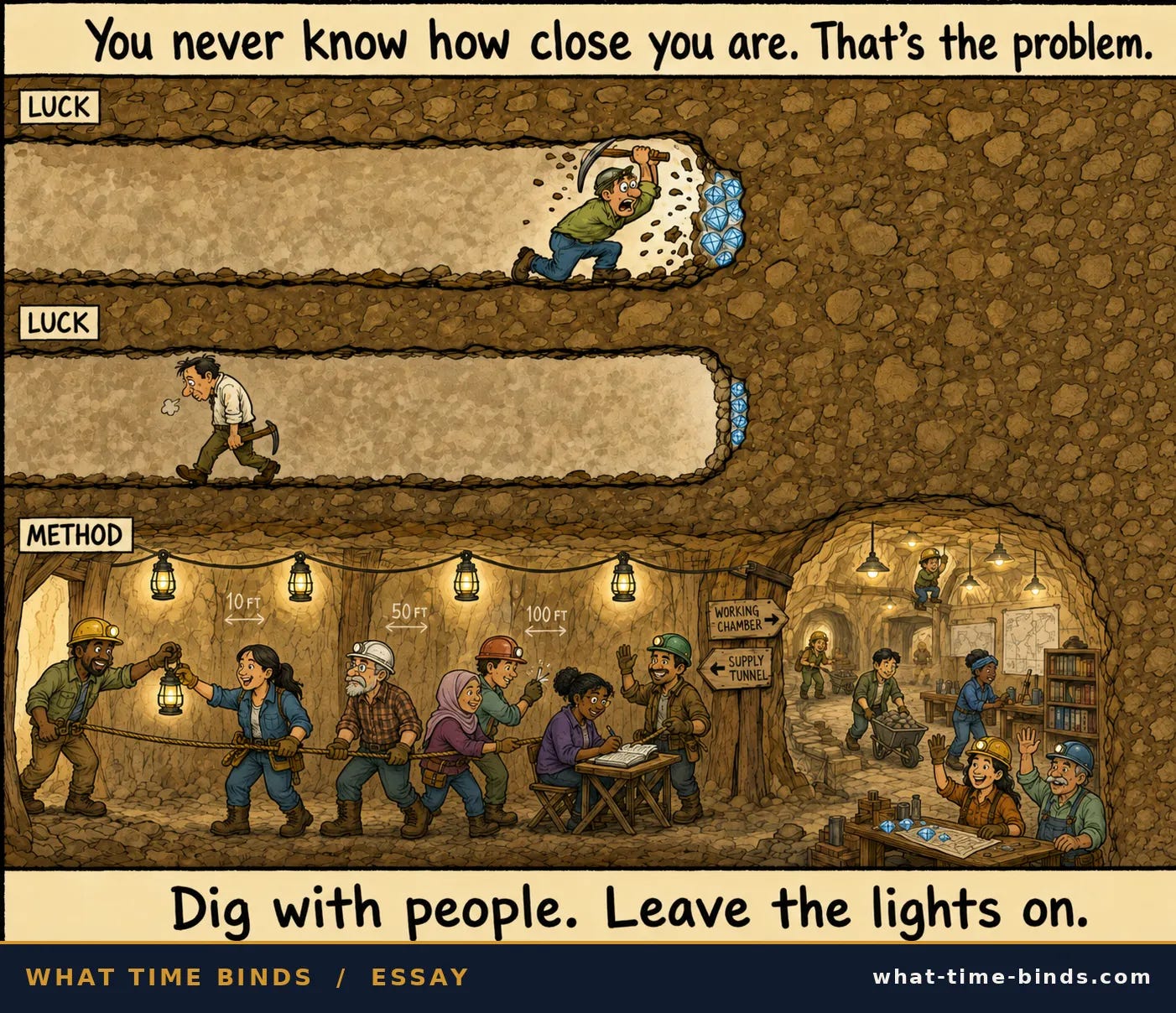
Same cross-section. Three tunnels.
Top tunnel: one man, alone, breaking through into a small pocket of diamonds. Label it LUCK.
Middle tunnel: one man, alone, same distance dug, walking back with two inches of rock between his face and the same pocket. Label it LUCK too. That repetition is the whole argument.
Bottom tunnel: wide, timber-braced, lit end to end by strung lanterns. Seven people working. A rope line back to the entrance. Chalk marks on the wall giving distance and date. Someone at a small table writing in a bound log. One miner passing a lantern down the line to a newcomer coming in behind. At the face they have broken into a chamber the size of a cathedral: workbenches, maps pinned to stone, a shelf of logbooks, two other crews already at work who look up and wave, and more lit tunnels branching away with people moving through them. A few diamonds sit ignored on a bench, holding down a map.
Label that one METHOD.
The chamber is bigger than the tunnel that reached it. Other people got there first, and the room did not get smaller. That is the part the original picture cannot show, because it only knows how to draw scarcity.
REPAIR PROTOCOL: The Dig Log
The artifact. Four lines. Keep it wherever you keep anything. Update it weekly.
Where I am. Distance, date, conditions.
What I have tried. Method, result.
What I do not know. Name the specific missing information in one sentence.
Who else has dug near here. Name, and what they found.
Seven prompts.
What is the one piece of information that would tell me how far I have left?
Who has worked this ground before me? List two names before you list zero.
What have I recorded in the last thirty days that another person could actually use?
If I stopped today, what would my record show, and would anyone be able to read it?
Am I continuing because I learned something this week, or because stopping feels like failure?
Who is behind me in this tunnel, and can they see?
What would make this a stop instead of a quit?
Scripts.
Knocking on the wall: “I have been working this for eight months. Here is where I am and what I have tried. What did you hit when you were in here?”
Handing back the lantern: “Before you start, here is the thing I learned that cost me four months. Take it.”
To someone who stopped: “What did you find in there? I want it written down before it’s gone.”
To a leader: “Get me the record from the last team that tried this. That is worth more to me right now than another month.”
Self-talk: “I don’t know how far it is. That is a measurement problem, and measurement problems have people attached to them.”
Back to the lane
The stakes and the tape did nothing for the Marine who placed them. He already knew where the safe ground ended. He set them for whoever came next, including people he would never meet, including people who would never learn his name.
Name one thing you learned the hard way this year that nobody else can find. Where would somebody have to dig to reach it?
Go write it down where they can.
About ninety days from now you will be handed a ballot with names on it, not ideologies. The only way to know what you are voting for is to make the people asking for your vote say which meaning they mean, and then to check. Read every race. Read every proposition. vote411.org
Jerry W. Washington, Ed.D., served 23 years in the Marine Corps. He holds a doctorate in Organizational Change and Leadership from USC Rossier and teaches at UC Irvine Division of Continuing Education. He writes What Time Binds, an independent newsletter on language, institutions, and democratic accountability.
Thank you dismantling this meme. Most memes we get are based on manipulation of a factoid that brings an emotional response that fits an agenda, not a reality. Particularly damaging during an election cycle because most people react to factoid and never check the reality, leaving a permanent record in their mind, that can be recalled with key words by the politician. The flood of meme misinformation is now constant, unrelenting and purposeful propaganda. With little or no rebuttal capable of reversing the propaganda. Used to be bumper stickers now it’s memes. Please Keep up the great work.
I want to explain perspectives in this piece.
Persistence still matters. What changes is where you point it.
Keep digging. Dig toward people.
The magnet word underneath this piece is "information." It carries at least
three readings, and each one produces a different version of the person in that tunnel.
Information as something you receive: tell me how far I have left. That person
waits.
Information as something you hold: my notes, my advantage, my edge. That person
digs alone on purpose.
Information as something you offer: here is what I found, take it. That person
marks the lane behind him.
All three sound like the same word in a meeting. One of them builds a crew.
So pin it there. Persistence is continuing to work a problem out loud, where
other people can hear you. Say where you are before you know whether it worked.
Report what failed. Answer when somebody knocks.
The prize is the room on the other side, and the people already in it.
Swinging a pick alone is guesswork. Swinging a pick with others is community.