

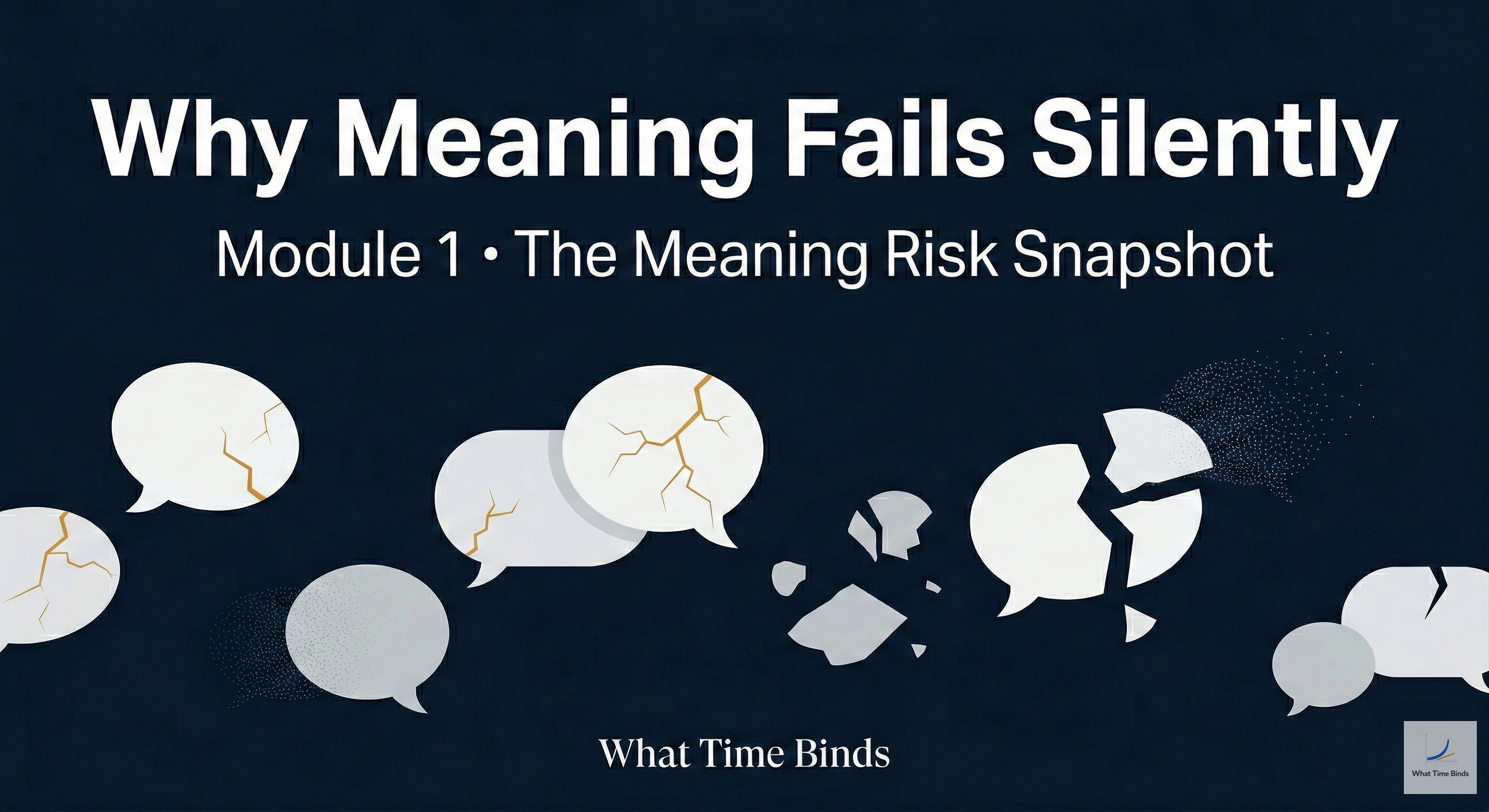
One in three patients experiences a diagnosis-related communication failure. In business, independent assessments of identical insurance cases vary by 55%. The pattern is the same everywhere: meaning drifts, and nobody notices until the cost arrives.
Before you read, think of a decision your team made this week where you later discovered someone understood the outcome differently than you did. What happened?
The meeting where everyone agreed
Tuesday afternoon. Seven people around a table—or seven tiles on a screen. The project lead says, “We need to finalize the rollout plan by Friday.” Everyone nods. A few people type notes. The meeting ends on time, which feels like a win.
By Thursday, two things become clear. The engineering lead understood “finalize” to mean lock the technical spec. The marketing director understood it to mean confirm the launch date. The product manager thought “rollout plan” referred to the internal pilot; the sales lead thought it meant the customer-facing release. Nobody was confused during the meeting. Everyone left with a clear picture. The pictures were different.
This is what meaning failure looks like from the inside: total clarity that happens to be pointed in four directions at once.
What this course is about
This course teaches a set of small, repeatable moves for catching and repairing that kind of failure before it compounds. The moves come from decades of research across operating rooms, cockpits, military operations, and organizational teams. They work. The evidence is unusually clear on this point.
Here is the statistic that frames everything we’ll do together over the next ten weeks:
When directed, closed-loop communication is used in operating room emergencies, task completion reaches 100%. A sender states the request. The receiver repeats it back. The sender confirms. Every task gets done.
That practice appears in 12% of interactions.
The gap between 100% and 12% is the entire problem this course addresses. Teams already have the tools. The tools already work. What’s missing is the cognitive and social infrastructure that makes people actually use them—consistently, under pressure, when it matters most.
That infrastructure is what we’re building here.
The four phases of meaning failure
The MRCI framework maps how meaning breaks down and how it gets repaired. Four phases. Every communication failure your team has ever experienced fits somewhere in this sequence.
Phase 1: Drift. Meaning diverges silently. Assumptions go unchecked. A key term means one thing to you and something else to the person across the table. Context that was clear in one conversation doesn’t travel to the next one. The conditions for mutual understanding aren’t met, and nobody notices—because drift doesn’t announce itself. It feels like agreement. That Tuesday meeting? Pure drift.
Phase 2: Suppression. Here is where things get worse. Someone on the team senses the drift. A flicker of doubt: Wait, are we talking about the same thing? They consider saying something. They don’t. Maybe the meeting is moving fast. Maybe the person who would need correcting is senior. Maybe they’ve raised concerns before and nothing changed, so why bother. The doubt gets swallowed, and the drift continues unchecked.
Suppression is where most communication programs lose the game. They teach people what to say. They don’t address the forces that keep people from saying it.
Phase 3: Repair Activation. Someone speaks the first sentence. “Can I check something—when we say finalize, do we mean the spec is locked, or the date is confirmed?” That sentence is a repair move. It breaks the silence, surfaces the drift, and creates a moment where meaning can be realigned.
This transition—from suppression to activation—is the single point this course targets most aggressively, because it is where proven practices most consistently fail to get used.
Phase 4: Outcome. Meaning is restored. Or it isn’t. Either way, the result feeds back into the system. If the repair works—the team realigns, the ambiguity gets pinned, the meeting produces a shared picture—it becomes slightly easier for the next person to speak up next time. If the repair fails—the concern gets dismissed, the speaker gets a sideways look, the meeting steamrolls forward—it becomes harder. Failed repairs teach teams to suppress. Successful repairs teach teams to repair.
The cycle runs continuously. It is running in your team right now.
A note about this course’s own language
The terms I just introduced (drift, suppression, repair activation, outcome) are themselves subject to the process they describe. You read those words and built your own interpretation of what each one means. That interpretation was shaped by your experience, your professional context, and the conversations about communication you’ve had before this one.
For example: later in this course, I’ll talk about “shared definitions.” If you read that phrase and imagine I mean everyone in the room must agree on one permanent, universal definition of a key term before any work can begin — that’s drift happening right now, between us, on a concept about drift. What I actually mean is narrower and faster: before a decision is made, the people in the room check whether they’re using the same keyword to point at the same thing. That check takes ten seconds. The habit takes months.
I’m flagging this early because the pattern is predictive. Every term in the Meaning Repair Lexicon will land differently depending on what you bring to it. That’s normal. It’s also the exact phenomenon this course exists to address. When a term in this course feels wrong to you, that friction is data; it means your working definition, and mine haven’t been grounded yet. Treat that friction as an invitation to check, not a reason to dismiss.
Why drift is invisible: the grounding problem
In 1991, Herbert Clark and Susan Brennan published a theory of communication that explains why meaning fails the way it does. Their insight was deceptively simple: understanding doesn’t happen automatically when words leave someone’s mouth. It has to be built, move by move, between the people in the conversation.
Clark and Brennan described three requirements for what they called “grounding”—reaching mutual understanding:
Presentation. One person says something. States a plan. Makes a request. This is the part we’re all good at.
Acceptance. The other person provides evidence that they understood. A nod. A paraphrase. A question. A repeat-back. This is the part we skip.
Grounding criterion. Both people reach a mutual belief that understanding is sufficient for the current purpose. This is the part we assume happened when it didn’t.
Closed-loop communication—the practice with the 100% completion rate—formalizes the acceptance phase. The sender states the message. The receiver repeats it back in their own words. The sender confirms or corrects. Three steps. When all three happen, tasks get completed, and meaning holds.
When teams skip the acceptance phase (which is most of the time), they’re operating on an assumption of shared understanding that may or may not be accurate. In a low-stakes conversation, the cost of a wrong assumption is small. In an operating room, a cockpit, an emergency department, a product launch, a board decision, a custody negotiation—the cost can be enormous.
The WHO Surgical Safety Checklist, which formalizes a version of this grounding process, reduces mortality by 25%. Global compliance sits at 73%. The most meaning-critical phase of the checklist—the Sign Out, where the team confirms what was done—drops to 62%.
The tools exist. They work. The challenge is making them stick.
The 12% question
Why do teams suppress the use of practices they know are effective? The evidence points to a few reinforcing forces, and none of them involve laziness or ignorance.
Speed compresses the acceptance phase. Under time pressure, the grounding criterion gets lowered. “Good enough” understanding replaces verified understanding. This is rational in the moment and expensive over time.
Hierarchy suppresses repair activation. A 2024 study of 730 nurses found that power distance orientation significantly predicted whether nurses perceived speaking up as futile. When the person who needs correcting outranks the person who spotted the error, the calculus changes. The drift continues.
Silence is socially learned. A three-year longitudinal study at a German automotive plant found that organizational silence spreads through storytelling. People learn to stay quiet by hearing what happened to others who spoke up—even if those stories are years old, even if the manager in the story has long since left. Silence becomes cultural infrastructure, inherited through narrative.
Repeated futility produces acquiescent silence. When speaking up fails to produce change again and again, people stop trying. Two experiments with 654 participants demonstrated this pattern: voice futility produces a silence that mirrors learned helplessness. People don’t just choose not to speak. They lose the expectation that speaking could matter.
These forces operate simultaneously. They explain the 12%. They also explain why telling teams to “communicate better” doesn’t move the number.
The boundary this course is honest about
There is a condition that sits before drift, and it’s worth naming early.
Sometimes a person enters a conversation with a definition so settled that no verification attempt will register. They aren’t suppressing a repair move; they’ve decided repair isn’t needed. The word means what it means. The question was closed before it was asked.
I call this meaning refusal, and it’s the boundary of what meaning repair can reach.
Meaning refusal can look like prejudice, certainty, expertise, or exhaustion. It can come from a lifetime of being ignored when you raised concerns, until asking “what do you mean?” sounds like one more institution demanding you justify yourself. It can come from a position of genuine authority where you’ve been right so often that checking feels unnecessary. It can come from a fixed frame about a loaded term — “AI,” “equity,” “leadership,” “accountability” — where the definition was locked in years ago, and new information gets filtered through it rather than allowed to change it.
This course works in the space of engaged disagreement — where people differ but are willing to check. Recognizing when you’ve hit meaning refusal is itself a skill, and it saves you from spending repair energy where it can’t produce a result. We’ll return to this distinction in Module 4, when we look at suppression and silence.
For now, hold the question: when you imagine the person on your team who is hardest to reach with a clarifying question, is the barrier fear (suppression) or certainty (refusal)? The repair move for each is different.
What we’re building
Over the next ten weeks, you’ll build a set of tools—a Meaning Repair Operating System—drawn from your own workflows and conversations. Each module introduces one named move. Each move is small enough to use in a live meeting, a handoff, a Slack thread, or a family dinner.
The course follows the four phases. Modules 1 and 2 address Drift: how to spot it, name it, and diagnose where your team is most vulnerable. Modules 3 through 7 focus on Repair Activation: the specific sentences, protocols, and meeting moves that break silence and restore shared meaning. Modules 4 and 9 tackle Suppression and Outcome: the leadership practices and after-action reviews that determine whether repair becomes a habit or a one-time event. Module 10 builds the adoption plan that carries these moves past the end of the course.
You don’t need to learn something entirely new. You need to build the conditions for consistent use of what already works.
That’s a more tractable problem than it sounds. And it starts with a diagnostic.
Next post: The Meaning Risk Snapshot → A step-by-step assessment of where meaning is failing on your team right now, with a quantitative baseline you’ll re-measure at Day 30 and Day 60.
This is Module 1, Post 1 of Meaning Repair for High-Stakes Teams, a 10-module course on the What Time Binds Substack. If you haven’t already, start with the Meaning Repair Lexicon—your reference card for the language of meaning repair.