

Cover image note (about the meme):
I first saw a version of this line attributed to writer John Pavlovitz. In that original phrasing, it named “Republicans”: “Republicans are not afraid of Critical Race Theory… They’re afraid of theories critical of racists…”I disagreed with the partisan framing. Racist beliefs and racist reflexes don’t belong to one party, and I’m not trying to turn a serious issue into a team sport.
So I rewrote it to be more accurate and more precise about my target: racists, regardless of political identity. I removed the party label and made the claim about the wider pattern; people reacting to the label “CRT” without understanding the framework, then shifting the conversation away from substance when racism gets named.
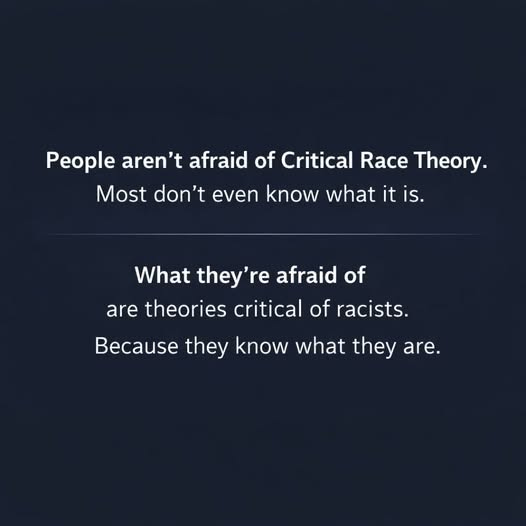
My revised version reads:
“People aren’t afraid of Critical Race Theory. Most don’t even know what it is. What they’re afraid of are theories critical of racists. Because they know what they are.”
Memes are compression devices. They take a messy, high-dimensional reality and collapses it into something shareable: fast, punchy, portable. That’s why memes travel. It’s also why they combust.
In a recent thread, I shared a meme that made two claims: (1) public familiarity with “Critical Race Theory” is low, and (2) a lot of the heat attached to “CRT” is about what people feel is being said about them.
And then the conversation did what social platforms train conversations to do: it slid away from meaning and into posture.
One commenter asked for studies. Another argued that anyone can “Google it in 30 seconds.” Another offered a “tale of caution,” invoking revolutionary history and warning that when “talking ends, violence begins.” A symmetrical warning showed up too: apply judgment as fervently to “your side” as you do to “their side.”
Here’s what I think was happening, and what the adult move looks like when a meme turns into a meaning fight.
Memes don’t argue; they frame
Memes are rarely neutral information. They are cultural packets designed to spread through imitation and remix, carrying a moral or social payload as they go. That’s the basic insight of meme scholarship: what matters is content, transmission, and the way a message gets shaped so people will pass it along.
A political meme functions like a shortcut into a worldview. It gives you a stance before it gives you shared definitions. It is built for the attention economy, and it often behaves like a “discursive weapon,” a quick moral categorization that tells the reader who is right, who is wrong, and what team they’re on.
So when a meme lands, the first fight usually is about the implied identity story.
The empirical baseline: familiarity is low
Before we get dramatic, we should get grounded. The “most people don’t know what CRT is” claim is measurable and has been measured.
Multiple surveys during the peak of the CRT culture-war cycle found low familiarity:
USC Dornsife (Understanding America Study reporting) found 96% of Americans said they don’t know enough about CRT to explain it to others.
Reuters/Ipsos reported 57% of adults were not familiar with the term.
The COVID States Project reported 7 in 10 Americans were not at all or not very familiar with CRT.
YouGov/Economist found only about a third said they’d heard of CRT and believed they knew what it means.
That’s the baseline: low familiarity, high volume, high temperature.
The argument then should shift from “Can people find information?” to “Do people actually understand what they think they’re fighting about?”
“Google it” confuses access with understanding
The “30 seconds on Google” move sounds practical. It also smuggles in a claim that doesn’t survive contact with cognitive science: access to information does not automatically produce comprehension.
Two concepts matter here:
1) The Google effect (transactive memory): when we believe information is easily retrievable, we tend to remember where to find it rather than retaining the information itself. In plain terms: the internet becomes the external hard drive, and our brains store pointers. This is similar for the way we use AI.
2) The illusion of explanatory depth: people routinely overestimate how well they understand complex systems, until they’re asked to explain the mechanism. Then confidence collapses.
CRT is a framework with history, claims, critiques, internal debates, and boundary disputes. “I skimmed a definition” is not “I can explain it.” Pretending otherwise creates a culture where people feel informed while staying structurally unprepared for the conversation.
Identity-protective cognition: why the thread kept slipping away from the meme
The meme said “public familiarity is low,” and it implied something sharper: that the energy around “CRT” often attaches to identity threat, people hearing “racism is being named,” then reacting to the implication.
That is exactly where identity-protective cognition tends to kick in: when evidence threatens group belonging, status, or moral self-concept, people process information in ways that protect identity rather than update beliefs.
This is why the thread kept orbiting procedure (“methodology”), possibility (“people can Google”), and warnings (“this frames disagreement as degeneracy”). Those moves can be sincere. They can also function as avoidance: ways to stay inside the safe perimeter where the self does not have to confront the meme’s implied diagnostic question.
And it matters that the meme is structured like a trap: if you argue with it, you can sound like you’re defending the category it criticizes. If you accept it, you may feel you’re conceding the moral frame. That’s a high-pressure rhetorical environment.
Memes do that. They compress complexity into a binary, then the audience has to fight inside the binary.
The “symmetry” demand sounds fair, and still misses the point
One commenter’s warning boiled down to: “You must judge your own side as hard as you judge the other side.”
In principle, yes: standards should apply consistently. In practice, reality does not distribute bad arguments evenly, and insisting on symmetry can become a way to neutralize critique, especially when the critique is aimed at racism as a behavior pattern, not at a political party as a tribe.
The adult move here is: symmetry in standards, not symmetry in outcomes.
Same rules for evidence. Same demand for definitions. Same willingness to revise. No obligation to pretend both sides are equally wrong in every case.
The “Lenin/killing” warning is a nervous-system flare, not an analysis
Invoking revolutionary history and “when talking ends, killing begins” shifts the conversation into catastrophe mode. It securitizes the discussion: it suggests the meme is a precursor to violence, therefore ordinary disagreement no longer applies.
That move usually signals that the speaker is no longer arguing the claim; they’re reacting to perceived moral exile. They’re naming a fear: “If you label people as racist, you’ll justify silencing them, and then force follows.”
That fear exists in the world. The adult move is to de-escalate the scale and return to the sentence on the screen:
Which clause is false?
Which inference is unfair?
Which definition are we using?
If we can’t do that, we’re not debating anymore, we’re shadowboxing ghosts.
The adult move: time-binding in a platform built for impulse
My research frame is simple here: our tools are adult-level (global reach, instant amplification), and our habits often stay adolescent (reflex, tribal scripts, heat over light). The adult move is time-binding: building continuity (definitions, evidence, mechanisms, and repair) so the next person doesn’t have to start from scratch.
So if a meme is the spark, the adult move is the follow-through:
define terms,
name the mechanism,
show evidence,
constrain the claim,
invite correction without surrendering the point.
That’s what “What Do You Mean?” is really for: not politeness, not centrism, but shared meaning as infrastructure.
Try this next time
A 60-second protocol for when a meme triggers a meaning fight
1) Lock the referent.
“What do you mean by CRT here—graduate legal scholarship, or the culture-war label?”
2) Separate access from understanding.
“Finding a definition isn’t the same as being able to explain the framework. Can you describe the core claims in your own words?”
3) Use the mechanism test.
“Don’t tell me whether it’s good or bad yet; tell me how it supposedly operates in a school or policy context.”
4) Anchor to one agreed fact before moving on.
“Do you accept that public familiarity is low based on these surveys? If yes, what part of the meme fails even given that?”
5) Name the evasion gently, then return to the sentence.
“I hear the methodology concerns. I’m parking that for now because you still haven’t said what you think is wrong with the meme’s argument.”