

What Time Binds — special edition for the 250th, Saturday, July 4, 2026
Author’s note
I watched the cable segment that opens the modern half of this essay on the evening of July 3, and I recognized the framing before I could name it. Twenty-three years in the Marine Corps teaches you the difference between criticizing the mission and betraying it; the confusion belongs to people who never sat through a debrief. I wrote this overnight because the 250th deserves better than a fight over who loves America. Douglass answered that in 1852. The rest of us are catching up.
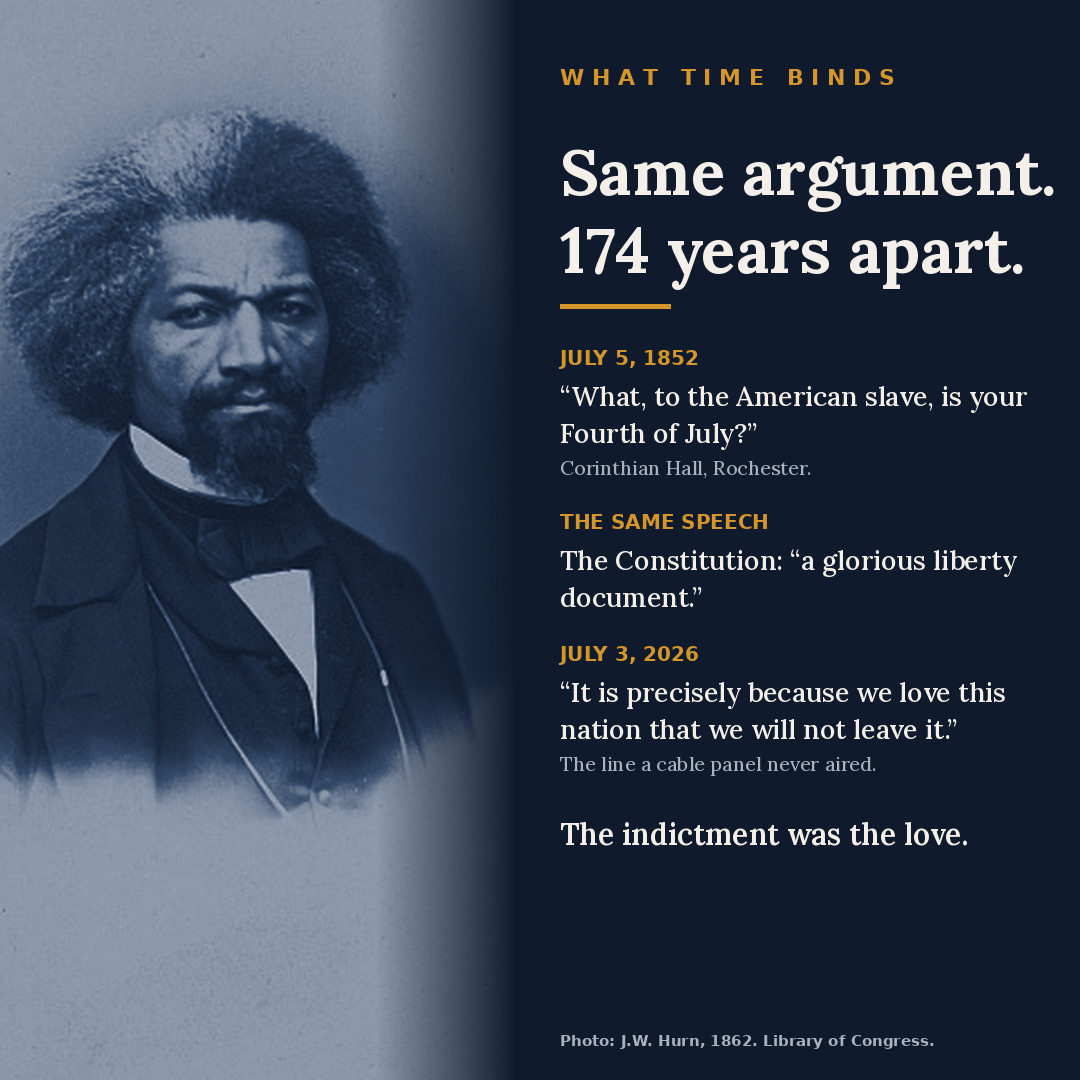
On July 5, 1852, Frederick Douglass stood in Corinthian Hall in Rochester, New York, and put the hardest question ever asked of this country to the Rochester Ladies’ Anti-Slavery Society: “What, to the American slave, is your Fourth of July?” He answered it without flinching. To the enslaved, he said, the holiday reveals “the gross injustice and cruelty to which he is the constant victim.” Then, in the same address, he called the Constitution, read as it ought to be read, “a glorious liberty document.” Both claims. One speech. A man born enslaved in Talbot County, Maryland, who had every reason to walk away from the American project, stood up on its seventy-sixth birthday and demanded it keep its word. He spent the rest of his life insisting that the demand was the love.
Yesterday afternoon, 174 years later, a cable news panel heard the same argument and called it hatred.
On the morning of July 3, Zohran Mamdani sat behind George Washington’s desk in the Governor’s Room at New York City Hall and delivered a nearly fifteen-minute address marking 250 years of American independence. Newly naturalized citizens stood beside him. The full text sits on nyc.gov. One passage traveled farther than the rest:
“The powerful have always known their answer. America, in their view, is an arena of supremacy, where only a select few are allowed freedom, where not all are created equal.”
By early afternoon the passage reached the set of Outnumbered, broadcasting from Liberty State Park with the Statue of Liberty over the panel’s shoulders. The clip Fox aired opened mid-thought: “America in their view is an arena of supremacy.” The sentence naming who “they” are, the powerful, stayed on the cutting-room floor.
The panel then reviewed a speech Mamdani did not give. One panelist called the remarks “frankly disheartening” at a minimum and “really horrifying commentary” ahead of the nation’s 250th Independence Day. Another said Mamdani is “trying to say that this country is not good enough.” A third called the clip infuriating: here was a man who “took advantage of the American dream,” became mayor of the greatest city in the country, and still “fails to understand Liberty.” Harris Faulkner kept it local: “Well, he’s not my mayor. I wouldn’t have had him. But that’s what this city behind us voted for.”
Now set the two texts side by side. The speech on nyc.gov ends with “God Bless America, God Bless New York City, and happy Fourth of July.” It calls the founding “a grand experiment in self-governance.” It describes citizenship as “the beautiful, patriotic work of rendering America, year after year, a little more faithful to its founding ideals.” It answers “love it or leave it” head-on: “It is precisely because we love this nation that we will not leave it.” None of that made air. The panel condemned a man who hates America. The transcript records a man explaining, at length, why he refuses to stop loving it.
Selective editing is an old story, and no network is innocent of it. The detail worth studying came after the edit. Even the clipped version contained the words “in their view.” The attribution was audible. The panel heard it and assigned the view to Mamdani anyway.
George Lakoff, the Berkeley cognitive linguist, explained this mechanism in The Political Mind (2008). His argument runs against everything civics class taught us about rational citizens weighing evidence. Roughly 98 percent of thought, by his estimate, happens below consciousness. We understand political language through frames, structures of meaning built up by repetition. When incoming facts contradict the frame, the frame wins. The facts bounce.
The deepest political frame, Lakoff argued, treats the nation as a family, and conservatives and progressives run the metaphor differently. In strict father morality, the nation-family needs a strong authority; obedience is virtue; criticizing the family in public is betrayal. In nurturant parent morality, love means responsibility; care obligates correction; telling the family hard truths is what a loving member does. “Love it or leave it” is coherent inside the first frame. Inside the second, it makes as much sense as telling a father who wants better for his kids to give them up.
Run the Outnumbered segment through that model and the mystery dissolves. Inside a strict father frame, a mayor listing the country’s failures on the eve of its birthday can only be performing hatred. The frame supplies the motive before the conscious mind finishes parsing the sentence. That floating pronoun, “their,” needed a referent, and the referent was already installed. Fox’s own written description of the segment says the panel reacted to “Massachusetts and Buffalo’s anti-patriotic actions, including NYC Mayor Mamdani’s divisive July 4th remarks.” The frame sat in the packaging before anyone spoke. By the time “in their view” hit the panel’s ears, “they” meant Mamdani and his party. Lakoff would say nobody on that set lied. Their frames heard the speech for them.
The segment even supplied its own counter-evidence. One panelist described a long talk with a friend, a Democrat who “does not like President Trump” and who made clear how much he loves his country. The friend came up as an exception, proof the party had abandoned decent people. Lakoff has a more useful word for that friend: biconceptual. Most Americans run both moral systems and shift between them depending on which one the language in front of them activates. The friend is the American majority. He can hear either speech.
This question was settled for me long before Lakoff gave me the vocabulary. After an operation, Marines conduct an after-action review. You sit down, rank checked at the door as far as the culture allows, and you name what went wrong. Out loud. On the record. In specific terms. Nobody in that room confuses criticism with disloyalty. The debrief exists because the mission matters and the next one is already coming. The Marines who worried me most always reported that everything was fine.
The oath I took was to the Constitution, a document that opens by admitting its own incompleteness. “In Order to form a more perfect Union” is a comparative, written by men who then built Article V so later generations could correct them. The founders shipped the country with a debrief mechanism. Treating criticism of America as hatred of America gets the founding documents backwards.
Douglass would have recognized the segment. He spent four decades answering the charge that indicting slavery meant hating America, and his answer never changed: the indictment was the love. He kept the receipts, kept the faith, and kept demanding. Mamdani’s address, whatever you make of his politics, is written inside Douglass’s tradition.
So is this newsletter. Today I will mark the 250th the way most veterans I know will: glad of the country, clear-eyed about the distance between its promises and its practice, and certain those two things belong in the same sentence. Douglass held both for a lifetime. We can manage a weekend.
The useful question for this weekend is the one the missing sentence asked. Who gets to say what America is, the powerful or the people the harbor let in? Mamdani gave his answer in a line the panel never played: “It is precisely because we love this nation that we will not leave it.”
Read it once in each frame. Then notice which reading arrived first. That reflex, Lakoff would tell you, is where American politics actually lives.
What Time Binds runs on receipts. Every claim in this essay traces to a primary source: the speech text, the broadcast, the 1852 address. If that standard is worth your inbox, subscribe free. You get essays like this one when the moment calls for them.