


Editor’s note
A guest essay this Monday from Wayne L. Coy.
Wayne is a Marine veteran and an Army Reserve intelligence analyst. He is working through his Master’s coursework on the way to a doctorate. He studies what the word violence covers and what it lets pass. His reading has moved through Dr. King’s creative maladjustment set against Malcolm X’s own answer to the same question — how a person refuses conditions they find unjust.
The essay below is his own. I did not edit his voice. He builds a three-register frame for violence and walks it through three events from the same July 4 weekend. Friday’s Binding named the mechanism. This is where it runs on a different scale.
Read Wayne here. Then find him at CoryBantic | Substack
— Jerry
Most people, if you ask them to picture violence, see something specific.
A fist. A blade. Two people, one act, a body that shows the evidence afterward. The stabbing in the parking lot. The punch that breaks something. Something immediate, traceable, with a beginning and an end and a face you can identify.
That picture is not wrong. It’s just not complete.
I’ve been writing about what happens when people refuse to accept conditions they find unjust. What determines whether that refusal becomes something constructive or something that makes the news in the worst possible way. The longer I’ve sat with this, the more I’ve come to believe that we cannot understand why people break the way they sometimes break without first understanding what’s been breaking them. Often for years. More often invisibly. So often through acts that nobody calls violence because nobody has to.
Violence operates in three registers: direct, structural, and cultural.
The first is the one everyone pictures. The second is built into the architecture of systems and institutions. It doesn’t require a fist. Just a policy, a contract, a definition applied asymmetrically. Outcomes that a blade would have produced more visibly, produced quietly instead through processes that have official names. The third is the most durable and the hardest to fight: the cultural register, where stories get told and retold until the distorted version becomes the one everyone accepts as true, and the people who say otherwise get called the problem.
Jerry Washington has been doing something I want to name before I go further. His concept of time binding (the way civilization passes forward what it knows through language, symbols, and institutional substrate) gives us the precise tool for understanding why the third form of violence is so effective. You don’t have to burn the evidence. You just have to control what the next generation inherits. Control the frame, and you control the inheritance.
A song in 1996 named it: they don’t have to burn the books. They just remove them.
What the Smithsonian report released on July 4th proposes goes even further than removal.
Page 6 of the 162-page White House Domestic Policy Council document, released on the 250th birthday of the country it claims to be saving, recommends that the Smithsonian post a label at every entrance. The label would tell visitors that the exhibits inside were “prepared by people who don’t want you to love your country.”
Read that again. A federal document recommending a loyalty warning at the door of a national museum.
You can agree with every complaint in the 162 pages and still stop cold at that sentence. Because what it proposes is not removal. It’s recoding. Leave the exhibits in place. Keep the frame, but change the lens the visitor brings in. The testimony stays on the wall. The visitor walks past a sign that tells them the people who built what they’re about to see are enemies of the nation. Before they’ve seen a single exhibit. Before they’ve formed a single opinion on their own.
Nobody threw a punch. Nobody burned anything. A piece of paper taped to a door would accomplish, over a generation of visitors, exactly what the fire would have. Quieter. Cheaper. Without the accountability of the image.
This is why Jerry’s time-binding insight matters right now. The substrate is not neutral. The wall, the website, the warning sign, the category label: these are the mechanisms through which one generation’s knowledge becomes the next generation’s inheritance. Edit the substrate, and you edit what gets passed forward. The report swaps history for heritage. As Jerry’s analysis shows, those are not the same thing. History is evidence, interpretation, the hard parts kept in. Heritage is what you inherit and are expected to defend. The report convicts history for not behaving like heritage, then calls the conviction a restoration of truth and sanity.
Name your document “truth and sanity” and the other reading is false and insane before anyone opens their mouth.
That is cultural violence. Nobody punched anyone. Nobody burned anything. And it doesn’t show up in any crime report.
Now I want to show you the same definition doing its work on the same day, in three different places at once.
The second register is structural violence.
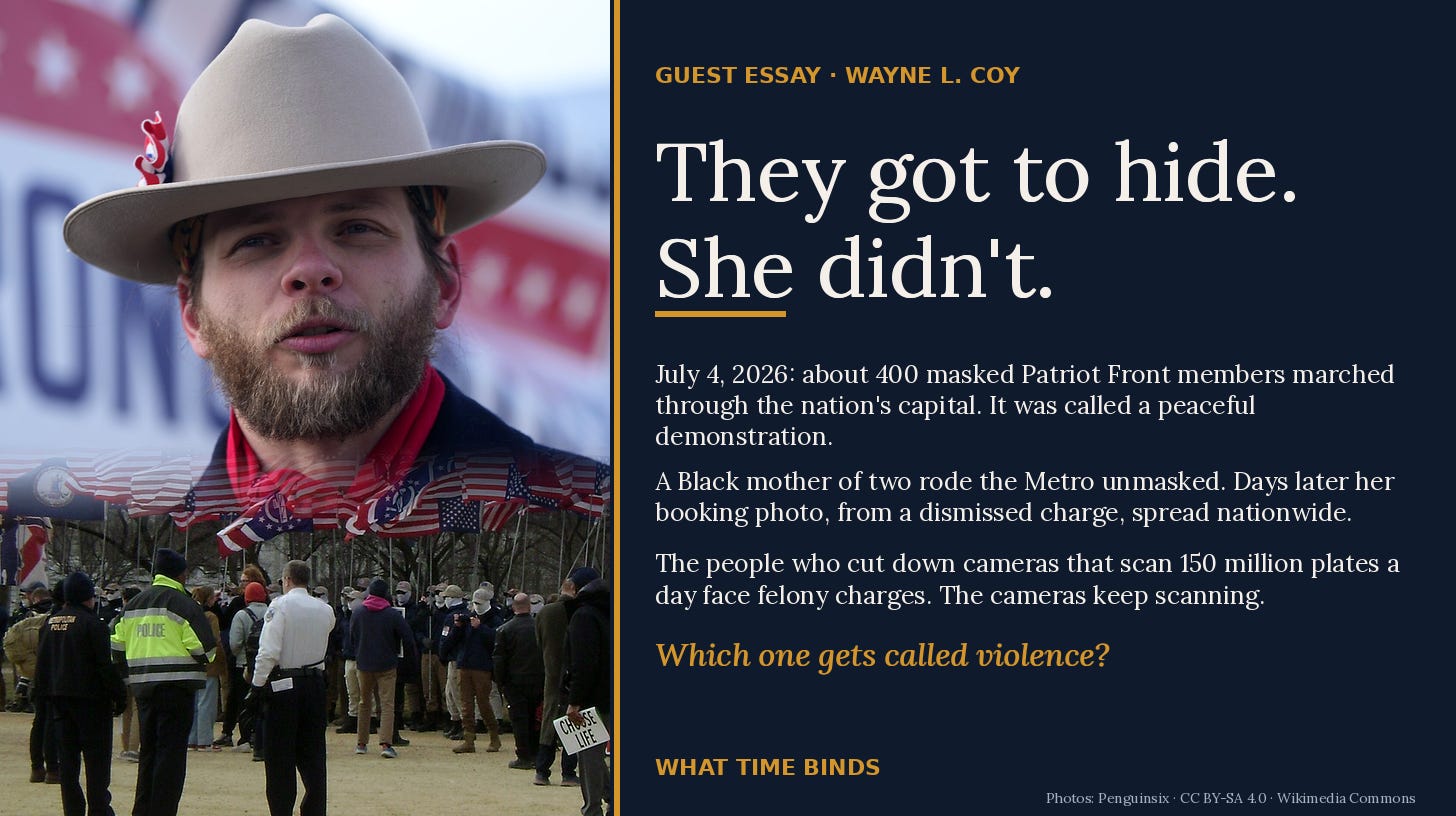
On July 4, 2026, hundreds of Patriot Front members boarded Washington DC Metro trains to march through the nation’s capital. They wore masks. Matching uniforms. They carried Confederate flags. They chanted “Reclaim America.” Their organization’s own manifesto states plainly that “our nation is European in racial character.” The point of the marching is the construction of a white ethnostate.
This was called a peaceful demonstration.
A Reuters photographer, Cheney Orr, captured an image on one of those Metro cars that has been called the defining photograph of America at 250 years old. A lone Black woman, face uncovered, seated in a car surrounded by masked members of a white nationalist group on their way to march through the capital. The image went everywhere. She didn’t choose to be its subject. She was a person on a train.
Days later, her mugshot appeared.
I’m not going to print her name here. She was a person on a train. She didn’t choose to be in this story, and she doesn’t deserve to have her name attached to one more piece of writing that uses her image to make a point. Even a point she might agree with. The people who spread her booking photo made that choice for her. I’m not going to make it again.
She’s a mother of two. The charge that generated the booking photo, an indecent exposure arrest from 2024, had been dismissed without prejudice. That didn’t stop the image from going wide. People who had spent three days calling the masked march a peaceful demonstration spent the next three days spreading her face across the internet.
Interior Secretary Doug Burgum was asked twice on CNN to simply condemn Patriot Front. He couldn’t do it.
Notice the geometry of this.
The marchers: faces covered, identities concealed, able to return to their ordinary lives once the demonstration ended. The accountability their masks were designed to prevent will likely never find them.
The woman on the train: face uncovered, on public transit, trying to move through a moment she didn’t choose. Her past, including a charge that was dismissed, distributed to anyone looking for a reason to flip the story.
They got to hide. She didn’t.
The march announces something specific about who belongs in this country. The group’s own manifesto states it explicitly. The woman on the train announced nothing. She sat there. She looked at the camera. That was enough to make her the target.
This is the definition of violence doing its work. The march that says your presence here is conditional on your race gets a permit and a police escort. The woman who was present on a train gets her booking photo published.
Which one of those gets called violence?
The third register is direct violence.
That same July 4th weekend, across five states, something else was happening.
Flock Safety cameras scan more than 150 million vehicles every day without warrant, without probable cause, without notifying the people being scanned. They were being cut down.
Three camera poles came down in Barrow County, Georgia, cut with what appeared to be a saw, solar panels severed, a fourth pushed over near a high school. Two came down in Pageland, South Carolina. In Houston, two were cut in half and spray painted. One of them had an American flag on it.
Here is what those cameras had been doing.
In Dayton, Ohio, an audit found the system’s data had been searched more than 7,100 times for immigration enforcement. Those searches were explicitly prohibited by the city’s own policy. City officials called it “egregious.” They couldn’t remove the cameras immediately because of the contract terms. They covered all 72 with trash bags.
In Mountain View, California, over 250 agencies that had never signed a data sharing agreement with the city conducted an estimated 600,000 unauthorized searches of its plate data over twelve months.
In Cambridge, Massachusetts, the company installed cameras without city knowledge. In Evanston, Illinois, after the city canceled its contract and ordered removal, the company reinstalled the cameras without permission. The city had to send a cease and desist letter to enforce its own decision on its own streets.
The ACLU calls this plainly: a dangerous nationwide mass surveillance infrastructure, with the company doing everything in its power to sign up governments “as below-the-radar as is possible, so nobody can stop them until it is theoretically too late.” Community groups tracking the cameras note that 99% of the plates being scanned belong to people suspected of absolutely nothing.
More than 70 cities have now canceled or rejected Flock contracts. In La Mesa, California, the city council voted to continue the cameras despite a clear majority of the public meeting’s attendees opposing it. Weeks later, cameras were smashed.
In Oregon, six were cut down. A note was left at the base of the severed poles. I won’t reprint it here. What I’ll say is that it communicated something specific about what the person doing it understood themselves to be doing.
A Virginia man faces 25 criminal charges for systematically destroying 13 cameras. He says he did it for the Fourth Amendment.
A system that scans 150 million vehicles daily without consent, routes that data to immigration enforcement without authorization, installs cameras without community knowledge, and reinstalls them after communities vote to remove them. What do we call that?
The people who cut the cameras down face felony charges. In some jurisdictions they are called domestic terrorists. The system that installed itself without consent, shared data it wasn’t authorized to share, and came back after it was told to leave? That gets called public safety infrastructure.
We have a word for cutting a camera down.
We are still working up the nerve to use it for what the camera was doing.
Three things happened on the same national holiday.
A white nationalist march carrying Confederate flags was called a peaceful demonstration. A Black woman sitting on a train had her dismissed charges published everywhere. And people across five states cut down surveillance cameras that had been routing their neighbors’ data to immigration enforcement without authorization.
The march gets a police escort. The woman gets a mugshot spread. The camera saboteurs get felony charges. The surveillance company gets a contract renewal.
The definition is not neutral.
It decides which acts require accountability and which acts get to keep running. It protects what has institutional backing and prosecutes what doesn’t. It has been doing this work across administrations, across technologies, through every generation that inherited the substrate as it had been edited for them.
Jerry wrote in his piece on the empty Pentagon wall that vigilance is required. Not just against overt censorship, but against the subtle shaping of narratives that seek to limit our understanding, constrain our empathy, and ultimately define who “we” are supposed to be.
The Smithsonian report calls the museums ideologically captured. The surveillance company calls its critics threats to public safety. The warning sign at the museum door calls the curators enemies of the country. The felony charges call the camera saboteurs criminals.
None of it calls what was done to the people first.
That’s the definition doing its work.
We should start calling it by its name.
Wayne L. Coy spent twelve years as a Marine combat engineer and serves as an Army Reserve intelligence analyst. He is a graduate student at USC Rossier School of Education and writes about the mechanisms that determine whether refusal becomes something constructive or something else entirely. Find him as CoryBantic at CoryBantic | Substack
Sources referenced:
— White House Domestic Policy Council (July 4, 2026). “Saving America’s Story.” whitehouse.gov
— Reuters/Cheney Orr (July 4, 2026). Metro photograph.
— Snopes (July 2026). Fact-check of Metro photograph. snopes.com
— The 19th/Errin Haines (July 2026). “The Black woman on the train did not look away.”
— Washington Post (July 7, 2026). “Family of Black woman seen in viral July 4 photo says she’s more than a symbol.”
— Daily Caller (July 8, 2026). Metro photograph subject identification and court records.
— Ms. Magazine (July 7, 2026). “The Mask Is the Message.” — Interior Secretary Burgum refusal.
— ACLU (2025/2026). “Get the Flock Out.” aclu.org
— TechTimes (June 29, 2026). “Flock Safety Crosses 100,000 Cameras.”
— Washington Times (July 2, 2026). “Public backlash explodes against mass surveillance cameras.”
— TechCrunch (February 23, 2026). “Americans are destroying Flock surveillance cameras.”
— Atlanta News First (July 8, 2026). “Flock camera vandalism under investigation in Barrow County.”
— ABC13 Houston (July 2026). “Houston Flock cameras vandalized, cut down and spray-painted.”
— GovTech (June 8, 2026). “Why Flock Safety Finds Itself in a Surveillance Backlash.”
— Jerry W. Washington, Ed.D. (2026). “Restoring Whose Truth? Revisited.” what-time-binds.com

When I think about what's been happening in our country at an accelerated rate virtually unnoticed, the observations in your article define so clearly. It is the truth that raises the hairs on the back of my neck and sets my mind in perpetual motion. While everyone is focused on AI, grass roots activists for hate, are systematically working to undermine the foundation of our constitution in the light of day.