

The question that started this
My friend Mario called me a few years ago with that particular energy people get when they’ve found the thing they want to build. He had a startup idea—a podcast, a framework, a platform. He read me his taglines and goals. In most cases, Mario’s ambitions are strong. These were planetary. Change the world. Shift the paradigm. Transform how people show up. The language was big, bright, and aimed at the horizon.
I listened. I asked questions. And the thing I kept bumping into wasn’t whether Mario’s vision was good—it was that every key term in his pitch meant something different depending on which sentence it landed in. “Framework” meant a personal philosophy in one breath and a scalable product in the next. “Unarmored” meant vulnerability in one context and authenticity in another, and those aren’t the same thing. The goals were real. The words holding them together were shifting under the weight.
Mario went on to build Unarmored Framework—a podcast worth your time. But those early conversations stuck with me, because they sounded exactly like something I kept hearing in a completely different setting.
A senior leader in a meeting I attended around the same time said, “We need more accountability on this team.”
Everyone nodded. The meeting moved on.
Over the following two weeks, three people each defined “accountability” differently. One built a tracking dashboard. One started scheduling weekly check-ins. One began documenting who missed which deadlines, building a case. Same word. Same room. Same nod of agreement. Three incompatible projects, all running simultaneously, each one perfectly rational given the meaning its owner had assigned to a single word nobody thought to define.
The rework cost about two weeks and a measurable amount of trust. And nobody had done anything wrong. The word had done it.
Mario pitching his startup. A leadership team aligning on “accountability.” A family agreeing to “be more supportive.” The pattern is identical every time: the word is in the room, everyone nods, and the meanings scatter the moment people walk out the door.
That pattern is why I started writing the What Do You Mean? series. And it’s why, over the past couple of years, I’ve been building something larger.
What I’ve been researching
If you’ve been reading What Do You Mean? on the What Time Binds Substack, you’ve watched me take apart one loaded word at a time—terms like accountability, boundaries, support, alignment, urgent—and show how each one fractures into competing meanings the moment pressure arrives. Every installment follows the same move: name the word, show how it splinters, pin a workable definition, and hand readers a script they can use in their next conversation.
Those posts were the fieldwork. Each one surfaced the same pattern: teams, families, and organizations don’t fail because they lack information. They fail because they assume shared meaning where none exists. The word is in the room. The meaning isn’t.
That pattern kept leading me back to the same question: is this a communication problem or an infrastructure problem? Are people bad at talking to each other, or is something structural making it nearly impossible to catch meaning failures before they compound?
The research says it’s the second one.
What the paper found
I spent the past several months conducting a formal scoping review—a structured, systematic survey of the existing research—to find out what scholars across multiple disciplines already know about how teams build, lose, and restore shared meaning under pressure.
The paper, titled "Meaning Repair as Cognitive Infrastructure for High-Stakes Teams: A Scoping Review and Integrative Framework," is now available on SSRN as a preprint.
Here’s what the review involved. Following PRISMA-ScR guidelines—the reporting standard for scoping reviews—I searched five academic databases: PsycINFO, Web of Science, Scopus, PubMed, and Communication & Mass Media Complete. The search covered eight overlapping domains: grounding theory, conversational repair, psychological safety, voice and silence, sensemaking, shared mental models, team cognition, high-reliability organizing, and cognitive overconfidence. I screened roughly 2,340 records, conducted full-text review on 262 sources, and included 131 in the final synthesis—68 empirical studies, 22 meta-analyses and systematic reviews, 27 theoretical papers, and 14 foundational monographs.
The review wasn’t looking for a single headline finding. It was mapping a terrain. And what it revealed is that at least eight academic disciplines have been studying pieces of the same problem without talking to each other.
Linguists have mapped the micro-mechanics of how people repair misunderstandings in conversation. Psycholinguists have theorized how mutual understanding gets built move by move. Organizational behavior researchers have shown that psychological safety determines whether people voice concerns or swallow them. Safety scientists have documented how structured communication protocols prevent catastrophic errors in operating rooms and cockpits. Team cognition researchers have demonstrated that shared mental models predict performance. Sensemaking scholars have shown how meaning collapses under extreme stress.
Each tradition has a piece. None of them has the whole picture. The paper’s central contribution is connecting those pieces into a single framework.
The MRCI framework
The framework is called Meaning Repair as Cognitive Infrastructure (MRCI). The core argument: meaning repair isn’t a communication skill you can train in an afternoon workshop. It’s a form of infrastructure. Like physical infrastructure—roads, power grids, water systems—it’s invisible when it works and catastrophic when it fails. And like physical infrastructure, it requires continuous maintenance, institutional support, and investment.
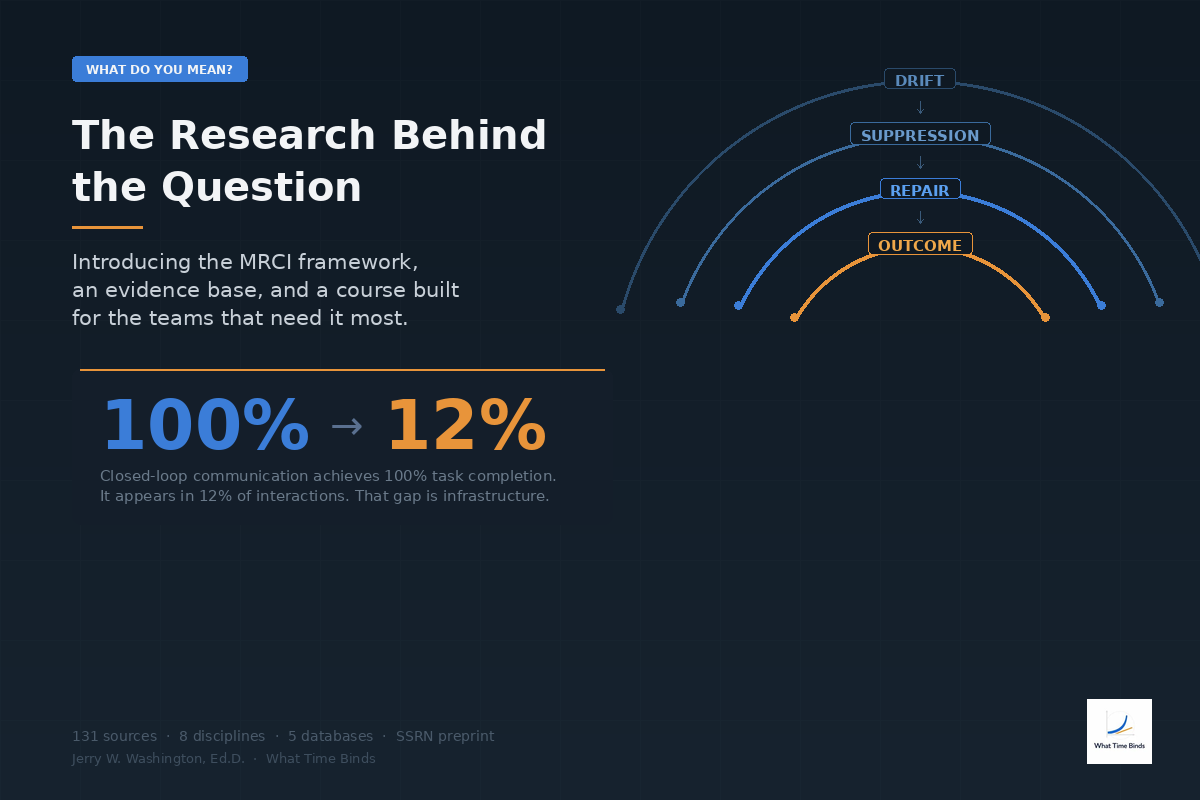
MRCI models how meaning breaks down and gets repaired through four phases:
Drift. Meaning diverges silently. Assumptions go unchecked, key terms go undefined, and context that was clear in one conversation doesn’t travel to the next. The conditions for mutual understanding aren’t met, and nobody notices—because drift feels like agreement.
Suppression. Someone detects the drift. A flicker of doubt. They consider saying something and don’t. Maybe the meeting is moving fast. Maybe the person who’d need correcting is senior. Maybe they’ve spoken up before, and nothing changed. The research here is striking: silence spreads through storytelling, and repeated futility produces a pattern that mirrors learned helplessness. People don’t just choose to stay quiet. They lose the expectation that speaking could matter.
Repair Activation. Someone speaks the first sentence. “Can I check something—when we say finalize, do we mean the spec is locked, or the date is confirmed?” That sentence is a repair move. Small. Specific. And, according to the evidence, remarkably effective when it actually happens.
Outcome. Meaning is restored, or it isn’t. The result feeds back into the system. Successful repair builds the conditions for more repair. Failed repair reinforces suppression.
The paper advances ten falsifiable propositions organized around these phases—testable claims about when drift accelerates, what predicts suppression, what activates repair, and how outcomes feed back into team culture. It also identifies the major measurement gaps: no validated instrument currently exists that measures meaning repair directly. That’s a problem and an opportunity, and it’s one of the things the course is designed to address.
The number that frames everything
One finding from the review anchors the entire project.
When closed-loop communication is used in operating room emergencies, the sender states a request, the receiver repeats it, the sender confirms, and task completion reaches 100%. Every task gets done. That practice appears in 12% of interactions.
The gap between 100% and 12% is not a knowledge gap. The teams know how to do it. It’s an infrastructure gap. The conditions that make people consistently use what they know—psychological safety, time protection, leadership modeling, cultural permission—aren’t being maintained.
That gap is what the course is built to close.
What I’m building on Substack
The What Do You Mean? series was the prep work. The SSRN paper is the evidence base. The next phase is the applied work: a 10-module course called Meaning Repair for High-Stakes Teams, delivered right here on the What Time Binds Substack.
The course translates the framework into a set of named, repeatable moves—small enough to use in a live meeting, a handoff, a Slack thread, a family conversation. Each module introduces one move. Each move maps to a phase of the MRCI framework. Over ten weeks, you build what I’m calling a Meaning Repair Operating System: a set of protocols, scripts, and habits drawn from your own workflows and relationships.
Here’s the sequence, broadly:
Modules 1–2 address Drift. You’ll learn to spot it, name it, and diagnose where your team is most exposed. The first tool is the Meaning Risk Snapshot—a structured assessment that gives you a quantitative baseline you’ll re-measure at Day 30 and Day 60.
Modules 3–7 focus on Repair Activation. This is where the course spends the most time, because it’s where the evidence says teams most consistently fail. You’ll learn stance-first language for speaking the first sentence when you sense drift. You’ll practice term pinning—stopping a conversation to define the word that’s pulling everyone in different directions. You’ll work with three meeting protocols (the Clarity Minute, live term pinning, and Who/They Resolution) designed to catch meaning failures in real time.
Modules 4 and 9 tackle Suppression and Outcome. Module 4 is about leadership: how silence gets built into team culture, and what leaders can do to dismantle it. Module 9 covers after-action reviews—structured debriefs that close the feedback loop so that what your team learns from a repair actually persists.
Module 10 builds the adoption plan. Research on habit formation is clear that starting with one practice for six to eight weeks before adding complexity maintains habits significantly longer than starting at full intensity. Module 10 helps you design a realistic rollout, not a wish list.
Every module produces a deliverable: a completed protocol card, a diagnostic, a leadership stance pack, a scorecard. By the end, you have a fully operational system built from your context and your team’s language.
What I hope you’ll get from this
I’ll be direct about what this course is and isn’t.
It’s not a communication skills workshop. It doesn’t teach you to “be a better listener” or “communicate more effectively” in some vague, aspirational sense. The evidence is clear that telling teams to communicate better doesn’t change behavior. What changes behavior is building the specific conditions—psychological safety, time protection, shared vocabulary, visible leadership modeling—that make proven practices actually get used.
It’s not a one-size-fits-all program. The course includes a cultural adaptation thread from Module 1, because research on power distance, communication directness, and silence norms makes clear that repair moves that work in a flat, direct-communication culture can backfire badly in a hierarchical or high-context one. You’ll adapt each protocol to your team’s actual context.
What I hope you get: a small set of moves you can actually use under pressure. A shared vocabulary your team can adopt—because the research shows that when teams have a shared name for a behavior, they can see it, call it out, and reinforce it. A diagnostic you can re-run quarterly. And the confidence that comes from knowing the evidence base behind what you’re practicing.
The research is real. The protocols are grounded. The moves are small on purpose. And the course is built for people who are already busy, already under pressure, and already tired of being told to “just communicate better.”
What comes next
The next post is the Meaning Repair Lexicon—a living glossary of every term, protocol, and named move in the course. Bookmark it. You’ll return to it often. It grows with each module, and it serves a purpose beyond reference: shared language is itself an intervention. When you can name a thing, you can see it. When your team can name it together, you can repair it together.
After the Lexicon, Module 1 begins. We start with a diagnostic.
I’ve spent a long time sitting with that question—What do you mean?—and following it wherever it led. It led through linguistics, organizational behavior, safety science, social psychology, and team cognition. It led to an SSRN paper and a framework with ten testable propositions. And now it leads here: to a set of tools I believe are worth building together.
Mario’s vision was real. So was the senior leader’s desire for accountability. So is every team’s wish to align, coordinate, and move fast. The ambition isn’t the problem. The problem is that the words carrying the ambition mean different things to the people who have to execute on them—and nobody stops to check.
This course is the stop. The check. And the infrastructure that makes checking a habit instead of an accident.
Let’s build it.
Meaning Repair as Cognitive Infrastructure for High-Stakes Teams is available on SSRN.
The What Do You Mean? series archive is on the What Time Binds Substack.
Next post: The Meaning Repair Lexicon — your reference card for the language of meaning repair.
Wish I had read this when I was early in my career, it would have helped in so many meetings and negotiations. great research and explanation. Thanks