


Before you read, think about the last time someone told you they wanted to be “successful.” Did you ask what they meant? Did they?
The lecture that rewired my vocabulary
Fall 2019. I’m sitting in a graduate seminar at USC Rossier, first semester of a doctoral program I’d started at forty-four. The professor puts a diagram on the screen — two layers, clean and precise.
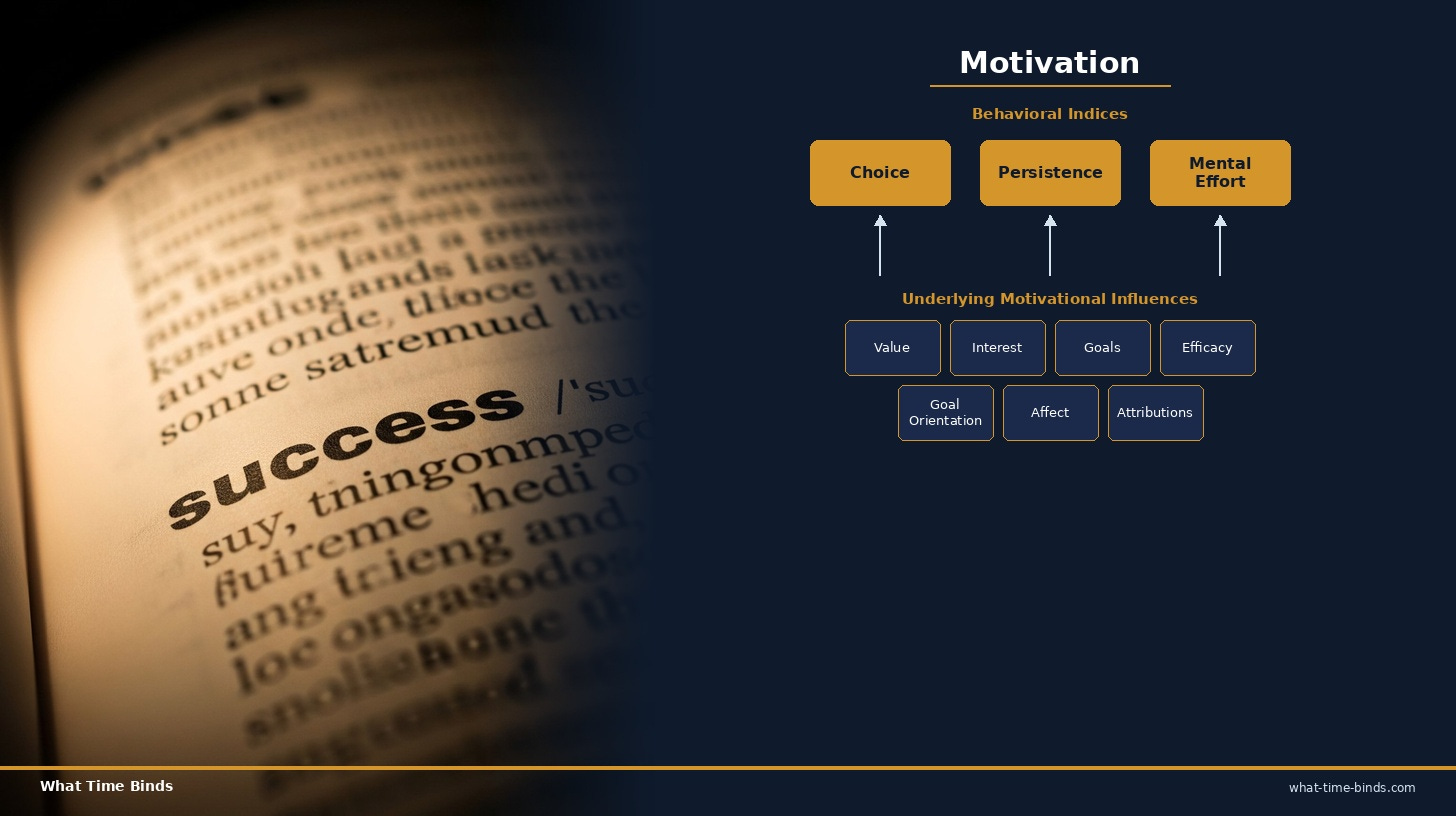
The top layer: Behavioral indices. Three boxes. Choice. Persistence. Mental effort. These are the things you can observe and measure. Which task does the person pick? How long do they sustain it? How much cognitive energy do they invest?
The bottom layer: Underlying motivational influences. Seven boxes feeding upward into those three. Value. Interest. Goals. Efficacy. Goal orientation. Affect. Attributions. These are the engines underneath — the factors that determine whether someone chooses to engage, keeps going when it gets hard, and brings their full mental capacity to the work.
Two tiers. The observable behavior on top, the internal architecture below. Precise, testable, measurable. I sat with that for a minute. Then I started running it against every time I’d heard the word “motivation” used in everyday conversation. In team meetings. In self-help content. In locker-room speeches. In corporate training decks. Almost none of it matched.
The popular version of motivation sounds like fuel — something you either have or you don’t. You’re “motivated” or you’re “unmotivated.” You need to “find your motivation” or “stay motivated.” It’s treated as a feeling, a burst of energy, a fire in your gut that gets you out of bed. And the implied source of that fire is almost always the same: the desire to win. To beat. To get ahead of someone else.
That version of motivation comes pre-loaded with a definition of success that nobody agreed to.
The magnet word: “success”
“Success” is one of the most powerful magnet words in daily life. It pulls everyone toward it — and everyone lands in a different place.
For some people, success means financial security. For others, it means professional recognition. For others, it means raising kids who are kind. For others, it means surviving a diagnosis. For others, it means publishing a book, or quitting a job that was killing them slowly, or finally learning to say no without apologizing.
All of those are legitimate. And here’s the catch: most people carry a definition of success they absorbed rather than chose. It arrived through family expectations, industry norms, social media metrics, or cultural pressure — and it installed itself as a default without a single explicit conversation about whether it fit.
When the word stays unpinned, it defaults to the version with the most cultural momentum. And in most Western, market-driven societies, that default sounds like this: success means having more than the person next to you.
That default carries a hidden assumption. It assumes success is a fixed quantity. That the supply is limited. That your win requires someone else’s loss.
That assumption has a name.
The zero-sum bias: a cognitive inheritance
In 2024, researchers Jillian Andrews Fearon and Friedrich Götz published a landmark study across six countries and more than 10,000 participants. They identified what they call the zero-sum mindset — a generalized belief that life works like a zero-sum game, where one person’s gain must come at another person’s expense.
Their findings cut against a common misunderstanding. Zero-sum thinking is distinct from competitiveness. Competitiveness is a motivational orientation — a drive to perform well. You can be highly competitive and still believe that other people’s success is compatible with yours. The zero-sum mindset, by contrast, is a belief about the structure of the world: that rewards exist in a fixed, limited amount, making one person’s success fundamentally incompatible with another’s.
The research showed this mindset is remarkably stable over time. It predicted lower cooperation across domains. And in the most striking finding, it predicted lower cooperation even in scenarios where cooperation was a matter of survival — situations where working together would benefit everyone, and yet zero-sum thinkers still withheld.
Evolutionary psychologists suggest a reason. For most of human history, critical resources — food, mates, territory, status — were genuinely scarce. If your neighbor had more grain, you probably had less. Zero-sum was the accurate read on reality. The cognitive shortcut that says their gain is my loss kept your ancestors alive.
The problem is that most of modern life operates in non-zero-sum space. Knowledge doesn’t deplete when you share it. Trust expands through use. Competence in one person can raise the performance of an entire team. Ideas multiply when they circulate. The scarcity heuristic still fires, but it’s reading a map that no longer matches the territory.
This is the Korzybskian gap in action: the map (your inherited model of how success works) diverges from the territory (how motivation and growth actually function) — and nobody notices because the old map feels so obviously correct.
What motivation science actually reveals: the abundance engine
Self-Determination Theory, developed by Edward Deci and Richard Ryan across four decades of research, is one of the most validated frameworks in contemporary psychology. It identifies three basic psychological needs that, when satisfied, produce high-quality motivation and well-being: autonomy (the experience of choosing your own behavior), competence (the experience of effectiveness and mastery), and relatedness (the experience of meaningful connection with others).
These three needs are the engine of the motivation that the academic literature measures through choice, persistence, and mental effort. When people experience autonomy, competence, and relatedness, they choose more challenging tasks, persist longer through difficulty, and bring greater cognitive investment to the work.
Here’s what matters for the zero-sum question: none of these needs are finite resources.
Your autonomy and mine can grow in the same room. Competence expands as more people develop it — the supply of mastery has no cap. Belonging multiplies through connection; one person’s sense of relatedness strengthens the conditions for everyone else’s. The needs that drive genuine, sustained motivation are inherently expandable. They grow through interaction. They multiply through environments that support them.
The evidence is operational, drawn from decades of controlled research across education, healthcare, organizations, sports, and parenting. When social environments support all three needs — when people have meaningful choice, receive competence-building feedback, and feel connected to the people around them — motivation increases for everyone present. The gain is shared. The loss is absent.
The self-help industry borrowed the language of motivation and grafted it onto a zero-sum frame: beat the competition, outperform the field, win the morning, dominate your niche. The academic science points in a different direction. Motivation that lasts — the kind that sustains choice, persistence, and mental effort across years — runs on autonomy, competence, and relatedness. It runs on conditions you can build without taking anything from anyone.
The boundary rule: where competition belongs (and where it doesn’t)
This brings us to the boundary that “success” needs and rarely gets.
Competition and collaboration are both legitimate. Both have value. They operate in different domains, and when one colonizes the other’s territory, the damage is predictable.
Competition belongs where resources are genuinely fixed. One championship trophy. One promotion slot. One contract award. One seat on the team. In these spaces, someone will win, and someone will lose. That’s the structure. Pretending otherwise doesn’t serve anyone. Compete cleanly, compete hard, and respect the outcome. Zero-sum analysis is accurate here because the situation is actually zero-sum.
Collaboration belongs where resources expand through sharing. Knowledge. Ideas. Trust. Skills development. Community capacity. Organizational learning. In these spaces, your gain increases the total supply rather than depleting it. A colleague who learns a new skill raises the team’s capability. A community that shares information builds collective resilience. Zero-sum analysis is inaccurate here — and when it takes hold, it produces the exact damage the research predicts: lower cooperation, lower innovation, lower trust, worse outcomes for everyone.
The failure mode is misidentification. When people treat an expandable space as though it were fixed — competing for credit on a team where credit expands with results, hoarding knowledge in an organization where shared knowledge multiplies value, treating another person’s professional growth as a threat to their own standing — they’re running zero-sum software on non-zero-sum hardware. The program doesn’t match the machine.
The moral boundary
There’s one more line to draw, and it matters.
Defining success on your own terms is powerful. It is also incomplete without a constraint. The constraint: your definition of success has to pass a test. Does achieving it require taking something from someone else? Does it depend on another person’s loss? Does it extract value from someone who didn’t agree to the exchange?
If yes, you’re either in a genuinely zero-sum space (where the rules of fair competition apply) or you’re in territory that demands a harder look. Success built on someone else’s involuntary cost is extraction, regardless of what you call it.
If no — if your version of success can coexist with other people’s flourishing, if your gain doesn’t mandate their loss — then the field is wide open. And the science says the field is wider than most people’s inherited maps suggest.
Repair Protocol: Pinning “Success” in Your Own Life
When a word this loaded stays undefined, it borrows definitions from whoever speaks loudest. Pin it.
Prompt 1: Write down your current working definition of success. One sentence. No editing.
Prompt 2: Where did that definition come from? Did you choose it, or did it arrive through expectation, comparison, or cultural default?
Prompt 3: Run the zero-sum test. Does your definition require someone else to fail or lose for you to achieve it? If yes, are you in a genuinely fixed-resource space, or are you applying scarcity thinking to an expandable domain?
Prompt 4: Check the three needs. Does your definition of success include room for autonomy (meaningful choice in how you pursue it), competence (a felt sense of growing mastery), and relatedness (connection to people who matter to you)? If any of the three is missing, the research says your motivation will erode under pressure.
Prompt 5: Name one space in your life where you’ve been competing when collaboration would produce more for everyone — including you.
Prompt 6: Name one space where competition is genuinely appropriate, and you’ve been avoiding it because competition feels uncomfortable.
Prompt 7: Pin it. Complete this sentence: “For this season of my life, success means ____________. It includes ____________. It excludes ____________. I’ll revisit this definition on ____________.”
Scripts for Real Conversations
With a colleague: “I’ve been thinking about what success actually means for this project — for me and for the team. I want to make sure my definition matches yours before we get further in. What does a successful outcome look like from where you sit?”
With a partner or family member: “I realized I’ve been operating with a definition of success I never actually said out loud. Can I tell you what it is, and can you tell me yours? I want to make sure they’re not working against each other.”
Self-talk: “Am I treating this as a competition because it actually is one — or because my default setting assumes it is? What would change if I checked?”
Reflection Questions
Where in your life are you measuring success against someone else’s scoreboard rather than your own?
Think of a time you felt genuinely motivated — sustained effort over weeks or months, through difficulty. Were the conditions closer to zero-sum competition or to autonomy, competence, and relatedness?
What would shift in your daily decisions if you treated knowledge, trust, and professional growth as expandable resources rather than fixed ones?
The four-word return
That graduate seminar changed something for me. The professor was teaching motivation as a measurable architecture — observable behaviors on top, seven underlying influences feeding them from below — powered by needs nobody has to lose for you to satisfy.
The word “success” will keep pulling people toward different meanings. That’s what magnet words do. The move is the same one it always is: pin the term before it pins you. Define it out loud. Check it against the science. Test it against the boundary. Write it down where future-you will see it.
Your success and mine can coexist. The research is unusually clear on this point.
The scarcity is in the map, not the territory.
What word in your life is operating with someone else’s definition?
Jerry W. Washington, Ed.D. (USC Rossier School of Education), is a retired Marine Corps Master Sergeant, independent researcher, and the creator of the Meaning Repair as Cognitive Infrastructure (MRCI) framework — a four-phase model for diagnosing and repairing communication failures in high-stakes environments. His scoping review of 131 academic sources across eight disciplines is available on SSRN. He writes What Time Binds on Substack, where he also teaches Meaning Repair for High-Stakes Teams — a free-to-start, 10-module course that installs repeatable repair moves for teams under pressure. He is co-founder of BoldTimers and Chief Community Officer alongside María Tomás-Keegan and Mel Ebenstein.
If this essay changed how you hear the word “success,” share it with someone still running on a borrowed definition. If you want the tools to pin meaning before it drifts, Module 1 is completely free.
What your piece made me think about is how the definition of success often comes from whatever feels most absent. When money is scarce, money becomes the whole definition. When someone has enough, they start saying "money isn't everything." The definition isn't just culturally absorbed — it's shaped by what's missing inside. The gap becomes the goal.
That might be part of why money sits so firmly as the default metric. It's not that people have carefully reasoned their way to it — it's that money is the most visible, most comparable proxy for "not struggling anymore." In a world full of comparison points, the easiest thing to measure becomes the easiest thing to chase.
Your zero-sum test is useful here. There's a Japanese phrase — 知足者富 (chī zú zhě fù), "the one who knows enough is rich." It points toward a definition of success that doesn't require anyone else's loss. But I'll be honest — knowing that and living it are very different things when there's so much around you designed to make "enough" feel like it's never quite here yet.
If I could actually pin my own definition, it would be something close to 晴耕雨読 (seikō udoku) — "plow when it's sunny, read when it rains." A life shaped by the weather, not by someone else's scoreboard. It doesn't require winning anything. It doesn't cost anyone anything. It's just a quiet rhythm that fits.
But I also know that's easier to write than to protect.
Excellent article Jerry!
I am glad I read it.
Your right. It dovetails in nicely with the short note I posted.