

I researched this essay on the day it happened.
March 25, 2026. One hundred and twenty-three nations voted to declare the transatlantic slave trade the gravest crime against humanity. Three voted no. The United States was one of them.
I pulled the resolution text. I read the U.S. explanation of the vote. I read the EU’s abstention statement, the UK’s statement, and France’s separate legal filing. I mapped the magnet words, ran the vote through my framework, and started writing.
Then I closed the document.
I closed it because my hands were shaking, and I have learned, the hard way, over years of doing this work in public, to tell the difference between writing with conviction and writing with heat. I had heat. I could feel it in the first paragraph. In the way I was reaching for words that accused rather than words that explained.
So I waited. I told myself I would come back when I could do what I ask my readers to do: name my priors, hold the strongest counterargument, and let the evidence lead.
A month later, I came back. The heat is still there. I am a Black man. I am the descendant of enslaved people. I spent 23 years in the Marine Corps building infrastructure for a country whose founding documents excluded my ancestors from the category of “person.” When my country votes no on a resolution about slavery, my body has an opinion before my brain arrives.
That is my prior. I carry it. I name it here because I believe in doing the work I ask of others: examining the maps I inherited before I use them to read new terrain.
Here is where the frustration sharpens. I know my priors. I have spent years interrogating them publicly in essays, in a research framework, and in a scoping review of 131 academic sources across eight disciplines. I wrote an entire essay called “Race as a Ghost Map” that opens by admitting the emotional weight I bring to these questions and then lays out a self-audit protocol anyone can use.
The question that kept me from publishing in March, and brings me back now, is whether the people who cast that “no” vote, and the 52 nations who abstained, have done the same work on their own maps. Because the evidence from the General Assembly floor suggests they have not.
The magnet word at the center
On March 25, 2026, the UN General Assembly adopted Resolution A/80/L.48 by a vote of 123 in favor, 3 against, and 52 abstentions. Ghana introduced the resolution on behalf of all 54 African Union member states. The United States, Israel, and Argentina were the three “no” votes. Every EU member abstained as a bloc. The resolution declared the trafficking and chattel enslavement of Africans “the gravest crime against humanity” and called for reparatory justice.
The magnet word is “crime.”
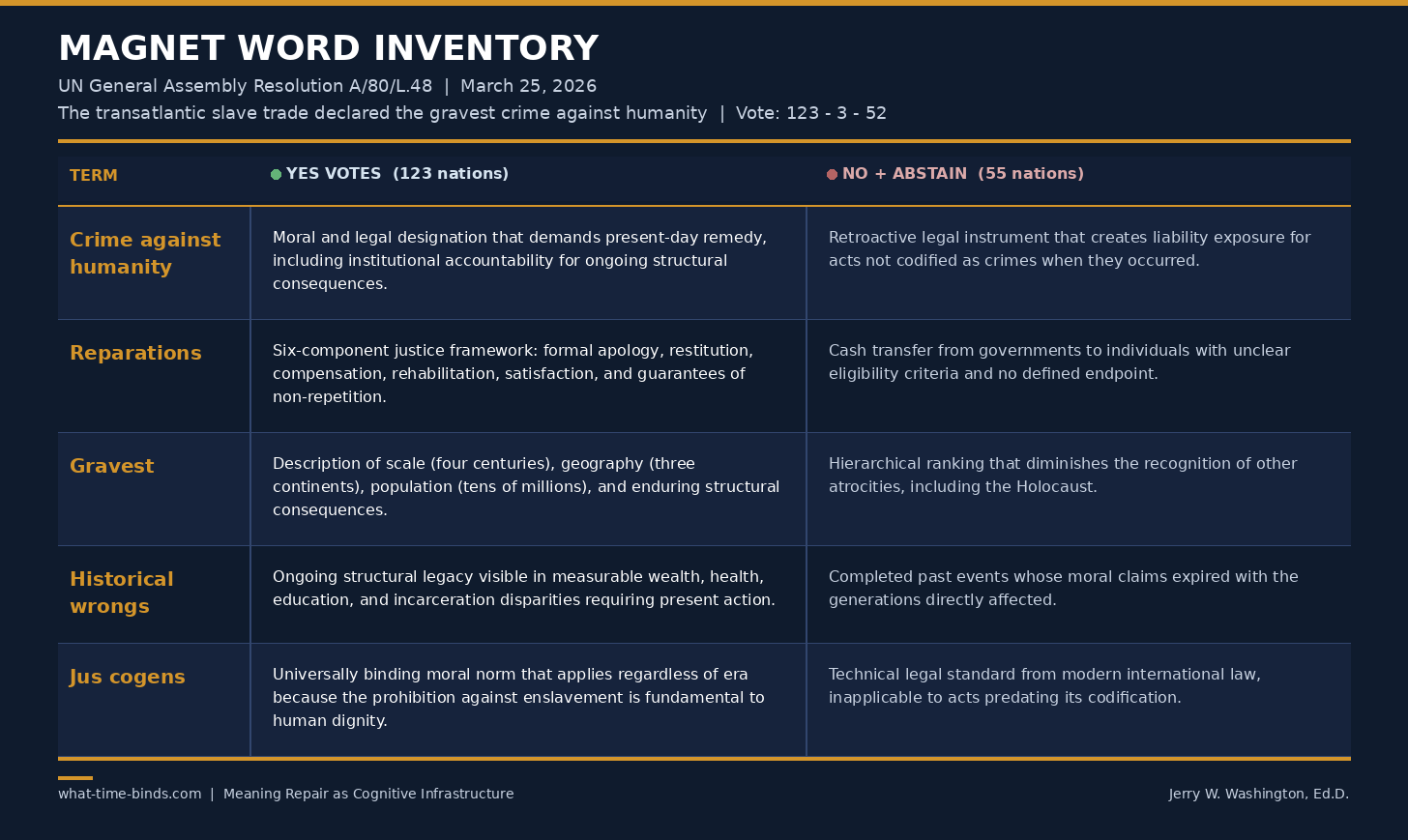
For the 123 nations voting yes, “crime against humanity” carries a specific moral and legal weight. It means: this happened, it was wrong by any standard human beings have ever held, the consequences persist in measurable ways, and the international community has an obligation to address those consequences. The word “gravest” adds emphasis. The word “reparations” names the obligation.
For the three nations voting no, and for much of the abstaining bloc, the same phrase triggers a different reading entirely. “Crime against humanity” sounds like a legal instrument being applied retroactively. “Gravest” sounds like a ranking that diminishes other atrocities. “Reparations” sounds like a financial claim without a clear recipient.
Same words. Different pictures. And because nobody stopped to say, “When we say crime, do we mean a moral declaration or a legal indictment?” the entire vote became a collision of unstated definitions.
This is what I study. This is what my Meaning Repair as Cognitive Infrastructure framework maps. And this UN vote is that framework running at full civic scale.
The four phases, live from the General Assembly
Drift. The meaning of “crime against humanity” has been drifting for 25 years. The 2001 Durban Declaration called slavery “a crime against humanity and should always have been so,” a carefully crafted phrase that acknowledged the moral reality while sidestepping retroactive legal application. That formulation was already a compromise. It contained two competing definitions inside a single sentence: slavery is a crime (present tense, moral), and it should always have been (subjunctive, acknowledging it was not legally designated as such at the time). For a quarter century, that ambiguity held. Both sides could point to the same words and see their own meaning reflected back. Drift felt like agreement.
Suppression. Four consecutive U.S. administrations boycotted Durban follow-up events: Bush, Obama, Trump, Biden. Every boycott is a suppression move at institutional scale. Drift was detected. The mismatch between the moral reading and the legal reading was known. And the response, each time, was to leave the room. The research on suppression in my scoping review describes this pattern precisely: silence spreads through storytelling. Each administration inherited the precedent of the last administration’s exit, and the bar for re-entry rose. By the time Ghana introduced this resolution in March 2026, the U.S. had 25 years of accumulated suppression infrastructure, inherited silence dressed as diplomatic continuity.
I wrote about this mechanism in “Version Control for Democracy.” At the President’s House in Philadelphia, NPS employees removed interpretive panels about enslaved people from a jointly curated historic site without notice or consultation. Judge Rufe’s ruling used version-control language to describe the damage: public memory had been edited by power without process. Her order was a restore command.
The UN vote is the same pattern at global scale. For 25 years, the Western bloc has been editing the shared record by subtraction: leaving conferences, boycotting commemorations, abstaining from votes. Each exit removes a panel from the interpretive exhibit. The simplified story fills the gap on its own.
Repair Activation. Ghana’s resolution is itself a repair move. Foreign Minister Ablakwa walked to the General Assembly podium and, in effect, said: “We have been using the same words and meaning different things for a quarter century. Here is what we mean. Here are six specific components: apology, restitution, compensation, rehabilitation, satisfaction, and guarantees of non-repetition. Here is the legal standard we are invoking: jus cogens. We are pinning this term.”
That is term pinning. It costs more than 20 seconds at this scale, and the mechanism is identical to what happens in a meeting room when someone finally says, “When we say finalize, do we mean the spec is locked, or the date is confirmed?”
Outcome. The pin held for 123 nations. For the rest, it failed. And now future-us inherits two competing artifacts: a General Assembly declaration endorsed by a supermajority, and a formal U.S. explanation of vote that reads like a counter-definition. The drift between these two maps is wider now than before the vote, because the vote forced the incompatible definitions into the open. Successful repair in part of the room, failed repair in the rest. The feedback loop is running.
A coalition of scholars and reparations advocates issued a warning in the weeks following the vote that names the risk precisely: the resolution could stall at declaration, with reparations language diluted into development assistance, reduced to symbolic gestures, and deferred indefinitely through what they called “death by commission.” In framework terms, that is the Phase 4 danger: the pin held on the day of the vote, and the definition can still drift back if the institutional follow-through stalls.
My priors, on the table
Here is where I need to slow down and do the thing I ask readers to do.
I carry priors into this analysis. I am the descendant of people who were property under American law. My family history contains gaps that will never be filled because enslaved people were recorded as inventory, not as persons. When Ambassador Negrea said the resolution’s supporters were engaged in “cynical usage of historical wrongs as a leverage point in an attempt to reallocate modern resources to people and nations who are distantly related to the historical victims,” my body read that sentence before my mind parsed it. The phrase “distantly related” landed in a place where reason does not live first.
So I will name what I notice in myself:
I notice that I want the U.S. to be wrong. That is a prior, and I hold it.
I notice that I feel the word “distantly” as erasure, as if the distance between me and my great-great-great-grandmother, whose name I will never know because no one recorded it, is a matter of diplomatic convenience. That is an emotional response, and it carries real information; it is a signal, and I treat it as one.
I notice that when Negrea said, “President Trump has done more for Black Americans than any other president,” I stopped reading his argument and started reading his credibility. That is a suppression risk in my own processing. If I dismiss the entire U.S. position because one sentence offended me, I am doing the same thing I critique: letting the emotional charge of a magnet word shut down the grounding check.
So I went back and read the full explanation of vote. I read it as if it were a team member’s position in a high-stakes meeting where I disagreed with the conclusion and needed to understand the reasoning.
The legal core of the U.S. argument rests on rejecting retroactive application of international law. The position holds that acts from the 15th through 19th centuries cannot constitute violations of jus cogens as that term is understood in contemporary international law. This is a real argument. It has legal weight. Scholars disagree about it, and reasonable people can land on different sides.
The argument about ranking atrocities, that calling slavery the “gravest” crime, objectively diminishes the suffering of countless victims and survivors of other atrocities,” is also a real concern. Israel shares it. The EU shares it. The anxiety about creating a hierarchy of suffering is genuine, even if I believe it misreads the resolution’s intent.
I can hold these things. I can acknowledge the legal argument while believing, with everything in my body and my training, that the moral answer is clear and that the legal objection functions, in practice, as a mechanism for avoiding the moral conclusion.
The thing that breaks the repair loop is the refusal to examine one’s own priors with the same rigor.
The frustration: unexamined maps on the Assembly floor
In my “Race as a Ghost Map” essay, I wrote that shaming people rarely updates maps. Ghost Maps thrive in defensiveness. If we want different outcomes, we have to get better at the craft of updating.
I still believe that. And I have tried to live it: auditing my own assumptions publicly, inviting readers to do the same, building a framework grounded in evidence rather than accusation.
This vote tested my patience with that posture. Because what I saw on the Assembly floor was a room full of nations with deeply unexamined maps, maps inherited from the same era that produced the slave trade itself, defending those maps with procedural language while 123 nations asked them to do one thing: say the full sentence.
The EU abstained because the resolution used superlatives. France warned against “pitting historical tragedies against each other.” The UK said slavery must “never be forgotten” while insisting there is no legal duty to address it. These are institutional suppression moves. Drift detected. Repair declined. Room exited.
The U.S. explanation of vote went further. It deployed a “distantly related” frame that erases the living, measurable consequences of slavery: wealth gaps, health disparities, incarceration rates, educational access, as if 400 years of compounding disadvantage disappears when you add enough generations to the denominator. And it wrapped a partisan claim about presidential records inside a diplomatic statement to the General Assembly.
Ambassador Negrea’s office did not interrogate its own priors. It performed them.
And there is a deflection gaining traction in the month since the vote that deserves attention: the claim that “Africans sold Africans,” offered as if it dissolves the case for reparations. This is another magnet word at work. “Participation” is collapsing the distance between selling war captives into a regional system that predated European contact and building a four-century industrial apparatus of chattel enslavement across three continents, capitalized by state-chartered corporations, enforced by national navies, and codified into property law. As one analysis published this month in the Mail & Guardian put it, no African kingdom built the legal infrastructure of chattel slavery or created the plantation economy and the financial instruments that sustained it. The “Africans sold Africans” argument functions the same way “distantly related” functions: it lowers the resolution on the map until the uncomfortable structural detail disappears.
That is the distinction I keep coming back to. I am willing to say: here is my map, here is where it might be wrong, here is the emotional weight I bring, and here is my evidence. The frustration, the real, bone-deep frustration, is directed at institutions and actors who refuse to do the same work. Who treat their inherited position as the ground state and every challenge to it as an intrusion.
In Ghost Map terms, that refusal has a name: self-exemption drift. The belief that your map requires no audit because it arrived before you did. Everyone else has priors. You have principles.
The democracy connection
This vote did not happen in a vacuum. It landed inside a measurable democratic recession.
I have written about this pattern across multiple essays, in “Greenland, Venezuela, and the Time-Binding Collapse,” in the Reclaiming Dr. King piece, in “Version Control for Democracy.” The through-line is consistent: when democratic institutions weaken, the space for meaning repair shrinks. Autocratizing systems compress the room for the question “What do you mean?” because that question, by its nature, distributes power. It gives the person hearing a word the right to ask whether the person speaking it meant what they think it means. That is a democratic act. It requires the assumption that both parties in the exchange have standing.
The UN vote maps onto this pattern. The 123 nations that voted yes were performing a democratic function at the international level: we disagree about this term, so we will define it, vote on it, and record the result. The three nations that voted no, and the 52 that abstained, were performing a different function: we will decline to participate in the definition process while retaining the power to act as if our definition is the default.
That asymmetry is what autocratization looks like in meaning systems. The powerful party does not need to win the argument. It needs to leave the room and continue operating under the old map as if the vote never happened.
In my time-binding language, this is space-binding behavior: the mindset of territorial control in the present moment, at the expense of the intergenerational record. The resolution asked the international community to bind time, to declare that what happened between the 15th and 19th centuries carries obligations into the present and future. The “no” vote said that time is over, and its claims expired with it. The Korzybskian Gap, between our capacity to transmit knowledge across generations and our willingness to act on what that knowledge demands, is right here, on full display, in a General Assembly chamber with 193 seats.
What would repair look like?
I am a meaning repair researcher. I do not get to diagnose the drift and then walk away. That would make me guilty of the same suppression I am critiquing.
So here is my attempt at pinning the terms in this room:
“Crime against humanity,” in this context, means: a moral designation that carries present-day obligations. It includes the recognition that the consequences of the transatlantic slave trade continue to structure economic, health, and social outcomes for people of African descent worldwide. It excludes the claim that legal instruments must be applied retroactively to create criminal liability for individuals. It includes the obligation of institutional accountability. Boundary test: if a nation accepts that slavery was a “crime against humanity” and refuses any form of reparatory engagement, the moral designation is decorative.
“Reparations,” in this context, means: a structured, multi-component response that may include formal apology, institutional reform, educational initiatives, restitution of cultural property, economic investment, and policy change. It includes truth-telling. It includes the acknowledgment that “we have addressed this” requires evidence, not assertion. It excludes the reduction of all reparatory claims to cash transfers from one government to another. Boundary test: if the only version of reparations you are willing to discuss is the one you find easiest to reject, you are not discussing reparations.
“Gravest,” in this context, means: a description of scale, duration, and structural consequence, supported by the historical record of a system that operated across four centuries, three continents, and tens of millions of human lives, with institutional legacies that remain measurable. It excludes the claim that other atrocities are diminished by this designation. Boundary test: if your objection to calling slavery the “gravest” crime is that it might minimize the Holocaust, ask yourself whether you raised the same objection when the Holocaust was described in equivalent terms. If you did not, the concern is selective.
The sentence I am trying to say
I am offended by the vote. I have earned the right to be, and I am not going to pretend otherwise.
I am also trained enough, and honest enough with myself, to know that my offense is a signal, and signals inform decisions; they do not make them. It tells me where my identity is fused to the question. It tells me where I need to slow down and check my own maps. And I have done that, here, in public, the way I always try to.
What I am asking, from the U.S., from the EU, from every nation that abstained, is the same thing I ask from teams in my workshops, the same thing I teach in my course, the same thing the MRCI framework installs as a daily practice:
Say what you mean. Then check whether the person across the table heard what you intended.
Because “crime against humanity” is wearing a trench coat. It is carrying at least three different definitions into every room it enters: a moral acknowledgment, a legal designation, and a call to action. The 123 nations that voted yes tried to pin all three. The U.S. rejected all three. And the 52 who abstained declined to choose.
That is meaning failure at civilizational scale. And meaning failure, left unrepaired, compounds. It always does.
I know my priors. I have named them. I have subjected them to evidence, to counterargument, to the discomfort of admitting where my emotional response might outrun my analysis.
The question I carry out of this vote is the same one I carry out of every MRCI analysis: are you willing to do the same? Or does your map arrive pre-audited, inherited, defended, and exempt from the scrutiny you demand of everyone else’s?
Because if your answer is the second one, the drift will keep compounding. And future-us will inherit a map with the hard parts subtracted, the bolt holes still visible where the panels used to hang, and no restore point in sight.
There is a date on the horizon that makes this concrete. September 2026 marks 100 years since the 1926 League of Nations Slavery Convention, the first international treaty to ban slavery. The African Union has designated 2026 through 2036 as the Decade of Action on Reparations. Ghana’s strategy is visible now: secure the General Assembly declaration first, then use it as institutional backing for binding mechanisms. The two competing artifacts I described, the 123-nation declaration and the U.S. counter-definition, will collide again, in a more specific venue, on a shorter timeline. Future-us is already arriving.
The fix, as always, starts with four words.
What do you mean?
Previously in this series: Version Control for Democracy explored the same meaning-repair pattern at the President’s House in Philadelphia. Race as a Ghost Map examined the cognitive machinery that keeps outdated maps of human difference in circulation. Greenland, Venezuela, and the Time-Binding Collapse mapped the democratic recession and the Korzybskian Gap.
The MRCI framework is introduced in full in The Research Behind What Time Binds. The term “self-exemption drift” was coined in the What Time Binds lexicon. “Trench coat,” Juno Tanaka’s term for a magnet word hiding multiple meanings, comes from Pinned Terms.
Oh man. You're a very patient man, Jerry. Of course, you, and entire GENERATIONS of African-Americans weren't given much choice, but to have to BE patient. Of course the countries that abstained -- to say nothing of the ones that voted against -- are blatantly dodging an opportunity for accountability.
If only we all could have conversations like this, on all levels, worldwide.