

Justice John Marshall Harlan wrote a sentence in 1896 that almost nobody quotes.
It sits in the Plessy v. Ferguson dissent, two sentences before the famous line. Here it is:
“The white race deems itself to be the dominant race in this country. And so it is, in prestige, in achievements, in education, in wealth, and in power. So, I doubt not, it will continue to be for all time, if it remains true to its great heritage.”
Then comes the line everybody quotes:
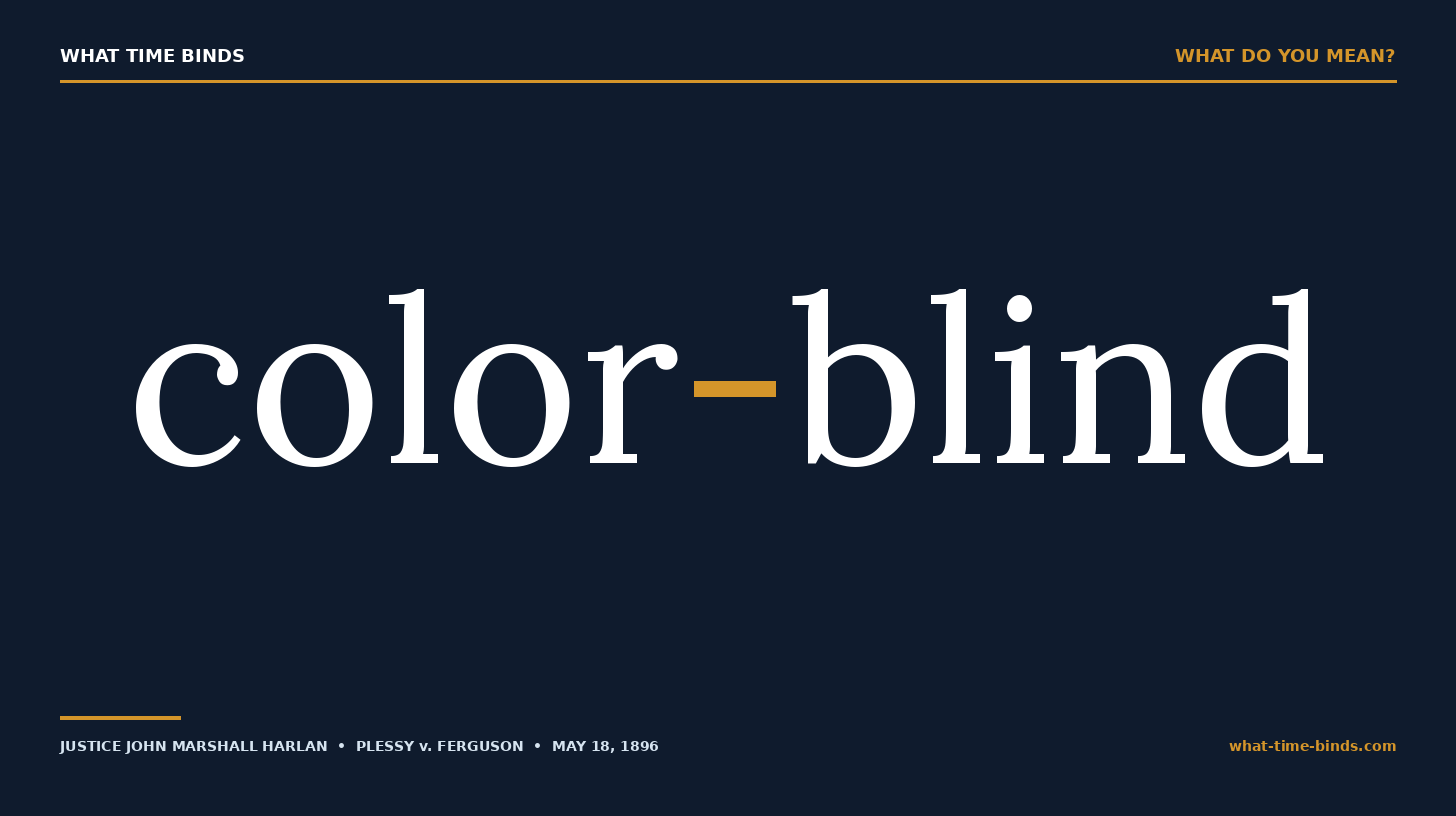
“Our Constitution is color-blind, and neither knows nor tolerates classes among citizens.”
The two sentences are roughly thirty words apart. They were written by the same man, in the same dissent, on the same day, against the same Louisiana segregation law. One sentence says white dominance is the natural order and will be for all time. The other says the law has no race to see.
People have been quoting one sentence and ignoring the other for 130 years.
That is the magnet word. That is what we have to pin.
The word at the center
A magnet word is a term that pulls multiple meanings toward itself while feeling like one shared definition. Everybody nods. Everybody agrees. Everybody walks out of the room with a different picture of what was decided.
“Color-blind” is the textbook case. The phrase has been carrying two incompatible meanings simultaneously since the day Harlan wrote it. The first meaning: the law cannot assign citizens to a lower legal class on the basis of race. No back of the train car. No separate school. No colored fountain. The second meaning: the law cannot consider race for any purpose, including the purpose of remedying the effects of having used race to assign citizens to a lower class for two hundred years.
Both readings are present in Harlan’s text. The first reading drives the part of the dissent that argues separate-but-equal violates the Fourteenth Amendment. The second reading is what gets quoted at oral argument when the goal is to dismantle a desegregation order or strike down a voting rights remedy.
The magnet word lets two opposing legal projects share a sentence.
What the sentence was for
Harlan was a Kentucky slaveholder who came to the Supreme Court in 1877. By 1896, he was the only justice on the Plessy court willing to say the Louisiana Separate Car Act violated the Constitution. His dissent was alone. The vote was 7–1.
Read in context, “color-blind” was an attack on a specific legal architecture: a law that named the races, classified citizens by race, and assigned them to physically separate spaces under threat of criminal penalty. The “thin disguise” of equal accommodations, Harlan wrote, would mislead no one. He named the mechanism. Louisiana was creating a “badge of servitude” through statute.
He also wrote, in the same opinion, that the white race would dominate “for all time, if it remains true to its great heritage.” Earlier in his career, he had owned slaves. His personal correspondence revealed paternalist attitudes toward Black Americans that persisted even after Plessy.
A man can be the only justice in 1896 willing to call segregation a constitutional violation and still believe in a permanent racial hierarchy. Harlan was that man. His dissent did real work. The same dissent contained the seeds of what conservative legal scholars would later use to dismantle the policies designed to repair segregation’s effects.
The sentence was a hinge. Two doors swing on it. They open in opposite directions.
How the meaning split
For seventy years after Plessy, almost nobody cited “color-blind” as a freestanding constitutional principle. The Supreme Court did not use the phrase in a majority opinion. Thurgood Marshall read Harlan’s dissent for inspiration as he prepared the cases that became Brown v. Board of Education in 1954, and he cited it in the Brown briefs. Brown’s holding addressed the harm segregation did to Black children. The decision did not establish a freestanding categorical prohibition on the government noticing race.
The phrase came back in the 1970s. Conservative legal scholars writing against affirmative action found Harlan’s sentence and pulled it forward as a weapon. By the time Clarence Thomas was writing law review articles in 1987, the argument was settled on the right: Harlan’s reasoning, applied consistently, would prohibit not just the Louisiana Separate Car Act but also race-conscious remedies for the law’s two-hundred-year history of doing exactly that.
That argument has now won.
In Shelby County v. Holder (2013), Chief Justice Roberts wrote that “things have changed in the South” and dismantled the preclearance system that required jurisdictions with histories of voting discrimination to get federal approval before changing voting rules. In Brnovich v. DNC (2021), the Court raised the bar for proving Section 2 violations under the results-based test. In Students for Fair Admissions v. Harvard (2023), the Court ruled race-conscious admissions unconstitutional, with Roberts writing that “eliminating racial discrimination means eliminating all of it.”
Five days ago, on April 29, 2026, the Court decided Louisiana v. Callais. By a 6–3 vote, Justice Alito’s majority opinion struck down Louisiana’s second majority-Black congressional district as a racial gerrymander. The opinion did not formally invalidate Section 2 of the Voting Rights Act. The Court did something more practical. It established new criteria that make Section 2 redistricting claims nearly impossible to win.
Alito wrote that allowing race to play “any part in government decision-making” represents a departure from the constitutional rule. That sentence is the 2026 reading of Harlan’s 1896 line. The hinge has finished swinging.
Pin the word
In this essay, “color-blind” means one of two things, and we have to say which one before we can have a real conversation:
Color-blind A: The law cannot assign citizens to a lower legal class on the basis of race. Race is a forbidden ground for hierarchy.
Color-blind B: The law cannot consider race for any purpose, including remediation of past hierarchy. Race is a forbidden ground for any classification.
Includes (Color-blind A): Striking down Jim Crow statutes. Forbidding racial covenants in housing law. Prohibiting race-based exclusion from juries. Outlawing race-based denial of public accommodation.
Excludes (Color-blind A): Whether the law can notice racial polarization in voting, racial concentration in housing, or racial disparities in health outcomes for the purpose of building a remedy. That remains an open question under this reading.
Includes (Color-blind B): Striking down Section 2 redistricting remedies. Banning race-conscious admissions. Forbidding government acknowledgment of racial disparity as a constitutional basis for action.
Excludes (Color-blind B): Almost everything Color-blind A includes. Color-blind A treats race-conscious remedies as constitutionally permitted. Color-blind B treats them as constitutionally forbidden.
The two readings produce opposite legal results in every case where a remedy for past racial harm requires the government to notice race. Voting rights. School integration. Affirmative action. Disparate-impact enforcement under Title VII and the Fair Housing Act.
Revisit when somebody quotes Harlan’s “color-blind” sentence in support of a position. Ask which reading they mean. Ask whether they have read the sentence about white dominance “for all time” that comes thirty words earlier. The answer tells you which constitutional project they think the sentence belongs to.
A script for the conversation
When somebody says “the Constitution is color-blind,” try this:
“Tell me which Harlan you are quoting. Are you quoting the Harlan who said the law cannot assign citizens to a lower class on the basis of race? Or the Harlan who said the law cannot notice race for any reason, including building a remedy? Those are different sentences from the same dissent. Which one are you working from?”
Twenty seconds. It will not change anybody’s mind. It will make the disagreement visible, which is the precondition for an actual conversation.
What the next generation inherits
Harlan wrote one more sentence in the Plessy dissent that gets quoted less than the famous one. He predicted his colleagues’ decision would prove “as pernicious as the decision made by this tribunal in the Dred Scott Case.” He was right about Plessy. It took fifty-eight years to overturn.
Plessy was overturned by a Court that read Harlan’s dissent and applied his first reading. The Constitution cannot assign citizens to a lower class on the basis of race. Brown v. Board of Education in 1954. The Civil Rights Act in 1964. The Voting Rights Act in 1965.
The current Court is reading the same dissent and applying the second reading. The Constitution cannot notice race for any purpose, including the purpose of repairing the harms the first reading was supposed to prevent.
Both readings have a scriptural foundation in Harlan. Both readings have produced concrete legal results. The Court that decided Brown built one country. The Court that decided Callais is building a different one.
The sentence is the same. What gets inherited depends on which reading the next generation can defend.
That work begins by saying out loud what “color-blind” actually means in the room you are sitting in — and which sentence in Harlan’s dissent the speaker is choosing to quote or ignore.
That is the repair. The rest is implementation.
Jerry W. Washington, Ed.D., is the founder of What Time Binds and the creator of the Meaning Repair as Cognitive Infrastructure (MRCI) framework. He is a retired Marine Corps Master Sergeant, a USC Rossier School of Education graduate, and an instructor at UCI Division of Continuing Education.
Start Module 1 of the Meaning Repair for High-Stakes Teams course — completely free, no paywall — at what-time-binds.com.
Previous What Do You Mean? entries: What Do You Mean, “Rally Around the Flag”? | What Do You Mean, “Discrimination”? (The Bounty Clause) | What Do You Mean, “Crime Against Humanity”? | What Do You Mean, “Success”?
Jerry, It was an amazing reversal by SCOTUS using Pretzel Logic to overturn 100+ years of precedents set to overcome our original sin. Anyone who lives/ed in the South and a few other states, knows that it still bad there for black and brown populations, with flaunting of the Confederate flag, hidden and overt racism continuing today under the context of "southern pride" or "southern heritage". Thanks for helping us understand what , how and why it happened now. Since most of these SCOTUS judges answered questions about not overturning precedents in their confirmation hearings, now that they are doing so, can this lead to their impeachment? There are suits starting to ask this question. If so, a very difficult if at best, would the decsions of SCOTUS on these issues (including Citizens United, the root of most of this evil) thus be overturned or vacated?