

The page from Monday
On Monday night, October 5, 2026, the president of the United States stood on stage at the Pinnacle Bank Expo Center in Grand Island, Nebraska. He was campaigning for Sen. Pete Ricketts. He was talking about gas prices and the war with Iran.
Here is the passage, as KTLA and Mediaite transcribed it:
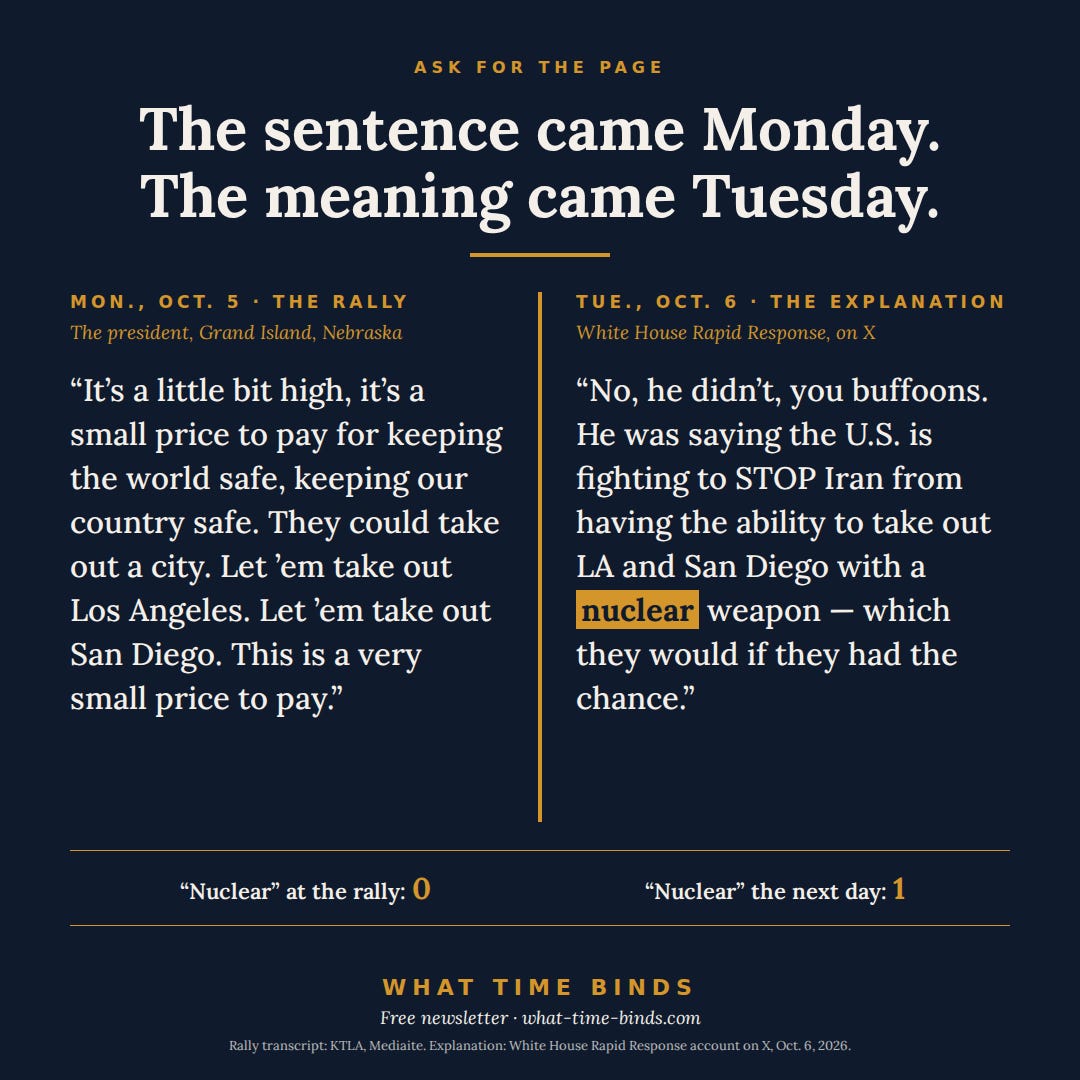
“With the war it’s just artificial, it’s a little bit high, it’s a small price to pay for keeping the world safe, keeping our country safe. They could take out a city. Let ‘em take out Los Angeles. Let ‘em take out San Diego. This is a very small price to pay and it’s going to be over very soon.”
The crowd cheered at the cities.
Read it once more and count. The phrase “small price” appears twice. The first time, it follows gas. The second time, it follows two American cities. Nothing in between tells you which cost he meant.
Open the KTLA transcript. Find both uses of “small price.” Write down the last noun before each one.
The page from Tuesday
The meaning arrived the next day. On Tuesday, October 6, the White House Rapid Response account answered the critics on X:
“No, he didn’t, you buffoons. He was saying the U.S. is fighting to STOP Iran from having the ability to take out LA and San Diego with a nuclear weapon — which they would if they had the chance.”
White House communications director Steven Cheung told CBS the president “was clearly stating U.S. cities would have been threatened if a nuclear Iran hadn’t been stopped.”
Put the two pages side by side. Tuesday’s page carries a word Monday’s page does not. The word is “nuclear.” Fox17 reported it plainly: the president did not mention nuclear weapons in the rally remarks.
The explanation may match what he meant. He has argued for months that the war stops Iran from building a bomb. Mediaite notes he has made that case against his own intelligence agencies’ findings. Either way, the record shows the order of events. The sentence came first. The meaning came a day later, from someone else.
That gap is where a word separates into two meanings. It lets the crowd cheer on Monday and the staff correct the crowd’s critics on Tuesday.
The strongest defense
A reader made the case for the president on my Facebook page Tuesday night. It deserves a full hearing, because it is the best version of the defense.
The argument runs in order. Read the whole passage: gas prices, the reason for the war, what Iran could do, the named cities, the war ending soon, prices coming down. In that order, “small price” means temporary high gas, a fair cost against the risk of a nuclear-armed Iran taking out a city. The reader granted that “let ‘em” is ambiguous and argued it carries little weight against the context. The remark, the reader said, was not a joke, a literal suggestion, or an invitation.
A graphic came with the argument. It lays the passage out in three boxes: “First he said” gas, “Then he said why,” “Then he went back to gas.” The second box reads: “If Iran gets the bomb, THEY can take out a city.” The footer charges that the viral clip “deletes box 1 and box 3.”
Part of that is right. Many clips cut the gas. The order of the passage matters, which is why I quoted all of it above. And the transcript does not support reading it as an invitation. The pin below says so.
Now put the graphic next to Monday’s page. The words “If Iran gets the bomb” are not in the transcript. The graphic supplied them, the way Tuesday’s statement supplied “nuclear.” Both make the sentence say what the defense needs it to say. Neither one is the sentence.
So the defense proves the point it set out to answer. To make “small price” mean only gas, you have to add words the president did not say.
Lay the graphic beside the KTLA transcript. Circle every word on the graphic that the transcript does not contain.
The pin: “small price”
A small price is a cost someone has judged worth paying. The phrase always carries three questions: what the cost is, who pays it, and who decided it was small.
What it includes. In this passage, “small price” includes higher gas. The first use attaches to it directly: “it’s a little bit high, it’s a small price to pay.” A fair reader grants that.
What else it touches. The second use follows the cities. “Let ‘em take out San Diego. This is a very small price to pay.” On the page, the nearest cost to that phrase is two American cities. The speaker never moved it back.
What it cannot be read to say. It cannot be read as an order to Iran, or an invitation. The transcript does not support that. It also cannot be read as a statement about nuclear weapons. That word lives only on Tuesday’s page. And it cannot be read as the speaker’s own cost. He named no price he pays.
One phrase, used twice, attached to two different costs, with no line between them. That is the definition of a word doing two jobs.
I ask for the page because a sentence like this one gets argued from memory within a day. Every Monday I take one word an institution bent and show the page it bent on. Subscribe and the next one is in your inbox, free.
Who pays it
Some prices in this war are already paid. At least 19 American service members have died, by Sen. Alex Padilla’s count, reported by Forbes. One was Noah Tietjens of Nebraska. The president spoke Monday in Noah’s home state.
The two cities he named hold their own share of the bill. Camp Pendleton sits between them. So do MCAS Miramar and Naval Base San Diego. I served at Pendleton. The families on that base would hear what he said and think: I’ve already given up birthdays with my children, anniversaries with my spouse, and entire years of my family’s life to deployments.
When a commander calls a cost small, the people who pay it read the sentence differently than the crowd does. Ask them which cost they heard.
The habit
When a phrase shows up twice in one passage, run three steps before you argue about it.
Write down each use, word for word, from the transcript. Not the clip. Not the graphic.
Next to each use, write the last noun before it. That is what the phrase is attached to on the page.
If someone explains the sentence later, circle every word in the explanation that the sentence never said.
Run it on Monday’s passage. You get gas, then cities. You circle “nuclear.” Now you can argue from the page instead of the clip.
A question for you. Who pays the small price in this sentence, and who decided it was small? Answer from the transcript, and tell me in the comments where I read it wrong.
You refuse to know. The record remembers. I refuse to forget.
Check your registration before Election Day, November 3, at vote411.org.
The comments are the appendix: tell me where the record is wrong and I will show the page or fix the line. Paid subscriptions open at 500 readers, and the paid product is Coded Threads, the codebooks built from these comment sections. A pledge now is a vote for that.
Jerry W. Washington, Ed.D., is a Marine Corps veteran of twenty-three years, a combat engineer by trade, an instructor at UC Irvine’s Division of Continuing Education, and the writer of What Time Binds, a record of how institutions bend words and how the page holds them to account.
1. You think the transcript is better than the clip for understanding what he meant? I think the clip better reveals, because his style of speaking with the rambling interconnected thoughts broken by thoughts of alternative scenerios shows up in the pacing and stress of the words that transcripts don't show. 2. People hear what the want to hear. If you already think the speaker is foolish or evil you will be listening for foolish and evil thoughts to be expressed.